← Back to the plain-language case
Abstract and Introduction state the reverse of the paper's own Schwann cell depletion result
Sci Adv (2023) · doi:10.1126/sciadv.add6995 · PMC9891701
Summary
The Abstract states that "Depletion of pancreatic-specific TASc promoted the tumorigenesis of PDAC tumors", and the Introduction repeats it. (TASc are tumor-associated nonmyelinating Schwann cells.) The paper's only pancreas-specific depletion is intrapancreatic AAV8-GFAP-DTA in KPC mice. For that experiment the Results report improved survival (Fig. 2C; log-rank; n = 8, 12 and 13 mice), fewer PanIN 2/3 lesions and inhibited tumor growth (Fig. 2D–G). The Fig. 2 title reads "Depletion of TASc attenuates pancreatic cancer tumorigenesis". The main text contains 17 statements (14 sentences, one Results subsection heading and two figure titles) that state a direction for the effect of depleting, inhibiting or targeting TASc (or TASc-expressed PVT1) on tumors. Fifteen say depletion is antitumor. Only the Abstract and Introduction sentences say it is protumor. The data, statistics and the paper's central thesis are unaffected. Still, the Abstract, the paper's own summary of its findings, reverses the direction of its headline in vivo result, and no correction has been issued.
What the paper reports
The two sentences that state the depletion result as protumor:
Depletion of pancreatic-specific TASc promoted the tumorigenesis of PDAC tumors.
Abstract, sentence 4
Depletion of TASc promoted the tumorigenesis of PDAC.
Introduction, final (third) paragraph
The same experiment as described in the Results and in the Fig. 2 legend:
TASc promotes PDAC tumorigenesis
Results, subsection heading
KPC mice given AAV8-GFAP-DTA exhibited improved survival time compared to control group (Fig. 2C). Upon AAV8-GFAP-DTA–mediated Schwann cell depletion, KPC pancreases exhibited increased percentage of PanIN 1, reduced PanIN 2/3, and inhibited tumor growth (Fig. 2, D to G).
Results, "TASc promotes PDAC tumorigenesis", paragraph 1
Depletion of TASc attenuates pancreatic cancer tumorigenesis.
Fig. 2 title
Log-rank test; n = 8, 12, and 13 mice, respectively.
Fig. 2 legend, panel C (WT, AAV8-GFAP-Blank and AAV8-GFAP-DTA KPC mice)
Error bars, SDs; n = 12 and 13 animals, respectively; Student’s t test.
Fig. 2 legend, panel G (tumor volumes at 22 weeks)
The paper's own summary of the add-back experiment in the same subsection points the same way:
Together, these results suggested that the presence of TASc in PDAC facilitates tumorigenesis and resistance to immunotherapy.
Results, "TASc promotes PDAC tumorigenesis", paragraph 2, last sentence
So do the pharmacological depletion with fluorocitrate (FC), the Discussion, and a later sentence of the same Abstract:
Furthermore, depletion of TASc in PDAC may profoundly diminish tumor growth and improve the infiltration and cytotoxicity of CD8+ T cells.
Results, "Targeting TASc by fluorocitrate sensitizes PDAC to immunotherapy", last sentence
Depletion of TASc-expressed Pvt1 or TASc using FC restored the immunoresistant metabolic microenvironment and improved the antitumor effects of immune checkpoint inhibitors.
Discussion, paragraph 2
Furthermore, depletion of TASc using a small-molecule inhibitor effectively sensitized PDAC to immunotherapy, signifying the important roles of TASc in PDAC immune resistance.
Abstract, last sentence
Each quotation was checked character for character against the article as archived in PubMed Central (src/show.py PMC9891701 --grep), and the key sentences also against the publisher's typeset PDF (see Status).
What the paper's own numbers show
Method. No quantity can be recomputed, because the error is in the stated direction of an effect. The tumor volumes and survival curves appear only as plotted data in Fig. 2, and the text and figure title state their direction explicitly. recompute.py.txt therefore holds a hand-curated list of every statement (sentence, Results subsection heading or figure title) outside Materials and Methods that states a direction for the effect of depleting, inhibiting or targeting TASc, or TASc-expressed PVT1, on tumor growth, tumorigenesis, survival or response to immunotherapy. To build it, every sentence of the Abstract, Introduction, Results and Discussion, every Results subsection heading and every figure title was read. A statement was included when its subject is the removal or inhibition of TASc (by AAV8-GFAP-DTA, by fluorocitrate, by "a small-molecule" agent, or by targeting in general) or of TASc-expressed PVT1, and it states a direction for one of those outcomes. Statements left out were: those about the presence, rather than the removal, of TASc or PVT1 (such as the heading "TASc promotes PDAC tumorigenesis"); deletions of PVT1 nucleotides, RAF1 or TDO2; immune-cell or TASc-abundance readouts only; the cytotoxicity, safety or specificity of FC; and sentences calling TASc a therapeutic target without stating a tumor outcome. The script checks each listed statement verbatim against the archived text and confirms its section, labels each with the direction it states, and tallies them. Run with the publisher's PDF and supplement as text (instructions in the script header), it also checks those. It prints every number below.
| Quantity | Location | Reported | Recomputed from the paper's own text |
|---|---|---|---|
| Effect of depleting pancreatic TASc on tumorigenesis | Abstract, sentence 4 | "promoted the tumorigenesis" | Opposite: depletion attenuates tumorigenesis (Results; Fig. 2 title; fig. S4 title) |
| Same | Introduction, final paragraph | "promoted the tumorigenesis" | Opposite, as above |
| Survival after AAV8-GFAP-DTA depletion | Results; Fig. 2C (log-rank; n = 8 WT, 12 Blank, 13 DTA) | "improved survival time compared to control group" | Depletion is antitumor |
| PanIN grade and tumor growth after depletion | Results; Fig. 2D–G (Fig. 2F n = 8, 12, 13; Fig. 2G n = 12 vs 13) | "reduced PanIN 2/3, and inhibited tumor growth" | Depletion is antitumor |
| Fig. 2 title | Fig. 2 legend | "Depletion of TASc attenuates pancreatic cancer tumorigenesis." | Depletion is antitumor |
| Directional statements on depleting, inhibiting or targeting TASc or TASc-expressed PVT1 | Main text (Abstract, Introduction, Results incl. subsection headings, Discussion, figure titles) | — | 17 statements (14 sentences, 1 heading, 2 figure titles): 2 protumor (Abstract, Introduction), 15 antitumor |
| Statements about the AAV8-GFAP-DTA experiment only | Main text | — | 5 statements: 2 protumor (Abstract, Introduction), 3 antitumor (Results ×2, Fig. 2 title) |
| Same, including the supplementary figure titles | Main text + figs. S4, S13, S16 | — | 20 statements, 2 protumor, 18 antitumor (19 and 17 if the fig. S16 schematic is left out); DTA experiment 6 statements, 2 protumor, 4 antitumor |
| Fluorocitrate or small-molecule statements | Main text | — | 7, all antitumor |
| PVT1-loss statements | Main text | — | 3, all antitumor |
| Statements naming both PVT1 loss and FC | Main text (Discussion) | — | 2, both antitumor |
| Sections that contain a protumor statement | Main text | — | Abstract and Introduction only |
| Supplement sentences of the form "deplet… promot… tumorigen…" | Supplementary Materials PDF | — | 0 |
The Abstract itself contains three depletion statements in opposite directions. Sentence 4 says depletion is protumor. The PVT1 sentence and the last sentence say depletion is antitumor.
A minor side observation that does not affect the finding: the Fig. 2G legend names three groups (WT, AAV8-GFAP-Blank, AAV8-GFAP-DTA) but gives n for only two ("n = 12 and 13 animals").
Figure
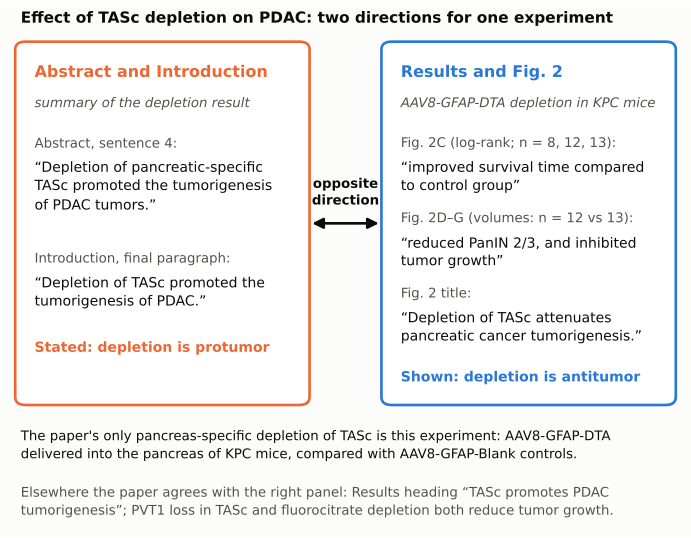
Figure 1. The left panel (orange) shows the two sentences, in the Abstract and the Introduction, that state the depletion result as protumor. The right panel (blue) shows what the paper reports for the same experiment, intrapancreatic AAV8-GFAP-DTA in KPC mice: the Results phrases for Fig. 2C and Fig. 2D–G, with sample sizes from the Fig. 2 legend, and the Fig. 2 title. The connector marks the conflict: one experiment, two opposite directions. All text is quoted from the paper. None of the paper's figures or data are reproduced.
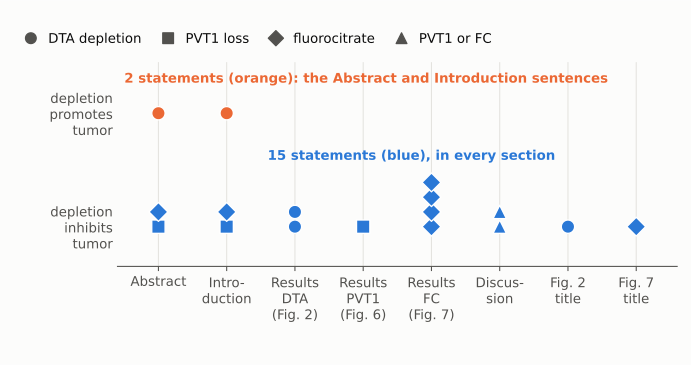
Figure 2. Each marker is one of the 17 main-text statements that state a direction for the effect of depleting, inhibiting or targeting TASc, or TASc-expressed PVT1, on tumors (inclusion rule under Method). Columns run in reading order from the Abstract to the Discussion, followed by the two figure titles. The Results FC column includes the subsection heading "Targeting TASc by fluorocitrate sensitizes PDAC to immunotherapy". The upper row holds statements that depletion promotes tumorigenesis. The lower row holds statements that it inhibits tumor growth or improves outcome. Marker shape gives the intervention: circles for AAV8-GFAP-DTA, squares for PVT1 loss, diamonds for fluorocitrate, triangles for sentences that name both PVT1 and FC. Markers in the same cell are stacked. Only the two orange markers, in the Abstract and the Introduction, sit in the upper row. Both concern the DTA experiment, whose three other statements all sit in the lower row. The supplementary titles of figs. S4, S13 and S16 (not drawn) would all sit in the lower row. Directions and locations come from recompute.py.txt.
Why it matters
- A headline result is stated in reverse in the Abstract. The Abstract sentence reports the paper's main in vivo test of function: whether removing TASc from the pancreas changes tumor development. Read literally, it says TASc restrain PDAC. That contradicts the Results heading ("TASc promotes PDAC tumorigenesis"), the Fig. 2 title, and the paper's therapeutic argument for depleting TASc with fluorocitrate plus anti–PD-1.
- Readers of the Abstract alone get the wrong direction. Many readers, indexing services, text-mining pipelines and automated summaries rely on the Abstract. Any of them could record "depletion of Schwann cells promotes pancreatic cancer". The Introduction repeats the sentence, so both places that summarize the findings carry the error. Crossref lists 68 citing works.
- The science itself is not affected. No reported value, test or P value changes, and the Results, figure legends and Discussion consistently give the antitumor direction. The same Abstract goes on to say that depleting TASc with a small molecule sensitized PDAC to immunotherapy, so a careful reader would notice the conflict. The error is in the wording of two summary sentences, not in the data or analysis.
Explanations considered
- The sentences refer to a different experiment or setting. This does not hold. "Pancreatic-specific" depletion matches only the intrapancreatic AAV8-GFAP-DTA delivery in KPC mice (Fig. 2, fig. S4). Every other statement about that experiment, in the Results, the Fig. 2 title and the fig. S4 title, reports an antitumor effect. The paper reports no subgroup, time point or model in which depletion accelerated tumors.
- "Tumorigenesis" is used in an unusual sense. This does not hold. The paper uses the word in its ordinary sense throughout, for example "TASc promotes PDAC tumorigenesis" and "Combining FC with the anti–PD-1 antibody significantly suppressed PDAC tumorigenesis".
- The increase in PanIN 1 lesions counts as "promoted". This does not hold. After depletion, the percentage of low-grade PanIN 1 rose while the share of high-grade PanIN 2/3 fell. The paper reports this shift in the same sentence as "inhibited tumor growth" and summarizes the panel under the title "Depletion of TASc attenuates pancreatic cancer tumorigenesis".
- The intended subject was TASc, not their depletion. "TASc promoted the tumorigenesis of PDAC", as in the Results heading, would be consistent with the data. So would "Depletion of TASc attenuated tumorigenesis", as in the Fig. 2 title. This explains how the wording could have arisen. It does not change the fact that the printed sentences state the opposite of the data.
- Conversion or archiving artifact. Ruled out. The publisher's typeset PDF in the PMC Open Access dataset (version 1, the only version; marked as the publisher's version, not an author manuscript) contains both sentences word for word. So does the Europe PMC full text. The conflict is in words ("promoted" against "attenuates"), not in symbols, signs or table cells that a conversion could alter.
- The supplement resolves it. It does not. The fig. S4 title ("Depletion of TASc inhibits PDAC tumorigenesis."), the fig. S13 title ("FC treatment sensitizes PDAC to immunotherapy.") and the title of the fig. S16 schematic ("Targeting tumor-associated non-myelinating Schwann cells improves anti-tumor immunity of immunotherapy-refractory pancreatic cancer.") all support the Results. The supplement contains no sentence saying depletion promotes tumorigenesis.
None of these explanations reconciles the Abstract and Introduction sentences with the paper's results.
Status
As of 2026-10-23:
- Version of record. The publisher's typeset PDF (16 pages, created 2023-01-26) held in the PMC Open Access dataset (
s3://pmc-oa-opendata/PMC9891701.1/;is_manuscript: false,is_retracted: false) was converted to text and searched. It contains the Abstract and Introduction sentences, the Results sentences and the Fig. 2 title as quoted. In the PDF's text layer the survival sentence is interrupted by a figure caption at a column break, and its text continues unchanged after the caption. The live PMC page and the Europe PMC full-text XML carry the same wording. The publisher's own page (doi.org redirects to science.org) returned HTTP 403 to automated access, so it could not be checked directly. - Supplements. The Supplementary Materials PDF (
sciadv.add6995_sm.pdf: methods and figs. S1 to S16) was converted to text and searched for depletion, DTA and FC statements. The fig. S4, fig. S13 and fig. S16 titles agree with the Results direction. The tables archive (Tables S1 to S7) was not opened, because the finding concerns the direction of a stated result, not a tabulated value. - Corrections. Crossref lists no update for the DOI: the record has no update-to field, and a filter for works that update it returned 0 results. PMC and Europe PMC list no correction, erratum, expression of concern or retraction (
src/known.py). The Europe PMC record (PMID 36724291) has no comment/correction list. It shows a revision date of 2024-05-08 without a stated reason. The PMC copy still carries the "promoted" wording. - PubPeer and the web. The PubPeer API returned HTTP 403, so PubPeer could not be queried directly. Earlier web searches by DOI and by title, combined with correction, erratum or PubPeer, found no notice or discussion of this point. A PubPeer comment therefore cannot be ruled out completely.
- Sources: PMC9891701 (via
src/show.py);src/known.py 10.1126/sciadv.add6995; PMC Open Access dataset files PMC9891701.1.pdf, PMC9891701.1.json and sciadv.add6995_sm.pdf; https://api.crossref.org/works/10.1126/sciadv.add6995 and https://api.crossref.org/works?filter=updates:10.1126/sciadv.add6995; Europe PMC REST record for DOI 10.1126/sciadv.add6995; https://doi.org/10.1126/sciadv.add6995 (HTTP 403); https://pubpeer.com/api/search/?q=10.1126/sciadv.add6995 (HTTP 403).
Suggested correction
Reverse the direction in the two sentences so that they match the Results, the Fig. 2 title and the fig. S4 title:
- Abstract: "Depletion of pancreatic-specific TASc attenuated the tumorigenesis of PDAC tumors." Alternatively: "Pancreatic-specific TASc promoted the tumorigenesis of PDAC tumors, and their depletion attenuated it."
- Introduction, final paragraph: "Depletion of TASc attenuated the tumorigenesis of PDAC."
No change to the data, figures, statistics or conclusions is needed. The Fig. 2G legend could also give the WT group size, since it currently gives n for two of its three groups.