← Back to the plain-language case
HIV care trial report redefines registered retention outcome and omits hair-sample adherence without disclosure
Lancet Reg Health Am (2022) · doi:10.1016/j.lana.2022.100307 · PMC9536254 · NCT02846350
Summary
NCT02846350 (COPA2) registered five primary outcomes on 2016-07-22, before enrolment began in November 2016. No later registry version changed them. The paper is the trial's main outcomes report. It discloses and explains two departures: viral load was analysed as a 0.50-log reduction instead of suppression, and medication persistence was not presented. It does not disclose two others. Retention in care is reported as whether the participant completed the study visit at each time point, whereas the registry and the published protocol define it as the number of missed clinic appointments in the previous 6 months. The registered primary outcome "Medication adherence: Hair sample" is not reported and is never mentioned. All the randomised comparisons that are reported are null, and the paper says so in its abstract. Its positive interpretation rests on indirect (mediation) effects that it labels exploratory.
What was registered
ClinicalTrials.gov NCT02846350 was first submitted on 2016-07-01. Version 0 passed QC on 2016-07-22 with status "Not yet recruiting" and was first posted on 2016-07-27. The registry gives the study start as 2016-07 (actual) and primary completion as 2020-11-30 (actual). The paper says baseline visits ran from November 2016 to March 2018.
Version 0 lists five primary outcomes and no secondary outcomes. The wording is quoted from the record, with escape characters removed:
| # | Measure | Description | Time frame |
|---|---|---|---|
| 1 | "HIV viral Load (VL)" | "VL will be assessed by blood sampling. Viral suppression (HIV VL <200 copies/mL) will be the primary dichotomous outcome; a secondary dichotomization will be made among detectable patients with VL <1000 and those with VL >1000." | "Less than 6 months detectable VL" |
| 2 | "Retention in care" | "Defined as the number of missed clinic appointments (i.e., "no shows" not cancelled in advance by patients or clinic staff) in the 6 months preceding assessment." | "2 years" |
| 3 | "Medication persistence" | "Medication persistence is the time to treatment discontinuation, with a permissible gap of < 30 days, participants will be considered to have discontinued the regimen if a therapy gap = > 30 days occurs." | "2 years" |
| 4 | "Medication adherence: Hair sample" | "Adherence by hair sample to estimate an average concentration of ARV medication exposure" | "2 years" |
| 5 | "Medication adherence: Self-report" | "Proportion of self-reported adherent participants over time" | "2 years" |
The record history has 13 versions, v0 (2016-07-22) to v12 (2022-06-22). None of them edits the Outcome Measures module. The history summary gives outcomesUpdateCount = 0, lastUpdateVersions.primaryOutcomes = 0 and originalData.primaryOutcomesSame = true. Version 12 was submitted the day before the paper went online (2022-06-23). Its five primary outcomes match version 0 word for word, and so does the current record (last update posted 2022-06-29). The later versions change only Study Status, Contacts/Locations, Sponsor/Collaborators, Study Design, Study Identification, Oversight, Conditions and the Document Section.
The published protocol (Trials 2018, doi:10.1186/s13063-018-2758-5, PMC6056946; reference 17 of the paper) defines the outcomes the same way. On retention:
"In this study, retention in care will be defined as the number of missed clinic appointments (i.e., "no shows" not canceled in advance by patients or clinic staff) in the 6 months preceding assessment, including that timepoint's visit with the COPA2 physician. The primary retention analysis will utilize a dichotomized indicator 0/1 of any missed visits vs. no missed visits"
On hair samples and self-report:
"Participants will provide two hair samples, at the 12-month and 24-month assessments."
"Hair sample will estimate an average concentration of ARV medication exposure over 6 weeks with cut-off values used as categorical variables (12 months and 24 months)"
"Self-report will reflect percentage adherent over the last 30 days (Visual Analog Scale; VAS)"
The protocol's analysis plan (Hypothesis 1.2) treats self-reported adherence as continuous. It "will use a linear mixed model ... to examine percentage adherence in the past 30 days as a continuous outcome".
What the paper reports
The paper states its objective (Methods, "Objectives and design"):
"The primary objective of the study was to evaluate the impact of a physician-delivered, MI patient-oriented treatment program on ART adherence, HIV viral load, retention in care, and self-efficacy among PWH disengaged from HIV care."
It cites the registration in the same paragraph ("was registered at clinicaltrials.gov, NCT02846350") and in the abstract. Its only statement about departures from plan is in Methods, "Measures of main study outcomes":
"Per the original protocol, ART adherence, HIV viral suppression, retention in care, and medication persistence were the primary outcomes of the study. At the end of the data collection period, changes to how HIV viral load was evaluated as a primary outcome had to be made given that viral suppression at baseline was a constant (see description below). Self-efficacy and patient-provider communication were the MI physician targets in the original protocol, as well as the theorised mechanisms by which the intervention was intended to work. Contrary to the study protocol, in the current study, we do not present medication persistence given issues related to pharmacy pickup data medical abstraction."
On viral load (Methods, "HIV RNA Viral Load"):
"For analyses, condition differences were analysed as a clinically significant reduction in HIV viral load from one-time point to the next, 0·50log. Though we originally intended to analyse HIV RNA viral load as the proportion of participants who were virally suppressed in each condition, the complete absence of participants who were virally suppressed at baseline precluded such analyses; that is, viral suppression at baseline was a constant at baseline."
The Discussion repeats that this "precluded the analysis of viral suppression as an outcome, as originally proposed in the protocol."
On retention, the definition is given in Methods, "Retention in HIV Care", and repeated in Results, "Retention":
"Retention in HIV care was calculated as to whether a participant completed a study clinical visit at any given time point."
"Retention was evaluated at 6 months, 12 months, 18, and 24 months as to whether the participant completed a follow-up visit."
On self-reported adherence (Methods, "Self-reported antiretroviral adherence"):
"Self-reported adherence was assessed every six months at all time points using a 10-point Visual Analogue Scale (VAS), with 0 representing none and 10 representing 100% (perfect adherence)."
The analysis covers five outcomes (Methods, "Data analyses"):
"To test the effect of the intervention on ART adherence, HIV viral load, CD4+ count, retention, and self-efficacy, mixed modelling was used"
"As such, indirect effects were examined as exploratory analyses using bivariate parallel latent growth curve (LGC) models"
A full-text search of the PMC version finds no occurrence of "hair". Hair-sample adherence is not mentioned in the text, the tables or the figure legends. No passage explains the retention definition or relates it to the registered count of missed clinic appointments. The only supplementary item listed is "Supplementary materials Image, application 1".
The discrepancy
| Outcome | Registered (version, date) | In the paper | Status |
|---|---|---|---|
| HIV viral load | Primary. "Viral suppression (HIV VL <200 copies/mL) will be the primary dichotomous outcome" (v0, 2016-07-22; unchanged to v12, 2022-06-22) | Continuous viral load, with condition differences as a "clinically significant reduction ... 0·50log". Condition p = 0.757 | Not reported as registered. The change is disclosed, with a reason |
| Retention in care | Primary. "the number of missed clinic appointments ... in the 6 months preceding assessment" (v0, 2016-07-22; unchanged to v12) | "whether a participant completed a study clinical visit at any given time point". Condition p = 0.999 | Not reported as registered. The measure is redefined and the change is not disclosed |
| Medication adherence: hair sample | Primary. "Adherence by hair sample to estimate an average concentration of ARV medication exposure" (v0; unchanged to v12) | Absent: no result and no mention | Not reported, not disclosed |
| Medication adherence: self-report | Primary. "Proportion of self-reported adherent participants over time" (v0; unchanged to v12) | Mean VAS score (0–10) in a mixed model. Condition p = 0.075 | Matches the published protocol (continuous VAS). Differs from the registry wording only (minor) |
| Medication persistence | Primary. "time to treatment discontinuation ... gap = > 30 days" (v0; unchanged to v12) | Not presented ("Contrary to the study protocol ...") | Not reported. Disclosed, with a reason |
| CD4+ count | Not registered (the registry lists no secondary outcomes) | Analysed alongside the main outcomes. Condition p = 0.584 | Added |
| Self-efficacy (HIV-ASES) | Not registered. The protocol describes it as an MI patient target or mediator | Named in the "primary objective" and analysed as a main outcome. Condition p = 0.096 | Added. The paper notes its role in the original protocol |
The registry time frame for viral load, "Less than 6 months detectable VL", is unclear. The paper assesses viral load at 6, 12, 18 and 24 months, which matches the protocol, so no time-point change is claimed here.
Figures
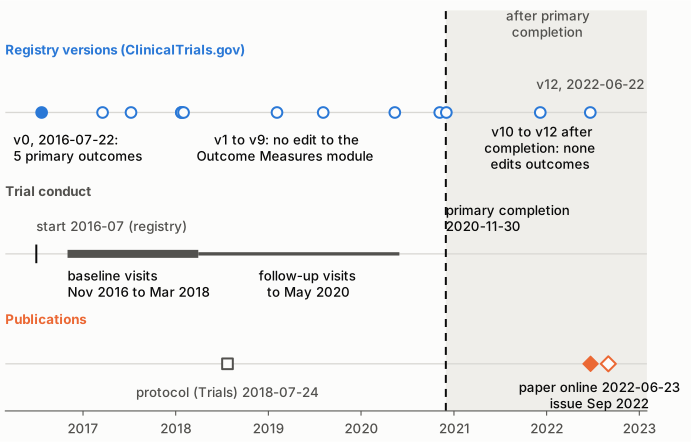
Figure 1. Timeline of NCT02846350. The top lane shows the 13 registry versions. Only v0 (2016-07-22, filled marker) set the primary outcomes. Hollow markers are versions that left the Outcome Measures module untouched, including the three versions (v10 to v12) after primary completion on 2020-11-30 (dashed line; shaded area after it). The middle lane shows the registry study start (2016-07) and the baseline and follow-up visit periods given in the paper (November 2016 to March 2018, follow-up to May 2020). The bottom lane shows the published protocol (2018-07-24) and the paper (online 2022-06-23, issue September 2022). The registered outcomes were in place before enrolment and never changed, so the differences in the paper did not come from a registry update. Sources: the ClinicalTrials.gov history endpoint, the PMC article and Europe PMC.
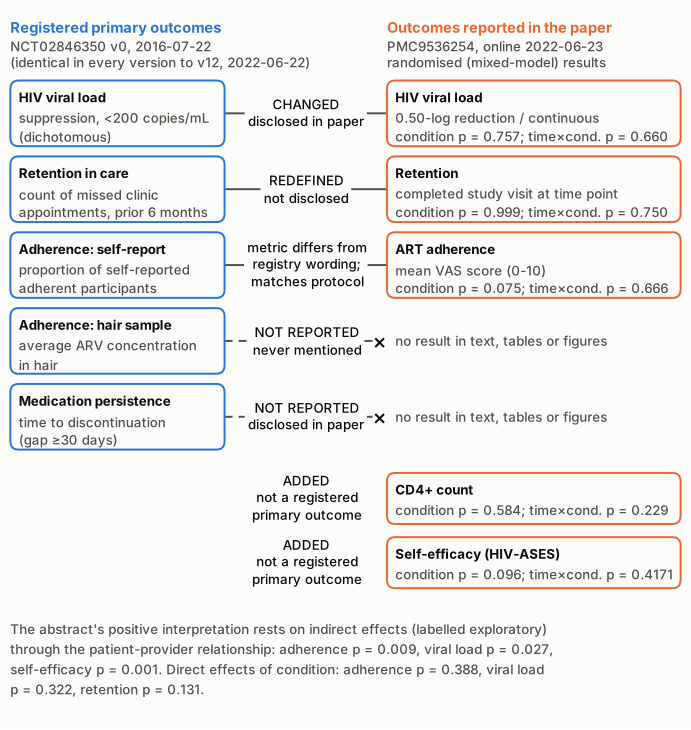
Figure 2. The five registered primary outcomes (left, blue; v0 wording, identical through v12) and the outcomes reported in the paper (right, orange). Each connector is labelled with its status. Solid connectors join a registered outcome to the measure the paper reports in its place. Dashed connectors ending in "×" mark registered outcomes with no result in the paper. Two departures are disclosed in the paper: viral load and persistence. Two are not: retention, which is redefined, and hair-sample adherence, which is absent. The self-report adherence metric matches the published protocol and differs only from the registry wording. CD4+ count and self-efficacy are added. The p values in the orange boxes are the paper's longitudinal mixed-model tests for the main effect of condition and for time × condition. The footer gives the paper's indirect and direct LGC effects. All values are quoted from the Results section.
Why it matters
Results for the registered primary outcomes. For every registered primary outcome that the paper reports, the randomised comparison is null:
- Viral load, analysed as a continuous measure (a disclosed change): condition F(1,572) = 0·10, p = 0·757; time × condition p = 0·660; LGC direct effect B = 0·13, p = 0·322.
- Retention, analysed as study-visit completion (an undisclosed change): "condition (Wald X2 = 15.36 = 0·01, p = 0·999)" (as printed); interaction p = 0·750; direct effect B = 0·48, p = 0·131.
- Self-reported adherence, as a mean VAS score: condition F(1,858) = 3·18, p = 0·075; interaction p = 0·666; direct effect B = -0·20, p = 0·388.
The abstract states these null findings plainly: "Using mixed models, the intervention had no effect on ART adherence over time by condition on HIV RNA viral load, CD4+ count retention, or self-efficacy." So the departures did not turn a null primary result into a positive one.
Where the positive conclusion comes from. The abstract's Interpretation reads: "These findings suggest that physician-delivered MI may enhance the patient-provider relationship, self-efficacy, and ART adherence, and reduced HIV viral load in patients disengaged from HIV care." This rests on indirect effects through the patient–provider relationship: adherence B = 0·188, p = 0·009; viral load B = -0·095, p = 0·027; self-efficacy B = 0·063, p = 0·001. The paper calls these "exploratory analyses". The published protocol did plan exploratory mediation analyses, with "Patient-level skills (self-efficacy, motivation, patient-provider relationship) as potential mediators". Those were planned for retention, adherence and viral suppression, though, not for self-efficacy as an outcome. None of these analyses appears in the registry.
Retention. The registered measure counts no-shows at clinic appointments over the 6 months before each assessment; the protocol dichotomises it as any versus none. The reported measure records whether the participant attended the study visit itself. Study visits were "combined with regularly occurring HIV clinical care visits" and participants "were compensated with US $10 per study visit for travel". As a result, the reported measure largely tracks completion of study follow-up, which the paper also reports as attrition (for example, 25·6% did not complete the 12-month assessment). It cannot show missed clinical appointments between study visits, and those are the behaviour a re-engagement intervention targets. The Discussion itself suggests the null retention result "may have been related to the fact that participants were recruited and incentivized by study staff, given that study and clinical visits were often scheduled on the same day". A reader comparing the paper with the registration or the protocol is not told that the measure differs.
Hair-sample adherence. This was the only objective (drug-level) adherence measure among the registered primary outcomes. The protocol scheduled collection at 12 and 24 months. The paper's adherence findings, including the indirect effect on adherence, rest entirely on self-report. A reader cannot tell from the paper whether hair samples were collected, analysed or are still unreported. Leaving out a registered objective measure without comment is the kind of selective outcome reporting that registration exists to reveal.
Explanations considered
- Paper role. The paper describes the main trial results: all four registered constructs, n = 360, two-year follow-up, and the registration cited in both the abstract and the Methods. The paper does not point to any other report of the hair-sample or missed-appointment outcomes; the word "hair" does not occur in it. Being a secondary or partial report therefore does not explain the omissions.
- Disclosure. The paper discloses the viral-load change (reason: no participant was suppressed at baseline) and the omission of medication persistence (reason: problems abstracting pharmacy pickup data). These two departures are not at issue here. Its list of protocol primary outcomes ("ART adherence, HIV viral suppression, retention in care, and medication persistence") folds the two adherence measures into one. It does not mention hair samples. It does not say that retention is measured differently from the protocol. On the viral-load change, readers may note that the eligibility criteria required "at least one HIV viral load of >500 copies/mL in the prior 3 months", and that the protocol compared suppression "at 6, 12, 18, and 24 months post baseline". Because the paper discloses this change, it is noted only for completeness.
- Registry or protocol amendments. None of the 13 registry versions changes an outcome. The registry's Document Section holds only an informed consent form (2018-10-22); no protocol or SAP is uploaded. The paper cites no protocol amendment or SAP, and none is uploaded to the registry. No amendment accounts for the retention definition or the missing hair-sample outcome.
- Wording differences. For self-reported adherence, the registry's "proportion of self-reported adherent participants" differs from the paper's mean VAS score. However, the published protocol specifies VAS percentage adherence as a continuous outcome in a linear mixed model, and the paper follows that. This is treated as a registry wording issue, not an outcome switch. For retention, the difference is not one of wording. A count of missed clinic appointments over 6 months, taken from clinic records, and a binary indicator of attending the study visit measure different things. The paper does not present them as equivalent.
- Data unavailable. The paper gives a data-availability reason for persistence. It gives none for retention or hair samples. The consent form "included a release for medical record abstraction of treatment history and laboratory results", so clinic appointment records may have been available, but the paper does not say whether they were. The issue documented here is that neither departure is disclosed, whatever the reason for it.
Status
As of 2026-10-23:
- Registry history. The ClinicalTrials.gov history (
/api/int/studies/NCT02846350/history) and versions 0 and 12 (/history/0,/history/12) were retrieved and compared with the current record (/api/v2/studies/NCT02846350). After normalising whitespace and HTML escapes, the primary outcomes are identical in all three. The registry has no secondary outcomes and no posted results (hasResults = false). - Publisher version. The article pages on thelancet.com returned HTTP 403, so the version of record was not inspected directly. This write-up uses the PMC archived text (PMC9536254). Europe PMC gives the first publication date as 2022-06-23 (Lancet Reg Health Am, vol 13, September 2022, article 100307).
- Corrections. No Crossref update relations, PMC notices or Europe PMC comment/correction links were found for 10.1016/j.lana.2022.100307.
- PubPeer. The PubPeer search page returned 403 (bot challenge) and the API returned 404 for this DOI. A web search found no PubPeer thread. The PubPeer check is therefore incomplete.
- Sources. ClinicalTrials.gov NCT02846350 and its history; the paper (PMC9536254); the published protocol (PMC6056946); Europe PMC record; Crossref metadata.
Suggested correction
The journal and authors may wish to consider a correction or clarification notice that does the following:
- States that retention was registered, and specified in the protocol, as the number of missed clinic appointments in the 6 months before each assessment (analysed as any versus none). It should say that the paper instead reports whether the study visit was completed, and why. If clinic appointment records are available, it should report the registered retention measure.
- States whether hair samples were collected at 12 and 24 months as planned, and whether they were analysed. It should either report the registered hair-sample adherence outcome or explain why it is not reported. If the outcome is reported elsewhere, it should cite that report.
- Lists the registered primary outcomes in full: five, with the two adherence measures shown separately. Against each it should give the measure actually reported or the reason none is reported, and it should mark CD4+ count and self-efficacy as outcomes not registered as primary.
- Optionally notes that the registry's "proportion of self-reported adherent participants" was operationalised as the protocol's continuous VAS measure.
The trial team could also post results to ClinicalTrials.gov for the registered outcomes, and update the registry entry with any outcome changes and their dates.