← Back to the plain-language case
Paper says trial was registered prospectively; registry record was first submitted 33 months after study start
Circulation (2021) · doi:10.1161/CIRCULATIONAHA.121.054117 · PMC8849598 · NCT03476785
Summary
The Methods state that "The trial was registered prospectively on ClinicalTrials.gov (NCT03476785)." The ClinicalTrials.gov record gives the study start as 2015-06-01 (type ACTUAL). It also shows that the record was first submitted on 2018-03-01 and first posted on 2018-03-26, 33 months (1004 days) after that start, while its status was still "Recruiting". The record does describe this trial: its final enrollment (56, ACTUAL) equals the 56 participants the paper says were randomized. The outcome reported in the paper (the LV stiffness constant at 1 year) matches the registered primary outcome in every registry version, so the outcomes were not switched. However, no version of the record existed before enrollment began, so the registry cannot show that this outcome was fixed in advance. The paper does not mention the late registration, the registry edit of 2019-04-16 that made the primary outcome description more specific and deleted one secondary outcome, or the fact that one registered secondary outcome, pulse wave velocity, is not reported.
What was registered
The ClinicalTrials.gov record history has three versions. None of them is dated on or before the study start.
| Version | Date (submitted / posted) | Status | Primary outcome (measure; time frame; description) | Secondary outcomes |
|---|---|---|---|---|
| v0 | QC 2018-03-16; first submitted 2018-03-01; posted 2018-03-26 | Recruiting; enrollment 53 (estimated) | "Left ventricular stiffness"; "1 year"; "Change in end diastolic ventricular pressure and volume curve" | "Aerobic fitness": "Change in peak aerobic capacity assessed by VO2"; "Vascular stiffness": "Change in pulse wave velocity"; "Diastolic function": "Change in left ventricular diastolic function measured by echocardiography" (all at "1 year") |
| v1 | 2019-04-16 / posted 2019-04-18 (modules changed: Study Status, Outcome Measures, Contacts/Locations) | Active, not recruiting | "Left ventricular stiffness"; "1 year"; "Change in ventricular stiffness after 1 year of exercise training measured as the stiffness constant of the diastolic limb of the left ventricular pressure-volume curve" | "Aerobic fitness": "Change in peak aerobic capacity (VO2) after 1 year of exercise training"; "Vascular stiffness": "Change in pulse wave velocity after 1 year of exercise training". The "Diastolic function" outcome was deleted. |
| v2 (current) | 2019-10-10 / posted 2019-10-14 (modules changed: Study Status, Study Design) | Completed; enrollment 56 (actual) | Same as v1 | Same as v1 |
Key registry dates, all fields of the record: - Study start: 2015-06-01, ACTUAL, in every version. - Primary completion: 2019-07-02, ACTUAL (v2). In v0 and v1 it was given as 2019-06-01, ESTIMATED.
The only outcome edit, v1 on 2019-04-16, came after recruitment had closed and 77 days before primary completion. The primary outcome measure and time frame stayed the same. The new description names a specific quantity, the stiffness constant of the diastolic pressure-volume curve, where v0 described the end-diastolic pressure-volume curve in general.
What the paper reports
The PMC copy is the NIH author manuscript (NIHMS1731529).
Registration statement. Methods, "Participant Population and Study Design", second paragraph:
The trial was registered prospectively on ClinicalTrials.gov (NCT03476785).
The abstract ends with:
Clinical Trial Registration: https://clinicaltrials.gov/ct2/show/NCT03476785
Main hypothesis and endpoint. The paper never uses the words "primary outcome" or "primary endpoint". The abstract, "Background":
In a prospective, randomized-controlled trial, we hypothesized that 1-year prolonged exercise training would reduce LV myocardial stiffness in patients with LVH.
Methods, "Statistical Analysis", which has the only other use of "primary":
The primary analysis included all participants who completed the 1-year follow-up.
Result for the stiffness endpoint. Abstract, "Results":
LV myocardial stiffness was reduced (right and downward shift in the EDPVR; pre LV myocardial stiffness 0.062±0.020 to post 0.031±0.009), whereas there was no significant change in controls (pre 0.061±0.033 to post 0.066±0.031, interaction P=0.001).
Results, "LV pressure-volume relationship":
1-year of exercise training significantly reduced LV chamber and myocardial stiffness constants (LV chamber stiffness: from 0.060±0.031 to 0.042±0.025; LV myocardial stiffness: from 0.062±0.020 to 0.031±0.009), with no significant changes in the control group (LV chamber stiffness: from 0.041±0.016 to 0.049±0.020; LV myocardial stiffness: from 0.061±0.033 to 0.066±0.031; Figure 4A: interaction P value=0.015 and Figure 4B: interaction P value=0.023).
Fitness. Results, "Effect of Exercise Training on Oxygen Uptake and LVEDV", which matches Table 2 (V̇O2 max, mL/min/kg, interaction P 0.0004):
The exercise training program resulted in a significant increase in V̇O2 max in the exercise group (from 26.0±5.3 to 31.3±5.8 mL/min/kg, P<0.0001).
Enrollment. Methods, "Participant Population and Study Design":
Fifty-six participants with LVH and elevated biomarkers were enrolled (signed a consent form) and randomized, comprising 18 controls and 38 exercisers.
The paper gives no recruitment or enrollment dates. Searches of the full text for "2015", "2016", "2017" and "2018" outside the references return nothing. Searches for "pulse wave" and "PWV" also return nothing.
The discrepancy
| Outcome | Registered (version, date) | In the paper | Status |
|---|---|---|---|
| LV stiffness at 1 year (primary) | v0 2018-03-16: "Change in end diastolic ventricular pressure and volume curve"; v1 2019-04-16 and v2 2019-10-10: "...stiffness constant of the diastolic limb of the left ventricular pressure-volume curve" | LV myocardial stiffness constant "a" from the EDPVR (transmural pressure), pre vs 1 year; the main hypothesis and the headline result | matched |
| Same registered primary (alternative reading) | as above | LV chamber stiffness constant (PCWP-based EDPVR), pre vs 1 year | matched (the registry wording also fits this measure) |
| Aerobic fitness, peak VO2, 1 year (secondary) | v0, v1, v2 | V̇O2max, pre vs 1 year (Table 2, Figure 2) | matched |
| Vascular stiffness, pulse wave velocity, 1 year (secondary) | v0, v1, v2 | Not in the main text, tables or figure legends | not reported |
| Diastolic function by echocardiography, 1 year (secondary) | v0 only; deleted in v1 (2019-04-16) | Not reported. 3D echo is used only for LVEDV. | not reported (removed from the registry before primary completion) |
| LVEDV, Starling curves, preload-recruitable stroke work | Not registered | Reported (Figures 3, 5, 6), not labelled primary | added |
| Timing of registration (not an outcome) | First submitted 2018-03-01; study start 2015-06-01 (ACTUAL) | "registered prospectively" | contradicted by the registry; not disclosed |
Figures
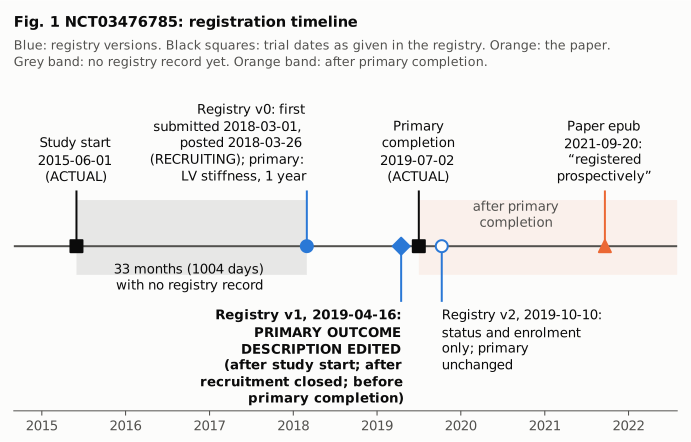
Figure 1. Trial timeline from the ClinicalTrials.gov record history and the paper. The study start (2015-06-01, ACTUAL) comes 1004 days before the record was first submitted (2018-03-01; posted 2018-03-26, status "Recruiting"). No registry record exists for the shaded grey interval. The only version that changed the primary outcome text (v1, 2019-04-16, bold) is dated after the study start and after recruitment closed, and 77 days before primary completion (2019-07-02, ACTUAL). Version 2 (2019-10-10, open marker) changed only the status and enrollment fields. The paper's epub (2021-09-20) describes the registration as prospective.
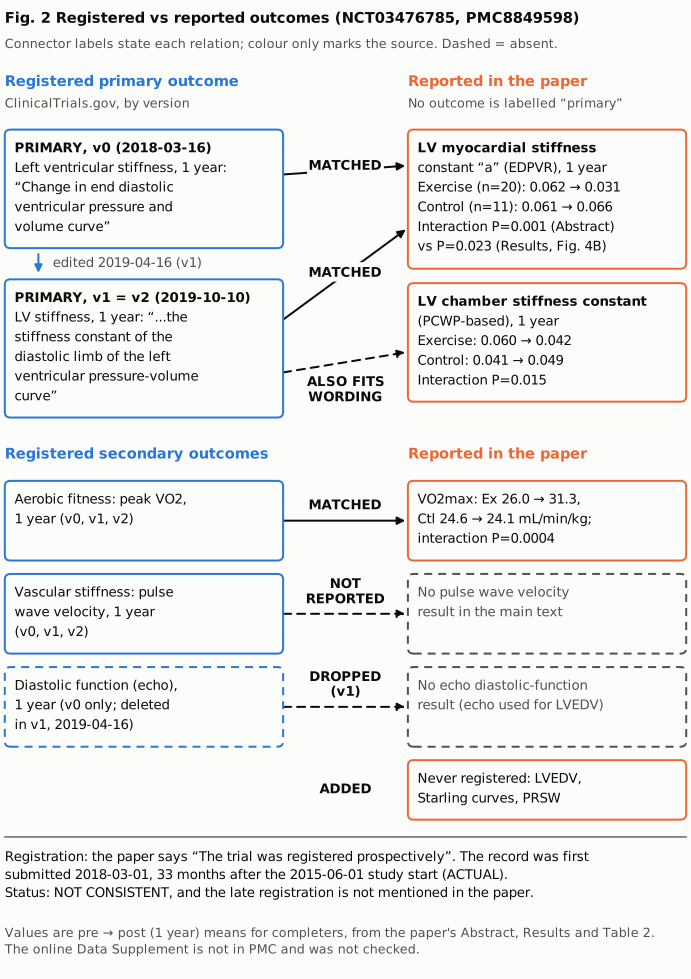
Figure 2. Registered outcomes by registry version (left, blue) against outcomes reported in the paper (right, orange). The label on each connector names the relation. Both wordings of the registered primary outcome, LV stiffness at 1 year, correspond to the stiffness constants the paper reports. The myocardial constant is the paper's headline result and the chamber constant also fits the registry wording. The paper's result for the registered primary outcome is shown in the diagram (exercise 0.062 → 0.031; control 0.061 → 0.066). Its group × time interaction P value is 0.001 in the Abstract and 0.023 in the Results and Figure 4B. Of the registered secondary outcomes, peak VO2 is reported, pulse wave velocity is not, and echocardiographic diastolic function was deleted from the registry in v1 and is not reported. The bottom strip states the registration-timing discrepancy, which is the main finding.
Why it matters
The paper reports the registered primary outcome, and the result is positive. In completers (exercise n=20, control n=11), the LV myocardial stiffness constant fell from 0.062±0.020 to 0.031±0.009 with exercise and changed from 0.061±0.033 to 0.066±0.031 in controls. The LV chamber stiffness constant fell from 0.060±0.031 to 0.042±0.025 with exercise and changed from 0.041±0.016 to 0.049±0.020 in controls (interaction P=0.015). Nothing here suggests that a different primary outcome was substituted.
The problem is what the word "prospectively" tells a reader. Under the ICMJE recommendations, a trial counts as prospectively registered only if it was registered at or before the first participant's enrollment. Readers and systematic reviewers use that statement to decide whether the registry entry can be taken as evidence that the primary outcome, time point and analysis were fixed before any outcome data existed. Here the registry gives a study start of 2015-06-01, and its first record dates from March 2018. Primary completion was 2019-07-02 and each participant was followed for one year, so the last participant must have started the intervention by about July 2018. Of the roughly 37-month window in which participants could have been enrolled, at least 33 months came before the record existed. v0 still listed the trial as "Recruiting", so some participants may have been enrolled after registration. The paper gives no enrollment dates, so the exact split cannot be determined.
Three further points bear on how the registry can be used to check this paper: - The primary-outcome edit. The v1 change of 2019-04-16 was made after recruitment closed and before primary completion. By then most participants' 1-year data had probably been collected. The edit made the outcome more specific without changing the construct, and its new wording matches what the paper reports. It is still a post-recruitment change to the registered primary outcome, and the paper does not mention it. - Ambiguous wording. The registry says "ventricular stiffness ... stiffness constant", which could mean the chamber constant (PCWP-based) or the myocardial constant (transmural-pressure-based). The paper features the myocardial constant. Both constants show a significant interaction, so the conclusion does not depend on which one was intended. - Inconsistent P values. The abstract gives the interaction P for myocardial stiffness as 0.001. The Results and Figure 4B give 0.023 for what reads as the same comparison. Both are below 0.05, but a reader cannot tell which is correct.
The registered secondary outcome pulse wave velocity is not reported anywhere in the main text. The registered secondary outcome echocardiographic diastolic function was removed from the registry in 2019 and is also not reported. The paper explains neither omission.
Explanations considered
- Paper role. This is the primary report of the trial, not a secondary or ancillary analysis. Registered final enrollment (56, ACTUAL) equals the paper's "Fifty-six participants ... enrolled ... and randomized". The registry describes an exercise arm and a yoga arm, matching the paper's yoga-based attention control. The paper cites no other registration. Because the record describes this trial, the registration date applies to this trial's enrollment. The registry's broader title ("Prevention of Cardiovascular Stiffening With Aging and Hypertensive Heart Disease") does not change that.
- Could the study start date be wrong or refer to something other than enrollment? The start date is marked ACTUAL and is the same in all three versions. Even if it were too early, enrollment of 56 participants must have begun well before March 2018. The text reports 3,597 candidates screened, and the last participant must have started the 1-year intervention by about July 2018 to fit the ACTUAL primary completion of 2019-07-02. A March 2018 registration cannot have preceded the first enrollment unless nearly all 56 participants were enrolled in roughly four months, and nothing in the paper or the registry suggests that.
- Disclosure. The paper contains no statement that the registration was retrospective, no registration date and no reason for late registration. Its only statement about timing is the claim that registration was prospective. Searches for "registered", "protocol", "amend", "primary outcome" and "changed" found no further disclosure.
- Protocol amendments. The paper cites no published protocol or statistical analysis plan and mentions no amendments. The registry's v1 edit to the outcome measures is not mentioned. The registry also states that outcomes assessors were masked. The text says LVEDV was analysed "by an experienced cardiologist who was blinded to filling pressures". These statements are consistent with each other, but neither replaces prospective registration as public evidence of what was pre-specified.
- Wording differences. "Change in end diastolic ventricular pressure and volume curve" (v0) and "stiffness constant of the diastolic limb of the left ventricular pressure-volume curve" (v1/v2) both describe the EDPVR stiffness constant the paper reports. That accounts for the outcome match. It does not account for the registration-timing statement.
- A loose use of "prospectively". The authors might have meant that the trial was designed and conducted prospectively, which the paper also says elsewhere ("This study was a prospective randomized controlled trial"). The sentence in question, however, is specifically about registration on ClinicalTrials.gov, and in that context "prospectively" has a standard meaning that the registry dates contradict.
- Regulatory context. Whether a legal registration deadline applied to this behavioral trial was not assessed. It does not bear on whether the published statement is accurate.
Status
Checked as of 2026-10-23.
- Registry history. All three versions of NCT03476785 (v0 2018-03-16, v1 2019-04-16, v2 2019-10-10) were read from the ClinicalTrials.gov history API (/api/int/studies/NCT03476785/history/{0,1,2}), retrieved 2026-10-22/23. The current record (/api/v2/studies/NCT03476785) is identical to v2. On 2026-10-23 the history endpoint returned HTTP 403 when rechecked. The first-submitted date (2018-03-01) and study start (2015-06-01, ACTUAL) also appear in the current record, so the central finding does not depend on the history endpoint.
- Publisher version. The publisher page (ahajournals.org) returned HTTP 403, and a mirrored PDF on a university site refused the connection. The PMC text is the NIH author manuscript. The publisher-supplied PubMed abstract (PMID 34543068) has the same outcome values and the same abstract P value (interaction P=0.001), and ends "Registration: URL: https://www.clinicaltrials.gov; Unique identifier: NCT03476785." The Methods sentence "registered prospectively" could not be checked against the version of record. The online Data Supplement is not in PMC and was not checked. It could contain pulse wave velocity data, but the main text does not refer to any.
- Corrections. Crossref, PMC and Europe PMC list no correction, erratum, expression of concern or retraction (checked with src/known.py). A Letter to the Editor (doi:10.1161/CIRCULATIONAHA.121.058145, PMC8966638) raises left atrial size, atrial fibrillation, baseline BMI and follow-up length, not registration. The authors' published response was not read.
- PubPeer. The PubPeer API was blocked by Cloudflare (HTTP 403). A web search found no PubPeer thread for the DOI or title. The absence of comments is therefore not confirmed directly.
- Sources. The paper: PMC8849598, via src/show.py. The registry: ClinicalTrials.gov NCT03476785, current record and history versions 0 to 2. PubMed 34543068. Crossref, PMC and Europe PMC notices.
Suggested correction
- Replace "The trial was registered prospectively on ClinicalTrials.gov (NCT03476785)" with a statement such as: "The trial was registered retrospectively on ClinicalTrials.gov (NCT03476785; first submitted 1 March 2018), after enrollment began in June 2015." Give the reason for the late registration and, if known, how many participants were enrolled before it.
- State that the registered description of the primary outcome was revised on 16 April 2019, after recruitment closed and before primary completion, to "the stiffness constant of the diastolic limb of the left ventricular pressure-volume curve". Also state that the secondary outcome of echocardiographic diastolic function was removed at the same time.
- Specify which stiffness constant, myocardial (transmural pressure) or chamber (PCWP), is the pre-specified primary outcome. Reconcile the interaction P value for LV myocardial stiffness: 0.001 in the Abstract against 0.023 in the Results and Figure 4B.
- Report the registered secondary outcome, pulse wave velocity at 1 year, or explain why it is not reported.