← Back to the plain-language case
The abstract gives the top tolerated monkey dose in mg/kg; the body gives μg/kg
Sci Adv (2021) · doi:10.1126/sciadv.abi8193 · PMC8357232
Summary
The abstract states that the T cell–engaging bispecific CCW702 "was well tolerated up to 34.1 mg/kg per dose" in cynomolgus monkeys. The Results, the Methods and the Fig. 6 legend all describe a single repeat-dose monkey study with doses of 2, 9.8 and 34.1 μg/kg, and they put the no-observed-adverse-effect level (NOAEL) at 34.1 μg/kg. Read literally, the abstract's 34.1 mg/kg is 34,100 μg/kg, 1,000 times the highest dose tested. The paper's own exposure value for that group (day-1 AUC 1.02 h·μg/mL) gives an apparent clearance of 33 mL/h/kg for a μg/kg dose. For a mg/kg dose it gives about 33,400 mL/h/kg, which is 2.6 times total cardiac output and physically impossible. This is the abstract's only primate safety number. Read as printed, it puts the tolerated monkey dose level with the highest mouse efficacy dose (35.2 mg/kg), when the tested dose was 33 to 1,000 times lower than the mouse efficacy doses.
What the paper reports
Abstract:
In cynomolgus monkeys, CCW702 was well tolerated up to 34.1 mg/kg per dose, with near-complete subcutaneous bioavailability and a PK profile supporting testing of a weekly dosing regimen in patients.
Results, "Pharmacokinetics and pharmacodynamics in nonhuman primate", second paragraph:
Doses of 2, 9.8, and 34.1 μg/kg were administered to animals QAD for 10 days (five total doses).
CCW702 administration was generally well tolerated at these dose levels with no changes in animal body weight, food consumption, or body temperature and the no-observed-adverse-effect level (NOAEL) determined to be the highest dose in the study of 34.1 μg/kg.
This occurred despite similar exposure of CCW702 on day 1 and on day 9 (1.02 hours·μg/ml versus 0.705 hours·μg/ml for the 34.1 μg/kg group) (fig. S17).
Same section, first paragraph (single-dose PK studies):
CCW702 exposure was detectable by electrochemiluminescence bioanalytical assay at doses of ≥9.8 μg/kg.
Subcutaneous dosing had near complete bioavailability (F = 108 ± 20.2%) with a maximum concentration (Cmax) and half-life (t1/2) of 1.5 (ng/ml)/(mg/kg) and 11.4 hours compared with the intravenous route of administration Cmax of 28.3 (ng/ml)/(mg/kg) and t1/2 of 1.6 hours, respectively (fig. S17).
Fig. 6 legend, panel A (panel B gives the same doses):
Heatmaps of cytokines measured from peripheral blood of animals administrated CCW702 at 2, 9.8, and 34.1 μg/kg, every other day for 10 days (a total of five total doses).
Methods, "Pharmacokinetic and pharmacodynamic 10-day study in cyno":
Nine naïve male cynomolgus monkeys (Macaca fascicularis, Chinese origin), age 2 to 4 years, weighing 2.5 to 3.2 kg were used for the study.
The NOAEL was determined to be 34.1 μg/kg under the study conditions.
For context, Results, "In vivo efficacy in xenograft and patient-derived xenograft models":
every 7 days (Q7D) at four-dose levels (1.13, 3.5, 11.1, and 35.2 mg/kg; groups G to J)
What the paper's own numbers show
Method. I converted the abstract's figure to μg/kg and compared it with the doses tested in the body. To find which unit the data support, I divided the top dose by the paper's day-1 AUC for that group. That gives the apparent clearance CL/F, and since F ≈ 1 (108%) it is close to systemic clearance. I compared CL/F under each reading with standard physiological values for the monkey (Davies & Morris, Pharm Res 1993;10:1093–5): cardiac output 217 mL/min/kg (13,020 mL/h/kg), hepatic blood flow 43.6 mL/min/kg (2,616 mL/h/kg) and plasma volume 44.8 mL/kg. Plasma clearance cannot exceed the blood flow that carries the drug to the organs that eliminate it, so it cannot exceed cardiac output. The AUC interval is given in fig. S17, which I could not access. A partial AUC would make CL/F an overestimate, but by much less than the factor of 1,000 at issue here. Every number below is printed by recompute.py.txt.
| Quantity | Location | Reported | Recomputed from the paper's numbers |
|---|---|---|---|
| Highest tolerated monkey dose | Abstract | 34.1 mg/kg per dose | = 34,100 μg/kg |
| Monkey repeat-dose levels | Results NHP para 2; Fig. 6 legend | 2, 9.8, 34.1 μg/kg, QAD × 5 | highest = 34.1 μg/kg = 0.0341 mg/kg |
| NOAEL | Results NHP para 2; Methods | 34.1 μg/kg | equals the top dose tested |
| Abstract value / top dose tested | derived | (implied equal) | 1,000 |
| Cumulative dose, top group | derived | — | 5 × 34.1 = 170.5 μg/kg = 0.171 mg/kg |
| Amount per dose, 2.5–3.2 kg animal | Methods (weights) | — | 0.085–0.109 mg if μg/kg; 85–109 mg if mg/kg |
| CL/F if top dose = 34.1 μg/kg | Results NHP para 2 (AUC 1.02 h·μg/mL) | — | 33.4 mL/h/kg, 0.26% of cardiac output (day 9: 48.4 mL/h/kg) |
| CL/F if top dose = 34.1 mg/kg | same | — | 33,431 mL/h/kg, 2.6 × total cardiac output |
| SC Cmax and AUC at top dose | Results NHP para 1 (1.5 per unit dose, t1/2 11.4 h) | AUC 1.02 h·μg/mL | Cmax 51.2 ng/mL; crude AUC ≈ Cmax/k = 841 ng·h/mL, close to the reported 1,020. This check holds under either reading, so it does not settle the unit on its own |
| Mouse Q7D efficacy doses / top monkey dose | Results (mouse efficacy) | 1.13–35.2 mg/kg | 33× to 1,032× the top monkey dose tested |
| Abstract value / top mouse dose | derived | — | 34.1 / 35.2 = 0.97 |
Figure
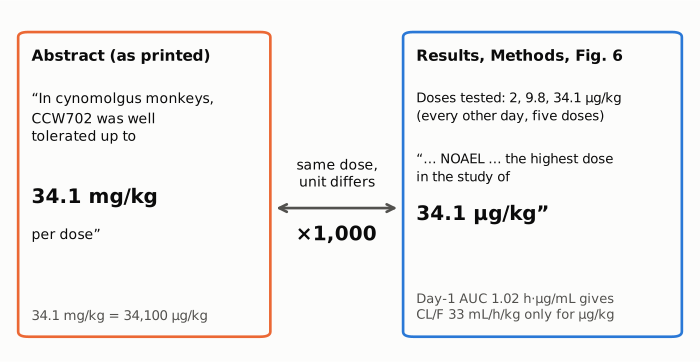
Figure 1. The two statements of the top cynomolgus dose. The left panel (orange, the value as printed in the abstract) quotes the abstract's "34.1 mg/kg per dose", which equals 34,100 μg/kg. The right panel (blue) shows the doses used in the Results, Methods and Fig. 6 legend, with the NOAEL at 34.1 μg/kg. The connector marks the factor of 1,000 between the two. The bottom line of the right panel gives the apparent clearance recomputed from the paper's own day-1 AUC, which is plausible only for the μg/kg reading. All values come from the paper or from recompute.py.txt.
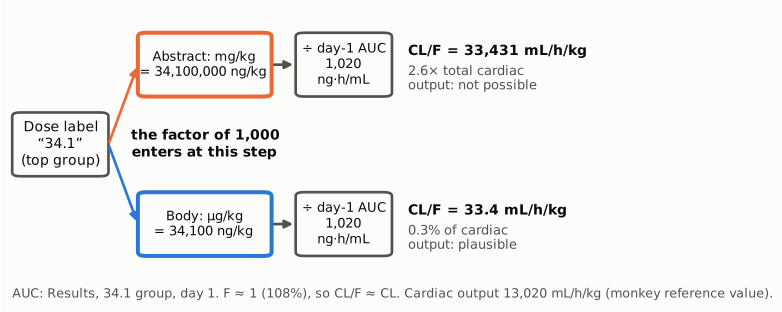
Figure 2. Where the factor of 1,000 enters. The dose label "34.1" for the top group is read in the abstract's unit (orange, mg/kg) and in the body's unit (blue, μg/kg). Each reading is divided by the paper's own day-1 AUC for that group (1,020 ng·h/mL). The mg/kg reading gives an apparent clearance of 33,431 mL/h/kg, 2.6 times the total cardiac output of a monkey, which is not possible. The μg/kg reading gives 33.4 mL/h/kg, which is plausible. The cardiac output value is an external reference (Davies & Morris 1993); all other numbers come from the paper or from recompute.py.txt.
Why it matters
The abstract sentence is the paper's only summary of primate safety. It is also the evidence the abstract offers just before it says the drug is in a first-in-human trial (NCT04077021). The data in the body are reported consistently, and the qualitative finding holds: CCW702 was well tolerated at every dose tested, and the NOAEL was the top dose. The error is in magnitude. Read as printed, the abstract suggests that monkeys tolerated about 34 mg/kg per dose, roughly the highest mouse efficacy dose (35.2 mg/kg Q7D), which implies a wide tolerability margin over the efficacious range. In fact the highest dose tested in monkeys was 0.0341 mg/kg per dose, 33 to 1,000 times below the mouse Q7D efficacy doses. Mouse and monkey doses in mg/kg are not directly interchangeable across species, but that is the comparison a reader of the abstract would make. No dose above 34.1 μg/kg was tested in monkeys, so the study established a NOAEL but not a maximum tolerated dose. The Methods also report clinical pathology changes and microscopic findings, judged not adverse, at doses above 2 μg/kg. A reader who relies on the abstract, or a database or review that cites it, will carry a tolerated dose that is 1,000 times too high.
Explanations considered
- A different, higher-dose monkey study. This does not account for the numbers. The only monkey tolerability study described is the 10-day repeat-dose study (nine animals, three groups), and its doses are 2, 9.8 and 34.1 μg/kg. The single-dose PK studies report no dose in mg/kg; their only dose statement is detectability "at doses of ≥9.8 μg/kg". The numeral 34.1 in the abstract matches the body's top dose exactly, unit aside.
- The body is wrong and the abstract is right. This is ruled out by the paper's own data. With the reported day-1 AUC, a 34.1 mg/kg dose implies a clearance of 33,431 mL/h/kg, 2.6 times total cardiac output. The μg/kg reading gives 33.4 mL/h/kg. The body uses μg/kg in six separate places (two Results paragraphs, both Fig. 6 legend panels, the Methods), and the version-of-record check found the same unit in the panel labels of the Fig. 6 image itself ("34.1 μg/kg/dose").
- A text-conversion artifact (μ rendered as m). This is ruled out. The same "34.1 mg/kg" appears in the publisher's JATS XML at Europe PMC, on the live PMC page and in the PubMed abstract, which the publisher supplies separately. The same files render μ correctly everywhere else.
- Mixing up mouse and monkey units. The mouse doses really are in mg/kg (0.15 to 35.2 mg/kg), and this may be how mg/kg came to appear. It does not change the result, because the abstract sentence names cynomolgus monkeys explicitly.
- A related unit question (side note, not part of this claim). The dose-normalized Cmax values are labeled "(ng/ml)/(mg/kg)". An IV Cmax of 28.3 ng/mL per mg/kg would require an initial distribution volume of about 35 L/kg for a roughly 50 kDa protein. Per μg/kg it gives 35 mL/kg, close to plasma volume (44.8 mL/kg, which predicts about 22 ng/mL per μg/kg). So these labels may also be 1,000-fold off. I list this only as an observation, because I could not check it against fig. S17.
Status
As of 2026-10-23. Version of record: the publisher's site (science.org, the target of the DOI redirect) returned HTTP 403, so I could not read its HTML or PDF directly. Four publisher-derived sources carry the same text: the live PMC page, the Europe PMC full-text XML (publisher JATS), the PubMed record (PMID 34380625), and the publisher's Fig. 6 image file, whose panel labels read "2 μg/kg/dose", "9.8 μg/kg/dose" and "34.1 μg/kg/dose". The quotations above were checked verbatim against the PMC-archived text. Supplement: the supplementary PDF (abi8193_sm.pdf, figs. S1 to S18, including fig. S17 with the monkey PK) is hosted only on science.org, which returned 403. Europe PMC's supplementary bundle holds only the main figures, so I could not check figs. S17 and S18. Corrections: I found none. Crossref has no update-to or updated-by relation, and the updates: filter returns 0 results. Crossref Labs (which includes Retraction Watch data) lists no updates. Europe PMC and PubMed show no errata or comment/correction links, and two web searches for an erratum or correction found none. PubPeer: the search page and the API returned 403 or not found, so I could not check PubPeer directly. A general web search found no PubPeer thread.
Suggested correction
In the abstract, replace "In cynomolgus monkeys, CCW702 was well tolerated up to 34.1 mg/kg per dose" with "In cynomolgus monkeys, CCW702 was well tolerated up to 34.1 μg/kg per dose (the highest dose tested)". The authors may also want to check the unit labels of the dose-normalized Cmax values in the first NHP Results paragraph and in fig. S17 ("(ng/ml)/(mg/kg)"), which the paper's own values suggest should be per μg/kg.