← Back to the plain-language case
Abstract pairs the adjusted BNT162b2 estimate with the interval of the unadjusted ChAdOx1 estimate
Lancet Infect Dis (2021) · doi:10.1016/S1473-3099(21)00330-3 · PMC8221734
Summary
The abstract reports the adjusted one-dose effectiveness of BNT162b2 against COVID-19 hospitalisation in adults aged at least 80 years as 71·4% (95% CI 46·5–90·6). The Results text and Table 2 give the same estimate as 71·4% (43·1–86·2), and that interval follows exactly from the adjusted odds ratio printed in Table 2, 0·286 (0·138–0·569), since the paper defines effectiveness as 1 − OR. The interval in the abstract, 46·5–90·6, is identical, both as effectiveness and as odds ratio (0·094–0·535), to the interval of a different estimate: the unadjusted ChAdOx1 nCoV-19 effectiveness of 76·7%. The point estimate and the conclusion are unaffected, but a headline sentence of the abstract gives the estimate an interval that is shifted upwards by 3.4 points at the lower end and 4.4 at the upper end, wider on the log-odds scale (implied SE 23% larger), and not centred on its own point estimate. The error is in the version of record and has not been corrected.
What the paper reports
Abstract, Findings (BNT162b2):
18 (13%) of 135 people with SARS-CoV-2 infection and 90 (34%) of 269 controls received one dose of BNT162b2. The adjusted vaccine effectiveness was 71·4% (95% CI 46·5–90·6).
Abstract, Findings (ChAdOx1 nCoV-19 and the period-restricted BNT162b2 estimate):
Nine (25%) of 36 people with COVID-19 infection and 53 (59%) of 90 controls received one dose of ChAdOx1 nCoV-19. The adjusted vaccine effectiveness was 80·4% (95% CI 36·4–94·5). When BNT162b2 effectiveness analysis was restricted to the period covered by ChAdOx1 nCoV-19, the estimate was 79·3% (95% CI 47·0–92·5).
Results, third paragraph (BNT162b2):
18 (13%) of the 135 people with SARS-CoV-2 infection and 90 (34%) of 269 controls received one dose BTN162b2 (difference -20·2%), giving an unadjusted vaccine effectiveness of 69·4% (95% CI 47·7–82·9) and an adjusted effectiveness of 71·4% (43·1–86·2; table 2 ).
Results, fifth paragraph (ChAdOx1 nCoV-19):
Nine (25%) of the 36 people with SARS-CoV-2 infection and 53 (59%) of 90 controls received one dose of ChAdOx1 nCoV-19 (difference -33·9%), giving an unadjusted vaccine effectiveness of 76·7% (95% CI 46·5–90·6) and adjusted effectiveness of 80·4% (36·4–94·5; table 2).
Table 2, "One dose of BNT162b2 (Pfizer)", logistic regression model, row "One dose" (vaccine effectiveness, odds ratio, p value):
71·4 (43·1 to 86·2) | 0·286 (0·138–0·569) | <0·0001
Table 2, "One dose of ChAdOx1 nCoV-19 (Oxford–AstraZeneca)", row "Unadjusted":
76·7 (46·5 to 90·6) | 0·233 (0·094–0·535) | <0·0001
What the paper's own numbers show
Method. The paper defines vaccine effectiveness as (1 − OR) × 100, and all eight one-dose effect rows of Table 2 obey that relation to the printed precision, except for a 0.1-point rounding difference in the upper bound of the ChAdOx1 matched-conditional row (printed 93·2; 1 − 0·067 gives 93.3). So any effectiveness interval can be converted back to an odds-ratio interval and compared with the table. For the adjusted estimate the odds ratio cannot be recomputed from raw counts, but its effectiveness interval follows directly from the printed OR interval. For the unadjusted estimates, the 2 × 2 counts given in the abstract and Results allow an independent recomputation (Wald interval on the log-odds scale, and the conditional maximum-likelihood estimate with its exact interval). A further check uses the fact that a 95% Wald interval is symmetric about ln(OR): I measure how far each point estimate lies from the log-midpoint of its interval, in units of the interval's half-width. All numbers below are printed by recompute.py.txt.
| Quantity | Location | Reported | Recomputed from the paper's own numbers |
|---|---|---|---|
| BNT162b2 adjusted VE (95% CI) | Abstract | 71·4% (46·5–90·6) | 71.4 (43.1–86.2) from Table 2 OR 0·286 (0·138–0·569) |
| BNT162b2 adjusted VE (95% CI) | Results ¶3; Table 2 | 71·4 (43·1 to 86·2) | 71.4 (43.1–86.2), agrees |
| Abstract BNT162b2 interval, as OR | Abstract | 46·5–90·6 | OR 0.094–0.535 |
| ChAdOx1 unadjusted VE and OR | Results ¶5; Table 2 | 76·7 (46·5 to 90·6); OR 0·233 (0·094–0·535) | 76.7 (46.5–90.6), agrees; same interval as the abstract's BNT162b2 interval |
| Table 2 rows whose VE interval is 46·5 to 90·6 | Table 2 | — | only "ChAdOx1 unadjusted" |
| Log-midpoint of the abstract BNT162b2 interval | Abstract | — | OR 0.224 (VE 77.6), vs point estimate OR 0.286 |
| Point estimate's distance from its interval's log-midpoint | Abstract, BNT162b2 adjusted | — | +0.28 half-widths |
| Same distance, all eight Table 2 effect rows and the other two abstract intervals | Table 2; Abstract | — | between 0.00 and +0.04 half-widths |
| BNT162b2 unadjusted OR from counts 18/135 vs 90/269 | Counts: Abstract, Results ¶3; reported OR/VE: Table 2 (VE also Results ¶3) | 0·306 (0·171–0·523); VE 69·4 (47·7–82·9) | Wald 0.306 (0.175–0.534), VE 69.4 (46.6–82.5); conditional MLE 0.307 (0.165–0.545), VE 69.3 (45.5–83.5) |
| ChAdOx1 unadjusted OR from counts 9/36 vs 53/90 | Counts: Abstract, Results ¶5; reported OR/VE: Table 2 (VE also Results ¶5) | 0·233 (0·094–0·535); VE 76·7 (46·5–90·6) | Wald 0.233 (0.098–0.552), VE 76.7 (44.8–90.2); conditional MLE 0.235 (0.087–0.589), VE 76.5 (41.1–91.3) |
| ChAdOx1 adjusted VE | Abstract; Table 2 | 80·4% (36·4–94·5); OR 0·196 (0·055–0·636) | 80.4 (36.4–94.5), agrees |
| BNT162b2 restricted-period VE | Abstract | 79·3% (47·0–92·5) | OR 0.207 (0.075–0.530); centred (+0.04 half-widths) |
| SE(ln OR) implied by the interval | Abstract vs Table 2 | — | 0.444 (abstract) vs 0.361 (Table 2), 23% larger |
The Table 2 conversion holds to the printed precision for every row except the 0.1-point rounding difference noted above (ChAdOx1 matched conditional, 93·2 vs 93.3), and exactly for the BNT162b2 adjusted row, so the correct interval for 71·4% is 43·1–86·2. The abstract's interval matches the ChAdOx1 unadjusted interval digit for digit, and its log-midpoint (OR 0.224) is that row's midpoint, not the midpoint of the BNT162b2 adjusted interval (OR 0.280).
Figure
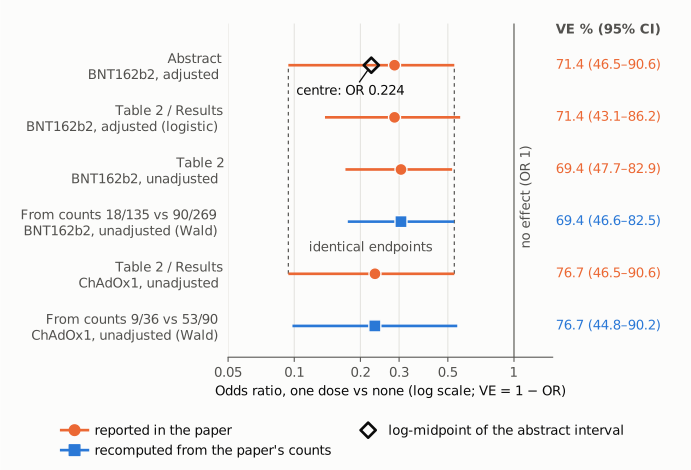
Figure 1. Odds ratios for one dose versus none, on a log scale (VE = 1 − OR), with 95% intervals. Orange circles and lines are values printed in the paper (the Abstract row shows the abstract's printed VE converted to OR, 1 − VE); blue squares and lines are unadjusted odds ratios recomputed by recompute.py.txt from the paper's 2 × 2 counts (Wald intervals); the open black diamond is the log-midpoint of the abstract's interval, computed by recompute.py.txt. The right-hand column gives each row as VE % (95% CI), in the colour of its row. The abstract row (top) carries the BNT162b2 adjusted point estimate, 0.286, but its interval ends exactly where the ChAdOx1 unadjusted interval ends (dashed lines at 0.094 and 0.535), and its centre (0.224) lies well to the left of the point estimate. The Table 2 BNT162b2 rows and the interval recomputed from the BNT162b2 counts end at 0.138–0.175 at the lower OR bound (adjusted 0.138, unadjusted 0.171, Wald from counts 0.175), not at 0.094. The vertical line marks no effect (OR 1).
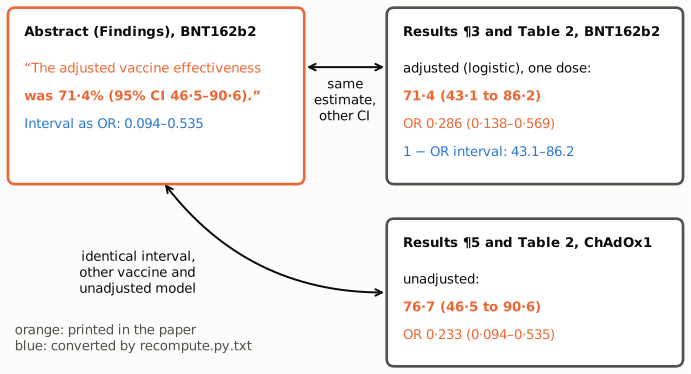
Figure 2. The three places in the paper that give the conflicting numbers. The abstract (orange outline) and Results/Table 2 (grey outline, top right) give the same BNT162b2 point estimate with different intervals; the abstract's interval is identical to the unadjusted ChAdOx1 nCoV-19 interval in Results paragraph 5 and Table 2 (bottom right). Orange text is printed in the paper; blue text is the 1 − OR conversion computed by recompute.py.txt.
Why it matters
- It is a headline estimate. The adjusted one-dose BNT162b2 effectiveness is the first of the paper's two primary results, and the abstract is the part most readers, indexers and citing authors use. The accompanying Comment in the same issue (PMC8221733) already repeats the abstract's interval: "Estimated vaccine efficacy for symptomatic disease 14 days after one dose of vaccine was 71·4 % (95% CI 46·5–90·6) for BNT162b2".
- It shifts the interval upwards. The upper bound is 90·6 instead of 86·2 (+4.4 points) and the lower bound 46·5 instead of 43·1 (+3.4 points), so the abstract's lower bound, the one readers use to judge the minimum plausible protection, is more favourable than the data support. The interval is not narrower: it spans 44.1 VE points against 43.1, and the SE(ln OR) it implies is larger, 0.444 against 0.361. Measured from the point estimate, it reaches 19.2 points above 71·4 (Table 2: 14.8) and 24.9 points below (Table 2: 28.3).
- It can bias re-use. A meta-analyst who back-calculates a standard error from the abstract would obtain SE(ln OR) = 0.444 instead of 0.361, giving this study about two-thirds (0.66×) of its proper inverse-variance weight, and would centre the estimate on an interval whose midpoint corresponds to VE 77.6%, not 71.4%.
- The conclusion stands. Both intervals exclude zero effectiveness, the point estimate is correct everywhere, and the Interpretation ("One dose of either BNT162b2 or ChAdOx1 nCoV-19 resulted in substantial risk reductions of COVID-19-related hospitalisation in people aged at least 80 years") is unaffected. The error is in how the abstract reports the result, not in the analysis.
Explanations considered
- A different BNT162b2 model. Not supported. Table 2 lists every BNT162b2 estimate: unadjusted 47·7 to 82·9, logistic adjusted 43·1 to 86·2, matched conditional −0·20 to 81·9, and unadjusted within 14 days −65·8 to 48·2. The period-restricted estimate, 79·3% (47·0–92·5), appears as its own sentence in the abstract. None is 46·5–90·6.
- A different confidence-interval method applied to the BNT162b2 data. Not supported. From the 18/135 and 90/269 counts, Wald and exact conditional intervals give VE of about 45–47 to 82–84, far below 90·6 at the top. The adjusted interval would differ from these, but the paper prints it (43·1–86·2), and the abstract's interval is not centred on 71·4 on the log-odds scale (+0.28 half-widths), whereas every interval in Table 2 and the other two abstract intervals are centred within 0.04 half-widths.
- Copying from the adjacent ChAdOx1 row. Consistent with all the numbers. 46·5–90·6 is the unadjusted ChAdOx1 interval, both as VE and as OR (0·094–0·535), and it is the only row of Table 2 with that interval. This is an observation about the numbers only; how the error arose is not known.
- A conversion or typesetting artifact. Not possible. The publisher's typeset PDF of the final issue version shows the same abstract sentence, Results text and Table 2 entries as the PMC XML, and the intervals are complete, internally consistent number pairs rather than garbled characters.
- Definition or units. Not an explanation. VE = (1 − OR) × 100 holds for every printed effect row of Table 2, to within a 0.1-point rounding difference in one bound (ChAdOx1 matched conditional).
- A correction already issued. None for this interval (see Status).
- Side observations, not part of the claim. The Results give the BNT162b2 difference in vaccination as −20·2%; the counts give 13.3% − 33.5% = −20.1 points (a rounding difference). The Wald p value implied by the adjusted OR and its interval is about 0.0005 (z = −3.46), while Table 2 prints <0·0001; a likelihood-ratio or other test could give a somewhat different value, so this is noted only for completeness.
Status
- Version of record. The publisher's web pages could not be retrieved by automated requests (the DOI redirect returned only a redirect stub and thelancet.com returned HTTP 403). I used the publisher's own typeset PDF from the PMC Open Access dataset (PMC8221734.1), which is the final issue version ("The Lancet Infectious Diseases, 21 (2021) 1539-1548", footer "Vol 21 November 2021", created 2021-10-18, after the July 2021 erratum). It carries 71·4% (95% CI 46·5–90·6) in the abstract (p 2), 71·4% (43·1–86·2) in the Results (p 5), and the Table 2 rows quoted above (p 7). The PMC web page and the Europe PMC full-text XML show the same numbers. Every quotation above was checked verbatim against the PMC-archived text with
src/show.py. - Supplements. The Europe PMC supplementary bundle contains only the two article figure images. Neither the PDF nor the XML refers to a separate appendix. A supplement could not change the verdict, because Table 2 prints the adjusted OR and its interval.
- Corrections and comments. As of 2026-10-24, the only notice is an erratum (doi:10.1016/S1473-3099(21)00397-2, PMC8318405, Lancet Infect Dis 2021;21(8):e208, dated 5 July 2021), listed by Crossref and Europe PMC; it corrects the spelling of an author's name and does not mention the interval. Crossref lists no other update relations, including none from Retraction Watch. The linked Comment (PMC8221733) repeats the abstract's interval. The PubMed abstract (PMID 34174190) still reads 71·4% (95% CI 46·5-90·6). PubPeer could not be queried directly (its site and API sit behind an automated-access check); web searches for the article together with "PubPeer" found no thread, and found no Retraction Watch coverage.
- Sources. PMC article PMC8221734 and its Open Access PDF; Europe PMC full-text XML and supplementary files; erratum PMC8318405; Comment PMC8221733; PubMed 34174190; Crossref; Europe PMC; PubPeer; https://doi.org/10.1016/S1473-3099(21)00330-3.
Suggested correction
In the abstract (Findings), replace
The adjusted vaccine effectiveness was 71·4% (95% CI 46·5–90·6).
with
The adjusted vaccine effectiveness was 71·4% (95% CI 43·1–86·2).
so that the abstract agrees with the Results text, Table 2 and the adjusted odds ratio 0·286 (0·138–0·569). The same change would apply to the PubMed abstract and could be noted against the accompanying Comment, which quotes the abstract's interval. No other number in the abstract needs changing.