← Back to the plain-language case
Registered 6-week re-intervention count reported instead as a 6-month total procedure count, without disclosure
Gut (2018) · doi:10.1136/gutjnl-2017-315335 · PMC6582745 · NCT02685865
Summary
This paper is the primary report of a single-centre randomised trial comparing lumen-apposing metal stents (LAMS) with plastic stents for EUS-guided drainage of walled-off necrosis (WON). In every ClinicalTrials.gov version (v0, 2016-02-18, to v7, 2019-02-08) the primary outcome has a 6-week time frame, and its description defines the counted events as re-interventions: repeat EUS-guided drainage, direct endoscopic necrosectomy (DEN) or a percutaneous catheter "due to inadequate treatment response". v0 to v3 title it "The number of re-interventions performed between metal and plastic stent groups to achieve treatment success". v4 (2017-09-13) changed "re-interventions" to "interventions" in the measure title and in the first sentence of the description, but left the definition, the hypothesis and the time frame unchanged; v4 to v7, including the current record, carry this wording. The paper's primary outcome is instead the "total number of procedures needed to achieve treatment success at 6-month follow-up". This count also includes the index procedure, ERCP, enteral feeding tubes and procedures for adverse events, so it differs from the registered outcome in both time point and construct. The paper does not mention the difference, and it reports no per-patient result or between-group test for the registered outcome.
What was registered
The record has eight versions, v0 to v7 (indices from the ClinicalTrials.gov history API). The record was first submitted on 2015-11-24. The earliest version, v0, is dated 2016-02-18 (first posted 2016-02-19), six days after the actual study start of 2016-02-12. v0 gave the start only as "2016-02", and from v3 (2017-04-21) the start is "2016-02-12" (actual). No version exists on or before the study start.
v0, 2016-02-18 (status Not yet recruiting; estimated enrolment 62). One primary outcome:
Measure: "The number of re-interventions performed between metal and plastic stent groups to achieve treatment success" (time frame: "6 weeks")
Description: "The primary objective of this study is to compare the number of re-interventions performed between metal and plastic stent groups to achieve treatment success at 6 week follow-up. Re-intervention is defined as the need for repeat EUS-guided drainage of WON using the same stent type and/or DEN and/or insertion of percutaneous catheter due to inadequate treatment response following initial WON drainage. As FCSEMS have larger diameter than plastic stents, the investigators hypothesize that the no. of re-interventions performed will be lower in the FCSEMS group compared to the plastic stent group."
The registered secondary outcome for treatment success was:
"Treatment success" (time frame: "6 week"): "Decrease in the size of WON to <33% of the original size and resolution of symptoms at 6-week outpatient follow-up (from day of hospital discharge) WITHOUT the need for cross-over to minimally invasive surgical debridement"
The other registered secondaries were technical success (day 0), treatment failure (6 months), recurrence (6 months), procedure duration (day 0), adverse events (6 months), duration of hospitalisation (6 months) and cost analysis (6 months).
v1 (2016-04-12), v2 (2017-02-13), v3 (2017-04-21). No change to the outcome measures. v1 changed the Study Identification module (brief title from "Trial Comparing FCSEMS and Plastic Stents" to "Comparison of FCSEMS and Plastic Stents") and the status, description, conditions and contacts modules; v2 and v3 changed the status module (status and dates) only.
v4, 2017-09-13 (status Active, not recruiting; actual enrolment 60; primary completion "2017-07-10", actual). The module labels include "Outcome Measures". The primary measure title became:
"The number of interventions performed between metal and plastic stent groups to achieve treatment success" (time frame: "6 weeks")
In the first sentence of the description, "re-interventions" became "interventions" ("...to compare the number of interventions performed between metal and plastic stent groups to achieve treatment success at 6 week follow-up."). The rest of the description was not changed: the definition still begins "Re-intervention is defined as the need for repeat EUS-guided drainage of WON using the same stent type and/or DEN and/or insertion of percutaneous catheter due to inadequate treatment response following initial WON drainage", and the hypothesis still refers to "the no. of re-interventions". The secondary treatment-success description became "Resolution of WON on CT scan and resolution of symptoms at 6-week outpatient follow-up (from day of hospital discharge) WITHOUT the need for cross-over to minimally invasive surgical debridement", still at "6 week". v4 also made wording edits to two other secondary-outcome descriptions, with no change to their time frames: treatment failure gained the words "or underlying diseaseor underlying disease." (as written), and procedure duration now starts when the "endoscope [is] inserted into the gastrointestinal lumen to perform transmural drainage" instead of "inserted into the oropharynx". This edit was made after the actual primary completion date then registered (2017-07-10; v6 later changed it to 2018-07-10) and nine days before the manuscript was received (2017-09-22).
v5, 2018-05-30. This is the last version before online publication (2018-06-01). The outcomes are the same as in v4.
v6, 2018-07-31, and v7, 2019-02-08. No outcome change. v6 changed the actual primary completion date from 2017-07-10 to 2018-07-10. v7 set the status to Completed. The current record (fetched from /api/v2/studies/NCT02685865 on 2026-10-23; last update posted 2019-02-11) matches v7, and it still gives the primary time frame as "6 weeks".
No version gives a 6-month time frame for the primary outcome. None defines the primary outcome as a count that includes the index procedure, ERCP, enteral feeding tubes or procedures for adverse events.
What the paper reports
The primary outcome, Abstract (Design):
"Primary outcome was comparing total number of procedures to achieve treatment success defined as symptom relief in conjunction with WON resolution on CT at 6 months."
Introduction, final paragraph:
"The primary objective of this randomised trial was to evaluate the effectiveness of LAMS by comparing the total number of procedures required to achieve treatment success between patients undergoing LAMS and plastic stent placement at 6-month follow-up."
Methods > Outcome measures:
"The main outcome measure was to compare the total number of procedures needed to achieve treatment success at 6-month follow-up."
Methods > Definitions:
"The total number of procedures required to achieve treatment success included the index endoscopic intervention, endoscopic reinterventions, percutaneous drain placement, ERCP, enteral feeding tube placement and any procedures performed for the management of adverse events or disease-specific events in each cohort during the 6-month follow-up period."
"Treatment success was defined as resolution of WON on CT scan in association with clinical resolution of symptoms at 6-month follow-up."
Methods > Sample size calculation:
"A two-sided sample size calculation was performed to detect a difference of one in the total number of procedures needed to achieve treatment success (assuming one for LAMS and two for plastic stents)"
Methods > Patient follow-up. This is the only role the 6-week visit has in the paper:
"On initial outpatient follow-up at 6 weeks postintervention, all patients underwent CT to assess treatment response prior to stent removal and an ERCP to assess for pancreatic duct integrity."
The primary result, Abstract (Results) and Table 3 ("Total no. of procedures for treatment success": mean 2.8 (SD 1.2) vs 3.2 (SD 1.5); median 2 vs 3; range 2–7 vs 2–7; p=0.192):
"There was no significant difference in total number of procedures performed (median 2 (range 2–7) LAMS vs 3 (range 2–7) plastic, p=0.192)"
The paper's statements about the registration and the protocol:
- The only registration statement is at the end of the Abstract: "Trial registration number NCT02685865." The words "registered" and "registration" (outside that line) do not appear in the text. The registry's hyphenated term "re-intervention" does not appear either, but "reinterventions" does, five times: as one component of the total procedure count (Methods > Definitions, "endoscopic reinterventions"), in the 3- and 6-month follow-up interviews ("disease-related reinterventions and readmissions") and three times in the Discussion. It is never reported as a separate outcome.
- The only protocol amendment described is in Results > LAMS cohort: "Therefore, the safety board recommended an amendment to the study protocol whereby a CT was obtained at 3 weeks in the LAMS cohort followed by stent removal if the WON had resolved." The Abstract also mentions it: "Interim audit resulted in protocol amendment where CT scan was obtained at 3 weeks postintervention followed by LAMS removal if WON had resolved."
- The only limitation about the primary outcome is in Discussion, limitations paragraph: "Four, we did not report outcomes from a patient perspective and the primary outcome was not adjudicated in a blinded fashion."
- Searches of the archived text for "registered", "primary outcome", "amend", "changed", "protocol", "6 week", "6-week" and "reintervention" found no statement about a change to the primary outcome's definition or time point.
The online supplement (gutjnl-2017-315335supp001.pdf, retrieved from the Europe PMC supplementary-files archive) has four tables: costs; "Procedures performed to achieve treatment success"; Poisson regression; and linear regression. Supplementary Table 2 lists procedure totals by type (LAMS vs plastic): "Repeat EUS-guided drainage 2 / 5", "Endoscopic necrosectomy 4 / 6", "Percutaneous drain placement 2 / 5", "Enteral feeding tube placement 7 / 13", "ERCP for pancreatic duct integrity 31 / 29" and "Management of adverse events 14 / 3". The supplement says nothing about the registration or any outcome change.
The discrepancy
| Outcome | Registered (version, date) | In the paper | Status |
|---|---|---|---|
| Number of re-interventions (repeat EUS drainage with the same stent type, DEN or percutaneous catheter, for inadequate response) to treatment success | Primary in v0–v3 (2016-02-18 to 2017-04-21). From v4 (2017-09-13) the title says "interventions", but the description keeps the re-intervention definition (through v7, 2019-02-08) | Not an outcome. The Results text and Supp. Table 2 give only procedure totals by type (LAMS 2+4+2 = 8; plastic 5+6+5 = 16), with no per-patient summary and no test | not reported |
| Time point of the primary outcome | "6 weeks" in every version, v0–v7; description "at 6 week follow-up" | "at 6-month follow-up" (Abstract, Introduction, Methods) | time point changed |
| Total number of procedures to treatment success (index procedure, endoscopic reinterventions, percutaneous drains, ERCP, enteral feeding tubes, procedures for adverse or disease-specific events) | In no version | Primary outcome and basis of the sample size calculation; median 2 vs 3, p=0.192 | added (as primary) |
| Treatment success | Secondary, "6 week"; v0: "<33% of the original size" plus symptoms; v4 (2017-09-13): "Resolution of WON on CT scan" plus symptoms | Secondary, "at 6-month follow-up"; 29 (93.5%) vs 28 (96.6%), p=0.999; also the end point of the primary count | time point changed |
| Technical success, procedure duration, adverse events, length of stay, costs, recurrence, treatment failure | Secondary, v0–v7 (day 0 or 6 months) | Secondary outcomes or definitions in Methods; reported in Table 3 and the text | matched |
Figures
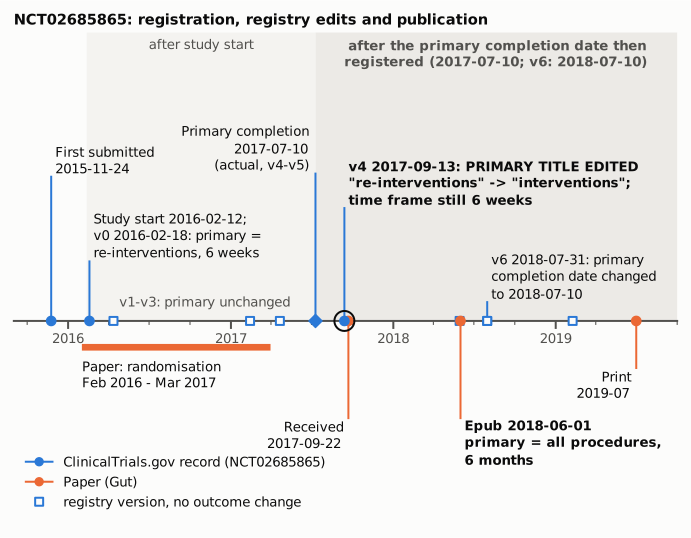
Figure 1. Timeline of NCT02685865 and the paper. Blue marks are registry events (above the axis). Filled circles are the first submission (2015-11-24), v0 (2016-02-18, six days after the actual study start of 2016-02-12) and v4. The diamond is the registered actual primary completion (2017-07-10). Open squares are registry versions that did not change the outcomes (v1–v3, v5, v6, v7); v5 (2018-05-30) sits beside the publication marker. The ringed marker is v4 (2017-09-13), the only version that edited the outcome measures. It falls after the actual primary completion date then registered (2017-07-10; v6 later changed it to 2018-07-10) and nine days before the manuscript was received. Orange marks are the paper (below the axis): the randomisation period it reports (February 2016 to March 2017), receipt (2017-09-22; its axis marker sits under the v4 marker nine days before it, and its stem leads down to the label), online publication (2018-06-01) and print (2019-07). The paper's 6-month primary outcome appears at no point in the registry. v6 (2018-07-31), after publication, moved the actual primary completion date to 2018-07-10. Source: make_figures.py.txt.
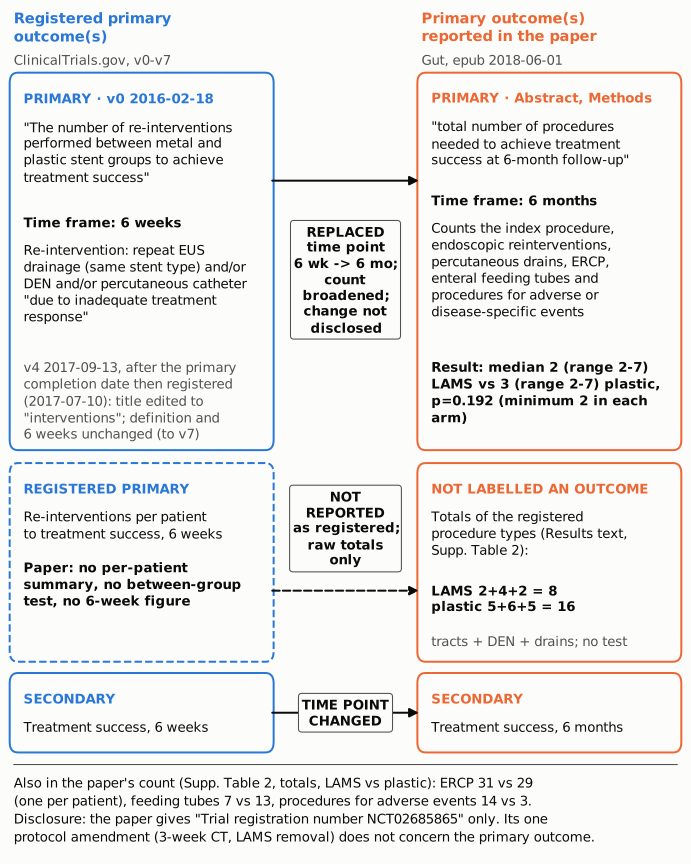
Figure 2. On the left, in blue, are the registered outcomes. On the right, in orange, are what the paper reports. Each connector carries a label for its status. Top row: the registered primary (re-interventions to treatment success at 6 weeks) was replaced by a 6-month total procedure count. That count adds the index procedure, ERCP, feeding tubes and procedures for adverse or disease-specific events. Its result was median 2 vs 3, p=0.192, with a minimum of 2 in each arm. The v4 title edit is noted in grey. Middle row (dashed outline: an outcome with no reported result): for the registered primary as defined, the paper gives only procedure totals for its three components (8 vs 16), with no per-patient summary, no test and no 6-week split. Bottom row: the registered secondary, treatment success at 6 weeks, is reported at 6 months. The footer lists the other procedure types in the paper's count (Supplementary Table 2) and the paper's only registration statement and only protocol amendment.
Why it matters
The paper reports no result for the registered primary outcome. The registered measure is a per-patient count of re-interventions done for inadequate treatment response, reaching treatment success at 6 weeks, and the paper gives no between-group comparison of it at any time point. The closest data are procedure totals for the three registered components: 8 in the LAMS arm (2 extra transmural tracts, 4 necrosectomies, 2 percutaneous drains) against 16 in the plastic arm (5, 6 and 5). These come from Results > LAMS cohort and Plastic stent cohort ("Additional procedures undertaken due to suboptimal treatment response at 72 hours (for ongoing SIRS) included creation of additional transmural tracts (n=2), direct endoscopic necrosectomy (n=4) and percutaneous drainage catheter placement (n=2)" and "...(n=5), direct endoscopic necrosectomy (n=6) and percutaneous drainage catheter placement (n=5)") and Supplementary Table 2. These are event totals, not patient-level data. They are not split at 6 weeks and are not tested, so the registered comparison cannot be reconstructed from the paper.
The substituted outcome is built differently in ways that bear on its result:
- Shared fixed components. Every patient's count includes the index procedure. Supplementary Table 2 lists "ERCP for pancreatic duct integrity" as 31 and 29, one per randomised patient, in line with the protocolised 6-week ERCP. Both arms therefore have a floor of 2 procedures, and the observed minimum is 2 in each arm (Table 3). Components that every patient receives add the same amount to both arms and shrink the relative contrast between them.
- Procedures for adverse events. The count includes "any procedures performed for the management of adverse events". Supplementary Table 2 gives 14 such procedures in the LAMS arm and 3 in the plastic arm. These were coil embolisations, endoscopies for bleeding or buried stents, ERCP for biliary stricture, retrieval of migrated stents and removal of a PEG-J tube. The registered outcome did not count them, and in the published count they add to the LAMS total.
- Different window. The registered window ended at 6 weeks. The published window runs to 6 months and takes in readmissions and later procedures.
So the paper's null primary result (p=0.192) and its "non-superiority" headline concern a different end point from the one registered. The totals for the registered components are lower in the LAMS arm (8 vs 16), but no test is given and these are not per-patient data. Whether the registered comparison would have been null or not cannot be judged from what is published. The registered hypothesis itself ("the no. of re-interventions performed will be lower in the FCSEMS group") is never tested as stated.
Two further points make the published primary harder to interpret:
- Sample-size assumptions. The power calculation assumes means of "one for LAMS and two for plastic stents" in "the total number of procedures". Under the published definition, every patient has at least two procedures (index plus ERCP), so an assumed mean of one in the LAMS arm is not possible. The paper does not explain how the assumptions relate to the definition.
- Totals that do not add up. The procedure totals in Supplementary Table 2, plus one index procedure per patient, come to 91 (LAMS) and 90 (plastic). These correspond to means of 2.94 and 3.10, against the reported 2.8 and 3.2 in Table 3, so the per-patient composition of the published count cannot be checked from the supplement either.
This is not a case where a null registered result became a positive headline: the published primary is itself null, and both outcomes are procedure counts. But the paper presents the 6-month total count as the trial's primary outcome. Readers, reviewers and meta-analysts who take it at face value would not know that the registered primary, measured at 6 weeks and restricted to re-interventions, is not reported.
Explanations considered
- Paper role. This is the trial's primary report: 60 patients were randomised, matching the registered actual enrolment of 60, and the paper gives full efficacy, safety and cost results with a sample-size calculation for the primary outcome. It is not a secondary or follow-up analysis that could legitimately use a different end point. This does not explain the discrepancy.
- Disclosure. None. The registration is cited only as "Trial registration number NCT02685865." The text searches listed above found no statement that the primary outcome, its time point or its counting rules differ from the registration. The supplement contains only results tables. Not disclosed.
- Protocol amendments. The paper describes one amendment, recommended by the safety board: "a CT was obtained at 3 weeks in the LAMS cohort followed by stent removal if the WON had resolved." It concerns imaging and stent removal in one arm. It does not concern the primary outcome's definition, its time point or which procedures are counted. A legitimate amendment to the outcome could exist, but the paper cites no published protocol or statistical analysis plan, the registry has no posted documents, and the change is not described. A real but unreported amendment would explain why the outcome differs, but not why the paper does not say so.
- Registry edit in v4. The v4 edit (2017-09-13) changed the title from "re-interventions" to "interventions". It could be read as a move towards a broader count. It did not, however, change the time frame (still 6 weeks), and the description still defines the counted events as re-interventions for inadequate response. The registry never described the paper's 6-month count. The edit was made after the then-registered actual primary completion date (2017-07-10; changed to 2018-07-10 in v6) and is not mentioned in the paper either.
- Wording differences. The registry's "metal" and "FCSEMS" arm is the paper's LAMS. The registry lists a "Hot Axios Fully covered self-expandable metal stent", and the paper describes the Hot AXIOS LAMS as "fully covered self-expandable metal stents", so the device is the same. "Number of procedures" and "number of re-interventions" could look like loose synonyms. They are not, because the paper explicitly adds the index procedure, ERCP, feeding tubes and adverse-event procedures. Six weeks and six months cannot be a wording difference.
- The 6-week visit as the assessment point. One reading is that the registry's "6 weeks" refers to the first outpatient CT visit, which still exists in the paper. But the registry ties both the count and treatment success to "6 week follow-up". The paper defines treatment success, which closes the count, "at 6-month follow-up", and it counts procedures "during the 6-month follow-up period". The paper's 6-week visit is the CT and ERCP and stent-removal visit, not the end point of the primary outcome.
Status
As of 2026-10-23:
- Registry history. All eight versions of NCT02685865 were reviewed: v0 2016-02-18, v1 2016-04-12, v2 2017-02-13, v3 2017-04-21, v4 2017-09-13, v5 2018-05-30, v6 2018-07-31 and v7 2019-02-08. The source was the ClinicalTrials.gov history endpoints (
/api/int/studies/NCT02685865/historyand/history/<version>), from copies retrieved for this project on 2026-10-22 and 2026-10-23; the live history endpoint returned HTTP 403 on 2026-10-23. The current record (/api/v2/studies/NCT02685865, fetched 2026-10-23) matches v7. No results are posted to the registry. - Publisher version. The text checked is the PMC archive of the version of record: Gut 2019;68(7):1200–1209, received 2017-09-22, revised 2018-04-09, accepted 2018-05-02, epub 2018-06-01. The online supplement (Supplementary Tables 1–4) was read from the Europe PMC supplementary-files archive. The paper cites no published protocol or statistical analysis plan.
- Corrections. No correction, erratum, expression of concern or retraction was found in Crossref (no
update-torelation), in PMC notices or in Europe PMC notices. - Letters. Europe PMC lists five "Comment in" items (PMIDs 30030302, 30301769, 30368455, 30389713 and 30448773, the last an authors' reply). Only one was read, doi:10.1136/gutjnl-2018-317777 (PMID 30389713), from an institutional repository copy. It discusses the primary outcome "total number of procedures needed to achieve treatment success at 6-month follow-up" but does not raise the registration. The authors' reply (PMID 30448773, doi:10.1136/gutjnl-2018-317848, "Authors reply: treatment strategy for necrotising pancreatitis", Gut 2020;69:189–190) is the most likely place for any post-publication explanation of the outcome definition, but it could not be accessed: Europe PMC has no full text, and the free publisher PDF that Unpaywall lists, the article page and an alternate BMJ host all returned HTTP 403 on 2026-10-23. A search-engine excerpt of it covers only the drainage algorithm (multigate drainage, CT at 72 hours), so whether it mentions the outcome definition or the registration is unknown. The other three letters were not read; none is open access in Europe PMC.
- PubPeer. The PubPeer API and site returned a bot-verification page (HTTP 403), and a web search found no PubPeer thread for this article. Whether it has PubPeer comments is unconfirmed.
- Sources. ClinicalTrials.gov record and history tab; PMC6582745; Crossref metadata; Europe PMC.
Suggested correction
The authors and the journal could add a statement to Methods > Outcome measures, along these lines:
"The primary outcome registered at ClinicalTrials.gov (NCT02685865; first submitted 24 November 2015) was the number of re-interventions (repeat EUS-guided drainage using the same stent type, direct endoscopic necrosectomy, or percutaneous catheter insertion for inadequate treatment response) needed to achieve treatment success at 6-week follow-up. The primary outcome reported here, the total number of procedures (including the index procedure, ERCP, enteral feeding tubes and procedures for adverse events) needed to achieve treatment success at 6-month follow-up, differs from the registered outcome in its definition and time point. [Date of and reason for the change.]"
The correction could also report the registered primary outcome as prespecified: the per-patient number of re-interventions to treatment success at 6 weeks, by arm, with the planned between-group test, or say why it cannot be computed. Treatment success at 6 weeks, the registered secondary, could be reported too. If a protocol amendment or statistical analysis plan set up the 6-month total count, making that document and its date available would let readers check when the end point was fixed relative to unblinded data. The registry record could be updated to give the outcome that was analysed, with a note on when it changed.