← Back to the plain-language case
The abstract names the inhibited RNA strand as negative, but the paper's own data show positive
Proc Natl Acad Sci U S A (2018) · doi:10.1073/pnas.1805195115 · PMC6176606
Summary
The paper studies a dengue virus genome carrying an NS3-G459L mutation that blocks an internal self-cleavage and acts as a trans-dominant inhibitor of wild-type virus in the same cell. The abstract states that this variant "dominantly inhibited negative-strand RNA synthesis." The Results section, using strand-specific RT-qPCR (Fig. 5 F and G), reports the opposite direction: positive-strand synthesis was strongly inhibited, while negative-strand synthesis was allowed (negative-strand RNA was significantly greater than the polymerase-dead control). The Results conclusion and the Discussion both state that positive-strand synthesis is the inhibited step. The single word "negative-strand" in the abstract therefore reverses the direction of the paper's key mechanistic result, and should read "positive-strand."
What the paper reports
an NS3-G459L variant that is incapable of cleavage at the internal NS3 junction dominantly inhibited negative-strand RNA synthesis of wild-type virus present in the same cell
— Abstract
To identify whether the dominant NS3-G459L mutant genome inhibited negative-strand synthesis (and therefore positive-strand synthesis as well) or just positive-strand synthesis, we performed strand-specific RT-qPCR to measure both strands of WT and GDD replicons (Fig. 5 F and G). ... The amount of positive-strand replicon RNA detected when cotransfected with the NS3-G459L dominant mutant was indistinguishable from that detected for the GDD replicon alone, indicating that positive-strand synthesis was strongly inhibited (Fig. 5F). By contrast, the amount of negative-strand replicon RNA was significantly greater than that for the GDD replicon alone (Fig. 5G), indicating that the NS3-G459L dominant mutant allows negative-strand synthesis and therefore specifically inhibits positive-strand synthesis.
— Results, "NS3-G459L Is a Dominant Inhibitor of WT Viral Growth"
Most importantly, viral genomes that abrogate this self-processing event trans-dominantly inhibit positive-strand RNA synthesis of WT genomes present in the same cell
— Discussion, "NS3 Internal Cleavage"
(F) Positive-strand replicon RNA was detected by strand-specific RT-qPCR. (G) Negative-strand replicon RNA was detected by strand-specific RT-qPCR (n = 2).
— Legend to Fig. 5
What the paper's own numbers show
There is no arithmetic to redo. The discrepancy is a reversed qualitative direction between two parts of the same paper describing one experiment: a strand-specific RT-qPCR of the luciferase replicon cotransfected with the NS3-G459L variant, measured at a single time point and normalized to the wild-type replicon alone, with the polymerase-dead GDD replicon as the no-synthesis reference. The two panels of that one experiment (Fig. 5F, positive strand; Fig. 5G, negative strand) are each reported relative to the GDD control. Taking those two relations as stated fixes which strand is inhibited.
| quantity | location | reported | recomputed (from the paper's own numbers) |
|---|---|---|---|
| Strand whose synthesis G459L inhibits | Abstract | negative-strand | positive-strand |
| Positive-strand replicon RNA, G459L vs GDD-dead | Results / Fig. 5F | = GDD → positive synthesis strongly inhibited | positive-strand inhibited (consistent with body) |
| Negative-strand replicon RNA, G459L vs GDD-dead (n = 2) | Results / Fig. 5G | > GDD → negative synthesis allowed | negative-strand allowed, not inhibited |
| Strand inhibited (stated) | Results conclusion | positive-strand | positive-strand |
| Strand inhibited (stated) | Discussion | positive-strand | positive-strand |
Four statements in the body (Fig. 5F, Fig. 5G, the Results conclusion, and the Discussion) place the inhibition on the positive strand; one statement in the abstract places it on the negative strand. recompute.py.txt encodes the two reported relations and prints VERDICT: claim CONFIRMED.
Figure
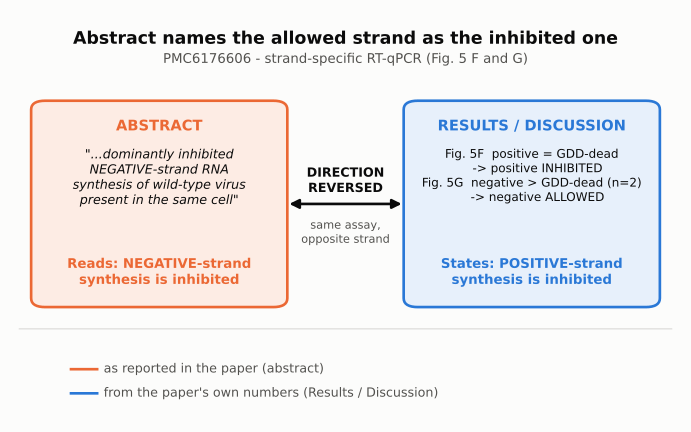
The abstract (left, orange, as reported) states that negative-strand synthesis is inhibited. The Results and Discussion (right, blue, from the paper's own numbers) state that positive-strand synthesis is inhibited while negative-strand synthesis is allowed, based on the strand-specific RT-qPCR in Fig. 5F/G of the same cotransfection experiment. The connector names the conflict: the two descriptions assign the inhibition to opposite strands of one assay. Colors are reinforced by the panel labels and legend so the distinction does not rely on color alone.
Why it matters
Which RNA strand's synthesis is blocked is the mechanistic heart of this result. A reader using the abstract alone would conclude that the dominant-negative genome blocks negative-strand (template) synthesis, an early step of replication. The paper's data support the reverse: negative-strand synthesis proceeds and positive-strand (progeny genome) synthesis is specifically inhibited. Flavivirus and antiviral-mechanism researchers who cite the abstract without reading the Results could adopt an inverted picture of where in the replication cycle the trans-dominant block acts. The paper's broader conclusion — that abrogating the internal NS3 self-cleavage yields trans-dominant inhibition of viral replication, supporting the proposed antiviral strategy — is unaffected in direction, magnitude, or significance, because it does not depend on which strand is affected. The error is confined to one word of one abstract sentence and is contradicted correctly elsewhere in the same paper.
Explanations considered
- A different experiment or population in the abstract vs. the body. No. Both refer to the same strand-specific RT-qPCR of the replicon cotransfected with NS3-G459L; the abstract summarizes exactly the experiment reported in Fig. 5 F and G.
- A different time point, normalization, or unit. No. It is one assay (single time point, normalized to the wild-type replicon alone); Fig. 5F and 5G are simply the positive- and negative-strand measurements of that one experiment.
- Loose reading: inhibiting positive-strand synthesis indirectly lowers negative-strand RNA, so "inhibited negative" is approximately true. No. Fig. 5G reports negative-strand RNA as significantly greater than the polymerase-dead GDD control, and the text explicitly calls negative-strand synthesis "allowed," not reduced.
- A logical-framing rescue in which "inhibited negative" is a defensible summary. No. The Results pose an explicit dichotomy — the mutant either "inhibited negative-strand synthesis (and therefore positive-strand synthesis as well) or just positive-strand synthesis" — and answer "just positive-strand." The abstract asserts the alternative the experiment rejected.
- A one-sided test, an adjusted-vs-unadjusted value, or a stated convention. Not applicable. This is a reversed qualitative direction, not a statistical-threshold or reporting-convention issue.
- A published correction or erratum that resolves it. None.
known.pyreturns empty Crossref, PMC, and EuropePMC notices, and no PubPeer thread was found.
Status
- Version of record checked. The error is present in the version of record, not an archiving artifact. The abstract sentence reading "negative-strand RNA synthesis" appears identically in the Europe PMC publisher-deposited full-text XML and in the PMC HTML; the PNAS publisher page could not be read directly (HTTP 403), but a third-party citation page independently quotes the abstract with "negative-strand RNA synthesis." The Results and Discussion text quoted above comes from the PMC archive via
src/show.py. - Supplements. The SI Appendix (primer sequences for the strand-specific RT-qPCR and supporting figures) does not bear on the discrepancy, which is a single word choice in the abstract rather than a numeric or table value. The main-text Results, the Fig. 5F/G legend, and the Discussion already give the correct, consistent direction.
- Corrections and PubPeer. No correction, erratum, or retraction notice found via Crossref, PMC, or EuropePMC (
known.py); no PubPeer thread located by search. - Sources. Abstract, Results, Discussion, and Fig. 5 legend as archived in PubMed Central (PMC6176606); Crossref/PMC/EuropePMC correction records via
known.py. As of 2026-10-23.
Suggested correction
In the abstract, change "dominantly inhibited negative-strand RNA synthesis of wild-type virus present in the same cell" to "dominantly inhibited positive-strand RNA synthesis of wild-type virus present in the same cell," making the abstract agree with the Results (Fig. 5 F and G), the Results conclusion, and the Discussion. No figure, table, or numeric value needs to change.