← Back to the plain-language case
Trial registered five months into enrollment and safety primary added later; paper says "prospectively registered"
Circulation (2017) · doi:10.1161/CIRCULATIONAHA.116.026493 · PMC5459585 · NCT01858363
Summary
The paper is the primary 12-month report of a randomized trial comparing a low-dose paclitaxel-coated balloon (DCB) with uncoated angioplasty (PTA). It states that "The study was prospectively registered". The ClinicalTrials.gov record was first submitted on 2013-05-08, but the paper reports that randomization began in December 2012 and the registry gives the study start as 2012-11. In the first registered version the only primary outcome was 12-month primary patency. The primary safety end point, one of the paper's two primary end points, was added as a registered primary outcome on 2014-02-12, about 14 months after randomization began and before primary completion. Both primary end points reported in the paper match the registration in force at publication, and neither the late registration nor the added primary outcome is mentioned in the paper.
What was registered
Five registry versions exist. They are numbered 1-5 here, in date order (indices 0-4 in the ClinicalTrials.gov history API). Every version gives the study start as "2012-11", and every version gives the first submission date as 2013-05-08.
Version 1, 2013-05-20 (first submitted 2013-05-08, first posted 2013-05-21; status Recruiting; estimated enrollment 360). This is the earliest version, and no version exists on or before the study start. It has one primary outcome:
Primary outcome: "Primary Patency at 12 months post-procedure" (time frame: "12 months")
Secondary outcome: "Major adverse event rate" (time frame: "1, 6, 12, 24 months")
No safety outcome is registered as primary.
Version 2, 2014-02-12 (status Recruiting). The module labels for this version include "Outcome Measures". It has two primary outcomes and no secondary outcomes:
"Primary Efficacy Endpoint" (time frame "12 months"); description: "Primary Patency at 12 months post-procedure"
"Primary Safety Endpoint" (time frame "30-Days and 12-Months"); description: "Freedom from device and procedure related target limb major amputation or death through 30-days post-procedure and clinically-driven target lesion revascularization at 12-month"
The secondary outcome "Major adverse event rate" was deleted in this version.
Version 3, 2015-06-25 and version 4, 2016-10-05. The outcomes are unchanged from version 2. Version 4, which changed only the Study Status and IPDSharing modules, records primary completion as "2016-03" (actual). It is the last version before the paper was received (2016-11-21) and published online (2017-04-19).
Version 5, 2021-10-11 (results first posted 2021-10-13; after publication). The primary outcomes were reworded for results reporting. The measures and time points did not change; the patency description adds the definition used in the paper (PSVR ≤2.5 and freedom from CD-TLR), which versions 1-4 did not spell out:
"Patency at 12-months" (12 months): "The primary efficacy endpoint was patency at 12 months post-procedure defined as the absence of target lesion restenosis determined by duplex ultrasound peak systolic velocity ratio (PSVR) ≤2.5 and freedom from clinically-driven target lesion revascularization (CD-TLR)."
"Percentage of Patients With Freedom From Device and Procedure Related Target Limb Major Amputation or Death Through 30-days Post-procedure and Clinically-driven Target Lesion Revascularization at 12-month" (30-Days and 12-Months)
The posted results (83.9% vs 60.6% for patency; 94.1% vs 83.3% for safety) agree with the paper. Actual enrollment is given as 294.
What the paper reports
The primary end points, from the Abstract (Methods):
"The primary safety end point was a composite of freedom from device- and procedure-related death through 30 days after the procedure and freedom from target limb major amputation and clinically driven target lesion revascularization through 12 months after the procedure. The primary effectiveness end point was primary patency at 12 months."
And from Methods > Outcomes:
"The primary effectiveness end point was primary patency (per lesion) through 12 months, defined as the absence of target lesion restenosis (duplex ultrasound–determined peak systolic velocity ratio ≤2.5) and freedom from CD-TLR."
The registration statement (Methods > Study Design, para 1):
"The study was prospectively registered (http://www.clinicaltrials.gov; unique identifier: NCT01858363)."
The enrollment period (Results > Patient Enrollment and Follow-Up, para 1):
"Between December 2012 and April 2015, 294 patients were randomized to DCB (222 patients, 254 lesions) or PTA (72 patients, 79 lesions) at 18 centers in Germany and Austria"
The paper's statements about prespecification are in Methods > Statistical Analysis. Para 1 sets out the two primary hypotheses (noninferiority with a 5% margin, then superiority, for safety; superiority for patency) and says of the safety hypothesis:
"A priori, if noninferiority was met and the lower 95% confidence limit was >0%, superiority would be claimed."
Para 2 says:
"All analyses were prespecified in a statistical analysis plan."
Neither statement gives a date, or says how the primary safety hypothesis relates to the registry entry of 2014-02-12 that first listed the safety composite as a primary outcome. No protocol amendment, no change to the primary end points and no registration date is mentioned anywhere in the text. The word "protocol" appears only in a sentence about the antiplatelet regimen (Methods > Study Device and Procedure). The Limitations paragraph does not mention registration.
The discrepancy
| Outcome | Registered (version, date) | In the paper | Status |
|---|---|---|---|
| 12-month primary patency | Primary in v1 (2013-05-20) as "Primary Patency at 12 months post-procedure"; primary "Primary Efficacy Endpoint" in v2-v4 (2014-02-12 to 2016-10-05) | Primary effectiveness end point: primary patency through 12 months (PSVR ≤2.5 and freedom from CD-TLR) | matched |
| Safety composite (device/procedure-related death through 30 days; target limb major amputation and CD-TLR through 12 months) | Absent from v1. Primary "Primary Safety Endpoint" from v2 (2014-02-12), during enrollment, before primary completion | Primary safety end point | added (in v2, about 14 months after randomization began; matches v2-v4; change not disclosed) |
| Major adverse event rate | Secondary in v1 only (1, 6, 12, 24 months); deleted in v2 (2014-02-12) | Reported as "Additional outcomes" (MAEs), not as a primary end point | not a primary outcome in either source; no primary-outcome status change |
| Registration timing | First submitted 2013-05-08 (posted 2013-05-21); study start 2012-11 in every version | "prospectively registered"; randomization "Between December 2012 and April 2015" | not prospective: registered roughly 5 months after the first randomization (about 6 months after the registry start date); not disclosed |
The safety composite has a minor wording difference. In the registry wording for v2-v4 ("Freedom from device and procedure related target limb major amputation or death through 30-days post-procedure and clinically-driven target lesion revascularization at 12-month"), the 30-day window could be read as applying to amputation as well as death. The paper puts amputation in the 12-month window. The version 5 description ("freedom from device and procedure-related death through 30 days post-procedure and freedom from target limb major amputation and clinically-driven target lesion revascularization (CD-TLR) through 12 months") matches the paper exactly. The wording also gives the same measure and time points, so this is classed as matched.
Figures
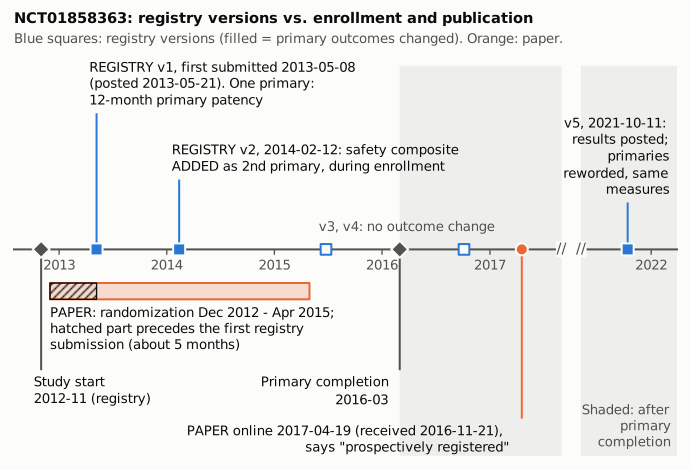
Figure 1. Timeline of NCT01858363 and the paper. Blue squares are registry versions: filled squares mark versions that changed the primary outcomes, and open squares mark versions that did not. Grey diamonds mark the registry study start (2012-11) and primary completion (2016-03). The orange bar is the randomization period reported in the paper (December 2012 to April 2015). Its hatched part is the stretch before the record was first submitted (2013-05-08). The orange circle marks online publication (2017-04-19). The safety composite was added as a primary outcome in version 2 (2014-02-12), after the study start and during enrollment, but before primary completion. The shaded area is the period after primary completion (axis broken between 2017 and 2021). Version 4 (2016-10-05) falls in it but changed only Study Status and IPDSharing. The only outcome change in that period is version 5 (2021-10-11), which reworded the primaries for results posting. All dates come from the registry history and the paper. Source: make_figures.py.txt.
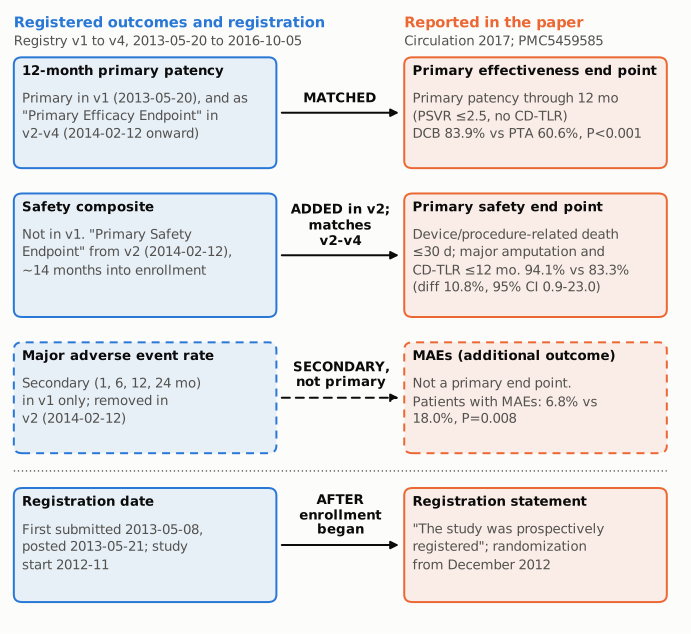
Figure 2. On the left, in blue, are the registered outcomes across versions 1-4 (2013-05-20 to 2016-10-05), including the registered secondary outcome and the registration date. On the right, in orange, are the outcomes as reported in the paper, with the paper's results. Each connector carries a label for its status. The 12-month patency outcome was registered as primary from the first version and matches the paper's primary effectiveness end point. The safety composite was not in version 1. It was added as a primary in version 2 (2014-02-12) and matches the paper's primary safety end point. The registered secondary "Major adverse event rate" (dashed boxes) was deleted in version 2. The paper reports MAEs as an additional outcome, so no primary outcome was dropped or demoted. The bottom row sets the registration date beside the paper's "prospectively registered" statement.
Why it matters
The paper reports a result for each registered primary outcome, and both results are positive. For primary patency at 12 months, the paper reports "83.9% (188 of 224) for DCB and 60.6% (40 of 66) for PTA, for a difference of 23.3% (95% confidence interval, 10.6%–36.1%; P<0.001)" (Results > Effectiveness Outcomes). For the primary safety composite, it reports "94.1% (193 of 205) with DCB and 83.3% (50 of 60) with PTA, for a difference of 10.8% (95% confidence interval, 0.9%–23.0%)", meeting both noninferiority and superiority (Results > Safety Outcomes). The abstract concludes: "Superiority with a low-dose DCB for femoropopliteal interventions was demonstrated over PTA for both the safety and effectiveness end points."
The registry and the paper report the same outcomes, so this is not a case of a switched primary outcome. The issue is what the registry can and cannot vouch for:
- Registration was not prospective. Under the ICMJE definition, prospective registration means registration before the first patient is enrolled. Here the record was first submitted after randomization had started. The paper's own dates place that start in December 2012, and the registry places the study start in 2012-11. The paper's statement that the study "was prospectively registered" therefore does not agree with the registry or with the paper's own enrollment dates. Registration came early in a randomization period of about 29 months and well before primary completion. The registry cannot show that the first registered primary outcome was fixed before enrollment, but it does show that it was fixed before most patients were randomized.
- One of the two primary end points was registered during enrollment. The safety composite, which supports half of the abstract's conclusion of "superiority ... for both the safety and effectiveness end points", first appears as a registered primary outcome on 2014-02-12, about 14 months after randomization began and roughly 14 months before it ended. The paper does not date the primary safety hypothesis or its noninferiority margin. It states that the superiority rule was set "A priori" and that analyses were "prespecified in a statistical analysis plan", but gives no date for either. A reader of the paper cannot tell that, by the registry's account, this end point became primary while the trial was under way. The 12-month data were not complete at the time (primary completion 2016-03).
- Readers and evidence syntheses rely on the registration statement. Reviewers who use "prospectively registered" as a marker of low risk of selective reporting could score this trial differently if they had the registry dates.
Explanations considered
- Paper role. The paper is the primary 12-month report of the trial (Methods > Patient Follow-Up: "the primary effectiveness and safety results at 12 months of follow-up presented here"). It is not a secondary or post hoc analysis, so the registered primary outcomes apply to it in full. This does not explain the discrepancy.
- Disclosure. The paper contains no statement about the registration date, about any amendment of the primary end points, or about a registry update. The only registration statement calls the registration "prospective". A search of the archived text for the NCT number, "registered", "protocol", "amend", "primary outcome", "primary end", "changed" and "December 2012" found nothing that discloses either point. The online-only Data Supplement could not be retrieved (the publisher returned HTTP 403). The paper cites it only for eligibility criteria (Table I) and the list of centers, so a disclosure there is unlikely but not ruled out. Not disclosed.
- Protocol amendments. The addition of the safety composite in version 2 may reflect a protocol amendment, for example to set up a noninferiority safety hypothesis. A change made during enrollment and before outcome data were complete can be legitimate. But no protocol, amendment history or statistical analysis plan is published, cited, or posted to the registry (the registry record has no document section). Version 2 also revised other modules (Study Identification, Study Status, Oversight, Study Design, Contacts/Locations). A legitimate amendment would account for why the registry changed, but not for why the paper is silent about it and calls the registration prospective.
- Start date revised later. This is ruled out. Version 1 already gave the study start as 2012-11 with status Recruiting, and the paper independently dates the first randomization to December 2012. The late registration does not come from a start date edited afterwards.
- Earlier registration elsewhere. None was found. The paper cites only NCT01858363, and the registry record lists no other identifiers that predate it.
- Wording differences. Version 2 relabelled the patency outcome as "Primary Efficacy Endpoint" and moved the original wording into the description. Version 5 reworded both primaries for results posting and added the paper's operational definition of patency (PSVR ≤2.5 and freedom from CD-TLR). These changes did not alter the measure or the time point, and they do not account for the discrepancy. The ambiguous 30-day window in the v2-v4 safety wording is a drafting difference, and the version 5 text resolves it in line with the paper.
- "Prospective" referring to the design. The abstract uses "prospective" for the trial design ("This was a prospective, randomized, multicenter, single-blinded trial"), which is accurate. The Methods sentence applies the word to the registration itself ("was prospectively registered"), so this reading does not resolve the statement.
Status
As of 2026-10-23:
- Registry history. Five versions of NCT01858363 were reviewed: 2013-05-20, 2014-02-12, 2015-06-25, 2016-10-05 and 2021-10-11. The source was the ClinicalTrials.gov history endpoint (
/api/int/studies/NCT01858363/history/<version>), from copies retrieved earlier for this project; the live endpoint returned HTTP 403 on 2026-10-23. The current record (/api/v2/studies/NCT01858363, last update posted 2021-10-13) agrees with version 5. - Publisher version. The text checked is the PMC archive of the version of record, Circulation 2017;135(23):2227-2236 (received 2016-11-21, accepted 2017-03-29, online 2017-04-19, issue 2017-06-06). The online-only Data Supplement was not accessible (HTTP 403).
- Corrections. No correction, erratum, expression of concern or retraction was found in Crossref (no
update-toentries), in PMC notices or in Europe PMC notices. Europe PMC lists only a "Comment in" editorial (doi:10.1161/CIRCULATIONAHA.117.028308), which is not a correction. - PubPeer. The PubPeer search page was blocked by a bot check, and a web search found no PubPeer thread for this article. Whether it has PubPeer comments is unconfirmed.
- Sources. ClinicalTrials.gov record and its history tab; PMC5459585; Crossref metadata; Europe PMC.
Suggested correction
The authors and the journal could correct the registration statement in Methods > Study Design and add the registry history. Suggested wording:
"The study was registered at http://www.clinicaltrials.gov (unique identifier: NCT01858363) on May 8, 2013, after enrollment had begun (first randomization December 2012). The initial registration listed primary patency at 12 months as the primary outcome. The primary safety end point was added to the registered primary outcomes on February 12, 2014, during enrollment and before the 12-month follow-up was complete."
If a protocol amendment set up the safety end point and its noninferiority margin, the correction could also give the amendment's date and rationale and say when the statistical analysis plan was finalized. Making the protocol and the plan available, for example as supplementary material, would let readers check that both primary hypotheses were fixed before outcome data were unblinded. The reported results do not need to change.