← Back to the plain-language case
Abstract's 95% interval for Madagascar vaccination access (78–81%) excludes its 77% estimate; Table 3 gives 76–78%
PLoS Med (2011) · doi:10.1371/journal.pmed.1001110 · PMC3201935
Summary
The abstract gives the proportion of Madagascar's population ever covered by any measles vaccination activity (the model parameter ρ) as "77% (95% CI: 78, 81)". The interval does not contain its own point estimate. The paper reports its estimates as posterior medians with 95% intervals taken from posterior quantiles, and with that method the median always lies inside the interval. Table 3 reports the same parameter as 77% (95% CI: 76, 78), and the Results' complementary figure, 23% (95% CI: 24, 22) never accessible, converts back to exactly 76 to 78. The abstract interval is therefore inconsistent with the rest of the paper. The point estimate, the ranking of the three countries and the conclusions are unaffected, but anyone who takes the uncertainty from the abstract gets an interval shifted upward by 2 to 3 points.
What the paper reports
Abstract, Methods and Findings:
We estimate that 93% (95% CI: 91, 94) of the population in Ghana was ever covered by any measles vaccination activity, 77% (95% CI: 78, 81) in Madagascar, and 69% (95% CI: 67, 70) in Sierra Leone.
Table 3, "Estimated proportion of the population accessible by any vaccination activity (ρ), within-activity inefficiency (ψ), and routine vaccination opportunity rate (λ) for Ghana, Madagascar, and Sierra Leone." (columns Country | ρ | ψ | λ):
Ghana | 93% (95% CI: 91, 94) | 0.03 (95% CI: 0.02, 0.04) | 0.66 (95% CI: 0.54, 0.82)
Madagascar | 77% (95% CI: 76, 78) | 0.34 (95% CI: 0.28, 0.41) | 0.60 (95% CI: 0.49, 0.73)
Sierra Leone | 69% (95% CI: 67, 70) | 0.33 (95% CI: 0.31, 0.39) | 0.47 (95% CI: 0.38, 0.61)
Results, first paragraph:
We estimate that 7% (95% CI: 6, 9) of children in Ghana, 23% (95% CI: 24, 22) of children in Madagascar, and 31% (95% CI: 33, 30) of children in Sierra Leone were never accessible by routine measles vaccination or campaigns (Table 3).
Methods, "Vaccination probability and coverage", defining ρ:
Let us assume that there exists some population of size 1-ρ that never has a chance of being vaccinated in any activity, which we term the inaccessible population.
Methods, "Application to Measles Vaccination", on how estimates and intervals were obtained:
Reported parameter estimates are the medians of the posterior distributions (posteriors were normally distributed on the scale used in estimation), and 95% confidence intervals from quantiles of the posterior distribution.
Editors' Summary, "What Did the Researchers Do and Find?" (relevant to a side note below):
The researchers estimate that 93%, 77%, and 65% of the target populations in Ghana, Madagascar, and Sierra Leone, respectively, were ever covered by any vaccination activity
What the paper's own numbers show
Method. For each country I checked whether each printed interval contains its point estimate, compared the abstract with Table 3, and converted the Results' "never accessible" figures (1 − ρ) back to ρ by subtracting each value and bound from 100. The posterior samples are not provided, so the interval cannot be re-estimated from data; the checks use only numbers printed in the paper. Every number below is printed by recompute.py.txt.
| Quantity | Location | Reported | Recomputed from the paper's own numbers |
|---|---|---|---|
| Madagascar ρ: does the interval contain the estimate? | Abstract | 77% (95% CI: 78, 81) | No. 77 is 1 point below the lower bound 78 |
| Madagascar ρ: does the interval contain the estimate? | Table 3 | 77% (95% CI: 76, 78) | Yes |
| Madagascar ρ: abstract vs Table 3 | Abstract; Table 3 | (78, 81) vs (76, 78) | Not identical; widths 3 and 2 points |
| Madagascar ρ implied by 1 − ρ | Results, paragraph 1 | 23% (95% CI: 24, 22) never accessible | 100 − 23 = 77, bounds 100 − 24 = 76 and 100 − 22 = 78: 77% (76, 78), identical to Table 3 |
| Never accessible implied by the abstract interval | Abstract vs Results | 23% (95% CI: 24, 22) | The abstract interval would imply 23% (19, 22), which also excludes 23 |
| Ghana ρ: abstract, Table 3, 100 − Results | all three | 93 (91, 94); 93 (91, 94); 7 (6, 9) | All three give 93% (91, 94) |
| Sierra Leone ρ: abstract, Table 3, 100 − Results | all three | 69 (67, 70); 69 (67, 70); 31 (33, 30) | All three give 69% (67, 70) |
| Sierra Leone ρ, point estimate (side note) | Editors' Summary | 65% | Abstract, Results and Table 3 give 69% |
For Ghana and Sierra Leone the abstract, Table 3 and the Results agree exactly. For Madagascar, Table 3 and the Results agree exactly, and the abstract interval is the only one of the nine printed intervals for ρ or 1 − ρ that excludes its estimate. A posterior median lies between the posterior's 2.5% and 97.5% quantiles by definition, so under the method the paper describes, "77% (95% CI: 78, 81)" cannot be a correct pair.
Figure
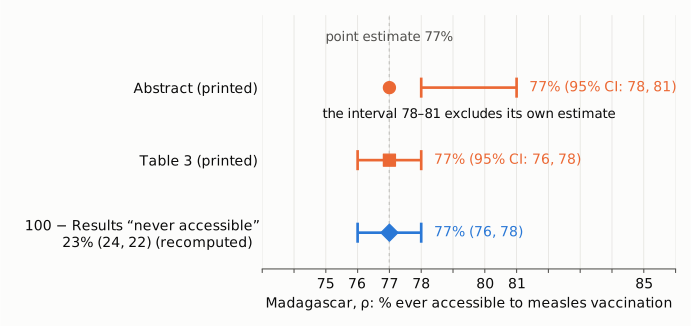
Figure 1. Madagascar's estimated proportion ever accessible to measles vaccination, ρ, with its 95% interval, as printed in three places. Orange rows are printed in the paper: the abstract (circle, 77% with 78 to 81) and Table 3 (square, 77% with 76 to 78). The blue row (diamond) is recomputed: 100 minus the Results' "never accessible" estimate of 23% (24, 22), which gives 77% (76, 78). The dashed vertical line marks the point estimate, 77%, which is the same in all three places. Only the abstract interval fails to contain it. The axis spans 73 to 86% so that one-point differences are visible; there is no null value for this quantity.
Why it matters
- The abstract is where the headline uncertainty is read. The abstract reports one ρ estimate per country, and this is the only Madagascar interval it gives. Someone who takes values from the abstract alone, for example for a review of coverage estimates or to set a prior on the accessible population in a measles transmission model, would record 78 to 81%, which is 2 to 3 points higher at each bound than the 76 to 78% in Table 3 and lies entirely above the point estimate.
- The point estimate and conclusions are unaffected. The 77% estimate is the same in the abstract, the Editors' Summary, the Results and Table 3, and Table S1 gives the base-model ρ for Madagascar as 0.77. With the correct interval, Madagascar (76, 78) still does not overlap Ghana (91, 94) or Sierra Leone (67, 70), so the ordering of the three countries holds. About 23% of Madagascar's children were estimated never to be reachable by any measles vaccination activity. No significance statement or comparison in the paper depends on the abstract interval.
- The error is detectable but easy to miss. The interval is visibly impossible to a reader who checks it against the estimate, and the correct values are in Table 3. Readers who copy numbers without checking containment, or automated extraction from abstracts, would not catch it. The paper has been cited about 62 times.
Explanations considered
- A different quantity or population. The abstract sentence and Table 3 both describe ρ, the proportion "ever covered" or "accessible by any vaccination activity", for the same Madagascar DHS 2008–2009 sample (9,747 children in Table 2), the same model and the same 95% level. Nothing in the paper indicates a different definition, time point, subgroup or adjustment. No Madagascar estimate anywhere in the paper has a 78 to 81 interval. Does not account for it.
- An asymmetric or one-sided interval. The Methods state that intervals are posterior quantiles around the posterior median. Any quantile-based interval, symmetric or not, contains the median. An interval that excludes its own estimate cannot be explained by asymmetry. Does not account for it.
- Rounding. Rounding to whole percentages is monotone: if the unrounded median is at least the unrounded 2.5% quantile, the rounded median is at least the rounded lower bound. The abstract has the estimate 1 point below the lower bound. Does not account for it.
- A different model specification in the abstract. Table S1 compares model variants and gives Madagascar's base-model ρ as 0.77 (point estimate only). The paper does not report an alternative model whose Madagascar interval is 78 to 81, and the abstract sentence pairs 77% with the interval as a single estimate. Not supported by anything in the paper.
- A PMC conversion or typesetting artifact. The publisher's HTML page, the publisher's PDF, the PMC and Europe PMC full text, and the French and English abstracts in the supplementary file Alternative Language Abstract S1 all print "77% (95% CI: 78, 81)". Does not account for it; the text is in the version of record.
- The Results bounds are in reversed order. The Results print 1 − ρ intervals as (24, 22) and (33, 30), with the upper bound first. This follows from subtracting Table 3's bounds in order from 100 and is itself evidence that the Results values were derived from Table 3's (76, 78). It does not create an inconsistency.
The most economical reading is a transcription slip in the abstract interval, with 76, 78 intended. The paper does not say how the abstract figure was produced, so this is an inference from the paper's other numbers.
Status
As of 2026-10-24:
- Version of record. The publisher PDF (journals.plos.org printable version) and the publisher HTML page both give the abstract as "77% (95% CI: 78, 81) in Madagascar". The PDF's Table 3 gives "77% (95% CI: 76, 78)" and its Results give "23% (95% CI: 24, 22)". The publisher HTML shows Table 3 only as an image. PMC and Europe PMC full text match the PDF.
- Supplements. The publisher lists eight supplementary files. Alternative Language Abstract S1 (French abstract, with the English abstract) repeats "77% (95% CI: 78, 81)". Table S1 gives Madagascar's base-model ρ as 0.77 without an interval. Text S1 contains derivations with no Madagascar values. No source data or posterior samples are provided. The supplements do not resolve the discrepancy.
- Corrections. No correction, erratum, retraction or expression of concern was found. Crossref lists no updates and no relations; PMC and Europe PMC list no correction notices; the PLOS article page shows no correction and "Reader Comments (0)". Web searches found no correction notice or coverage.
- PubPeer. The PubPeer API returned errors (404, then a Cloudflare challenge), and a web search found no PubPeer thread for this DOI; the absence of a thread could not be confirmed directly.
- Sources. Article as archived in PMC (PMC3201935); publisher page https://journals.plos.org/plosmedicine/article?id=10.1371/journal.pmed.1001110 and its PDF and supplementary files; Crossref and Europe PMC records for doi:10.1371/journal.pmed.1001110.
Suggested correction
In the Abstract, Methods and Findings, replace "77% (95% CI: 78, 81) in Madagascar" with "77% (95% CI: 76, 78) in Madagascar", matching Table 3 and the Results. The source of the interval cannot be confirmed without the posterior samples, so the authors may wish to confirm it from their MCMC output.
Separately, the Editors' Summary gives Sierra Leone's proportion ever covered as 65%, while the abstract, Results and Table 3 give 69% (95% CI: 67, 70). If 69% is correct, "93%, 77%, and 65%" should read "93%, 77%, and 69%".