← Back to the plain-language case
Abstract names G3244A where the body names G3242A as the second termination-abolishing pathogenic mutation
Cell (2010) · doi:10.1016/j.cell.2010.05.018 · PMC2887341
Summary
The Summary (abstract) of this crystal-structure paper on the human mitochondrial transcription terminator MTERF1 ends its results with a disease link: "the mitochondrial pathogenic G3249A and G3244A mutations interfere with key interactions for sequence recognition, eliminating termination." The body of the paper names a different second mutation, G3242A, in each of the three places where it states this result: the Introduction, the Results section on pathogenic mutations, and the Conclusions. The body also describes G3244A in terms that cannot fit the abstract sentence: its base pair makes "no specific interaction" with MTERF1 in the crystal structure, the mutation does not affect DNA binding, and its effect on termination is "moderate". A reader of the abstract alone is therefore told that the wrong variant loses a recognition contact and abolishes termination, and is never told about G3242A, the variant the paper's own data support.
What the paper reports
Abstract (Summary), final results sentence:
Finally, we have demonstrated that the mitochondrial pathogenic G3249A and G3244A mutations interfere with key interactions for sequence recognition, eliminating termination.
Introduction, last paragraph:
We have shown that two mutations, G3249A that causes a variant of Kearns-Sayre syndrome (Seneca et al., 2001) and G3242A that is associated with an uncharacterized mitochondrial disorder (Mimaki et al., 2009), interfere with protein-DNA interactions that are key for sequence recognition by MTERF1 and as a consequence eliminate its transcriptional termination activity.
Results and discussion, "Pathogenic mutations in the leu-tRNA", first paragraph (structure and binding):
All remaining mutations would not be expected to severely conflict with MTERF1 sequence recognition, except for G3242A and G3249A. G3242 interacts in the structure with Arg251, while G3249 forms a double hydrogen bond with Arg387 (Figure 6B). Both of these mutations would eliminate a guanine-arginine interaction: the hydrogen bond between O6 of the guanine and the amino group of the arginine could not be formed in the mutant DNA. Consistent with the mild decrease in binding observed in the R251A mutant, G3242A resulted in weak or no effect on binding. However, the G3249A mutation appears to completely eliminate specific DNA binding (Figure 6A and 3SE), consistent with the effect of the R387A mutation.
Same section, second paragraph (termination assays, Figure 6C/D):
As expected, only residual termination is observed in both orientations with the G3249A mutation. In addition, consistent with what was observed with the R251A mutant, the G3242A mutation, while not substantially altering binding, results nevertheless in a strong decrease in termination.
Unexpectedly, one additional mutation appears to moderately affect termination: G3244A, while not affecting DNA binding, results in a moderate but reproducible effect on termination. Interestingly, no specific interaction is observed in the crystal structure with any of the nucleotides in this base pair. However, it is adjacent to the extrahelical A:T base pair and displays a high base pair buckle (see Experimental Procedures).
Results and discussion, "Conclusions":
An important conclusion derived from the crystal structure is that two pathogenic mutations that interfere with arginine-guanine interactions involved in sequence recognition by MTERF1 result in a strong impairment in the ability of MTERF1 to terminate transcription. G3242A does not substantially affect binding, but very strongly reduces the ability of MTERF1 to terminate transcription, while G3249A appears to completely eliminate specific binding by MTERF1 and consequently severely impairs termination. Their strong effect on termination suggests that the pathogenic effects of the G3249A and G3242A MtDNA mutations might be at least partially mediated by interfering with the activity of MTERF1 at the leu-tRNA site.
Further experiments will be needed to address whether the G3249A and G3242A mutations result in transcriptional alterations in vivo and if this effect is sufficient to explain their clinical phenotype.
What the paper's own numbers show
Method. No arithmetic is involved. The error concerns which mutation is named, so I checked the paper's internal consistency. I parsed the PMC-archived full text and counted every mention of the five leu-tRNA variants the paper discusses (G3242A, A3243G, A3243T, G3244A, G3249A) in each section. I then extracted the pair of mutations that each section names as disrupting sequence recognition and eliminating or strongly impairing termination. Finally, I tabulated what the body says about each candidate's structural contact, its effect on binding and its effect on termination. recompute.py.txt holds the excerpts verbatim, checks all 33 excerpt sentences against the archived text (all found), and prints every value below.
| Quantity | Location | Reported | Recomputed from the paper's own text |
|---|---|---|---|
| Second mutation said to disrupt recognition and eliminate termination | Abstract (Summary) | G3244A (paired with G3249A) | Contradicted by all three body sections below |
| The same pair | Introduction, last paragraph | G3249A and G3242A | G3242A |
| Mutations expected to conflict with sequence recognition | Results, Pathogenic mutations, first paragraph | "except for G3242A and G3249A" | G3242A |
| The same pair | Conclusions (pair named twice; G3242A mentioned 4 times) | G3249A and G3242A | G3242A |
| Agreement of the three body sections with each other | Introduction, Results, Conclusions | — | All three name G3249A + G3242A |
| Agreement of the abstract with the body | Abstract vs body | — | No. The pairs differ in one mutation, G3244A vs G3242A, a single-character difference |
| Mentions of G3242A / G3244A / G3249A | Abstract | 0 / 1 / 1 | G3242A, the body's second mutation, never appears in the abstract |
| Mentions of G3242A / G3244A / G3249A | Introduction | 1 / 0 / 1 | — |
| Mentions of G3242A / G3244A / G3249A | Results, Pathogenic mutations | 3 / 2 / 3 | G3244A appears only here, as "one additional mutation" |
| Mentions of G3242A / G3244A / G3249A | Conclusions | 4 / 0 / 4 | — |
| Mentions in the whole article | All sections | G3242A 8, G3244A 3, G3249A 9 | — |
| Structural contact of the mutated base pair | Results, Pathogenic mutations | G3242 contacts Arg251; G3249 is double hydrogen-bonded to Arg387; G3244 base pair: "no specific interaction is observed" | Only G3242A and G3249A can remove a recognition contact |
| Effect on DNA binding | Results, Pathogenic mutations | G3242A "weak or no effect"; G3244A "not affecting DNA binding"; G3249A "completely eliminate specific DNA binding" | — |
| Effect on termination | Results, Pathogenic mutations; Conclusions | G3249A "only residual termination"; G3242A "strong decrease" / "very strongly reduces"; G3244A "moderate but reproducible effect" | G3244A's effect is moderate, not elimination |
By the paper's own account, G3244A meets neither condition in the abstract sentence. It removes no recognition contact, and it does not eliminate termination. G3242A meets the first condition and, in the body's words, comes close to meeting the second ("very strongly reduces").
Figure
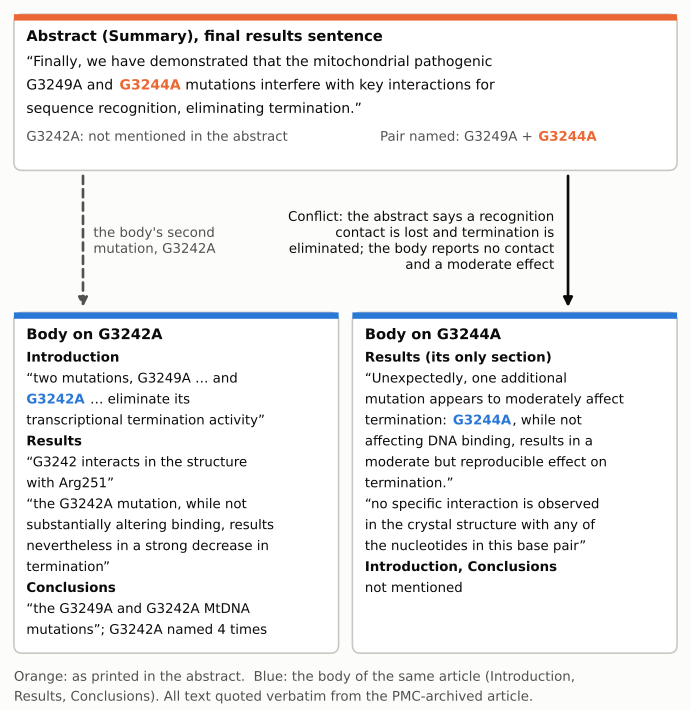
The top panel holds the abstract's only sentence about the pathogenic mutations, with the second mutation it names (G3244A) in orange. The two lower panels hold verbatim excerpts from the body of the same article. The left panel collects what the Introduction, Results and Conclusions say about G3242A, the mutation they name alongside G3249A: it contacts Arg251, and it strongly decreases termination while leaving binding largely intact. G3242A does not appear in the abstract (dashed connector). The right panel collects everything the body says about G3244A. It appears only in the Results, as "one additional mutation" whose base pair makes no specific contact with MTERF1, which does not affect binding and which has a moderate effect on termination. The solid connector marks the conflict between the abstract's claim about G3244A and the body's description of it. All text is quoted from the PMC-archived article, and the section counts come from recompute.py.txt.
Why it matters
- It is the abstract's only disease-related result. The abstract's closing claim ("suggest a link between mitochondrial disease and the regulation of mitochondrial transcription") rests on this sentence. The version-of-record Highlights mention "Two mitochondrial pathogenic mutations" without naming them, so the abstract is the only summary that names the variants. In the abstract, the second disease variant tied to loss of MTERF1 function is the wrong one.
- Both the mechanism and the size of the effect are misattributed. For G3244A the abstract claims loss of a sequence-recognition contact and elimination of termination. The body reports no contact, normal binding and a moderate effect, which it tentatively explains by destabilization of a buckled G:C pair next to the everted A:T pair. A reader of the abstract would place G3244A in the wrong mechanistic category.
- The variant the data support is missing. G3242A, which the Conclusions call one of "two pathogenic mutations that interfere with arginine-guanine interactions", is not named in the abstract. Abstract-only readers would not learn that this variant was studied or what effect it had.
- The abstract is the version that circulates. The same sentence appears in PubMed/Europe PMC (PMID 20550934), in indexing services and in the OSTI record. It is the text most likely to be quoted, for example when variant pathogenicity evidence is assessed from the literature.
- What is not affected. The structure, the DNA unwinding and three-nucleotide eversion, the role of base flipping in stable binding and termination, and the body's account of the pathogenic mutations are all internally consistent. The data for G3242A and G3244A (Figure 6A, C, D) are described consistently in the body.
Explanations considered
- A single-character slip (G3242A typed as G3244A). The two names differ in one digit, and both variants are discussed in the same section, so this is plausible. It explains how the sentence could arise. It does not make the printed abstract correct, because the abstract still attributes a recognition contact and abolished termination to a variant that the paper shows has neither.
- A text-conversion or archiving artifact. Ruled out. The version of record (the Cell full-text page, read from a Wayback Machine snapshot because the live publisher pages refused automated access) has the same Summary sentence, and the same body sentences that name G3242A. The PMC author manuscript, PubMed, Europe PMC, Semantic Scholar and OSTI 1020213 all carry the same abstract wording.
- A different numbering convention, for example heavy-strand versus light-strand positions. Ruled out. mtDNA positions number base pairs, not strands, and the paper uses one numbering throughout. It discusses G3242, A3243 and G3244 as three distinct, adjacent positions with different structural roles (Arg251 contact, everted nucleotide, buckled base pair without contact).
- The abstract summarizing a different experiment, such as the forward-orientation assay or the supplement. Not supported. The Results describe the termination assays in both orientations together ("The results (Figure 6C/D) are mostly consistent with the DNA binding data") and give no orientation in which G3244A eliminates termination. The supplement (Figures S1–S3: alignment, conservation, ITC titrations) concerns binding, and the body states that G3244A does not affect binding. I could not download the supplement files or view the Figure 6 images (see Status), so this rests on the text's description of those data.
- "Eliminating termination" used loosely for "strongly impairing". Even on this reading the sentence fits G3242A ("very strongly reduces") but not G3244A ("moderate"), and the structural half of the sentence ("interfere with key interactions for sequence recognition") still excludes G3244A. The body itself uses "eliminate" for G3242A in the Introduction but "strong decrease" in the Results. That is a lesser wording difference within the body, separate from the abstract error.
- A deliberate claim that G3244A acts through sequence recognition. Not supported anywhere in the paper. The only mechanism the body proposes for G3244A is a slight destabilization of the bound protein, offered with "It is possible that".
Status
- Version of record. Checked. The live publisher pages (doi.org, cell.com full text and PDF, ScienceDirect) returned HTTP 403 or a redirect wall to automated access. The Elsevier API without a key gives metadata only (open archive, cover date 2010-06-11). I read the version of record from a Wayback Machine snapshot of the Cell full-text page (web.archive.org/web/20230111224332/https://www.cell.com/cell/fulltext/S0092-8674(10)00554-4). Its Summary sentence is identical to the PMC text. Its Introduction, Results and Conclusions name G3242A exactly as quoted above. Its Highlights say only "Two mitochondrial pathogenic mutations interfere with transcriptional termination" and do not name the mutations. All quotes in this write-up were confirmed verbatim against the PMC-archived text (author manuscript NIHMS208049).
- Supplements. PMC lists NIHMS208049-supplement-01.doc and -02.pdf. The version of record lists Figures S1–S3. Neither set could be downloaded (PMC download wall, no Europe PMC supplementary bundle, cell.com 403), and the Figure 6 images could not be fetched either. The conflict is between two passages of the main text, so the supplement cannot remove it.
- Corrections and comments. As of 2026-10-23 I found no correction, erratum, retraction or expression of concern. Crossref lists no update relations for the DOI; its only relation is a Faculty Opinions review link. PMC and Europe PMC list no correction notices. Europe PMC links one "Comment in" item, a 2010 Cell Metabolism commentary (PMID 20620988), which is not a correction. The PMC record carries a related-article link to a retraction notice (PMC4698954); that notice concerns a different, cited paper on a related protein, not this article. PubPeer's API refused automated access (Cloudflare challenge), and a web search for the title on PubPeer returned no PubPeer entry. A web search for the abstract wording with "erratum" or "correction" found nothing relevant.
- Sources. PMC article PMC2887341 (author manuscript NIHMS208049); Wayback Machine snapshot of the Cell full-text page; PubMed/Europe PMC record PMID 20550934; Crossref metadata for 10.1016/j.cell.2010.05.018; OSTI 1020213; PubPeer (via API and web search).
Suggested correction
- In the Summary (abstract), replace "G3249A and G3244A" with "G3249A and G3242A", so that the sentence reads: "Finally, we have demonstrated that the mitochondrial pathogenic G3249A and G3242A mutations interfere with key interactions for sequence recognition, eliminating termination."
- Consider aligning the strength of the wording with the Results and Conclusions. G3249A abolishes specific binding and leaves only residual termination, while G3242A barely affects binding but strongly reduces termination. "Severely impairing termination" would match both. The same applies to "eliminate" for G3242A in the Introduction.
- Optionally, mention in the abstract that G3244A, which makes no contact with MTERF1, has a moderate effect on termination, because the body presents this as an unexpected finding.
- Because the abstract propagates through PubMed and indexing services, a published correction notice linked to the article record would be more effective than a silent change to the online text.