← Back to the plain-language case
Abstract swaps which CEACAM1 variant the Results report as strongly overexpressed in lung tumors
Nucleic Acids Res (2008) · doi:10.1093/nar/gkn697 · PMC2582617
Summary
The abstract states "overexpression of CEACAM1 variant 1 but not variant 2 in lung tumors". The paper's Results report the opposite emphasis for the same 35 paired lung adenocarcinomas: variant 2 was "highly and significantly overexpressed" (tumor/normal ratio 36.42, P = 0.000002), and variant 1 was "only slightly overexpressed" (ratio 3.53, P = 0.0014). By the paper's own numbers both variants are significantly higher in tumor, and the variant 2 ratio is 10.3 times the variant 1 ratio. The exon-array pattern, the survival hypothesis in the Results and the Discussion's "switch in abundance from the L form (variant 1) to the S form (variant 2)" all point the same way as the Results. The abstract therefore misstates which CEACAM1 isoform rises in lung tumors. This matters because the paper presents the isoforms as having different biology, with the L form described as tumor-suppressive.
What the paper reports
Abstract:
We found overexpression of ERG variant 2 but not variant 1 in lung tumors and overexpression of CEACAM1 variant 1 but not variant 2 in lung tumors but not in breast or colon tumors.
Results, "Quantification of CEACAM1 transcript variants in NSCLC", first paragraph (variant definitions and exon-array pattern):
CEACAM1 is encoded by nine exons with two known variants in the RefSeq database. Variant 1 uses all nine exons while variant 2 is missing exon 7 (Figure 4c). Our array data demonstrated higher expression of exons 1 through 6 as well as 8 and 9 in tumors versus normal while expression of exon 7 was essentially equal (Supplementary Figures).
Results, same section, second paragraph (variant-specific qRT-PCR):
In 35 lung adenocarcinoma patients we found that CEACAM1 variant 2 was highly and significantly overexpressed in paired tumor versus normal (tumor/normal ratio = 36.42; P = 0.000002) while variant 1 was only slightly overexpressed in tumor (tumor/normal ratio = 3.53; P = 0.0014).
In the breast and colon tissues however, we found no significant differences in expression of either variant 1 or variant 2 in tumor versus normal (unmatched) samples (Figure 4b).
Given this data we postulated that overexpression of CEACAM1 variant 2 in lung cancer may be responsible for the survival differences observed between tumor types.
Figure 4 legend, panel (c):
Exon location and PCR primers locations for qPCR of variant 1 (NM_001712; primers 1 and 2), variant 2 (NM_001024912; primers 3 and 4).
Discussion, CEACAM1 paragraph:
Two common variants are known for CEACAM1; one with a long cytoplasmic domain (L form or variant 1) and one with a short cytoplasmic domain (S form or variant 2).
Our quantitative analysis clearly demonstrates a switch in abundance from the L form (variant 1) to the S form (variant 2) in NSCLC and we also demonstrate that no such switch appears to occur in breast cancer or colon cancer.
For comparison, the ERG clause of the same abstract sentence against its own Results ("Differential expression of ERG splice variants in lung adenocarcinoma"):
We observed that ERG variant 2 was significantly overexpressed (mean tumor/normal ratio 4.73; paired t-test P-value = 0.0005) in tumor samples compared to paired normal while ERG variant 1 was slightly under-expressed in tumor samples compared to normal (ratio = 0.74; P = 0.0186).
What the paper's own numbers show
Method. The individual qPCR measurements are not published, so the paired tests cannot be re-run. The check reads the reported tumor/normal ratios and P-values against the abstract's statement. A variant counts as "overexpressed" when its ratio is above 1 and P < 0.05, the threshold the paper uses throughout. I then compared the size of the two CEACAM1 changes (ratio of ratios and log2 fold change), checked which variant the exon-array pattern implies, and ran the same check on the ERG clause in the same abstract sentence as a control. Every number below is printed by recompute.py.txt.
| Quantity | Location | Reported | Recomputed from the paper's numbers |
|---|---|---|---|
| CEACAM1 variant 2 (S form, lacks exon 7), lung, 35 pairs | Results, CEACAM1 section; Fig. 4a | ratio 36.42, P = 0.000002 | log2 fold change +5.19; −log10 P = 5.70; significantly overexpressed. The abstract says "not variant 2": conflicts |
| CEACAM1 variant 1 (L form, all nine exons), lung, 35 pairs | Results, CEACAM1 section; Fig. 4a | ratio 3.53, P = 0.0014 ("only slightly overexpressed") | log2 fold change +1.82; −log10 P = 2.85; significantly overexpressed. The abstract says overexpressed: agrees |
| Size of the variant 2 change relative to variant 1 | Results, CEACAM1 section | not stated | 36.42 / 3.53 = 10.32 (log2 difference 3.37); P-values differ by a factor of 700 |
| Exon-array pattern | Results, CEACAM1 section, first paragraph | exons 1–6, 8, 9 higher in tumor; exon 7 "essentially equal" | exon 7 occurs only in variant 1, so a flat exon 7 with rising shared exons points to a rise in variant 2: agrees with the Results, not with the abstract |
| Direction stated elsewhere | Results (survival hypothesis); Discussion | "overexpression of CEACAM1 variant 2"; "switch … from the L form (variant 1) to the S form (variant 2)" | both say variant 2 rises in lung tumors |
| Breast and colon, both variants | Results; Fig. 4b | no significant difference | consistent with the abstract's "but not in breast or colon tumors" |
| ERG variant 2, lung, 35 pairs (control) | Results, ERG section | ratio 4.73, P = 0.0005 | log2 +2.24; significantly overexpressed. The abstract says overexpressed: agrees |
| ERG variant 1, lung, 35 pairs (control) | Results, ERG section | ratio 0.74, P = 0.0186 | log2 −0.43; significantly under-expressed. The abstract says not overexpressed: agrees |
The ratio of ratios compares the size of each variant's tumor/normal change. It does not compare the absolute abundance of the two transcripts.
Figure
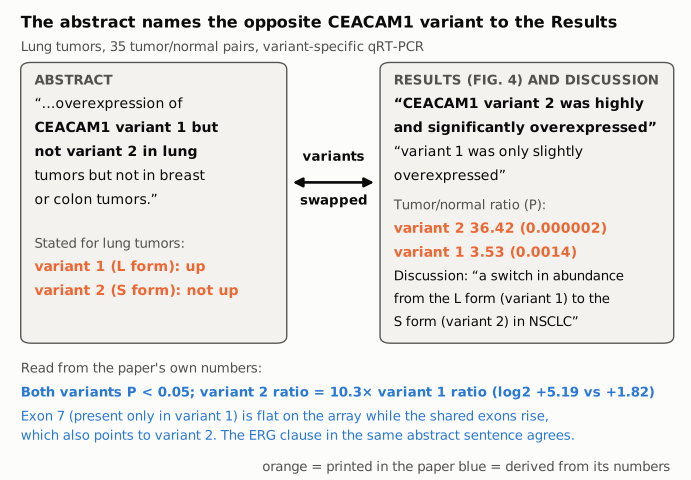
Figure 1. The left panel holds the abstract's CEACAM1 clause and what it states for lung tumors. The right panel holds the Results and Discussion sentences and the variant-specific tumor/normal ratios with their P-values, as printed (orange). The connector marks the conflict: the abstract names variant 1 as the overexpressed isoform and excludes variant 2, while the body reports variant 2 as the strongly overexpressed isoform. The blue lines are read from the paper's own numbers. Both variants have P < 0.05, the variant 2 ratio is 10.3 times the variant 1 ratio, and the exon-array pattern also points to variant 2.
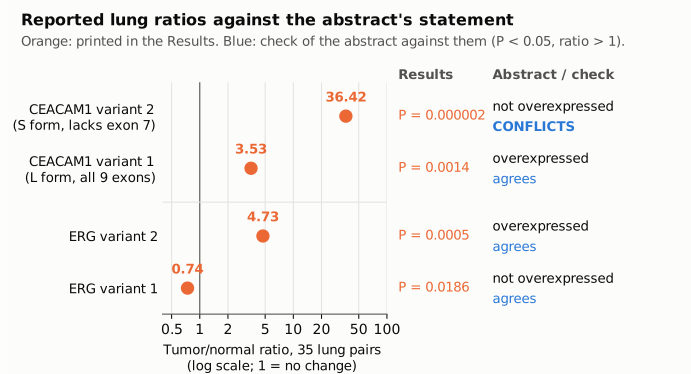
Figure 2. Tumor/normal expression ratios reported in the Results for the 35 paired lung samples (orange dots, log scale; the thin vertical line at 1 means no change), with the reported P-values. The right column gives what the abstract says for each variant and whether that agrees with the reported ratio and P-value (blue; overexpressed means ratio > 1 and P < 0.05). Three of the four clauses in the abstract sentence agree with the body. The one that conflicts is the statement that CEACAM1 variant 2, the variant with the largest and most significant increase, is not overexpressed.
Why it matters
- It names the wrong isoform. The abstract identifies the L form (variant 1) as the CEACAM1 isoform overexpressed in lung tumors and excludes the S form (variant 2). The body reports that the S form has the large increase (36.42-fold, P = 0.000002) and the L form a modest one (3.53-fold, P = 0.0014). The abstract's "not variant 2" is wrong, and its "variant 1" is only the smaller of two significant increases.
- The isoforms are presented as biologically different. The Discussion describes the L form as having "a tumor suppressive phenotype" and frames the finding as an isoform switch toward the S form in lung cancer, consistent with the earlier semi-quantitative report it cites. A reader of the abstract alone would conclude the reverse: that the tumor-suppressive form predominates in the increase in lung tumors.
- It is one of the abstract's few gene-level findings. The abstract highlights four genes (ERG, CEACAM1, CDH3, P16). Readers, indexing services and later citations that rely on the abstract inherit the reversed CEACAM1 statement, and nothing in the abstract signals the conflict.
- What it does not affect. The genome-wide result (2369 genes with differentially expressed alternative transcripts), the ERG, CDH3 and P16 findings, the breast and colon CEACAM1 result, and the CEACAM1 numbers, Figure 4 and the Discussion are all internally consistent. Only the abstract sentence is affected.
Explanations considered
- A different variant numbering. Ruled out. The Results define variant 1 as using all nine exons and variant 2 as lacking exon 7. The Figure 4c legend gives variant 1 as NM_001712 and variant 2 as NM_001024912. The Discussion gives variant 1 as the L form and variant 2 as the S form. The labels are used the same way in every part of the body, and under that numbering the body says variant 2 is the strongly overexpressed one.
- The abstract refers to a different population. Not supported. The abstract clause is about lung tumors, and so are the 35 paired adenocarcinomas in the Results. The additional 43 unpaired lung tumors are described as "indistinguishable from the original 35 adenocarcinoma samples". Breast and colon were analyzed separately, and the abstract gets that comparison right.
- The ratio is defined the other way round (normal/tumor). Ruled out. The Results call the quantity a "tumor/normal ratio" and say variant 2 "was highly and significantly overexpressed in paired tumor". The exon-array evidence (exon 7 flat, the other exons up in tumor) gives the same direction independently.
- "Not variant 2" means "not significantly". Ruled out. The variant 2 P-value, 0.000002, is the smallest of the four variant-specific P-values reported for lung, so variant 2 is not a non-significant result under any threshold the paper uses.
- The whole abstract sentence is garbled. Not supported. The ERG clause of the same sentence ("ERG variant 2 but not variant 1") matches its own Results (4.73, P = 0.0005; 0.74, P = 0.0186). The mismatch is specific to the CEACAM1 clause, where exchanging "variant 1" and "variant 2" would make the clause match the body.
- A conversion or archiving artifact. Ruled out. The publisher's version of record carries the same abstract wording and the same Results numbers as the PMC archive.
- Already corrected. No correction, erratum or other notice was found (see Status).
Status
As of 2026-10-24:
- Version of record. The DOI resolves to the publisher's version of record (academic.oup.com). Its abstract has the same sentence ("overexpression of CEACAM1 variant 1 but not variant 2 in lung tumors but not in breast or colon tumors"), and its Results have the same CEACAM1 numbers (36.42, P = 0.000002; 3.53, P = 0.0014). The PMC archive used here matches the publisher page word for word at both places. The PMC web page (behind a reCAPTCHA) and the Europe PMC full-text XML (HTTP 500) could not be opened.
- Supplementary material. The publisher's supplementary archive (four files: Supplementary Methods and primer design, Tables S1 and S2, and a 12-page Supplementary Figures PDF) was read. For CEACAM1 it holds only the exon-level array data, the exon 7 versus exon 8 qPCR verification and the primer design. The variant-specific tumor/normal results appear only in main-text Figure 4. Nothing in the supplement supports the abstract's wording. The array data are deposited in GEO (GSE12236) and were not needed, because the conflict is between two statements of the same qPCR result.
- Corrections and notices. Crossref (no update-to or updated-by relations), PMC and Europe PMC notice records list no correction, erratum, expression of concern or retraction. The publisher's article page shows no correction notice. Web searches found no erratum.
- PubPeer. The PubPeer API returned 403 to automated requests, so a direct search could not be completed. Web searches found no PubPeer thread on this article.
- Sources. The article as archived in PMC (PMC2582617); the publisher's version of record and supplementary archive; Crossref, PMC and Europe PMC records.
Suggested correction
In the abstract, change the CEACAM1 clause so that it names the variant reported in the Results, Figure 4 and the Discussion, for example:
We found overexpression of ERG variant 2 but not variant 1 in lung tumors and overexpression of CEACAM1 variant 2 but not variant 1 in lung tumors but not in breast or colon tumors.
Because variant 1 was also significantly, though modestly, overexpressed (3.53-fold, P = 0.0014), a more exact wording would be "marked overexpression of CEACAM1 variant 2 (S form), with only slight overexpression of variant 1 (L form), in lung tumors but not in breast or colon tumors". No change to the numbers, figures or Discussion appears to be needed.