← Back to the plain-language case
Abstract says mediators explain 37% of the association; the paper's coefficients give 23%
Psychol Med (2026) · doi:10.1017/S0033291725102936 · PMC13092991
Summary
The abstract states that childhood internalizing symptoms, externalizing behaviors and peer problems account for "37% of the total association" between prenatal tobacco exposure and adolescent suicide attempt, split as 16%, 12% and 9%. The paper defines the proportion mediated as the indirect association divided by the total association, β = 0.731. The paper's own coefficients give an internalizing share of 1.6% (0.012 / 0.731), not 16%, and a combined share of 23.1% (0.169 / 0.731). The Results state 23% for the combined share, and the Discussion says "more than one-fifth". The abstract's 37% is the sum 16 + 12 + 9, so it carries the ten-fold internalizing figure. The abstract's headline result therefore overstates the mediated share by about 14 percentage points. It also presents a non-significant pathway (OR 1.01, 95% CI 0.99 to 1.03) as the largest of the three mediators.
What the paper reports
Abstract, Results:
In models adjusted for key covariates, we found a significant association between prenatal tobacco exposure and increased risk of adolescent suicide attempts (odds ratio = 2.08, 95% confidence interval = [1.68, 2.56]), partly mediated through internalizing problems, externalizing behaviors, and peer problems from ages 3 to 14 years (accounting for 37% of the total association, that is, 16%, 12%, and 9%, respectively).
Methods, "Mediation analysis", which defines the quantities:
Indirect associations were calculated using the product of the coefficient approach (i.e. the product of the coefficient for the association between exposure and mediator, and between mediator and outcome).
The remaining unexplained part was represented by the direct association (total association = indirect + direct associations). The proportion of the association mediated was also calculated as the ratio between the indirect association and total association, to better understand the relative importance of each mediator.
Results, "Association between maternal smoking during pregnancy and childhood psychosocial difficulties" (the exposure-to-mediator paths):
Children whose mothers smoked during pregnancy were more likely to exhibit internalizing symptoms (β = 0.205, SE = 0.031, p < 0.001), externalizing behaviors (β = 0.477, SE = 0.031, p < 0.001), and peer problems (β = 0.279, SE = 0.031, p < 0.001) across their childhood.
Results, "Association between childhood psychosocial difficulties and adolescent suicide attempt" (the mediator-to-outcome paths):
We found that externalizing behaviors (β = 0.188, SE = 0.051, p < 0.001; OR = 1.21, 95% CI = [1.09, 1.33]) and peer problems (β = 0.241, SE = 0.052, p < 0.001; OR = 1.27, 95% CI = [1.15, 1.41]) from ages 3 to 14 increased the likelihood of later suicide attempt. Internalizing symptoms were not significantly associated with increased likelihood of suicide attempt (β = 0.057, SE = 0.052, p = 0.278; OR = 1.06, 95% CI = [0.96, 1.17]).
Results, "Pathways of association between maternal smoking during pregnancy and adolescent suicide attempt":
Structural equation models demonstrated that prenatal smoking was significantly associated with an increased risk of suicide attempt in adolescence (total association: β = 0.731, SE = 0.107, OR = 2.08, 95% CI = [1.68, 2.56]) after adjusting for the selected covariates.
Mediation analysis showed that 12.3% of the association was explained by externalizing behaviors (indirect association: β = 0.90, SE = 0.025, OR = 1.09, 95% CI = [1.04, 1.15]), and 9.2% by peer problems (indirect association: β = 0.057, SE = 0.025, OR = 1.07, 95% CI = [1.03, 1.11]). Internalizing symptoms explained 16% of the association, although the indirect association was not statistically significant (β = 0.012, SE = 0.011, OR = 1.01, 95% CI = [0.99, 1.03]) (Figure 2).
The proportion of the total effect mediated through all three mediators was estimated at 23% (overall indirect effect: β = 0.169, SE = 0.023, OR = 1.18, 95% CI = [1.13, 1.24]), suggesting that ~23% of the association between prenatal smoking and adolescent suicide attempts is attributed to these mediators. The direct association of prenatal tobacco exposure on suicide attempts remained significant (β = 0.562, SE = 0.107, OR = 1.75, 95% CI = [1.42, 2.16]).
Discussion, fourth paragraph:
Externalizing behaviors and peer problems accounted for 12.3% and 9.2% of the association between prenatal smoking exposure and suicide attempt, respectively. This indicates that psychosocial difficulties collectively mediated more than one-fifth of this association.
Table 2, whole sample, adjusted columns (OR, 95% CI): total association 2.08 (1.68–2.56); direct 1.75 (1.42–2.16); indirect via internalizing symptoms 1.01 (0.99–1.03); via externalizing behaviors 1.09 (1.04–1.15); via peer problems 1.07 (1.03–1.11); total indirect 1.18 (1.13–1.24).
What the paper's own numbers show
Method. The Methods give three rules, and the paper prints every input they need. (1) Each indirect association is the product a × b of the exposure-to-mediator coefficient and the mediator-to-outcome coefficient. (2) Total = direct + indirect. (3) The proportion mediated is indirect / total. All coefficients are on the log-odds scale: exp(β) reproduces each printed OR. I applied the three rules to the printed coefficients. As independent checks I also took the log-scale centre of each printed 95% CI and the log of each printed OR. No raw data are available, so the model was not refitted. Every number below is printed by recompute.py.txt.
| Quantity | Location | Reported | Recomputed from the paper's own numbers |
|---|---|---|---|
| Total association, β (OR) | Results; Table 2 | 0.731 (2.08) | exp(0.731) = 2.077, consistent |
| Direct association, β (OR) | Results; Table 2 | 0.562 (1.75) | exp(0.562) = 1.754, consistent |
| Overall indirect, β (OR) | Results; Table 2 | 0.169 (1.18) | 0.731 − 0.562 = 0.169; sum of a × b = 0.1686; CI centre 0.1687 |
| Internalizing indirect, β | Results | 0.012 (OR 1.01, CI 0.99–1.03) | 0.205 × 0.057 = 0.0117; CI centre 0.0098; consistent |
| Externalizing indirect, β | Results | 0.90 (OR 1.09, CI 1.04–1.15) | 0.477 × 0.188 = 0.0897; CI centre 0.0895. exp(0.90) = 2.46, not 1.09, so 0.90 is a misprint of 0.090 |
| Peer problems indirect, β | Results | 0.057 (OR 1.07, CI 1.03–1.11) | 0.279 × 0.241 = 0.0672; CI centre 0.0670; exp(0.057) = 1.059, not 1.07, so 0.057 is a misprint of about 0.067 |
| Share mediated, internalizing | Results; Abstract | 16% | 0.0117 / 0.731 = 1.6% (from printed 0.012: 1.64%) |
| Share mediated, externalizing | Results; Abstract | 12.3%; 12% | 0.0897 / 0.731 = 12.3%, consistent |
| Share mediated, peer problems | Results; Abstract | 9.2%; 9% | 0.0672 / 0.731 = 9.2%, consistent |
| Share mediated, all three | Results; Discussion | 23%; "more than one-fifth" | 0.169 / 0.731 = 23.1%; 1.6 + 12.3 + 9.2 = 23.1%, consistent |
| Share mediated, all three | Abstract | 37% (16 + 12 + 9) | 23.1% |
| Sum of the components printed in the Results | Results | 16 + 12.3 + 9.2 = 37.5% | contradicts the 23% printed in the same paragraph |
| Indirect β the 16% would require | — | — | 0.16 × 0.731 = 0.117 (OR 1.12, about 9.7 × the printed 0.012; 95% CI with the printed SE 1.10 to 1.15) |
| Overall indirect and direct β the 37% would require | — | — | indirect 0.270 (OR 1.31); direct 0.461 (OR 1.58), against the printed 0.169 (OR 1.18) and 0.562 (OR 1.75) |
| Direct share of the total | implied | 63% if the abstract held | 0.562 / 0.731 = 76.9% |
Three independent routes give the same decomposition: the product of coefficients, the total − direct identity, and the CI centres. All three put the overall indirect association at 0.169 and the internalizing component at about 0.01. The 12.3%, 9.2% and 23% in the Results agree with them. The only figures that disagree are the internalizing 16%, which appears in both the Results and the Abstract, and the abstract's 37%, which is built from it.
Two smaller slips, noted in passing, do not affect the finding. The Results give "1,229 (17%)" children as exposed, but 1,229 / 8,861 = 13.9%. And the sentence after the total association (OR 2.08) reads "1.75 times higher odds", which is the direct OR.
Figure
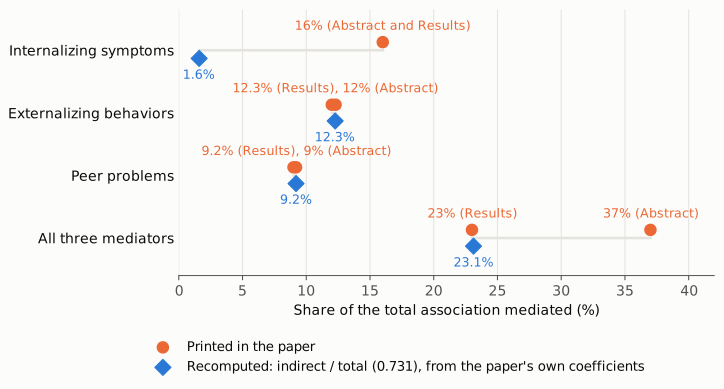
Figure 1. Share of the total association between prenatal tobacco exposure and adolescent suicide attempt (β = 0.731) that is mediated by each mediator and by all three together. Orange circles are the values printed in the Results and the Abstract. Blue diamonds are recomputed by recompute.py.txt as indirect / total, with each indirect association taken as the product of the paper's printed exposure-to-mediator and mediator-to-outcome coefficients. The overall share is the printed 0.169 / 0.731. Externalizing behaviors, peer problems and the Results' 23% agree with the recomputed values. The internalizing share (16% printed, 1.6% recomputed) and the abstract's combined 37% (23.1% recomputed) do not. The axis starts at zero.
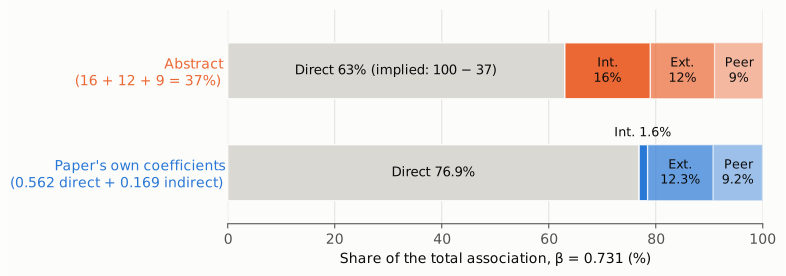
Figure 2. The same total association split into its direct and indirect parts. Top (orange): the split stated in the abstract, 16% + 12% + 9% = 37% mediated. The 63% direct share is not printed; it is implied as 100 − 37. Bottom (blue): the split given by the paper's own coefficients, direct 0.562 / 0.731 = 76.9% and indirect 1.6% + 12.3% + 9.2% = 23.1%. Because total = direct + indirect, the abstract's 37% cannot be squared with the direct association the paper reports: it would require a direct β of 0.461 (OR 1.58) instead of the printed 0.562 (OR 1.75).
Why it matters
- The abstract's headline number is wrong. The abstract gives one quantitative mediation result, and that result is the 37%. The paper's own coefficients, its Results paragraph and its Discussion all support about 23%. Readers who see only the abstract will take away a mediated share roughly 60% larger, in relative terms, than the paper's analysis supports.
- A non-significant pathway is presented as the largest mediator. In the abstract, internalizing symptoms carry the largest share (16%), ahead of externalizing behaviors (12%) and peer problems (9%). By the paper's own estimates the internalizing indirect association is the smallest (OR 1.01, 95% CI 0.99 to 1.03) and is reported as not significant. Its mediator-to-outcome path is not significant either (p = 0.278). The Discussion and the closing paragraph name only externalizing behaviors and peer problems as the mediating pathways.
- The abstract's recommendation leans on that figure. The abstract concludes that "interventions targeting mental health symptoms and peer problems may maximize suicide prevention efforts". The body of the paper supports targeting externalizing behaviors and peer problems.
- What is not affected. The total association (adjusted OR 2.08), the direct association (OR 1.75), the significant indirect paths through externalizing behaviors and peer problems, and the conclusion that mediation is partial all stand as reported. Table 2 and the sex-stratified and continuous-exposure analyses are consistent with the corrected decomposition.
Explanations considered
- A different model, with internalizing symptoms fitted alone. The Methods say each mediator was first analyzed separately, then all three together. For 16%, the internalizing indirect β would have to be about 0.117 (OR 1.12). With a = 0.205, that needs a mediator-to-outcome β of about 0.571 (OR 1.77), but the paper reports 0.057 (OR 1.06, p = 0.278). The 16% sits in the same sentence as β = 0.012 and OR 1.01, and next to the 12.3% and 9.2% that match the joint model. No single-mediator estimates are reported anywhere. This explanation is not supported.
- A different scale for the proportion. The Methods define the proportion as indirect / total. On the log-odds scale, which reproduces 12.3%, 9.2% and 23%, the internalizing share is 1.6%. On the rounded Table 2 ORs it is 1.4% (log scale) or 0.9% ((OR − 1) / (OR − 1)). No scale gives 16%.
- A different sample or exposure coding. Using Table 2's ORs, the internalizing share is 3.3% in the unadjusted model, 1.2% for females, 1.8% for males, and 1.3% with smoking as a continuous variable (Supplementary Table S2). None is near 16%.
- The 16% is right and the 0.012 is wrong. This is ruled out by the paper's own numbers. The OR 1.01, the CI 0.99 to 1.03 (log-scale centre 0.0098), the product 0.205 × 0.057 = 0.0117, the overall indirect 0.169 and the total − direct identity all independently support an internalizing indirect association of about 0.012. A β of 0.117 with the printed SE would give a CI of about 1.10 to 1.15, which is clearly significant.
- Rounding in the abstract. Rounding explains 12.3% → 12% and 9.2% → 9%. It does not explain 16% or 37%.
- A conversion artifact in the archived text. Ruled out. The same strings appear in the Cambridge Core version of record, the PMC HTML page and the Europe PMC full-text XML.
The pattern fits a shifted decimal (1.6% printed as 16%) that was then carried into the abstract's sum. The printed externalizing β of 0.90 for 0.090 is a misprint of the same kind. The cause cannot be determined from the paper.
Status
As of 2026-10-24:
- Version of record: checked on Cambridge Core (via doi.org). The abstract's "accounting for 37% of the total association, that is, 16%, 12%, and 9%", the Results' "Internalizing symptoms explained 16% of the association" and "β = 0.90", and the 23% overall share appear there exactly as in PMC.
- Supplement: the supplementary file (doi:10.1017/S0033291725102936.sm001) contains Tables S1 and S2 and Figure S1. Table S2 (continuous exposure) gives adjusted ORs of total 2.10, direct 1.79, internalizing indirect 1.01 (0.99–1.03), externalizing 1.08, peer problems 1.07 and total indirect 1.17, the same pattern as the main analysis. It reports no proportions mediated, so it does not resolve the discrepancy.
- Corrections: none found. Crossref shows no update-to or updated-by relation. PMC and Europe PMC notice checks returned nothing. The PubMed record (PMID 41480736) is typed "Journal Article" only, with no linked comments or corrections. The Cambridge Core page shows no correction notice.
- PubPeer: no discussion found. The PubPeer API refused automated queries (HTTP 403), the PubPeer search page did not resolve to an entry for this DOI, and web searches for the title together with "PubPeer" or "correction" found no thread or notice.
Sources: version of record; PMC13092991; Crossref record.
Suggested correction
- Abstract, Results: replace "accounting for 37% of the total association, that is, 16%, 12%, and 9%, respectively" with "accounting for 23% of the total association, that is, 1.6%, 12%, and 9%, respectively". Because the internalizing indirect association is not significant, the authors may also wish to revise "partly mediated through internalizing problems, externalizing behaviors, and peer problems" so that it names the significant pathways.
- Results, "Pathways" paragraph: "Internalizing symptoms explained 16% of the association" should read "1.6%". "(indirect association: β = 0.90" for externalizing behaviors should read "β = 0.090". The authors should also check the peer problems indirect β (printed 0.057). Its OR (1.07), its CI centre (0.067) and the product of its paths (0.067) all point to about 0.067, which is also the value that gives the reported 9.2%.
- Abstract, Conclusions: the authors may wish to reconsider "interventions targeting mental health symptoms and peer problems" in light of the corrected internalizing share. The Discussion's own wording is "externalizing behaviors and peer problems".
- Minor: "1,229 (17%)" should read 13.9% if 8,861 is the denominator. The sentence after the total OR of 2.08 should give 2.08, not 1.75, times higher odds.