← Back to the plain-language case
Abstract states no severe treatment-related adverse events; the paper's Table 3 and Results report two
BMC Med (2026) · doi:10.1186/s12916-026-04695-1 · PMC13032705
Summary
The Abstract's only safety result reads "No dose-limiting toxicities (DLTs) or severe treatment-related adverse events (TRAEs) were reported". The Discussion repeats this as "No DLTs or serious TRAEs were observed". The paper's own Results text and Table 3 report grade ≥ 3 TRAEs in 2 of the 87 Part III patients (2.3%; exact 95% CI 0.3% to 8.1%): a grade 5 (fatal) dyspnea in the head and neck squamous cell carcinoma (HNSCC) cohort and a grade 3 anemia in the sarcoma cohort. Table 3 also counts 2 patients under "TRSAE", which its footnote defines as "treatment-related severe adverse events". Under the CTCAE v5.0 grading the paper uses, grade 3 means severe, so the zero in the summary statements contradicts the paper's own count. The paper is also inconsistent about the fatal event: it calls the grade 5 dyspnea a TRAE, yet says that none of the 6 deaths "was attributed to T3011". In a first-in-human trial, a possible treatment-related death is a safety signal readers need to see in the Abstract.
What the paper reports
All quotations were checked verbatim against the PMC-archived text with src/show.py. The passages from the Abstract, Results, Table 3 and Discussion were also checked against the publisher's version of record.
Abstract, Results (the last sentence of the paragraph, which reports the Part III results):
No dose-limiting toxicities (DLTs) or severe treatment-related adverse events (TRAEs) were reported.
Abstract, Conclusions:
T3011 shows a favorable safety profile, immune-modulating effects, and preliminary efficacy in patients with advanced solid tumors.
Results > Safety (Part III, N = 87):
Grade ≥ 3 TRAEs occurred in 2 (2.3%) patients, one case occurred in an HNSCC patient (grade 5, dyspnea), and another in a sarcoma patient (grade 3, anemia). Adverse events led to T3011 discontinuation in 4 patients (4.6%) and death in 6 patients (6.9%). The causes of death included pulmonary infection (n = 1), dyspnea (n = 1), respiratory failure (n = 1), cerebral infarction (n = 1), and death of unknown cause (n = 2). However, none of these was attributed to T3011.
Overall, the NCI CTCAE grades for these common TRAEs with an incidence exceeding 5% were predominantly grade 1 or 2, with only one grade 3 event (anemia) occurring in the sarcoma cohort.
Table 3, "Safety summary" (columns HNSCC N = 28 / BC N = 12 / Sarcoma N = 44 / Melanoma N = 1 / Others N = 2 / Total N = 87):
TRSAE | 1 (3.6) | 0 | 1 (2.3) | 0 | 0 | 2 (2.3)
≥ Grade 3 TRAE | 1 (3.6) | 0 | 1 (2.3) | 0 | 0 | 2 (2.3)
Table 3 footnote:
TRSAE treatment-related severe adverse events
Discussion, first paragraph:
No DLTs or serious TRAEs were observed, consistent with previously reported general tolerable safety profiles of intratumoral oncolytic viral therapies
Conclusions:
demonstrating a favorable safety profile, immune-modulating effects, and preliminary efficacy, particularly in patients with recurrent or metastatic HNSCC
Methods (grading and the DLT definition):
Adverse events were graded according to the NCI-CTCAE version 5.0.
AEs were coded using the MedDRA version 26.0 or higher and categorized by system organ class and preferred terms, severity (CTCAE v5.0 grades 1–5), and relationship to the study drug.
The DLT evaluation period was defined as 28 days from the initial administration of T3011.
Grade 5 toxicities (death) and other toxicity-driven premature treatment discontinuations adjudicated by investigators/sponsors were also considered DLTs.
Results > Patients and treatments > Part I and II:
Based on the safety data from both Part I and Part II, no DLT events were reported. No SAE, TRAE leading to discontinuation of T3011 or death was observed.
What the paper's own numbers show
Method. I transcribed all ten rows of Table 3 and all seven rows of Table 4. For each row I summed the five cohort counts, compared the sum with the printed total, and recomputed every printed percentage from the cohort sizes (28, 12, 44, 1, 2; total 87). I then checked the percentages in the Results > Safety text against the same denominators. Exact (Clopper-Pearson) 95% intervals were computed for the grade ≥ 3 TRAE proportions. Every number below is printed by recompute.py.txt.
The tables are arithmetically consistent: every row sum and every percentage in Tables 3 and 4 matches the printed value. (Two cosmetic points in the PMC-archived Table 3: the row label reads "≥ Grade TEAE", without the 3, where the Results give the matching 17.2% for "≥ Grade 3 AEs"; and the sarcoma cell of "TEAE leading to death" is printed as "1" with no percentage, which would be 2.3%.) The problem is not arithmetic. The summary statements give a count of zero where the paper's own table and text give two.
| Quantity | Location | Reported | Recomputed from the paper's own numbers |
|---|---|---|---|
| Severe TRAEs, Part III | Abstract, Results | none ("No … severe treatment-related adverse events (TRAEs) were reported") | 2 of 87 (Table 3 and Results text) |
| Serious TRAEs | Discussion | none ("No DLTs or serious TRAEs were observed") | 2 of 87 under TRSAE in Table 3; one of the two is graded fatal |
| ≥ Grade 3 TRAE, total | Table 3; Results > Safety | 2 (2.3%) | 1+0+1+0+0 = 2; 2/87 = 2.30% (exact 95% CI 0.3% to 8.1%) |
| TRSAE ("treatment-related severe adverse events"), total | Table 3 | 2 (2.3%) | 1+0+1+0+0 = 2; 2/87 = 2.3% |
| ≥ Grade 3 TRAE, HNSCC | Table 3; Results (grade 5 dyspnea) | 1 (3.6%) | 1/28 = 3.57% (exact 95% CI 0.1% to 18.3%) |
| ≥ Grade 3 TRAE, sarcoma | Table 3; Results (grade 3 anemia) | 1 (2.3%) | 1/44 = 2.27% (exact 95% CI 0.1% to 12.0%) |
| Grade ≥ 3 TRAEs if the dyspnea were judged unrelated | — | — | 1/87 = 1.15% (exact 95% CI 0.03% to 6.2%): still not zero |
| TEAE leading to death | Table 3; Results > Safety | 6 (6.9%), "none of these was attributed to T3011" | 3+1+1+0+1 = 6; 6/87 = 6.9%; listed causes 1+1+1+1+2 = 6, one of them dyspnea |
| Grade 5 TRAE | Results > Safety | 1 (dyspnea, HNSCC) | conflicts with 0 deaths attributed to T3011 in the same paragraph |
| Any-grade TEAE | Table 3; Results | 77 (88.5%) | 24+8+42+1+2 = 77; 77/87 = 88.5% |
| ≥ Grade 3 TEAE | Table 3; Results | 15 (17.2%) | 4+2+8+0+1 = 15; 15/87 = 17.2% |
| Any-grade TRAE | Table 3; Results | 55 (63.2%) | 12+7+33+1+2 = 55; 55/87 = 63.2% |
| SAE | Table 3 | 13 (14.9%) | 3+1+8+0+1 = 13; 13/87 = 14.9% |
| TRAEs ≥ 5% (7 terms) | Table 4; Results | 9, 9, 6, 6, 5, 5, 5 of 87 | all row sums and percentages match |
For reference, an observed count of 0 of 87 would carry an exact 95% upper bound of 4.2%; the reported count of 2 gives an interval reaching 8.1%.
Figure
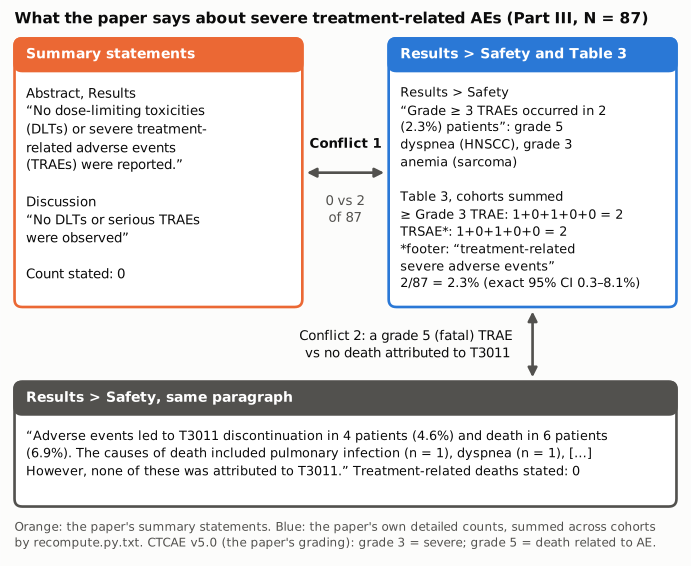
Figure 1. The two summary statements (orange panel: Abstract, Results and Discussion) and the paper's own detailed safety reporting for Part III (blue panel: Results > Safety and Table 3), with the cohort counts of the two relevant Table 3 rows summed by recompute.py.txt. Conflict 1: the summary statements say zero severe or serious TRAEs, while the detail gives 2 of 87 patients (2.3%; exact 95% CI 0.3% to 8.1%), under both "≥ Grade 3 TRAE" and "TRSAE", which the Table 3 footer defines as treatment-related severe adverse events. Conflict 2 (gray panel): the same Results paragraph calls one of the two a grade 5 dyspnea TRAE, which under CTCAE v5.0 means death related to the adverse event, but then says none of the 6 deaths, one of whose listed causes is dyspnea, "was attributed to T3011". All text in the figure is quoted or summarized from the paper; no figure or image from the paper is reproduced.
Why it matters
- The Abstract's only safety finding is contradicted by the paper's own table. Safety is the primary endpoint of Parts I and II and a key secondary endpoint of Part III. A reader of the Abstract is told that no severe TRAEs occurred. The body reports two patients with grade ≥ 3 TRAEs, one of them graded fatal.
- The omitted event is a possible treatment-related death in a first-in-human trial. The paper itself grades the HNSCC dyspnea as a grade 5 TRAE. Whether or not that attribution is right, the reader needs to know that the investigators recorded it. The Abstract and Discussion do not mention it.
- The cohort singled out in the Conclusions is the one with the fatal event. The Conclusions describe "a favorable safety profile … particularly in patients with recurrent or metastatic HNSCC". The only grade 5 TRAE was in the HNSCC cohort (1/28, 3.6%; exact 95% CI 0.1% to 18.3%).
- The attribution of the death is unresolved within the paper. One sentence makes the dyspnea a grade 5 TRAE; three sentences later, none of the deaths is attributed to T3011. Both cannot be right, and the paper does not say which is. Under the Methods' DLT definition, a related grade 5 toxicity counts as a DLT. The paper does not say whether DLT assessment applied in Part III or when the death occurred relative to the 28-day DLT window, so whether the event bears on the "no DLTs" statement cannot be determined from the paper.
- What the error does not change. Table 3 is arithmetically consistent, and a rate of 2/87 grade ≥ 3 TRAEs is low. A broad description of the safety profile as tolerable may well survive the correction. The DLT result for the dose-escalation Parts I and II, where the Results report no DLT and no SAE, is not contradicted. The error is in the summary statements, which give zero where the paper's data give two.
Explanations considered
- The Abstract sentence refers only to Parts I and II. The Results do say that no DLT and no SAE occurred in Parts I and II, so "No DLTs" fits those parts. But the sentence closes the Abstract's Results paragraph, which reports only Part III ("Among the 87 patients treated with T3011 monotherapy in Part III …"), and it does not name a part. The Discussion repeats the claim for the study at the RP2D. The Conclusions then rest a "favorable safety profile" on it, for patients with advanced solid tumors in general. Even on this reading, the Abstract would leave out the Part III grade ≥ 3 TRAEs entirely. Does not account for the discrepancy.
- "Severe" means something other than CTCAE grade ≥ 3. The paper grades AEs by CTCAE v5.0, where grade 3 is "severe or medically significant" and grade 5 is death related to the AE. The paper's own Table 3 counts 2 patients as treatment-related severe AEs (TRSAE). If "severe" were instead read as "serious" (the Discussion's word), the fatal event is serious by the standard regulatory definition (ICH E2A: an event that results in death), and the TRSAE row, which sits directly below the SAE row, still counts 2. Under every definition the paper uses, the count is 2, not 0. Does not account for it.
- The grade 5 dyspnea was later judged unrelated, and the Abstract reflects that. This would reconcile the Abstract with the "none of these was attributed to T3011" sentence. It would still leave the grade 3 anemia, which the paper consistently reports as treatment-related ("only one grade 3 event (anemia) occurring in the sarcoma cohort" and "anemia (6.9%, Grade ≤ 3)" in Results > Safety; anemia is listed among the TRAEs in Table 4). One severe TRAE (1/87) still contradicts "no severe TRAEs". It would also make Table 3 and the Results text wrong. Does not account for it.
- Conversion or typesetting artifact. The same wording and numbers appear in the publisher's version of record, the PMC page, the Europe PMC full-text XML and the local PMC archive. Table 3 is internally consistent, and its counts agree with the Results text. Ruled out.
- The supplement resolves it. Additional file 3 ("AE details") lists AE names and dates by participant identifier, but it has no CTCAE grade, causality, seriousness or outcome columns, so it cannot show which events were grade ≥ 3 or treatment-related. It neither confirms nor resolves either conflict.
Status
- Version of record. Checked on the publisher's page (https://link.springer.com/article/10.1186/s12916-026-04695-1, rendered in headless Chromium because plain fetches met a JavaScript challenge; BMC Med 24:177, published 20 February 2026). The Abstract, Results > Safety, Table 3 (including the TRSAE footnote) and Discussion passages quoted above read the same there. The PMC page and the Europe PMC full-text XML match as well.
- Supplements. The publisher lists three additional files. File 1 is the CONSORT checklist. File 2 (Figs. S1 to S6 and Table S1, PD-L1 CPS) contains no safety or grade data. File 3 (.xlsx; AE details and RNA-seq data) has an "AE details" sheet with 614 rows for 91 participant identifiers in four columns (identifier, AE occurrence, start date, AE name). It records no grade, causality, seriousness or outcome.
- Corrections and comments. As of 2026-10-24, Crossref lists no update relations for the DOI, and PMC and Europe PMC list no correction, expression of concern or retraction notice (
src/known.py). PubPeer could not be queried directly: its API and search page returned a Cloudflare human-verification challenge (HTTP 403). Web searches for the DOI and the title with "PubPeer" found no thread. - Sources. PMC13032705 (via
src/show.py); https://doi.org/10.1186/s12916-026-04695-1; the publisher's version of record and Additional files 1 to 3; Europe PMC; Crossref; NCI CTCAE v5.0 (grade definitions); ICH E2A (definition of a serious adverse event).
Suggested correction
- Replace the Abstract sentence "No dose-limiting toxicities (DLTs) or severe treatment-related adverse events (TRAEs) were reported." with a statement that matches the Results, for example: "No DLTs occurred in Parts I and II. In Part III, grade ≥ 3 TRAEs occurred in 2 of 87 patients (2.3%): one grade 5 dyspnea (HNSCC) and one grade 3 anemia (sarcoma)."
- Revise the Discussion sentence "No DLTs or serious TRAEs were observed" in the same way, and reconsider the "favorable safety profile … particularly in patients with recurrent or metastatic HNSCC" wording in the Conclusions in light of the grade 5 TRAE in that cohort.
- Resolve the attribution of the fatal dyspnea. Either it was treatment-related, in which case "none of these was attributed to T3011" should be corrected, or it was not, in which case Table 3 (≥ Grade 3 TRAE and TRSAE) and the Results sentence should be corrected to 1 (1.1%). In either case the remaining grade 3 anemia means the Abstract cannot say that no severe TRAEs occurred.
- State whether DLT assessment applied to Part III and, if it did, whether the grade 5 event occurred within the 28-day DLT window.
- Minor: correct the Table 3 row label "≥ Grade TEAE" to "≥ Grade 3 TEAE", and add the missing percentage (2.3) to the sarcoma cell of "TEAE leading to death".