← Back to the plain-language case
Reported Fisher's exact p < 0.01 for 18/20 versus 3/6 patent grafts recomputes to 0.062
Nat Commun (2025) · doi:10.1038/s41467-025-68075-8 · PMC12868887
Summary
In the rabbit carotid model, the Results compare 2-week graft patency between the new micro-nano structured grafts (MnVGs, 18 of 20 patent) and electrospinning-only control grafts (3 of 6 patent), and give "p < 0.01, Fisher’s exact test". Fisher's exact test on these counts gives p = 0.062, two-sided and one-sided alike. This is above the paper's own significance level of 0.05. None of the usual alternative tests for a 2 × 2 table gets below 0.01 either; the smallest, a one-sided two-proportion z-test, gives 0.015. The comparison is the basis for the paragraph's conclusion that MnVGs "significantly outperformed conventional electrospinning grafts". The counts show a large observed difference (90% vs 50%), but with six control grafts the stated test does not reach significance.
What the paper reports
Results, section "MnVGs maintained high patency rates and rapid neo-adventitia Ingrowth", first paragraph:
15 mm segmental defect was surgically created in the left carotid artery of each rabbit, with MnVGs implanted in the experimental group (n = 20) and electrospinning grafts as controls (n = 6) (Fig. 2a, b). At 2 weeks after implantation, graft performance diverged markedly between groups.
Doppler ultrasound revealed a 90% patency rate (18/20) in the MnVGs group whereas controls exhibited 50% patency (3/6) and significant regurgitation despite of administration of anticoagulating agents (p < 0.01, Fisher’s exact test).
The last sentence of the same paragraph:
Collectively, these results demonstrated that MnVGs significantly outperformed conventional electrospinning grafts, with structural openness critically enhancing patency and regenerative efficiency in 2 weeks.
Abstract:
When implanted in rabbits, MnVGs rapidly regenerated neo-adventitia within the highly porous graft walls and achieved endothelialization as early as 2 weeks postoperatively, resulting in 90% patency rate (18/20).
Discussion, fourth paragraph:
The key finding of this study is that MnVGs achieved rapid endothelialization within 2 weeks postoperatively, resulting in a 90% patency rate (18/20) in 1.5 cm carotid artery reconstruction in rabbits.
Methods, "Animal experiments":
Male New Zealand white rabbits (6 months old, weighing 3.5-4.5 kg; n = 32) underwent implantation of 15 mm long MnVGs interposition grafts in the left carotid artery. The experimental cohorts included a control group (Con-2W; n = 6) and a test group (MnVGs; n = 26).
Methods, "Statistical analysis":
Group comparisons were assessed using the Student’s t-test for two groups and one-way analysis of variance (ANOVA) followed by Tukey’s post-hoc test for multiple groups. Statistical significance was set at P < 0.05.
What the paper's own numbers show
Method. I built the 2 × 2 table from the counts in the Results sentence: MnVGs 18 patent and 2 occluded, controls 3 patent and 3 occluded. The Source Data file (sheet "Figure 2", "Figure 2e Number of graft") gives the same counts: 2 weeks, 18 patent and 2 occluded; con-2 weeks, 3 patent and 3 occluded. I computed Fisher's exact test by hand from the hypergeometric distribution and with scipy.stats.fisher_exact. I then computed every common alternative for a 2 × 2 table, the odds ratio with its exact confidence interval, and how much the counts would have to change for Fisher's p to fall below 0.01. Every number below is printed by recompute.py.txt.
With margins fixed (21 patent and 5 occluded among 26 grafts, 20 of them MnVGs), the number of patent MnVGs can only be 15 to 20. The observed 18 has probability 13,300/230,230 = 0.0578. Only 19 (0.0046) and 20 (0.0001) are as extreme or more so, so the p-value is (13,300 + 1,050 + 21)/230,230 = 14,371/230,230 = 0.0624. The opposite tail adds nothing, because every table with 15 to 17 patent MnVGs is more probable than the observed one. That is why the one-sided and two-sided p are the same.
| Quantity | Location | Reported | Recomputed from the paper's own numbers |
|---|---|---|---|
| MnVG patency | Results; Abstract; Discussion | 90% (18/20) | 18/20 = 90.0% (consistent) |
| Control patency | Results | 50% (3/6) | 3/6 = 50.0% (consistent) |
| Fisher's exact p, two-sided | Results | p < 0.01 | 0.0624 |
| Fisher's exact p, one-sided | (alternative convention) | p < 0.01 | 0.0624 |
| Fisher mid-p, one-sided (doubled for two-sided) | (alternative convention) | p < 0.01 | 0.0335 (0.0671) |
| Pearson chi-square, uncorrected / Yates-corrected | (alternative test) | p < 0.01 | 0.0292 / 0.1119 |
| Two-proportion z-test (z = 2.18), two-sided / one-sided | (alternative test) | p < 0.01 | 0.0292 / 0.0146 |
| Barnard exact, two-sided | (alternative test) | p < 0.01 | 0.0384 |
| Boschloo exact, two-sided / one-sided | (alternative test) | p < 0.01 | 0.0593 / 0.0296 |
| Odds ratio (sample; conditional MLE with exact 95% CI) | not reported | not reported | 9.00; 7.97 (0.64 to 136.7) |
| Difference in patency (Newcombe 95% CI) | not reported | not reported | 0.40 (0.029 to 0.721) |
| MnVG count needed for Fisher p < 0.01, with controls at 3/6 | sensitivity | n/a | 20/20 (p = 0.0077); 19/20 gives 0.0278 |
| Control count needed for Fisher p < 0.01, with MnVGs at 18/20 | sensitivity | n/a | 1/6 or fewer (1/6: p = 0.0018); 2/6 gives 0.0129 |
| MnVGs out of the Methods' n = 26, vs 3/6 | Methods, "Animal experiments" | n/a | 24/26: p = 0.0342; 25/26: 0.0149; only 26/26 gives p < 0.01 (0.0040) |
The stated test gives p = 0.062, about six times the printed bound and above the paper's α of 0.05. The exact 95% confidence interval of the odds ratio (0.64 to 136.7) includes 1, which agrees with that test. The smallest p-value of any variant is 0.015, from a one-sided large-sample z-test. That test is not the one reported, and its normal approximation is poor with three occluded grafts among six. Some of the less conservative methods (uncorrected chi-square, mid-p, Barnard, the Newcombe interval for the difference) put the result just below 0.05. None of them supports p < 0.01.
Figure
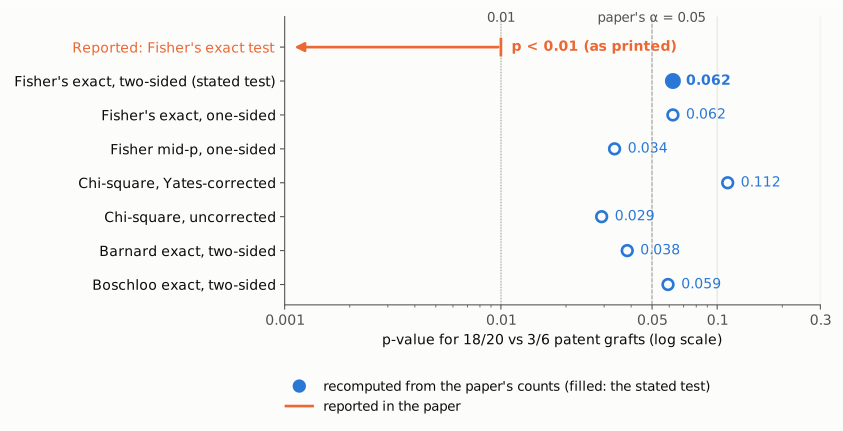
Figure 1. P-values for the 2-week patency comparison (18 of 20 MnVGs patent vs 3 of 6 controls), on one log-scale axis. The orange arrow is the value printed in the Results, "p < 0.01, Fisher’s exact test", drawn as the interval from 0.01 downward. The blue markers are p-values recomputed from the paper's counts. The filled marker is the test the paper names, Fisher's exact test, two-sided (0.062); open markers are common alternatives. The dotted line marks 0.01 and the dashed line marks the paper's significance level of 0.05. Every recomputed value lies to the right of the printed bound. The log scale is used because p-values span orders of magnitude; it does not exaggerate the gap, which is a factor of about 6 between 0.01 and 0.062.
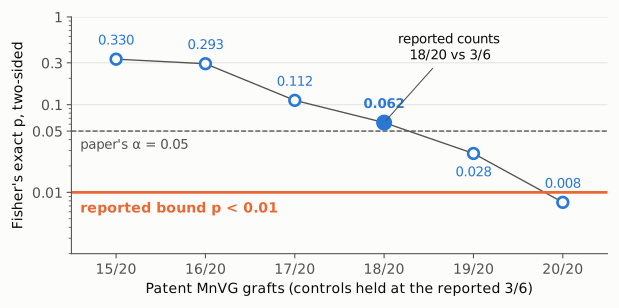
Figure 2. Fisher's exact two-sided p, recomputed for each possible number of patent MnVGs out of 20, with the controls held at the reported 3 of 6. The reported counts (18/20, filled marker) give 0.062. Only 20/20 would give p < 0.01 (0.008, orange line), and only 19/20 or more would give p < 0.05. Holding the MnVGs at 18/20 instead, the controls would need 1 of 6 patent or fewer (see table).
Why it matters
- The comparative claim rests on this test. The paragraph sets out to "evaluate the impact of graft wall openness" by comparing MnVGs with dense-walled electrospinning-only grafts, and concludes that MnVGs "significantly outperformed conventional electrospinning grafts, with structural openness critically enhancing patency". The only statistic given for patency is this Fisher test. At the stated test's p = 0.062 the difference is not significant at the paper's own α = 0.05, let alone at 0.01.
- The direction of the effect is not in question. 90% versus 50% patency favors MnVGs, and the counts themselves are reported consistently in the text and the Source Data. What changes is the strength of evidence. With six control grafts the estimate is imprecise: the exact 95% interval for the odds ratio runs from 0.64 to 137. The result is better read as suggestive than as established.
- The descriptive and mechanistic findings are not affected. The 90% (18/20) patency figure in the abstract, introduction and Discussion is a correct description of the MnVG group. The endothelialization, cell-coverage and lymphatic endothelial cell results rest on other measurements and tests. Later sentences that explain the "superior performance of MnVGs, as evidenced by their high patency rate" by rapid endothelialization inherit the uncertainty of the patency comparison, however.
Explanations considered
- One-sided instead of two-sided test. Does not explain it. For this table the one-sided Fisher p is also 0.0624, because the lower tail contributes no table at least as improbable as the observed one.
- A different test or convention: mid-p, chi-square with or without Yates correction, z-test, Barnard or Boschloo. Does not explain it. These give 0.015 to 0.112 (Figure 1, table). The smallest, 0.015, is a one-sided large-sample z-test, not the exact test the paper names, and it is still above 0.01.
- A different denominator. Does not explain it. The Results give n = 20 MnVGs; the Methods give n = 26 MnVG rabbits and 6 controls (n = 32). The Source Data for Fig. 2e give 18 patent and 2 occluded at 2 weeks, which matches n = 20. If the 26 were the denominator, 24/26 would give p = 0.034 and 25/26 p = 0.015. Only 26/26 would give p < 0.01, and that would contradict the stated 18/20. The difference between n = 20 and n = 26 is not explained in the text; it does not affect the conclusion here.
- A different time point or pooled time points. Does not explain it. The sentence ties the test to the 2-week Doppler result, and the control group exists only at 2 weeks (Con-2W). The Source Data list MnVG counts at 4 weeks (12 patent, 0 occluded) and 12 weeks (6 patent, 0 occluded), but these later time points have no control group, so they cannot enter a 2-week comparison with the controls.
- Adjusted or multiplicity-corrected p. Does not explain it. No adjustment is described for this test, and any adjustment would increase p, not reduce it.
- A text-conversion artifact. Ruled out. The publisher's HTML, the Europe PMC full-text XML and the PMC page all read "p < 0.01, Fisher’s exact test" with the same counts.
- A correction already issued. None found (see Status).
- Note on the screening claim. The automated screen that flagged this paper put Fisher's p at "around 0.04". That is not accurate. The two-sided Fisher p is 0.062. Values of 0.03 to 0.04 come only from the mid-p, uncorrected chi-square or Barnard tests. The finding holds, and is somewhat stronger than first stated.
- Context, not part of the finding. The rat experiment reports 100% (6/6) patency in controls versus 50% (3/6) with a VEGFR3 inhibitor, without a p-value in the text. For reference, Fisher's exact two-sided p for that table is 0.18 (one-sided 0.091). The Discussion's statement that LEC inhibition "diminishes patency" is therefore also based on a difference that the exact test does not find significant at n = 6 per group.
Status
- Version of record. The publisher's article page on nature.com ("Open access, Published: 29 December 2025") has the same Results sentence, with "(p < 0.01, Fisher’s exact test)", the same counts, the same Methods group sizes (Con-2W n = 6, MnVGs n = 26) and the same Statistical analysis section (t-test, ANOVA with Tukey, P < 0.05). The Europe PMC full-text XML and the PMC page agree. Every quotation above was checked verbatim against the PMC-archived text with
src/show.py. - Supplements. The publisher lists nine supplementary files. The Supplementary Information PDF (MOESM1, 19 pages) has no patency statistics or Fisher test. The Description of Additional Supplementary Files (MOESM2) and the Reporting Summary (MOESM7) contain nothing relevant. The Transparent Peer Review file (MOESM8) mentions "90% patency" but not the p-value. The Source Data workbook (MOESM9, sheet "Figure 2") confirms the 2 × 2 table 18/2 versus 3/3 at 2 weeks, so the supplement confirms the discrepancy rather than resolving it. MOESM3 to MOESM6 are videos and were not opened.
- Corrections and comments. As of 2026-10-24 I found no correction, erratum, retraction or expression of concern.
src/known.pyreturns no Crossref update relations, no PMC notices and no Europe PMC notices. The Crossref record has no update-to or updated-by fields, and the publisher's article page shows no notice. The Europe PMC search service returned HTTP 503 ("temporarily unavailable") on repeated attempts, including on 2026-10-24, so the Europe PMC search could not be completed. The PubPeer API returned no record (HTTP 404) for the DOI, and a web search for the title together with "PubPeer" or "correction" found no thread and no notice. - Sources. PMC article PMC12868887; publisher article page https://www.nature.com/articles/s41467-025-68075-8 and its supplementary files MOESM1 to MOESM9; Europe PMC full-text XML; Crossref; PubPeer; https://doi.org/10.1038/s41467-025-68075-8.
Suggested correction
In Results, section "MnVGs maintained high patency rates and rapid neo-adventitia Ingrowth", replace
(p < 0.01, Fisher’s exact test)
with
(p = 0.062, two-sided Fisher’s exact test)
and revise the paragraph's last sentence so that it does not describe the patency difference as significant. For example:
Collectively, these results suggested that MnVGs outperformed conventional electrospinning grafts in 2-week patency (90% vs 50%), although the difference did not reach statistical significance with six control grafts.
The authors may also wish to state the number of MnVG rabbits consistently between the Results (n = 20) and the Methods (n = 26), and to add Fisher's exact test to the Statistical analysis section, which currently lists only t-tests and ANOVA.