← Back to the plain-language case
Trial report omits one of two registered primary outcomes and does not disclose the omission
Lancet Reg Health Am (2025) · doi:10.1016/j.lana.2025.101339 · PMC12795688 · NCT04316221
Summary
ClinicalTrials.gov NCT04316221 has listed two primary outcomes since its first version (2020-03-18): the Caregiver Reported Child Development Instruments (CREDI) and the Guide for Monitoring Child Development (GMCD), both with a 6-month time frame. The Outcome Measures section was never edited in any of the record's six versions. The published protocol lists both instruments as primary in its abstract and data-collection schedule (Figure 7), although the defining sentence of its Primary Outcomes subsection names only the CREDI. The paper, which presents itself as the trial's primary report, names a single primary outcome (the CREDI global development score). It does not mention the GMCD anywhere, and it does not say that a registered primary outcome was dropped or why. The reported CREDI result is null. No GMCD result is reported.
What was registered
The record history (ClinicalTrials.gov history API, versions 0 to 5; the web history tab numbers the same versions 1 to 6) shows these versions and changed modules:
| Version (API) | Date | Modules changed | Primary outcomes |
|---|---|---|---|
| 0 | 2020-03-18 | first version (submitted 2020-03-16, posted 2020-03-20) | CREDI; GMCD |
| 1 | 2021-01-29 | Study Status (estimated start moved from 2020-06-01 to 2021-04-01) | unchanged |
| 2 | 2021-07-07 | Study Status (start 2021-04-01 marked actual; recruiting), Contacts/Locations | unchanged |
| 3 | 2023-01-30 | Study Status | unchanged |
| 4 | 2023-05-19 | Study Status, Study Design (enrollment changed to actual), Contacts/Locations | unchanged |
| 5 | 2026-03-12 | Study Status | unchanged |
The history summary reports "primaryOutcomesSame": true, "secondaryOutcomesSame": true and "outcomesUpdateCount": 0. The full records for versions 0, 1, 2, 4 and 5 were retrieved, and their primary-outcome entries are identical.
- Version 0 (2020-03-18), the first registration, gave an estimated start of 2020-06-01. Version 1 (2021-01-29) changed the estimated start to 2021-04-01 and was the version in force at the registered study start (2021-04-01) and when enrollment began (2021-05-28, per the paper); version 2, which marked the start as actual, was not posted until 2021-07-07. Version 1 has the same primary outcomes as version 0, word for word:
Caregiver Reported Child Development Instruments (CREDI) · time frame: 6 months · "The long form CREDI uses caregiver report and captures five domains: motor, language, cognition, social-emotional, and mental health. The CREDI is designed specifically to measure normal development within populations and has been tested in high, middle and low income countries The CREDI included a Guatemalan sample in the validation"
Guide for Monitoring Child Development (GMCD) · time frame: 6 months · "The GMCD has been used in low- and middle-income countries in children ages 0-24 months and focuses on seven areas: expressive language, receptive language, fine motor, gross motor, relating, play, and self-help." - Version 4 (2023-05-19), the last version before primary completion (2023-09-30) and before online publication (2025-12-20): the same two primary outcomes, with identical wording. - Version 5 (2026-03-12, after publication; current record): the same two primary outcomes. The record has no posted results (
hasResults: false).
The registered secondary outcomes, all at 6 months, are "changes in infant hemoglobin", "weight-for-age", "length-for-age", "Head circumference" and "Infant diet quality" (WHO Infant and Young Child Feeding indicators).
Published protocol (J Acad Nutr Diet 2022;122:432–444, doi:10.1016/j.jand.2021.03.015, online 2021-05-04; also the paper's supplement mmc2.pdf). The protocol is internally inconsistent about the GMCD. Its abstract lists both instruments as primary:
"Primary outcomes for this study are changes in global development scores, assessed using the Guide for Monitoring Global Development and the Caregiver Reported Child Development Instruments."
The body's "Primary Outcomes" subsection, however, opens with a defining sentence that names only the CREDI:
"Primary outcomes for this study are differences in global development scores between study arms, assessed using the Caregiver Reported Early Child Development Instruments (CREDI) long form at baseline (ie, infants aged 6 to 9 months) and endline."
The same subsection then describes the GMCD: "The Guide for Monitoring Child Development is extensively used alongside the CREDI in low- and middle-income countries in children aged 0 to 24 months", and "Together the Guide for Monitoring Child Development and the CREDI ... provide complementary information about child development." Figure 7 of the protocol ("Data collection description and schedule") lists the GMCD under "Primary outcome" and schedules it at endline in both groups. Under "Protocol Amendments" the protocol says: "Any modification or addition will be communicated by updating the information on the www.clinicaltrials.gov website."
Because the protocol can be read either way, the main benchmark here is the registry, which the protocol itself names as the place where changes are recorded and which lists the CREDI and the GMCD as primary outcomes in all six versions.
What the paper reports
The paper states a single primary outcome:
"The primary outcome was the overall global development score from the Caregiver Reported Early Childhood Development Instruments (CREDI) long form, which has been validated in Guatemala and piloted previously by our team."
— Methods, "Sociodemographic variables and outcomes", paragraph 2
"We hypothesized that infants receiving a single whole egg per day and local standard nutrition care during the complementary feeding period would have improved global development (primary outcome) and growth, anemia status, and diet quality (secondary outcomes) relative to infants who received only local standard nutrition care."
— Introduction, final paragraph, which opens "We report primary findings from the Saqmolo’ Project"
"Mixed linear or logistic regression models were used to estimate between-group differences in primary (global development score) and secondary (growth, anemia status, and diet quality) outcomes."
— Abstract, Methods
Its statements about the registration, protocol and analysis plan are:
"This trial was preregistered with ClinicalTrials.gov (NCT04316221). A detailed trial protocol was published previously."
— Methods, first paragraph, which also says "The study followed the Consolidated Standards of Reporting Trials (CONSORT) reporting guideline."
"A detailed statistical analysis plan was made publicly available prior to data analysis."
— Methods, "Statistical analysis", first sentence (ref 51)
The archived PMC text, including the tables, figure legends and back matter, has no match for "GMCD" or "Guide for Monitoring". The supplementary tables (mmc1.docx) do not mention it either. The text contains no "amend" and no "deviat". The only departure from plan the paper describes concerns adherence monitoring: "More intensive weekly monitoring of self-reported egg consumption by telephone was planned but proved infeasible due to geographical limitations in cellular signal coverage."
The cited analysis plan (Harvard Dataverse doi:10.7910/DVN/1OSZOC, file "Saqmolo data analysis plan 1.19.2024.pdf", published 2024-01-23, after primary completion on 2023-09-30) says: "The primary endpoint for this study is differences between groups in child global development scores, as assessed using the Caregiver Reported Child Development Instruments (CREDI)." It does not mention the GMCD, and it does not say that the primary outcomes were changed from the registration or the protocol.
The discrepancy
| Outcome | Registered (version, date) | In the paper | Status |
|---|---|---|---|
| CREDI long form, global development score, 6 months | Primary; v0 2020-03-18 to v5 2026-03-12, unchanged | Sole primary outcome. Global raw scaled score at endline (6-month intervention), with domain scores as sensitivity analyses | matched |
| Guide for Monitoring Child Development (GMCD), 6 months | Primary; v0 2020-03-18 to v5 2026-03-12, unchanged. The published protocol (2021) lists it as primary in its abstract and data-collection schedule (Figure 7); its body's defining sentence names only the CREDI | Not mentioned anywhere: not as a primary, secondary or exploratory outcome, and not in the limitations | not reported |
| Infant hemoglobin, 6 months | Secondary; v0 to v5 | Secondary: altitude-adjusted hemoglobin and anemia | matched |
| Weight-for-age, length-for-age, head circumference, 6 months | Secondary; v0 to v5 | Secondary: z scores plus underweight, stunting and low head circumference. Weight-for-length z, which the protocol lists, is also reported | matched |
| Infant diet quality (WHO IYCF indicators), 6 months | Secondary; v0 to v5 | Secondary: minimum dietary diversity, minimum meal frequency, minimum adequate diet | matched |
The randomized sample (1200) matches the registered enrollment (1200, actual).
Figures
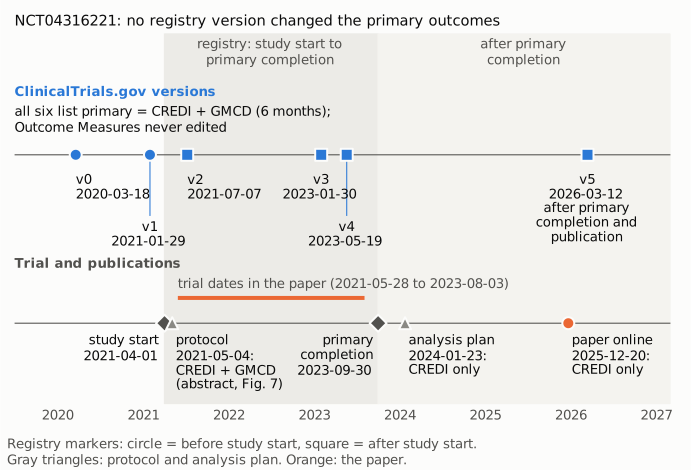
Figure 1. Timeline of the registration and publications. The upper lane shows the six ClinicalTrials.gov versions (blue; circles are versions before the registered study start, squares are versions after it). The darker band runs from the registered study start (2021-04-01) to primary completion (2023-09-30), and the lighter band covers the period after primary completion. No version changed the primary outcomes, so the figure has no outcome-change markers: every version lists the CREDI and the GMCD. The lower lane shows the registered start and primary-completion dates, the trial dates given in the paper (orange bar, 2021-05-28 to 2023-08-03), the published protocol (2021-05-04; CREDI and GMCD as primary in its abstract and Figure 7), the analysis plan deposited after primary completion (2024-01-23, CREDI only) and the paper (2025-12-20, CREDI only). The one version dated after primary completion, v5 (2026-03-12), also follows the paper's publication and still lists both primary outcomes.
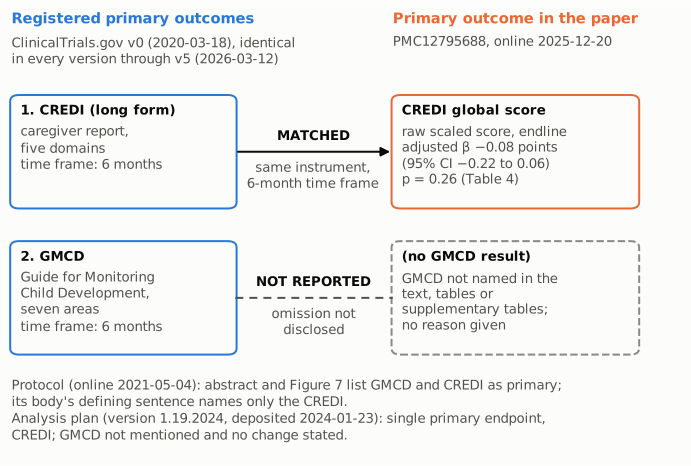
Figure 2. Registered primary outcomes and the primary outcome reported. Left (blue): the two primary outcomes registered in v0 (2020-03-18), unchanged through v5 (2026-03-12). Right (orange): the primary outcome the paper reports, with its adjusted result (β −0.08 points, 95% CI −0.22 to 0.06, p = 0.26, Table 4). The CREDI connector is labelled "MATCHED" (same instrument, same 6-month time frame). The GMCD connector, labelled "NOT REPORTED", ends at a dashed box stating that the paper names the GMCD nowhere in the text, tables or supplementary tables and gives no reason. The note at the bottom summarises the protocol (both instruments primary in its abstract and Figure 7, only the CREDI in its body's defining sentence) and the analysis plan, which lists only the CREDI and states no change.
Why it matters
- Half of the registered primary set is missing without explanation. The registry has always listed two primary development instruments, and the paper reports one. A reader who checks the paper against the registration, as CONSORT item 6b invites ("any changes to trial outcomes after the trial commenced, with reasons"), finds the GMCD missing, with no statement of whether it was collected, analysed or dropped, or when.
- The registered primary that is reported is null. In the adjusted endline model the global CREDI score did not differ between groups ("β [SE] -0.08 [0.07] points [95% CI -0.22 to 0.06]; p = 0.26"; Results, "Modeling results for primary outcome"). The change-score sensitivity analysis and the four CREDI domain scores also showed no difference, and no prespecified effect modifier interacted significantly. Endline medians were 47.7 in both groups. The CREDI result is fully reported and the omission does not affect it.
- The development conclusion rests on one of the two registered instruments. The abstract concludes that egg provision "improved diet quality but did not benefit development, growth, or anemia status among Maya infants". For development, that claim rests on the CREDI alone. The paper itself names the CREDI's mode of administration as a limitation ("The CREDI is reported by caregivers and may be subject to social desirability bias") and suggests it may explain a contrast with another trial ("This might be because of our use of the CREDI, which relies on caregiver report, versus the BSID, which uses direct assessment by a trained observer"). The protocol says the GMCD and the CREDI "provide complementary information about child development". A GMCD result, in either direction, would bear directly on how far the null development finding generalises across instruments. Readers of the paper cannot tell that such a result was planned.
- Readers relying on the analysis plan would not see the change either. The plan the paper cites was deposited after primary completion and names only the CREDI. Neither the plan nor the paper notes that it differs from the registration and from the protocol's abstract and Figure 7.
Explanations considered
- The paper is a secondary or partial report. This does not apply. The paper says "We report primary findings from the Saqmolo’ Project". It reports the registered secondary outcomes alongside the primary outcome and does not point to a separate report. A Europe PMC search for "Saqmolo" (2026-10-23) returns only this paper, the protocol (J Acad Nutr Diet 2022), a protocol abstract (Curr Dev Nutr 2021) and an egg-composition study (Food Sci Nutr 2023). None of them reports GMCD results.
- The change is disclosed. It is not. The paper's only statements about the registration and plans are that the trial "was preregistered", that a protocol "was published previously" and that an analysis plan "was made publicly available prior to data analysis". None of them mentions the GMCD or a change in primary outcomes. The limitations section does not address it either.
- A documented protocol amendment explains it. None was found. The registry's Outcome Measures module was never edited in six versions (2020-03-18 to 2026-03-12), even though the protocol commits to communicating outcome changes "by updating the information on the www.clinicaltrials.gov website". The analysis plan (version 1.19.2024) lists only the CREDI, so a narrowing appears there. But the plan does not say that it departs from the registered or protocol primary outcomes, gives no reason, and is dated after primary completion. Citing the plan therefore does not, by itself, disclose the change to the reader. Whether the GMCD was administered at all is not stated in any of these documents.
- The two names refer to the same outcome. They do not. The CREDI and the GMCD are separate instruments. The registry lists them as two primary outcomes with different descriptions (caregiver-report CREDI with five domains; GMCD with seven areas), and the protocol cites them separately and schedules them separately (Figure 7). The protocol abstract's "Guide for Monitoring Global Development" is a naming variant of the same GMCD: the protocol's Outcomes section and Figure 7 call it "Guide for Monitoring Child Development". The paper's single primary outcome is explicitly the CREDI score.
- Time-point or metric differences. These are not at issue. The CREDI is analysed at the 6-month endline, consistent with the registered time frame. The difference concerns which outcomes are reported, not when they were measured.
- A later correction resolves it. None was found (see Status).
- The protocol already made the CREDI the sole primary outcome. Partly. The defining sentence of the protocol's Primary Outcomes subsection names only the CREDI, while its abstract and Figure 7 list the GMCD as primary as well, so the protocol is ambiguous. The registry, which the protocol designates for recording any modification, lists both as primary in every version, and the paper cites the registration. The protocol's ambiguity therefore does not disclose to the paper's readers that a registered primary outcome is not reported.
The documents do not show why the GMCD is absent, and this write-up makes no inference about the reason. A change of outcomes can have legitimate reasons, such as feasibility, instrument availability or field constraints. The issue documented here is that the omission is not disclosed.
Status
As of 2026-10-23:
- Registry history. The ClinicalTrials.gov history list endpoint (
/api/int/studies/NCT04316221/history) and the version records 0, 1, 2, 4 and 5 (/history/<version>, retrieved through the study's history page in a browser because direct requests returned HTTP 403) all list both primary outcomes. The current record (API v2, last update posted 2026-03-13) also lists both. No results are posted. - Publisher version. The text quoted here is the PMC archive of the article (Lancet Reg Health Am vol 54, February 2026, article 101339; online 2025-12-20). The publisher pages (thelancet.com, sciencedirect.com) returned HTTP 403. The Elsevier article API returned metadata only (cover date 2026-02-28, open access), so the wording was not compared against the publisher's own page.
- Corrections. No correction, erratum or retraction notice was found in PMC, Crossref (no
update-toorrelationentries) or Europe PMC. - PubPeer. Not checked. The site returned a Cloudflare verification challenge.
- Sources. ClinicalTrials.gov NCT04316221 (current record and history); PMC12795688 (full text and supplements mmc1.docx and mmc2.pdf, the latter the published protocol, via Europe PMC); the protocol, J Acad Nutr Diet 2022;122:432–444 (doi:10.1016/j.jand.2021.03.015, PMID 33962902); the statistical analysis plan, Harvard Dataverse doi:10.7910/DVN/1OSZOC.
Suggested correction
A correction to the article that:
- states that ClinicalTrials.gov NCT04316221 (and the abstract and Figure 7 of the published protocol) listed two primary outcomes at 6 months, the CREDI and the Guide for Monitoring Child Development (GMCD), and that the article reports only the CREDI;
- says whether GMCD data were collected and, if not, when and why the decision was made;
- if the GMCD was collected, reports the between-group result with the same models used for the CREDI (or a reason it cannot be reported), and says when the decision to make the CREDI the sole primary outcome was taken relative to the analysis plan (version 1.19.2024) and to the start of outcome analysis, as CONSORT item 6b asks for any change to trial outcomes;
- qualifies the abstract's conclusion that the intervention "did not benefit development" as resting on the caregiver-reported CREDI only.
Separately, the ClinicalTrials.gov record could be updated to reflect the outcomes actually analysed, with the change and its reason noted, as the protocol's amendment section anticipates.