← Back to the plain-language case
Abstract and conclusions call the 57.4% concordant trials discordant; discordance was 42.6%
BMC Med (2025) · doi:10.1186/s12916-025-04328-z · PMC12403310
Summary
The study compares the data sharing plans that 376 clinical trials stated in their registrations with those stated in their publications, and its Abstract (Results and Conclusions) and main Conclusions section say that more than half of the trials were discordant, citing "216/376, 57.4%". By the paper's own Methods definitions and Table 2 (155 Yes/Yes, 13 Yes/No, 147 No/Yes, 61 No/No), those 216 trials (57.4%) are the concordant ones, and 160/376 (42.6%, 95% CI 37.7–47.6%) are discordant, as the Results text, Table 3, Supplementary Table S6 and the Discussion ("over 40% were discordant") also state. Concordance is one of the study's two stated outcomes, so a reader of the abstract alone gets its headline figure the wrong way round: a minority of trials, not a majority, had discordant plans. No test result or odds ratio changes; the correction is to three sentences.
What the paper reports
Abstract, Results:
Over half (216/376, 57.4%) had discordance between registration and publications.
Abstract, Conclusions:
More than half of published trials have data sharing discordance between registration and publication.
Main text, Conclusions section:
More than half of published trials have discordance between data sharing plans that they submit in trial registration versus publications.
The rest of the paper uses the same 216 trials as the concordant group.
Methods, "Study outcomes":
Subsequently, data sharing concordance was assessed: (1) plan to share data in registration and publication (both Yes in registration and publication, i.e., “Yes/Yes”) and (2) no plan to share data in registration and publication (both No in registration and publication, i.e., “No/No”). Discordance between registered and published plans to share data included (1) plan to share data in registration but no plan to share data in the publication (Yes in registration but No in publication, i.e., “Yes/No”) and (2) no plan to share in registration but a plan to share in publication (No in registration but Yes in publication, i.e., “No/Yes”).
Results, "Concordance between registered and published plans to share data":
A total of 376 trials were included for assessing the concordance, among which 216 (57.4%) had concordance between registered and published plans to share data (n = 155 and 61 for Yes/Yes and No/No, respectively; Table 2). For the discordance, there were 13 (3.5%) and 147 (39.1%) trials as Yes/No and No/Yes, respectively.
Table 2 (registration rows × publication columns): Yes/Yes 155 (41.2%), Yes/No 13 (3.5%), No/Yes 147 (39.1%), No/No 61 (16.2%); total 376 (100%).
Table 3 column headers: "Concordance between registered and published plans to share data", with sub-columns "(n = 160)" and "Yes(n = 216)". The archived text has no label in front of the first sub-column; the counts identify it as the discordant group.
Discussion, paragraph 1:
It was found that more than half of trials published in high-profile journals did not plan to share data in registration, and over 40% were discordant between registration and publication plans.
Discussion, paragraph 4:
Despite the ICMJE requirement, we found discordant data sharing plans in over 40% of trials, a finding that requires attention to increase consistency and reliability.
All quotes above were checked verbatim against the PMC-archived article text.
What the paper's own numbers show
Method. I took the four cell counts from Table 2 and applied the Methods definitions: concordant = Yes/Yes + No/No, discordant = Yes/No + No/Yes. I gave each share a Wilson 95% confidence interval. I re-ran the McNemar test on the two discordant cells as a consistency check. I then applied the same definitions to the two sensitivity tables in Additional file 1 (Table S7a, 78 undecided/missing registrations removed; Table S7b, those registrations counted as "Yes"). All calculations are in recompute.py.txt.
| Quantity | Location | Reported | Recomputed |
|---|---|---|---|
| Trials assessed for concordance | Results; Table 2 | 376 | 155 + 13 + 147 + 61 = 376 |
| Concordant (Yes/Yes + No/No) | Results; Table 2; Table 3 "Yes" | 216 (57.4%) "had concordance" | 155 + 61 = 216/376 = 57.4% (95% CI 52.4–62.3%) |
| Discordant (Yes/No + No/Yes) | Results; Table 2; Table 3 | 13 (3.5%) + 147 (39.1%); Table 3 n = 160 | 13 + 147 = 160/376 = 42.6% (95% CI 37.7–47.6%) |
| Share discordant | Abstract, Results | "Over half (216/376, 57.4%) had discordance" | 160/376 = 42.6%; 216/376 is the concordant share |
| Is discordance more than half? | Abstract Conclusions; main Conclusions | "More than half" | No: 160 < 188 (half of 376); the CI upper bound, 47.6%, is below 50% |
| Discordance | Discussion (twice) | "over 40%" | 42.6%, consistent |
| Overstatement in abstract | Abstract vs Table 2 | 57.4% | 57.4 − 42.6 = 14.8 percentage points |
| Concordance, undecided removed | Results; Table S7a | 64.7% | 193/298 = 64.8%; discordant 105/298 = 35.2% (30.0–40.8%) |
| Concordance, undecided as Yes | Results; Table S7b | 65.9% | 248/376 = 66.0%; discordant 128/376 = 34.0% (29.4–39.0%) |
| McNemar test, 13 vs 147 | Results | P < 0.001 | χ² = 112.2 (110.6 with continuity correction), P ≈ 3e-26; exact P ≈ 7e-30 |
| Registered plan to share | Abstract | 44.6% (171/383) | 171/383 = 44.6% |
Every Table 2 cell and margin percentage reproduces exactly. The sensitivity figures differ from the recomputed ones by 0.1 point because the paper sums its printed component percentages (52.0% + 12.7% and 55.8% + 10.1%), two of which are rounded down (38/298 = 12.75%, printed 12.7%; 210/376 = 55.85%, printed 55.8%). This difference does not affect the finding. Only the abstract and conclusion sentences disagree with the data.
Figure
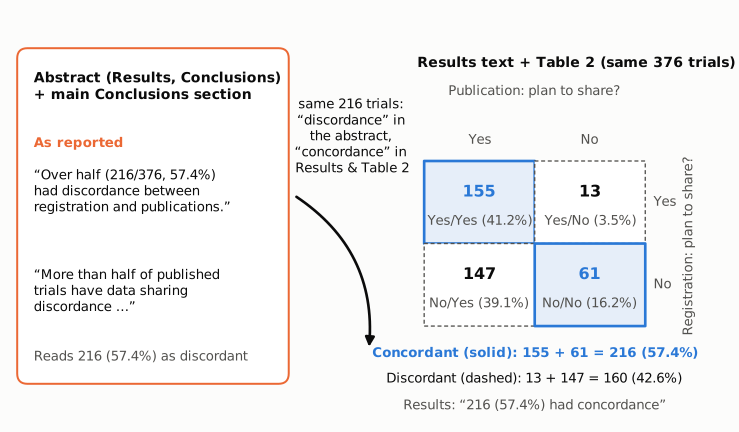
Figure 1. On the left (orange) are the Abstract Results and Conclusions sentences, which call 216/376 (57.4%) of trials discordant; the main Conclusions section repeats this. On the right is the paper's Table 2, redrawn as a 2 × 2 grid (rows: plan to share in the registration; columns: plan to share in the publication). Cells with solid blue borders are concordant by the Methods definition: Yes/Yes 155 + No/No 61 = 216 (57.4%). Cells with dashed borders are discordant: Yes/No 13 + No/Yes 147 = 160 (42.6%). The Results text describes the same 216 trials as having "concordance". The arrow links the abstract's 216 to the Table 2 total it equals, the concordant sum.
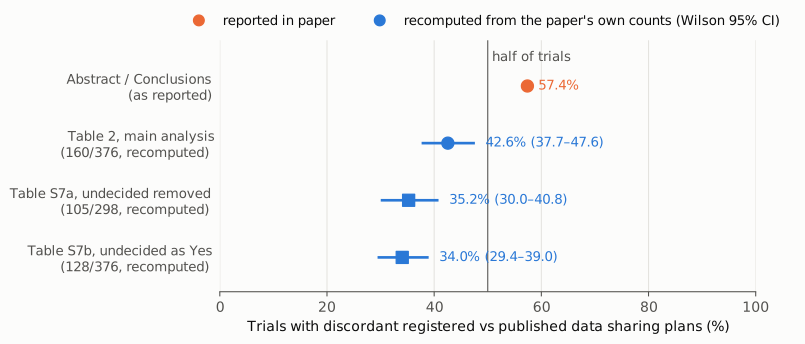
Figure 2. Share of trials whose registered and published data sharing plans disagree, on a full 0–100% axis. Orange: the value given in the abstract and conclusions (57.4%, "over half"). Blue: values recomputed from the paper's own counts, with Wilson 95% confidence intervals. The rows are the main analysis (Table 2, 160/376) and the two sensitivity analyses in Additional file 1 (Table S7a, 105/298; Table S7b, 128/376). The thin vertical line marks half of the trials. Every recomputed estimate and confidence interval lies below that line. The only value above it is the reported one, and that figure is the concordant share.
Why it matters
Concordance between registered and published data sharing plans is one of the study's two stated outcomes, and the abstract and conclusions give its central figure the wrong way round. A reader of the abstract alone learns that a majority (57.4%) of trials in six high-profile journals changed their data sharing plans between registration and publication. By the paper's own counts, a majority (57.4%) were consistent and 42.6% were discordant. The 95% interval for discordance, 37.7–47.6%, excludes 50%, so the error is not a matter of sampling uncertainty. The size of the problem is overstated by about 15 percentage points and pushed across the majority threshold. Abstract and conclusion sentences are the parts most likely to be quoted in later literature and in policy discussion of ICMJE data sharing requirements.
The following results are not affected: the 44.6% (171/383) of registrations with a plan to share; the drug-intervention odds ratio (2.71); the COVID-19 odds ratio for concordance (0.59), which was modelled with the correct groups (Table 3, n = 216 vs n = 160); the McNemar test; the content-level discordance among the 155 Yes/Yes trials; and the sensitivity analyses. The broader message, that a substantial share of trials report inconsistent data sharing plans, still holds at 42.6%. The Discussion already states it correctly ("over 40%").
Explanations considered
- A different definition of discordance. The Methods give a single definition (Yes/No + No/Yes), and no other trial-level definition appears anywhere in the paper. This does not explain the numbers.
- A different population or denominator. The abstract's 216/376 uses the same 376 trial publications as Table 2 and the Results. These are the trials analysed after the later-starting registration ID was chosen for each of the 7 pooled publications. The only other denominator, 383 registration IDs, is used just for the 171/383 figure, which is consistent. This does not explain the numbers.
- Content-level discordance. The abstract also reports "significant discordance" in SAPs/protocols, code and IPD. That analysis covers only the 155 Yes/Yes trials. A count of 216 cannot be built from it, and 216 (57.4%) matches the concordant total (155 + 61) exactly. This does not explain the numbers.
- Sensitivity analyses. These report concordance of 64.7% and 65.9%, so discordance is about 35% and 34%. Discordance is below half in every analysis the paper reports. This does not explain the numbers.
- Rounding or presentation. The error is not a rounding or threshold effect: 160 versus 216 out of 376 is a swap of the two complementary groups.
- Text-conversion artifact in PMC. The same wording appears in the PMC page and in the publisher-supplied JATS full text served by Europe PMC. The error also appears in three separately written sentences in two sections. An archiving artifact is therefore unlikely.
- Correct elsewhere in the paper. The Methods, Results text, Table 2, Table 3, Supplementary Table S6 ("Concordance (n =216)" and "Discordant groups (n =160)") and the Discussion ("over 40% were discordant") all treat 216 as concordant and 160 as discordant. The conflict is confined to the abstract and the two conclusion statements, which is consistent with a wording error in those sentences.
Status
As of 2026-10-23:
- Version of record. The publisher's HTML and PDF could not be opened from this machine: doi.org redirects through bmcmedicine.biomedcentral.com to link.springer.com, which requires a login. The text checked was the PMC-archived article (pmc.ncbi.nlm.nih.gov/articles/PMC12403310/) and the publisher-supplied JATS full text served by Europe PMC. Both carry the three sentences quoted above, and Table 2 is identical in both.
- Supplements. Additional file 1 (12916_2025_4328_MOESM1_ESM.docx, from static-content.springer.com) was read. Table S6 labels the groups "Concordance (n =216)" and "Discordant groups (n =160)". Tables S7a and S7b give 155/13/92/38 (N = 298) and 210/36/92/38 (N = 376). Discordance is below half in both. The supplement supports the reading given here and does not resolve the conflict.
- Corrections. No correction, erratum or expression of concern was found. Crossref update metadata: none. Crossref
filter=updates:query: 0 results. PMC notices: none. Europe PMC (PMID 40890807) lists no comment or correction. Crossref record:update-to,updated-byandrelationempty (rechecked 2026-10-23). Web searches for the DOI or title together with "correction" or "erratum", run during verification, returned nothing relevant. - PubPeer. PubPeer could not be queried directly: its search page returned HTTP 403 and its API returned a Cloudflare human-verification page (rechecked 2026-10-23). Web searches run while this finding was verified, for the title together with "PubPeer", found no PubPeer thread; a further search on 2026-10-23 could not be run because the session's search quota was exhausted.
Suggested correction
Abstract, Results. Replace "Over half (216/376, 57.4%) had discordance between registration and publications." with:
Over half (216/376, 57.4%) had concordance between registration and publications, and 160/376 (42.6%) had discordance.
Abstract, Conclusions. Replace "More than half of published trials have data sharing discordance between registration and publication." with:
More than 40% of published trials have data sharing discordance between registration and publication.
Main Conclusions section. Replace "More than half of published trials have discordance between data sharing plans that they submit in trial registration versus publications." with:
More than 40% of published trials (160/376, 42.6%) have discordance between data sharing plans that they submit in trial registration versus publications.
The corrected wording matches the Discussion's own statement ("over 40% were discordant"). Optionally, the unlabeled first sub-column of Table 3 could be headed "No" to match "Yes(n = 216)".