← Back to the plain-language case
Registered primary outcome, door-to-balloon time, was replaced after completion; main text omits this
JAMA Netw Open (2024) · doi:10.1001/jamanetworkopen.2024.3729 · PMC10980970 · NCT05415085
Summary
This single-center randomized trial compared culprit lesion PCI before complete coronary angiography with complete angiography first in STEMI. The first ClinicalTrials.gov version of NCT05415085 (v0, 2022-06-08) registered one primary outcome, "Reduction in door-to-balloon time". The second and current version (v1, 2023-10-17) replaced it with "Needle-to-balloon time of 10 minutes or less". v1 was posted 474 days after the registered primary completion date (2022-06-30) and 164 days before publication. The paper reports needle-to-balloon time of 10 minutes or less as "the primary outcome of this study". Its main text does not say that the primary outcome was changed, and it describes the trial as "prospectively registered", although the record was first submitted about 13 months after enrollment began. The only disclosure is one undated sentence in the protocol supplement. The originally registered outcome appears in a single Results sentence as a non-significant difference (61.6 vs 73 minutes; P = .12), and the paper does not identify it as the registered primary.
What was registered
ClinicalTrials.gov NCT05415085 has two versions. The record history lists the modules each version changed, and its lastUpdateVersions field shows that the primary outcomes were last changed in v1 and the secondary outcomes in v0, so the secondary outcomes never changed.
v0, first version. First submitted 2022-04-27, QC 2022-06-08, first posted 2022-06-10. Status RECRUITING; study start 2021-05-01 (actual); primary completion 2022-06-30 (estimated); enrollment 250 (estimated). Primary outcome:
Reduction in door-to-balloon time | Change in door-to-balloon time in minutes | time frame: through study completion, an average of 1 year
The brief summary in v0 reads: "The aim of this study is to assess the impact of culprit-first versus culprit-last percutaneous coronary intervention on the door to balloon time and clinical outcomes in patients with ST-elevation myocardial infarction." The keywords include "door-to-balloon time".
v1, current version. Submitted and QC 2023-10-17, posted 2023-10-19. Changed modules: Study Status, Study Design, Outcome Measures, Contacts/Locations. Status COMPLETED; primary completion 2022-06-30 (actual); study completion 2023-04-13 (actual); enrollment 106 (actual). Primary outcome:
Needle-to-balloon time of 10 minutes or less | Change in needle-to-balloon time in minutes | time frame: through study completion, an average of 1 year
The brief summary and keywords were not changed: the current record still gives the aim as the impact "on the door to balloon time and clinical outcomes" and still lists "door-to-balloon time" as a keyword.
Secondary outcomes, identical in v0 and v1:
Need for hemodynamic (mechanical/medical) support during PCI | Number of patients that needed mechanical support during PCI
Need for respiratory support during PCI | Number of patients that needed respiratory support during PCI
Rate of failed PCI | As determined by the operator
All three have the time frame "through study completion, an average of 1 year".
What the paper reports
Abstract, "Main Outcomes and Measures":
A needle-to-balloon time of 10 minutes or less.
Methods, "Study Protocol and End Point":
The primary outcome of this study was a needle-to-balloon time of 10 minutes or less. Secondary outcomes included the need for hemodynamic support (ie, mechanical and/or medical) during PCI, the need for invasive or noninvasive ventilation during PCI, and the rate of failed PCI.
Methods, "Power Calculation":
Based on previously published data, the primary outcome of a needle-to-balloon time of 10 minutes or less was used for sample size calculation.
Methods, "Study Design and Population", the only statement about the registration:
This study was prospectively registered in Clinical Trials.gov (NCT05415085).
The same paragraph gives the enrollment period: "The study included patients with a diagnosis of STEMI who underwent primary PCI between April 1, 2021, and August 31, 2022."
Results, "Primary and Secondary Outcomes", which holds the paper's only result for door-to-balloon time:
The primary outcome of a needle-to-balloon time of 10 minutes or less was achieved in 46 of the 90 patients (51.1%) who underwent culprit lesion PCI before CAG and in 18 of the 94 patients (19.1%) who underwent CAG followed by culprit lesion PCI (odds ratio, 4.4 [95% CI, 2.2-9.1]; P < .001).
There was no significant difference in the mean (SD) door-to-balloon time (61.6 [45.8] vs 73 [59.8] minutes; P = .12).
The main text contains neither "amend" nor "changed". Door-to-balloon time appears in it only as background (Introduction and Discussion, citing earlier studies) and in the Results sentence above. The Abstract, Key Points and Conclusions do not mention it.
Supplement 1 ("Study Protocol and Statistical Analysis Plan", jamanetwopen-e243729-s001.pdf), section "3. Endpoints", is the only place the change is mentioned:
a. Primary endpoint: o Reduction in Door-to-Balloon (D2B) time Protocol amendment: The investigators ask the IRB for a study protocol amendment due to reconsideration of study protocol and primary outcome: o Revised primary outcome: Needle-to-balloon time within 10 minutes.
The protocol text carries no date for the amendment or for its approval. Its sample-size paragraph uses the revised outcome, in the same words as the paper's Power Calculation section. Its "Study Cohort" section gives an "Estimated number of 300 patients (~150 each group)". The case report form appended to it is labelled "February 2021" and "Ver 1.4". That label belongs to the form; it does not date the amendment.
The discrepancy
| Outcome | Registered (version, date) | In the paper | Status |
|---|---|---|---|
| Door-to-balloon time ("Reduction in door-to-balloon time"; change in minutes) | Sole primary in v0 (2022-06-08); removed in v1 (2023-10-17) | Not named as an outcome. One Results sentence: mean 61.6 vs 73 min, P = .12. Not in the Abstract, Key Points or Conclusions | demoted |
| Needle-to-balloon time of 10 minutes or less | Absent from v0; sole primary in v1 (2023-10-17, after primary completion) | Primary outcome: 46/90 (51.1%) vs 18/94 (19.1%), OR 4.4 (95% CI 2.2-9.1). Also the basis of the power calculation | matched to v1; added relative to v0 |
| Needle-to-balloon time in minutes (the v1 description, "Change in needle-to-balloon time in minutes") | Description text of the v1 primary | Reported as mean 11.4 vs 17.3 min, P < .001, not labelled primary | matched (wording difference: the registry title is a threshold, its description is continuous) |
| Hemodynamic support during PCI | Secondary, v0 and v1 | Secondary | matched |
| Respiratory support during PCI | Secondary, v0 and v1 | Secondary ("invasive or noninvasive ventilation") | matched |
| Rate of failed PCI | Secondary, v0 and v1 | Secondary | matched |
The main text gives no account of the change. A reader of the article alone would see a primary outcome that matches the current registry record and a statement that the trial was prospectively registered.
Figures
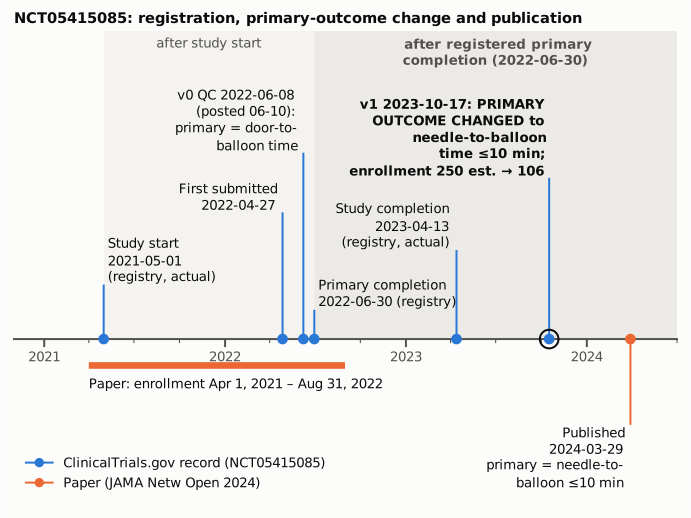
Figure 1. Registry events (blue, above the axis) and paper events (orange, below the axis) on one calendar axis. The paper's enrollment period (April 1, 2021 to August 31, 2022) is the orange bar. The light-grey band marks the period after the registered study start, and the darker band the period after the registered primary completion date (2022-06-30). The record was first submitted on 2022-04-27, 361 days after the registered start and 391 days after the paper's enrollment start, and its first version (v0, QC 2022-06-08) named door-to-balloon time as the primary outcome. The circled event, v1 on 2023-10-17, replaced the primary outcome with needle-to-balloon time of 10 minutes or less and changed enrollment from 250 (estimated) to 106 (actual). It falls after primary completion, after study completion (2023-04-13) and 164 days before publication on 2024-03-29.
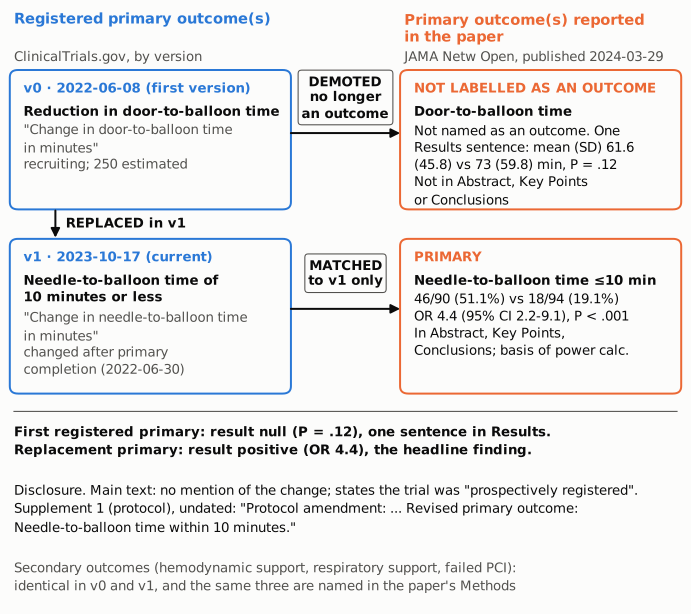
Figure 2. Left column: the primary outcome in each registry version, quoted from the record (v0, 2022-06-08; v1, 2023-10-17). Right column: how the paper treats each one. The v1 outcome matches the paper's primary outcome, which carries the headline result (51.1% vs 19.1%; OR 4.4). The v0 outcome, door-to-balloon time, is not named as an outcome in the paper. Its only result is one Results sentence reporting no significant difference (61.6 vs 73 minutes; P = .12). The connector labels state the relation (REPLACED, DEMOTED, MATCHED). The bottom panel summarises the disclosure: none in the main text, one undated sentence in Supplement 1. The secondary outcomes are the same in both registry versions and in the paper.
Why it matters
A registered primary outcome lets readers judge whether the outcome that carries a trial's conclusions was chosen before the results were known. Here the first registered primary outcome, door-to-balloon time, is the one the trial's registry summary still names as its aim. It was replaced in the registry on 2023-10-17, after the registered primary completion date and after study completion. The paper's headline findings rest entirely on the replacement outcome: the Key Points finding (51.1% vs 19.1%), the abstract's odds ratio of 4.4, and the conclusion that culprit lesion PCI before complete CAG "resulted in shorter reperfusion times".
For the originally registered primary outcome the paper reports a mean (SD) door-to-balloon time of 61.6 (45.8) vs 73 (59.8) minutes, "no significant difference", P = .12. That result appears once, in the Results text. The Abstract, Key Points and Conclusions do not report it, and nothing in the paper tells the reader that it was the registered primary outcome.
The registry does not show when the decision to change the outcome was made. The protocol supplement records that an amendment was requested but gives no date. Without that date, a reader cannot tell whether the change came before enrollment, during it, or after outcome data were available. Each of these calls for a different reading of the result, and CONSORT 2010 item 6b asks trial reports to state any changes to trial outcomes after the trial commenced, with reasons.
The registration timing adds to this. The record was first submitted on 2022-04-27, 391 days after the paper's enrollment start (April 1, 2021) and 361 days after the registered start (2021-05-01). Under the ICMJE and WHO definition, which requires registration before the first participant is enrolled, the registration was retrospective. The paper's statement that the study was "prospectively registered" therefore does not match the record. The door-to-balloon primary was itself first recorded after about a year of enrollment.
Explanations considered
- Paper role (secondary analysis or a different paper for the registered outcome). Does not account for it. This is the main report of the trial. It cites only NCT05415085 and presents its outcome as "the primary outcome of this study". No other publication from the trial is cited.
- Disclosure. Partly addresses it, in a supplement only. Supplement 1 states that an amendment of the primary outcome was requested, "due to reconsideration of study protocol and primary outcome". The main text, which most readers and indexing services see, does not mention it. The supplement gives no date for the amendment or its approval, no reason beyond the quoted phrase, and no indication of whether outcome data had been seen. The main text's statement "This study was prospectively registered" does not reflect the change or the registration date.
- A protocol amendment approved before enrollment, with a late registry update. Possible, and it would be a legitimate reason for the change. The published material cannot confirm it. The protocol supplement does not date the amendment. The first registry version, submitted in April 2022 after about a year of enrollment, still named door-to-balloon time, and the registry was updated only after the trial was completed. If the amendment came before enrollment, the paper could say so with the IRB approval date.
- Wording differences (the two outcomes are the same measure described differently). Does not account for it. Door-to-balloon time runs from arrival at the hospital to first balloon inflation; needle-to-balloon time runs from the first arterial puncture to first balloon inflation (the paper defines both time points in Methods, "Data Collection"). They are different intervals, and the paper reports them separately, with different results (P = .12 vs P < .001). A smaller wording point concerns v1 itself: its title names a threshold ("10 minutes or less") while its description reads "Change in needle-to-balloon time in minutes". The paper's primary analysis uses the threshold, so it matches the v1 title.
- Correction or registry note. None found (see Status). The registry record has no note explaining the change, and the brief summary still states the door-to-balloon aim.
Separately, three other registry-paper differences are not part of the outcome change and are noted for completeness only. The registry gives enrollment as 106 (actual), while the paper reports 214 randomized in Results (106 and 108 per arm) and 216 in the Abstract. 106 is the number the paper gives for the culprit-lesion-first arm. The registry lists masking as "DOUBLE" (participant, care provider), while the paper describes an "open-label" trial. The registered primary completion date (2022-06-30) precedes the end of enrollment reported in the paper (August 31, 2022).
Status
As of 2026-10-23:
- Registry history. ClinicalTrials.gov API v2 current record, fetched 2026-10-23 (versionHolder 2026-10-22): last update submitted 2023-10-17, posted 2023-10-19. The version history (2 versions) and the archived v0 record were retrieved on 2026-10-22 from the internal history routes (
/api/int/studies/NCT05415085?history=trueand/api/int/studies/NCT05415085/history/0). The same history endpoints returned HTTP 403 when retried on 2026-10-23, and the history tab has no static content. The v1 content is identical to the current record. - Publisher version. The publisher's page (jamanetwork.com/journals/jamanetworkopen/fullarticle/2816961) carries the same registration statement and primary-outcome sentence as the PMC archive and shows no correction, erratum or editorial notice. Its comments section shows no comments. All paper quotes above were checked verbatim against the PMC-archived text. The supplement quotes were checked against the text extracted from Supplement 1 (jamanetwopen-e243729-s001.pdf).
- Corrections. Crossref lists no update relations for the DOI. PMC and Europe PMC list no correction, retraction or comment notices. A web search found no letter, comment or correction about the trial.
- PubPeer. Could not be checked: both the API and the search page refused automated access (HTTP 403).
- Sources. PMC10980970 and its Supplement 1; https://clinicaltrials.gov/study/NCT05415085 (current record and history); Crossref; Europe PMC; the publisher's article page.
Suggested correction
- In Methods, state that the primary outcome registered at ClinicalTrials.gov on 2022-06-08 was door-to-balloon time, that it was changed to needle-to-balloon time of 10 minutes or less, and give the date of the protocol amendment and its IRB approval, the reason, and whether the change was made before or after any outcome data were seen. The registry update date (2023-10-17) should also be stated.
- Report door-to-balloon time as the originally registered primary outcome, with its effect estimate and confidence interval, in the Results and in the Abstract.
- Replace "This study was prospectively registered" with the registration dates: first submitted 2022-04-27 and first posted 2022-06-10, after enrollment began on April 1, 2021.
- Minor: reconcile the number randomized (216 in the Abstract, 214 in Results). Ask the sponsor to update the registry's enrollment figure, masking field and brief summary so that they agree with the trial as reported.