← Back to the plain-language case
Abstract reports 11 of 34 combination-arm responders; Results and Table 2 support 8 confirmed, 9 overall
Clin Cancer Res (2021) · doi:10.1158/1078-0432.CCR-21-2160 · PMC9401547
Summary
The abstract's only efficacy result for this first-in-human trial of MK-4830 is that "Eleven of 34 patients in the dose-escalation phase who received combination therapy achieved objective responses", which implies a response rate of 32.4%. The Results and Table 2 place those 11 responders across all 84 treated patients: 1 on monotherapy, 8 confirmed plus 1 unconfirmed among the 34 patients in the combination arm (part C), and 1 among the 18 patients who crossed over from monotherapy. The combination arm therefore has 8 of 34 confirmed responders (23.5%, the 24% ORR in Table 2), or 9 of 34 (26.5%) counting the unconfirmed one, and no grouping in the paper gives 11 responders among combination-treated patients. ORR was a tertiary endpoint and the safety conclusions are unaffected, but the abstract overstates the arm's response count by 3 patients and its response rate by 8.8 percentage points.
What the paper reports
All quotations were checked verbatim against the PMC-archived text.
Abstract, Results:
Of 84 patients, 50 received monotherapy and 34 received combination therapy.
Eleven of 34 patients in the dose-escalation phase who received combination therapy achieved objective responses; 5 previously had progressive disease on anti–PD-1/PD-L1 therapies.
Results, "Tumor response" (one paragraph, quoted in order):
Eleven of 84 patients (10 confirmed and 1 unconfirmed) with heavily pretreated advanced solid tumors in the dose-escalation phase of the trial achieved an objective response. One of 50 patients in the monotherapy group achieved a confirmed partial response (PR) for an ORR of 2% (Table 2)
Eight of 34 patients receiving combination therapy achieved a confirmed response (CR, n = 1; PR, n = 7) and 6 additional patients had SD ≥6 months (per RECIST v1.1 by investigator review) for an ORR of 24% and a DCR of 41% (Table 2; Supplementary Table S2). One additional patient in the combination treatment group achieved an unconfirmed PR. In the crossover group, 1 patient with MSI-high colorectal cancer achieved a confirmed PR.
In addition, 5 of 11 patients (45%) who achieved a response (4 confirmed and 1 unconfirmed) had previous disease progression on an anti–PD-1/PD-L1 alone or in combination with other agents.
Reductions in target lesion size of ≥30% were observed in the patient receiving monotherapy and the 10 patients receiving combination therapy (including those who crossed over; Fig. 2C and D).
Results, "Safety":
Of the 52 patients treated with combination therapy (n = 34 in part C; n = 18 who crossed over from parts A and B), 48 (92%) experienced AEs (Table 1)
Results, "Biomarker analysis > PD-L1":
Of the 34 patients in the dose-escalation phase who received combination therapy, 25 [6 responders (CR or PR), 19 nonresponders (SD, PD, or missing, including 5 patients with SD and PFS of ≥6 months)] had evaluable PD-L1 status (Fig. 3A).
Table 2, "Summary of confirmed tumor response per RECIST v1.1 by investigator assessment" (excerpt; columns are MK-4830 monotherapy, MK-4830 + pembrolizumab, crossover to MK-4830 + pembrolizumab):
Confirmed response, n (%) | n = 50 | n = 34 | n = 18
ORR | 1 (2)a | 8 (24)b | 1 (6)c
CR | 0 | 1 (3) | 0
PR | 1 (2) | 7 (21) | 1 (6)
Discussion, second paragraph:
45% of patients achieved a PR with MK-4830 plus pembrolizumab after previous disease progression on an anti–PD-1/PD-L1 alone or in combination with other agents
What the paper's own numbers show
Method. I tallied responders by treatment group from the Results text and Table 2. I then tried every numerator and denominator the paper defines for combination therapy: part C confirmed, part C including the unconfirmed PR, and all 52 patients who ever received the combination (part C plus crossover). I also checked Table 2's row sums and percentages, and computed exact (Clopper–Pearson) 95% CIs to show how large the discrepancy is. Every number below is printed by recompute.py.txt.
| Quantity | Location | Reported | Recomputed from the paper's own numbers |
|---|---|---|---|
| Responders, all 84 dose-escalation patients | Results, Tumor response | 11 of 84 (10 confirmed, 1 unconfirmed) | 1 mono + 8 part C confirmed + 1 part C unconfirmed + 1 crossover = 11 of 84 (13.1%); 10 confirmed, 1 unconfirmed. Consistent |
| Responders, 34 combination (part C) patients | Abstract, Results | 11 of 34 (implies 32.4%) | 8 of 34 confirmed (23.5%); 9 of 34 with the unconfirmed PR (26.5%) |
| Responders on any combination therapy | Safety gives 52 combination-treated; Tumor response gives "the 10 patients receiving combination therapy (including those who crossed over)" | — | 8 + 1 + 1 = 10 of 52 (19.2%); 11 is not reachable |
| Combination ORR | Table 2; Results | 8 (24%) | 8/34 = 23.5%. Consistent |
| Combination responders by tumor type | Table 2, footnote b | 2 + 2 + 1 + 1 + 1 + 1 | 8. Consistent with Table 2 |
| Combination DCR | Results | 41% | (8 + 6)/34 = 41.2%. Consistent |
| Combination row of Table 2 | Table 2 | CR 1, PR 7, SD 9, PD 16, no assessment 1 | sums to 34. Consistent |
| Excess in the abstract | — | — | 11 − 8 = 3 patients; 32.4 − 23.5 = 8.8 percentage points (37.5% relative); 5.9 points above 9/34 |
| Exact 95% CI | — | not reported | 11/34: 17.4–50.5%; 8/34: 10.7–41.2%; 9/34: 12.9–44.4%; 10/52: 9.6–32.5% |
| Responders with prior anti-PD-1/PD-L1 progression | Abstract; Results | "5" (abstract, of combination responders); "5 of 11 (45%)" (Results, of all responders) | 5/11 = 45.5% |
The Results paragraph is self-consistent: its group counts add to exactly the 11 of 84 it states, and the separate statement that 10 combination-treated patients (counting crossovers) had at least 30% tumor shrinkage matches the 8 + 1 + 1 combination-treated responders. Table 2 and its footnote both give 8 confirmed combination responders. The abstract keeps the numerator of the whole-trial statement (11) and swaps the denominator for the part C count (34). The combination arm's own count is 8 confirmed, or 9 with the unconfirmed PR, so 11 of 34 overstates it.
Figure
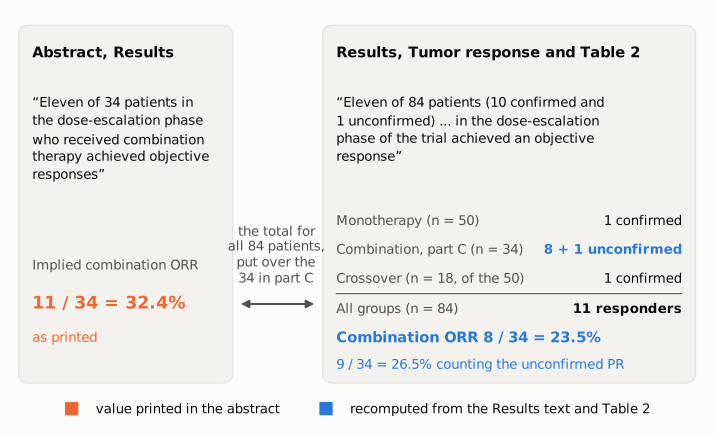
Figure 1. Left: the abstract's statement and the response rate it implies (orange, 11/34 = 32.4%). Right: the Results statement for all 84 patients and the per-group counts given in the Results text and Table 2. They add to 11 responders across monotherapy, part C combination and crossover. The part C combination arm has 8 confirmed responders (23.5%), or 9 (26.5%) counting one unconfirmed PR (blue, recomputed). The connector marks the conflict: the abstract's numerator is the total for all 84 patients, and its denominator is the 34 patients in part C.
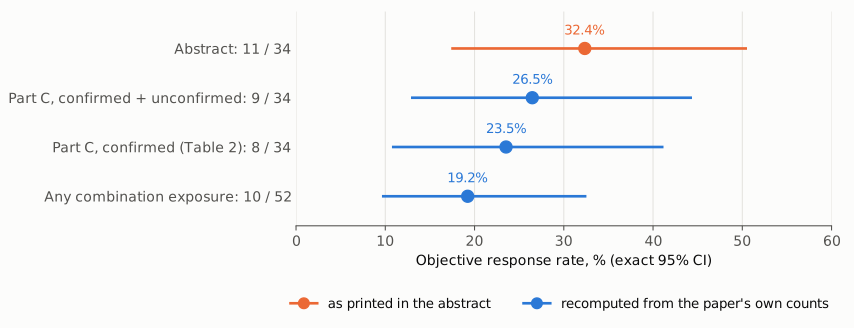
Figure 2. Objective response rate with exact (Clopper–Pearson) 95% confidence intervals on one linear axis starting at 0. Orange: the rate implied by the abstract (11/34). Blue: the rates the paper's own counts give for the combination arm (8/34 confirmed as in Table 2; 9/34 including the unconfirmed PR) and for every patient who received combination therapy, including crossovers (10/52). The intervals overlap because the arm is small. The figure shows the size of the overstatement. It is not a test.
Why it matters
- It is the abstract's only efficacy number. The abstract reports no ORR. A reader of the abstract alone, or of an index that shows only the abstract, would infer a combination-arm response rate of about 32% (11/34), where the paper's Table 2 gives 24% confirmed. Early-phase response rates in small arms are often cited when sizing later trials or comparing agents, so the overstatement can spread through citations.
- The "5 previously had progressive disease" clause inherits the error. In the Results, 5 of 11 is a share of all responders in every group. The abstract presents the 5 as a subset of combination-arm responders. The paper does not say whether all 5 were in part C, so the abstract's framing cannot be checked. The Discussion's "45% of patients achieved a PR with MK-4830 plus pembrolizumab after previous disease progression" has the same denominator problem: 45% is 5 of 11 responders across all groups, not a share of combination patients.
- What is not affected. The primary objectives (safety and tolerability), the absence of dose-limiting toxicities, the pharmacokinetic and target-engagement results, Table 2 and the Results text all stand. The abstract's conclusion that the combination showed "antitumor activity" also holds at 8 or 9 of 34. ORR was a tertiary objective. The error is confined to how the response count is presented in the abstract, and the matching phrasing in the Discussion.
Explanations considered
- The abstract counts every patient who ever received the combination. Does not account for the numbers. The paper's own wider denominator is 52 (34 in part C plus 18 crossovers), and the responders on combination therapy number 8 + 1 + 1 = 10, which the Results confirms ("the 10 patients receiving combination therapy (including those who crossed over)"). That gives 10 of 52, not 11 of 34. Adding crossover responders to the 34-patient denominator would still give only 10.
- The abstract includes unconfirmed or immune-related responses. Does not account for the numbers. The Results reports exactly one unconfirmed combination-arm PR, giving 9 of 34. Table 2 footnote e ("Eleven patients have been evaluated by immune Response Evaluation Criteria in Solid Tumors") is attached to the crossover column's 13 patients without a RECIST assessment, not to part C, and the paper reports no immune-related RECIST responses for any group.
- A different data cutoff or analysis set. Not supported. The paper states a single clinical cutoff (July 10, 2020), and the abstract's denominator of 34 is the same part C population as Table 2. Supplementary Table S2 lists 8 confirmed combination responders. The biomarker section reports 6 responders among 25 PD-L1-evaluable part C patients, consistent with at most 9.
- A text-conversion artifact. Ruled out. The numbers are spelled out ("Eleven of 34") in running text. The same wording is in the publisher-deposited PubMed abstract (PMID 34598945), the OpenAlex abstract and the live PMC page.
- Already corrected. No. The article has two published corrections, and neither changes the abstract (see Status). The April 2022 correction explicitly states that the combination-arm responder count "was correct in Table 2 (n = 8)".
- Side observations, not part of the main finding. (1) Table 2 prints the monotherapy "SD with PFS ≥6 months" cell as "5 (1)". 5/50 is 10%, so the percentage is a typographical slip. (2) "A total of 51% of patients with responses previously received ≥3 lines of therapy" cannot be a share of 11 responders (5/11 = 45.5%, 6/11 = 54.5%) or of 10 confirmed responders (50%, 60%). (3) All other percentages in Table 2 match their counts, and the Safety percentages for 52 patients (92%, 54%, 8%) recompute correctly.
Status
- Version of record. The publisher's page (aacrjournals.org, reached through doi.org) returned HTTP 403 behind a bot challenge, for the article and for its correction notices. I checked the PMC article page (which shows the article as corrected), the PMC-archived XML used for every quotation here, the publisher-deposited PubMed abstract (PMID 34598945) and the OpenAlex record. All carry the "Eleven of 34" sentence and the Results and Table 2 figures quoted above. The article appeared online in 2021 and in print as Clin Cancer Res 2022;28(1):57–70.
- Supplements. The Europe PMC supplementary bundle has five PDFs: Fig. S1 (disposition), Fig. S2 (pharmacokinetics and receptor occupancy), Fig. S3 (best overall response and duration by arm), Table S1 (baseline characteristics, n = 50/34/84) and Table S2 (characteristics of confirmed responders: monotherapy n = 1; MK-4830 + pembrolizumab n = 8). Table S2 supports 8 confirmed combination responders. Nothing in the supplement supports 11 in that arm.
- Corrections. Crossref lists two publisher corrections. (1) Clin Cancer Res 2022;28(8):1734, doi:10.1158/1078-0432.CCR-22-0564, 14 April 2022: "the number of patients who had ORR to MK-4830 + pembrolizumab was correct in Table 2 (n = 8), but footnote 'b' contained incorrect information regarding cancer types and the number of patients with each cancer type." (2) Clin Cancer Res 2022;28(18):4158, doi:10.1158/1078-0432.CCR-22-2320, 15 September 2022 (PMC9475239): "the Spearman correlations were correct in the text and incorrect in Fig. 4." Neither mentions the abstract. I read the text of both notices from their OpenAlex abstract records. PMC and Europe PMC list no other notices, and there is no retraction or expression of concern.
- PubPeer. The PubPeer API returned no record (HTTP 404) for the DOI, and a web search for the title together with "PubPeer" found no thread, as of 2026-10-24.
- Sources. PMC9401547 (article and supplementary files); PMC9475239; PubMed 34598945; Crossref records for 10.1158/1078-0432.CCR-21-2160, 10.1158/1078-0432.CCR-22-0564 and 10.1158/1078-0432.CCR-22-2320; OpenAlex; PubPeer; https://doi.org/10.1158/1078-0432.CCR-21-2160. Status as of 2026-10-24.
Suggested correction
In the abstract, replace
Eleven of 34 patients in the dose-escalation phase who received combination therapy achieved objective responses; 5 previously had progressive disease on anti–PD-1/PD-L1 therapies.
with wording that matches the Results and Table 2, for example
Eight of 34 patients who received combination therapy in the dose-escalation phase achieved a confirmed objective response (ORR 24%) and 1 had an unconfirmed response; overall, 11 of 84 patients responded, of whom 5 previously had progressive disease on anti–PD-1/PD-L1 therapies.
If the 5 patients with prior anti-PD-1/PD-L1 progression were all in the combination arm, the authors may prefer to say so explicitly. In the Discussion, "45% of patients achieved a PR with MK-4830 plus pembrolizumab after previous disease progression" could read "5 of 11 responders (45%) had previous disease progression on an anti–PD-1/PD-L1". The authors may also wish to correct the monotherapy "SD with PFS ≥6 months" cell in Table 2 to "5 (10)" and check the denominator behind "51% of patients with responses".