← Back to the plain-language case
95% upper bound for zero neural tube defects among 384 dolutegravir-exposed outcomes is tenfold too small
Lancet HIV (2021) · doi:10.1016/S2352-3018(20)30268-X · PMC7869891
Summary
The paper's primary safety outcome is neural tube defect (NTD) prevalence after periconceptional dolutegravir (DTG) exposure. It observes no NTDs among 384 DTG-exposed and 1068 efavirenz (EFV)-exposed birth outcomes (Table 3). In the Abstract and the Results it reports a 95% Wilson confidence interval of 0–0·0010 for the DTG group and 0–0·0036 for the EFV group. For 0 events in n, the Wilson 95% upper bound is z²/(n + z²). With n = 384 that is 0·0099, about ten times the printed value; a bound of 0·0010 would need about 3838 outcomes, and no DTG-exposed pregnancy count in the paper comes close. The same method reproduces every other Wilson (prevalence) interval in the paper, including the EFV bound. The paper cites five DTG-exposed NTD rates from other studies: 1·04% (the Botswana estimate used in the Methods power calculation), 0·94%, 0·66% and 0·30% (Botswana) and 0·4% (the Antiretroviral Pregnancy Registry). The printed DTG bound (0·10%) lies below all five, so it appears to exclude every one of them. The bound implied by the paper's own counts (0·99%) contains four of them, 0·94%, 0·66%, 0·4% and 0·30%. Only the 1·04% power-calculation rate lies above it, by 0·05 percentage points.
What the paper reports
Abstract, Methods:
NTD incidences were calculated with 95% Wilson confidence intervals (95%CI).
Abstract, Findings:
There were no NTD in either DTG-exposed (0 [95%CI 0, 0·0010]) or EFV-exposed groups (0 [95%CI 0, 0·0036]).
Methods, "Variable definitions and statistical analysis":
We computed Wilson 95% confidence intervals (95%CI) for prevalence estimates of the primary outcomes.
Results, third paragraph:
The estimated NTD prevalence for DTG-exposed infants was 0 (95%CI 0-0·0010) and 0 (95%CI 0-0·0036) in EFV-exposed infants. Our composite outcome was more frequent in DTG-exposed fetuses (n=25, 7% [95%CI 0·044-0·094]) compared to those EFV-exposed (n=43, 4% [95%CI 0·030-0·054])
Table 3 ("Birth outcomes of periconceptionally DTG- and EFV- exposed women, Brazil, 2015-2018"), excerpt (selected rows; the P-value column and the "Outcome" row that carries its P value are omitted):
| Only EFV regimen(N=1068) | Any DTG regimen(N=384) |
Neural tube defects, n (%) | 0 (0) | 0 (0)
Live birth | 1025 (96) | 359 (93)
Stillbirth | 15 (1) | 2 (1)
Abortion | 28 (3) | 23 (6)
Results, "Updated NTD incidence estimate":
2 / (0·78 * 900 + 382) = 0·0018 or 1·8 per 1,000 DTG-exposed pregnancies (95%CI 0·5-6·7 per 1,000 DTG-exposed pregnancies)
Research in context panel, "Evidence before this study" (the comparison rates):
out of 426 women exposed to DTG at conception, four gave birth to infants with NTD (0·94%) compared to 0·10% among those exposed to other antiretrovirals. Since that initial warning, updated data from the Botswana study showed a decreased prevalence compared to the initial evaluation though statistically increased compared to women on non-DTG regimens (0·30% vs 0·10%). Other recent smaller studies from Botswana demonstrated increased NTD prevalence among women with DTG exposure (1 among 152 women or 0·66%) but statistical analyses comparing risk to other groups included the null. Lastly, data from North America and Europe using the Antiretroviral Pregnancy registry observed 1 NTD event among 248 DTG-exposed women (0·4%).
Methods, "Study design and data sources" (the power calculation):
Assuming a NTD prevalence of 0·06% for births among DTG-unexposed women and a prevalence of 1·04% in the DTG-exposed women (the estimated prevalence from Botswana available at the time)
Abstract, Interpretation:
Neither DTG or EFV exposure was associated with NTD in our national cohort; incidence of NTD is likely well under 1% among DTG-exposed HIV-positive women
The version of record repeats the bound. The publisher's edited abstract, as indexed in PubMed (PMID 33387477), reads:
There were no NTDs in either dolutegravir-exposed (0, 95% CI 0-0·0010) or efavirenz-exposed groups (0, 95% CI 0-0·0036).
What the paper's own numbers show
Method. I computed the Wilson score interval at the stated 95% level (z = 1·959964) for 0 events, using every denominator the paper gives for each group: birth outcomes (Table 3 N), women, and live births. For x = 0 the upper bound has the closed form z²/(n + z²). I inverted that formula to find the n at which the bound equals 0·0010. To rule out a different method or level, I also computed Clopper–Pearson, the rule of three, and Wilson bounds at 90% (equal to a one-sided 95% bound) and 99%. To test whether the authors' method and denominators are as stated, I recomputed the paper's other Wilson intervals: the composite outcome in each group and the updated DTG estimate. Every number below is printed by recompute.py.txt.
| Quantity | Location | Reported | Recomputed from the paper's numbers |
|---|---|---|---|
| DTG NTD, 0/384 birth outcomes, Wilson 95% upper bound | Abstract (Findings); Results ¶3; Table 3 N | 0·0010 | 0·0099 (0·99%), 9·9 times the reported value |
| DTG NTD, 0/382 women | Abstract; Results | (same 0·0010) | 0·0100 |
| DTG NTD, 0/359 live births | Table 3 | (same 0·0010) | 0·0106 |
| EFV NTD, 0/1068 birth outcomes, Wilson 95% upper bound | Abstract (Findings); Results ¶3; Table 3 N | 0·0036 | 0·0036 (0·00358), matches |
| EFV NTD, 0/1045 women; 0/1025 live births | Results; Table 3 | (same 0·0036) | 0·0037; 0·0037 |
| DTG 0/384, other methods and levels | derived | 0·0010 | Clopper–Pearson 95% 0·0096; rule of three 0·0078; Wilson 90% (one-sided 95%) 0·0070; Wilson 99% 0·0170 |
| n at which a 0/n Wilson 95% upper bound equals 0·0010 | derived | — | 3838 (the value rounds to 0·0010 only for n from 3655 to 4039) |
| Largest DTG-exposed pregnancy or outcome counts | Abstract; Results; Table 3 | 382 women; 384 birth outcomes; updated DTG denominator 1084 (whole analysed cohort: 1427 women, 1452 outcomes) | all below 3655 |
| Larger counts in the paper that are not DTG-exposed pregnancy denominators | Results ¶1; Introduction | 3390 possible pregnancies screened; 2507 selected for investigation; 22 624 Brazilian women on DTG aged 15–49 | 0/n Wilson 95% upper bounds 0·0011, 0·0015 and 0·0002; none falls in the 3655–4039 range that gives 0·0010 |
| Composite outcome DTG, 25/384 | Results ¶3; Table 3 (2 stillbirths + 23 abortions) | 7% (0·044–0·094) | 6·5% (0·0445–0·0943), matches |
| Composite outcome EFV, 43/1068 | Results ¶3; Table 3 (15 + 28) | 4% (0·030–0·054) | 4·0% (0·0300–0·0538), matches |
| Updated DTG estimate, 2/(0·78 × 900 + 382) = 2/1084 | Results, updated estimate; Abstract | 0·0018 (0·0005–0·0067) | 0·00185 (0·00051–0·00670), matches |
| Table 3 column totals | Table 3 | N = 384; N = 1068 | 359 + 2 + 23 = 384; 1025 + 15 + 28 = 1068 |
The DTG NTD bound is the only Wilson (prevalence) interval in the paper that does not reproduce. Every other Wilson interval reproduces with the stated method and the Table 3 denominators. The bootstrap 95% CIs for the propensity-weighted odds ratios (Methods; Results; Figure 2 of the paper) depend on individual-level data and were not recomputed.
Figure
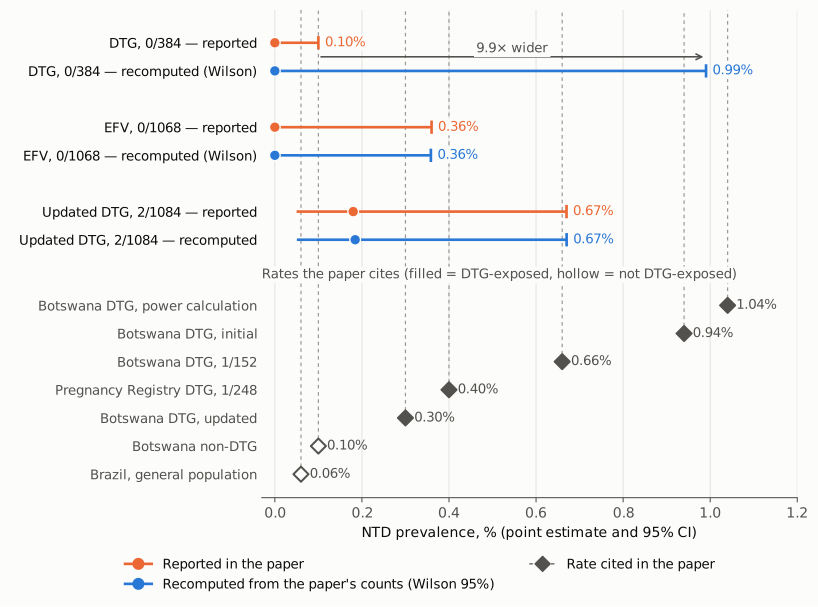
Figure 1. NTD prevalence intervals on one axis, in percent. Each pair of rows shows the interval as reported in the paper (orange) and as recomputed from the paper's own counts with the Wilson 95% method the paper states (blue). Dots are point estimates and the end ticks are upper bounds, with values printed next to them. For EFV (0/1068) and for the updated DTG estimate (2/1084) the reported and recomputed intervals coincide. For DTG (0/384) the recomputed upper bound is 0·99%, 9·9 times the reported 0·10%. The lower rows show every NTD rate the paper cites for comparison, each with a thin dashed line running up through the intervals: five DTG-exposed rates (filled diamonds: Botswana 1·04% from the power calculation, 0·94%, 0·66% and 0·30%, and the Pregnancy Registry 0·4%) and two rates without DTG exposure (hollow diamonds: Botswana non-DTG 0·10%, Brazil general population 0·06%). As printed, the DTG interval ends at 0·10% and lies below all five DTG-exposed rates. As recomputed, it contains four of them; only the 1·04% power-calculation rate lies above it.
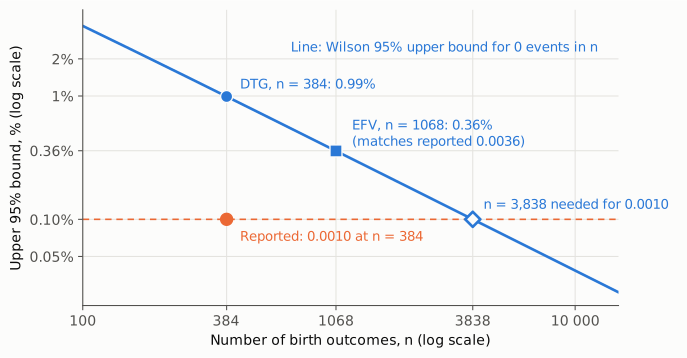
Figure 2. The Wilson 95% upper bound for 0 events in n, z²/(n + z²), on log–log axes (blue line). The recomputed DTG (n = 384, 0·99%) and EFV (n = 1068, 0·36%) bounds lie on the line, and the EFV value matches the paper. The reported DTG bound of 0·0010 at n = 384 (orange dot, with a dashed orange line at its level) lies far off the line. The line reaches 0·0010 only at n = 3838 (hollow diamond), about ten times the DTG sample and larger than the whole analysed cohort (1452 birth outcomes).
Why it matters
NTD prevalence among women exposed to DTG at conception is the outcome the study was set up to measure, after the 2018 safety signal from Botswana. Its confidence interval is the cohort's own statement of how high the DTG-associated NTD risk could plausibly be. The misprinted bound is in the Abstract Findings, which is also the version of record's abstract and is indexed in PubMed, and in the Results. The correct value is printed nowhere in the paper, so a reader cannot recover it without recomputing.
The error changes what the cohort appears to exclude.
- As printed (upper bound 0·10%), 0/384 would appear to rule out every DTG-exposed NTD rate the paper cites: 1·04%, 0·94%, 0·66%, 0·4% and 0·30%. It would also put the DTG upper bound at the Botswana non-DTG background of 0·10%, implying the cohort alone could exclude any material DTG excess.
- As recomputed (upper bound 0·99%), the interval contains the DTG-exposed rates 0·94%, 0·66%, 0·4% and 0·30%, and both rates without DTG exposure (0·10% and 0·06%). Only the 1·04% rate assumed in the power calculation lies above it, by 0·05 percentage points. Zero events in 384 has probability 0·32 if the true prevalence is 0·30%, 0·21 at 0·4% and 0·079 at 0·66%. At 0·94% it has probability 0·027, just above the 0·025 tail of a two-sided 95% interval, consistent with 0·94% lying just inside the interval (the exact Clopper–Pearson bound is 0·96%); at 1·04% it is 0·018. The cohort by itself therefore cannot distinguish the Botswana updated rate from background. The Discussion acknowledges this point in words ("it is likely that our study was underpowered to detect a difference in NTD risk"). The printed interval is far narrower than that statement implies.
Also unaffected: the point estimates (0 NTDs in each group), the Table 3 counts, the composite-outcome intervals and regressions, and the updated estimate (0·18%, 95% CI 0·05–0·67%). The Interpretation's "well under 1%" is supported by the updated estimate, which is computed correctly. On the cohort data alone, though, the upper bound is 0·99%, just under 1%. The overall conclusions survive. What is overstated, about tenfold, is the precision of the primary-outcome estimate in the Abstract and Results.
Explanations considered
- A different denominator. This does not account for the numbers. The paper gives 384 birth outcomes (Table 3), 382 women and 359 live births for the DTG group, and these give upper bounds of 0·0099, 0·0100 and 0·0106. A bound of 0·0010 needs at least about 3655 observations. The largest DTG-exposed pregnancy count in the paper is the updated estimate's 1084, and the whole analysed cohort has 1452 outcomes. The paper does print larger counts (3390 possible pregnancies screened and 2507 selected for investigation in the Results, and 22 624 Brazilian women on DTG aged 15–49 in the Introduction), but none is a DTG-exposed pregnancy denominator, and none would give 0·0010 under the stated method in any case: their 0/n Wilson 95% upper bounds are 0·0011, 0·0015 and 0·0002.
- A different interval method or level. This does not account for the numbers. For 0/384, Clopper–Pearson gives 0·0096, the rule of three 0·0078, a one-sided 95% (two-sided 90%) Wilson bound 0·0070 and a 99% Wilson bound 0·0170. None is near 0·0010. The paper states Wilson 95% intervals twice.
- The method was applied differently throughout. This does not account for the numbers. The same Wilson 95% calculation reproduces the EFV NTD bound (0·0036), both composite-outcome intervals (0·044–0·094 and 0·030–0·054) and the updated estimate (0·0005–0·0067) to the printed precision. Only the DTG NTD bound departs.
- Percent versus proportion. This does not account for the numbers. The NTD bounds are printed as proportions, like the EFV bound. Read as a percentage, 0·0010% would need about 384 000 outcomes.
- A conversion or typesetting artefact in the archived manuscript. This is ruled out for the abstract: the publisher's edited abstract in PubMed prints the same 0·0010. The value also appears identically in two separate places in the manuscript.
- A typographical slip. This is the simplest account consistent with the numbers. The correct value, 0·0099, rounds to 0·010 at three decimals, and for 382 women it is 0·0100 at four. An extra or misplaced zero in either gives 0·0010. Whatever the route, the printed value is wrong and about ten times too small.
Status
- Version of record. The publisher's full text on thelancet.com and sciencedirect.com could not be opened by automated access (HTTP 403 and Cloudflare challenge pages), and doi.org resolved only to a redirect stub. The publisher's edited abstract was checked through PubMed (PMID 33387477, record revised 2026-01-27) and Europe PMC. It repeats "0, 95% CI 0-0·0010" for DTG and "0, 95% CI 0-0·0036" for EFV, and confirms the denominators of 384 DTG-exposed and 1068 EFV-exposed fetuses. The Results paragraph of the version of record could not be seen. The PMC text (author manuscript, NIHMS1664153) was used for every other quote, and each quote above was checked verbatim against it. Separately, the edited abstract gives the stillbirth-or-miscarriage counts as 23 (6%) and 28 (3%) with p=0·0037, where the manuscript abstract gives 25 (6·5%) and 43 (4·0%) with p=0·05. This difference does not bear on the NTD bound and is not analysed here.
- Supplements. The appendix (Supplemental Tables 1–6, including results for all women in Supplemental Table 3) is listed on the PMC page but could not be downloaded: PMC returned a placeholder or HTTP 403, Europe PMC reported it as not open access, and the publisher copy was blocked. It is unlikely to change the finding, because the version-of-record abstract itself confirms the denominators and no denominator or standard method gives 0·0010.
- Corrections and comments. As of 2026-10-23, none was found. Crossref lists no update relations for the DOI, PMC and Europe PMC list no correction notices, and the PubMed record has no erratum or comment links. A web search for the title with "correction", "erratum" or "PubPeer" found no correction or comment thread. The PubPeer API was blocked by a Cloudflare challenge, so PubPeer itself could not be queried directly.
- Sources. PMC7869891 as archived (Abstract, Methods, Results, Table 3, Research in context panel, Discussion); PubMed efetch for PMID 33387477; Crossref and PMC/Europe PMC notice queries;
recompute.py.txtin this folder.
Suggested correction
- In the Abstract (Findings) and the Results (third paragraph), replace the DTG NTD interval "0–0·0010" with the Wilson 95% interval for 0/384, 0–0·0099 (0–0·0100 if the 382 women are the intended denominator). Leave the EFV interval (0–0·0036) as it is.
- State the denominator used for the NTD prevalence (birth outcomes, women or live births), since the paper uses all three elsewhere.
- Optionally, note that the corrected DTG interval contains the DTG-exposed prevalences from the Research in context panel (0·94%, 0·66%, 0·4% and 0·30%), though not the 1·04% assumed in the power calculation, which fits the Discussion's statement that the study was underpowered for NTDs. The updated estimate, 0·0018 (0·0005–0·0067), needs no change.