← Back to the plain-language case
Abstract reverses the direction of the paper's own DDIT4 and gastric cancer survival finding
Gastroenterology (2020) · doi:10.1053/j.gastro.2020.09.016 · PMC7857017
Summary
The abstract states that "Lower DDIT4 expression correlated with longer survival" in gastric cancer. The rest of the paper reports the opposite for the only gastric cancer survival cohort it analyses, a tissue microarray (TMA) of 509 patients. The Introduction, Results, Figure 4 title and Discussion all say that high DDIT4 goes with longer survival, and the Kaplan-Meier curves in Figure 4B agree: the DDIT4-positive group (n = 200) lies above the DDIT4-negative group (n = 309), log-rank P = .021. The reversed sentence is also in the copyedited abstract indexed in PubMed, and no correction has been issued, so readers who see only the abstract get the direction of the paper's main human result backwards.
What the paper reports
Abstract, Results (PMC author manuscript):
Lower DDIT4 expression correlated with longer survival of gastric cancer patients.
Abstract, Results, as deposited in PubMed (PMID 32956680) and Europe PMC, in the journal's copyedited wording:
Lower DDIT4 expression correlated with longer survival of patients with gastric cancer.
Abstract, Conclusions:
During injury-induced metaplastic proliferation, failure of licensing mTORC1 reactivation correlates with increased proliferation of cells harboring DNA damage, as well as increased tumor formation and growth in mice and humans.
Introduction, final (5th) paragraph:
Patients with low expression have poorer survival.
Results, section "Loss of DDIT4 causes cell-autonomous increased growth of human gastric…", paragraph 1:
We examined another annotated tissue microarray on which we had compiled 509 patients with gastric cancer. We saw statistically significant correlation of high DDIT4 expression with increased patient survival and more differentiated tumors, especially in patients who had received chemotherapy, consistent with DDIT4 slowing proliferation in response to DNA damage (Figure 4A–C; Table S3).
Figure 4 title:
In humans, loss of DDIT4 correlates with worse gastric cancer survival and causes cell-autonomous increased mTORC1 and proliferation despite chemotherapy
Figure 4 legend, panel B:
Overall survival determined via Kaplan-Meier curves separated by DDIT4 expression, with an event defined as a cancer-related death.
Discussion, paragraph 3:
Our results showing DDIT4 expression correlating with less proliferation in precancerous lesions and better survival of patients with gastric cancer confirm and extend on those of a previous report43.
Discussion, paragraph 4:
Paradoxically, however, studies across multiple organs have shown disparate results for DDIT4 in tumorigenesis with some studies showing higher DDIT4 decreases cancer survival44, 47–50.
Figure 4B and 4C, legend boxes printed on the image (read from the PMC image file nihms-1661019-f0004.jpg, not from the text):
4B, Overall Patients: DDIT4 negative (n=309); DDIT4 positive (n=200); P = .021
4C, Patients receiving chemotherapy: DDIT4 negative (n=263); DDIT4 positive (n=170); P = .016
What the paper's own numbers show
Method. The paper reports no hazard ratio or survival estimate in its text, so there is no estimate to recompute. Instead I recorded the direction of the DDIT4 and survival association in every place the paper describes it, and checked the group sizes printed on Figure 4B and 4C against the cohort size in the Results. All quotes from the paper's text were matched verbatim against the PMC-archived text, and recompute.py.txt repeats this check for every one of them; the PubMed wording was checked against the PubMed efetch record, and the Figure 4B and 4C counts were read from the figure image. In Figure 4B and 4C the DDIT4-positive curve lies above the DDIT4-negative curve over most of follow-up. In this paper, "positive" is the high-expression group (Figure 4A shows cores scored "negative" or "positive").
| Quantity | Location | Reported | Recomputed / what the paper's own material shows |
|---|---|---|---|
| Direction of DDIT4 and survival | Abstract, Results (PMC and PubMed) | Low DDIT4 → longer survival | Opposite to every statement below and to Figure 4B |
| Direction of DDIT4 and survival | Introduction, final (5th) paragraph | Low DDIT4 → poorer survival | High DDIT4 → longer survival |
| Direction of DDIT4 and survival | Results, 509-patient TMA | High DDIT4 → increased survival | High DDIT4 → longer survival |
| Direction of DDIT4 and survival | Figure 4 title | Loss of DDIT4 → worse survival | High DDIT4 → longer survival |
| Direction of DDIT4 and survival | Discussion, paragraph 3 | DDIT4 expression → better survival | High DDIT4 → longer survival |
| Direction of DDIT4 and survival | Figure 4B and 4C curves | Positive curve above negative curve | High DDIT4 → longer survival |
| Body statements that agree | Intro, Results, Fig 4 title, Discussion, Fig 4B | n/a | 5 of 5 agree with each other; the abstract contradicts all 5 |
| Cohort size | Results text vs Figure 4B | 509 patients; 309 + 200 | 309 + 200 = 509 (matches) |
| Chemotherapy subgroup | Figure 4C | 263 + 170 | 433 patients, 85.1% of the 509 |
| DDIT4-positive share | Figure 4B / 4C | 200 of 509; 170 of 433 | 39.3% in both |
| Log-rank P | Figure 4B / 4C | .021 / .016 | Not recomputable from published material (no individual data) |
Figure
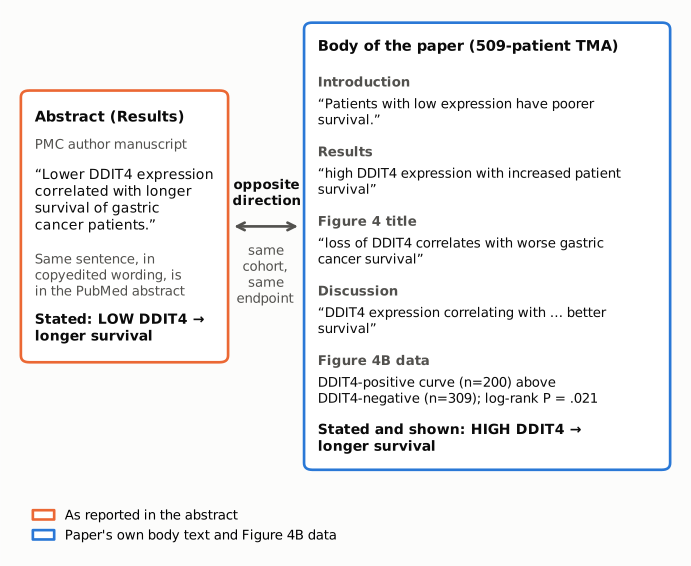
Figure 1. On the left (orange outline) is the abstract's Results sentence, quoted from the PMC author manuscript; the same sentence, in copyedited wording ("…of patients with gastric cancer"), is in the publisher-deposited abstract in PubMed. On the right (blue outline) are short excerpts from the Introduction, the Results, the Figure 4 title and the Discussion, plus the group sizes and log-rank P value printed on Figure 4B. They describe the same 509-patient gastric cancer tissue microarray (the Introduction sentence does not name the cohort, but the 509-patient TMA is the paper's only survival analysis) and the same endpoint (overall survival, with cancer-related death as the event). The abstract states that low DDIT4 goes with longer survival. Every body statement, and the Kaplan-Meier data, state or show that high DDIT4 goes with longer survival. The counts come from recompute.py.txt, which transcribes them from the Figure 4 image. The paper's own figure is not reproduced.
Why it matters
- The human survival association is the paper's only patient-outcome evidence linking DDIT4 loss to gastric cancer. The abstract's Conclusions draw on it in part ("increased tumor formation and growth in mice and humans", which also covers the human-cell xenograft and in-vitro data), and so does the paper's mechanism (DDIT4 restrains proliferation of DNA-damaged cells, so losing it should worsen outcomes). The abstract's Results sentence contradicts both the abstract's own Conclusions and the evidence behind them.
- The abstract is what most readers, indexing services, systematic reviewers and automated literature tools see. A reader of the abstract alone would conclude that DDIT4 is a marker of poor prognosis in gastric cancer, which is the reverse of what this study found.
- The confusion is easy to compound. The Discussion itself notes that other studies found "higher DDIT4 decreases cancer survival". A reader comparing studies by their abstracts could wrongly count this paper among them.
- This write-up does not question the survival analysis itself (Kaplan-Meier curves with a log-rank test) or the numbers printed on Figure 4B and 4C. Other estimates in the paper, and Supplementary Table 3, were not checked. The error is a reversed statement in the abstract, the most widely read part of the paper.
Explanations considered
- A different population or subgroup. This does not explain it. The paper has one gastric cancer survival cohort, the 509-patient TMA in Figure 4B. The only subgroup shown, patients who received chemotherapy (Figure 4C, n = 433), has the same direction (positive curve above negative, P = .016), and the Results call the association stronger there ("especially in patients who had received chemotherapy"). The second TMA, of 218 patients with normal and precancerous lesions, has no survival analysis.
- Results from other studies. This does not explain it. Discussion paragraph 4 cites external studies (references 44 and 47–50) in which higher DDIT4 lowers survival, but it presents them as disagreeing with this study ("Paradoxically, however…"), not as part of its own findings.
- Inverted coding or scale. No evidence of this. DDIT4 is scored "negative" or "positive" by immunohistochemistry (Figure 4A), the figure legends label the groups explicitly, and the text uses "loss of DDIT4" and "low expression" in agreement with the "negative" group.
- A different endpoint. This does not explain it. The only endpoint is overall survival, with cancer-related death as the event (Figure 4B legend), and the same endpoint is used throughout.
- A conversion or manuscript-copy artifact. Ruled out. The conflict is in words ("Lower … longer" against "high … increased"), not in symbols, signs or table cells. The same sentence, in the journal's copyedited wording, appears in the abstract deposited in PubMed and Europe PMC.
- A correction already issued. None was found (see Status).
- What remains. Every part of the paper except one abstract sentence agrees on the direction, and so do the Kaplan-Meier curves. The simplest reading is that the abstract sentence was worded backwards.
Status
- Version of record. The publisher's pages could not be reached by automated access: doi.org redirects to linkinghub.elsevier.com, which returned only a redirect stub, and sciencedirect.com and gastrojournal.org returned HTTP 403. The copyedited abstract deposited in PubMed (PMID 32956680, efetch XML) and in the Europe PMC core record reads "Lower DDIT4 expression correlated with longer survival of patients with gastric cancer." Its wording differs slightly from the manuscript ("patients with gastric cancer" rather than "gastric cancer patients"), which indicates it is the journal's edited version, so the reversed sentence very likely also appears in the version of record. PMC7857017 is the NIH author manuscript (NIHMS1661019). The publisher's full-text body could not be checked; the body quotes above come from the PMC author manuscript.
- Figures and supplements. I opened Figure 4 itself (nihms-1661019-f0004.jpg, from the PMC CDN) and read the group sizes and P values in panels B and C. The PMC page lists Supplementary Tables 1–3 (.docx), Supplementary Figures 1–6, Supplementary Figure Legends and Supplementary Materials and Methods. Supplementary Table 3, the clinicopathological table cited for the survival result, could not be downloaded: PMC served a download-challenge page, and Europe PMC reported the supplementary files as not open access. Figure 4B settles the direction without it.
- Corrections and comments. As of 2026-10-23 I found no correction, erratum, retraction or expression of concern. Crossref lists no update relations for the DOI. PMC and Europe PMC list no notices, and the PubMed record has no CommentsCorrections entries. Crossref Labs (which includes Retraction Watch data) shows no updates. PubPeer could not be checked directly: its API and search page were blocked by a bot-protection challenge (HTTP 403). A web search for the title with "pubpeer" returned no PubPeer page.
- Sources. PMC article PMC7857017 (author manuscript NIHMS1661019) and its Figure 4 image; PubMed 32956680 (efetch XML); Europe PMC core record; Crossref REST API; Crossref Labs; PubPeer (attempted); web search.
Suggested correction
- Change the abstract's Results sentence so that it matches the body of the paper and Figure 4B, for example: "Higher DDIT4 expression correlated with longer survival of patients with gastric cancer." The equivalent "Lower DDIT4 expression correlated with shorter survival…" would also work.
- Ideally, add the effect size to the abstract and Results (for example a hazard ratio with a 95% CI from a Cox model, alongside the log-rank P = .021 for the 509 patients), so the size and direction of the association can be read without the figure.
- Ask PubMed and Europe PMC to update their abstract records when the correction is published, since those are the copies most readers see.