← Back to the plain-language case
Abstract gives the headline smoking-initiation CI as 0.92–1.61; the body gives 0.92–1.16
PLoS Biol (2020) · doi:10.1371/journal.pbio.3000973 · PMC7728259
Summary
This two-sample Mendelian randomization study estimates the effect of genetically predicted smoking on multiple sclerosis (MS) risk. Its abstract gives the main smoking-initiation estimate as OR 1.03, 95% CI 0.92–1.61, but the Results and the Discussion give the same inverse-variance weighted (IVW) estimate as OR 1.03, 95% CI 0.92 to 1.16. On the log-odds scale, an OR of 1.03 with a lower limit of 0.92 implies an upper limit of 1.153, which matches 1.16. An interval of 0.92–1.61 would be centred on 1.22, and its upper arm would be 3.95 times as long as its lower arm, whereas every other interval in the paper is symmetric to within rounding. The published peer-review history shows that a reviewer raised this value and the response to reviewers called it a typo for 1.16, yet the version of record still prints 1.61. The null conclusion is unchanged, but the abstract interval is about 2.4 times too wide on the log scale. It also contains the observational OR of 1.5 that the paper's own Discussion says the MR result contradicts.
What the paper reports
Abstract:
There was no clear evidence for an effect of smoking on the risk of developing MS (smoking initiation: odds ratio [OR] 1.03, 95% confidence interval [CI] 0.92–1.61; lifetime smoking: OR 1.10, 95% CI 0.87–1.40). These findings suggest that smoking does not have a detrimental consequence on MS susceptibility.
Results, "Smoking initiation", first sentence:
The inverse-variance weighted (IVW) MR estimate (odds ratio [OR] 1.03, 95% confidence interval [CI] 0.92 to 1.16) revealed no strong evidence for a causal effect of the genetic risk of smoking initiation on the incidence of MS (Fig 2).
Results, "Smoking initiation", the sensitivity estimates:
the consistent MR–Egger estimate (OR 1.13, 95% CI 0.67 to 1.91)
gave a similar causal estimate (OR 1.05, 95% CI 0.93 to 1.17)
The MR-PRESSO outlier corrected causal estimate was 1.040 (95% CI 1.040 to 1.041).
Results, "Lifetime smoking":
estimate (OR 1.10, 95% CI 0.87 to 1.40) revealed no strong evidence for a causal effect of the genetic risk of lifetime smoking
which still overlapped the null (OR 1.34, 95% CI 0.49 to 3.65)
Discussion:
Although a small effect cannot be entirely excluded, the relatively narrow CIs, particularly for smoking initiation (0.92 to 1.16), make a clinically relevant effect less likely.
This contradicts previously reported observational studies that show an association with MS risk among smokers, compared to nonsmokers, of a meta-analysed effect estimate OR of 1.5
Methods, "Mendelian randomization analyses":
For smoking initiation, the ORs are expressed per unit increase in log odds of ever smoking regularly (smoking initiation)
Peer-review history published with the article (Decision Letter 1, reviewer comment, from the Europe PMC full-text XML):
Is the confidence interval for smoking cessation in the abstract correct? 1.03 (0.92, 1.61) - either the lower or upper bound seem incorrect.
Response to reviewers (attachment pbio.3000973.s002, "Response to reviewers .pdf", dated 2 Oct 2020):
Response: Thank you for pointing out this typo. The confidence intervals should instead read (0.92, 1.16). We have corrected this in the abstract of the revised manuscript.
The reviewer wrote "smoking cessation", but the only abstract interval matching "1.03 (0.92, 1.61)" is the smoking-initiation estimate, and the response treats it as that one.
What the paper's own numbers show
Method. MR estimates such as IVW, MR-Egger and MR-RAPS are computed on the log-odds scale, and their 95% intervals are exp(b ± 1.96·SE). Three things follow. ln(OR) should sit at the midpoint of ln(lower) and ln(upper). The two arms, ln(OR/lower) and ln(upper/OR), should imply the same SE, so their ratio should be close to 1. And the OR and the lower limit together fix the upper limit at exp(2·ln OR − ln lower). I applied these checks to every interval the text reports with an OR. MR-PRESSO is left out because its lower arm (1.040 to 1.040) is zero at the printed precision. All numbers below are printed by recompute.py.txt.
| Quantity | Location | Reported | Recomputed from the paper's numbers |
|---|---|---|---|
| Smoking initiation IVW, upper 95% limit | Abstract | 1.61 | 1.153, implied by OR 1.03 and lower limit 0.92 |
| Smoking initiation IVW, upper 95% limit | Results; Discussion | 1.16 | 1.153, consistent |
| Implied upper limit over rounding of OR (1.025–1.035) and lower limit (0.915–0.925) | derived | 1.16 / 1.61 | 1.136–1.171: contains 1.16, excludes 1.61 |
| Log-midpoint of 0.92–1.61 | Abstract | OR 1.03 | 1.217 |
| Log-midpoint of 0.92–1.16 | Results; Discussion | OR 1.03 | 1.033 |
| OR at which 0.92–1.61 would be symmetric (over rounding of the lower limit) | derived | OR 1.03 | 1.214–1.220 |
| Upper arm ÷ lower arm, 0.92–1.61 | Abstract | — | 3.95 |
| Upper arm ÷ lower arm, 0.92–1.16 | Results; Discussion | — | 1.05 |
| Upper arm ÷ lower arm, MR-Egger 1.13 (0.67–1.91) | Results | — | 1.00 (log-midpoint 1.131) |
| Upper arm ÷ lower arm, MR-RAPS 1.05 (0.93–1.17) | Results | — | 0.89 (log-midpoint 1.043) |
| Upper arm ÷ lower arm, lifetime IVW 1.10 (0.87–1.40) | Abstract; Results | — | 1.03 (log-midpoint 1.104) |
| Upper arm ÷ lower arm, lifetime MR-Egger 1.34 (0.49–3.65) | Results | — | 1.00 (log-midpoint 1.337) |
| SE of log OR implied by the interval | Abstract (0.92–1.61) vs Results (0.92–1.16) | — | 0.1428 vs 0.0591, a ratio of 2.41 |
| Observational OR 1.5 inside the interval? | Discussion; Abstract vs Results | — | inside 0.92–1.61; outside 0.92–1.16 |
| OR 1 inside the interval? | both | — | yes for both |
| Approximate Wald P for OR 1.03 with SE 0.0591 | derived | not reported | 0.62 |
Every interval in the body is symmetric on the log scale to within rounding (arm ratios 0.89–1.05), as is the lifetime-smoking interval in the abstract. The abstract's smoking-initiation interval is the only exception. Its OR and lower limit match the Results exactly, and its upper limit has the same digits as the Results' 1.16 in reverse order.
Figure
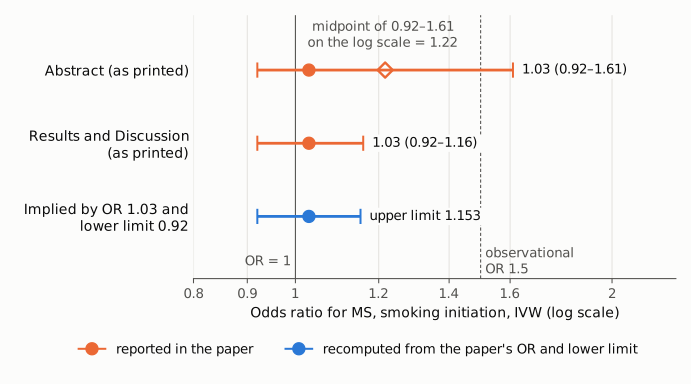
Figure 1. The smoking-initiation IVW estimate on a log odds-ratio axis. Orange: the two versions printed in the paper. The Abstract prints OR 1.03 (0.92–1.61), and the Results and Discussion print OR 1.03 (0.92–1.16). Blue: the interval implied by the printed OR 1.03 and lower limit 0.92 under a symmetric interval on the log scale, with an upper limit of 1.153. The open diamond marks the log-scale midpoint of the Abstract interval (1.22), far from the printed OR. The solid line marks OR = 1. The dashed line marks the observational meta-analysed OR of 1.5 that the Discussion compares against. It lies inside the Abstract interval and outside the Results interval.
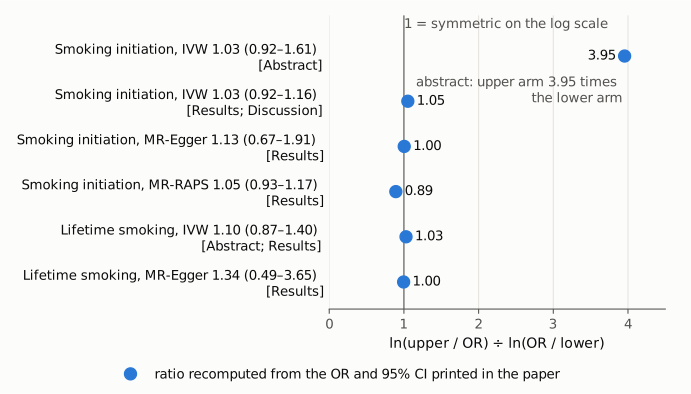
Figure 2. For each odds ratio and 95% CI printed in the text, the ratio of the upper arm to the lower arm on the log scale, ln(upper/OR) ÷ ln(OR/lower). A Wald interval gives 1. The six intervals from the Results and the Abstract's lifetime-smoking interval fall between 0.89 and 1.05, which is what rounding to two decimals produces. The Abstract's smoking-initiation interval, 0.92–1.61, gives 3.95.
Why it matters
The abstract is where most readers meet this result, and the 0.92–1.61 interval tells a different story from 0.92–1.16 in three ways.
- Precision. The body's interval implies a log-scale SE of about 0.059 and rules out an effect larger than about 16% per unit increase in the log odds of smoking initiation. The abstract's interval implies an SE of about 0.143, 2.4 times larger, and is compatible with effects of up to 61%.
- The paper's own argument. The Discussion argues that "the relatively narrow CIs, particularly for smoking initiation (0.92 to 1.16), make a clinically relevant effect less likely". The abstract's interval does not support that argument. Its upper limit is wide enough that a reader of the abstract could reasonably conclude a sizeable harmful effect has not been excluded, and the abstract's conclusion that "smoking does not have a detrimental consequence on MS susceptibility" then rests on a weaker interval than the analysis produced.
- Comparison with observational studies. The Discussion contrasts the MR result with an observational meta-analysed OR of 1.5. The body's interval excludes 1.5, while the abstract's includes it. The exposures are on different scales (per unit log odds of smoking initiation in the MR analysis, ever versus never smoking in the observational studies), so this comparison is approximate. It is still the comparison the paper invites.
The direction and statistical significance do not change. The point estimate is 1.03 in both places, and both intervals contain 1. Figures, tables, the lifetime-smoking estimate and the analyses themselves are unaffected. The error is in how one number in the abstract is reported.
Explanations considered
- A different estimator or sensitivity analysis. This does not account for the numbers. The abstract presents the figure as the smoking-initiation estimate, and its OR (1.03) and lower limit (0.92) are identical to the Results IVW estimate. No other smoking-initiation estimate in the text has an upper limit of 1.61: MR-Egger is 0.67–1.91, MR-RAPS 0.93–1.17 and MR-PRESSO 1.040–1.041. Supplementary Table B (MR estimates, S1 Data) does not contain 1.61 either.
- A different exposure. This does not account for the numbers. The lifetime-smoking estimate is reported separately in the same abstract sentence, and it matches the Results (0.87–1.40 in both).
- Rounding. This does not account for the numbers. Over the full rounding range of the OR (1.025–1.035) and the lower limit (0.915–0.925), the implied upper limit is 1.136–1.171. That range contains 1.16, but not 1.61.
- An asymmetric interval method. This is unlikely to account for the numbers. The paper reports IVW estimates from the TwoSampleMR package, whose intervals are symmetric on the log scale. Every other interval in the paper is symmetric to within rounding (arm ratios 0.89–1.05). To fit 0.92–1.61, the upper arm would have to be 3.95 times the lower arm for this one estimate only.
- A conversion or archiving error. This is excluded. The PMC archive copy, the Europe PMC full-text XML, the publisher's HTML page and the publisher's PDF all print 0.92–1.61 in the abstract and 0.92 to 1.16 in the Results and Discussion. The medRxiv preprint (10.1101/2020.06.24.20138834, version 1, 2020-06-24) also prints 0.92-1.61 in its abstract.
- The abstract value is the intended one and the body is wrong. This is excluded by the paper's own numbers and by the peer-review record. Only 1.16 is consistent with OR 1.03 and lower limit 0.92. The response to reviewers states that the interval "should instead read (0.92, 1.16)".
The digits of 1.61 are those of 1.16 in reverse order, which fits a transcription slip. The response to reviewers describes the value as a typo. No further explanation of the cause is offered here.
Status
- Version of record. I checked the publisher's HTML (journals.plos.org/plosbiology/article?id=10.1371/journal.pbio.3000973, fetched 2026-10-24), which gives the abstract as 0.92–1.61 and the Results and Discussion as 0.92 to 1.16. The version-of-record check for this write-up also extracted the publisher's printable PDF (13 pages), which carries the same strings. The Europe PMC full-text XML and the PMC archive copy match. Every quotation from the article above was confirmed verbatim against the PMC archive text with
src/show.py. The peer-review quotations come from the Europe PMC XML (sub-article pbio.3000973.r002, Decision Letter 1) and from the response attachment pbio.3000973.s002 (7 pages), which I downloaded from PLOS and read. - Peer-review record. A reviewer queried "1.03 (0.92, 1.61)" in Decision Letter 1 (dated 19 Aug 2020). The response dated 2 Oct 2020 calls it a typo for (0.92, 1.16) and says it was "corrected ... in the abstract of the revised manuscript". The published abstract still reads 0.92–1.61. The same response says the Discussion sentence citing 0.92-1.16 was added in that revision.
- Supplements. S1 Data (pbio.3000973.s001, DOCX: Figs A–H, Tables A–H) does not report the headline IVW interval, and neither 1.61 nor 1.16 appears in it. Its only 0.92 is a SNP allele frequency. Attachment s002 is the response to reviewers described above. The XML gives s003 the same filename and file size, so it was not read separately.
- Corrections and comments. As of 2026-10-24 I found no correction, erratum, expression of concern or retraction.
src/known.pyfound one Crossref update, a "new_version" record dated 2020-12-10 that points to the article's own DOI (the update from uncorrected proof to final version). It found no PMC or Europe PMC notices. The PLOS article page has no correction notice, and its Reader Comments page shows "Reader Comments (0)". A web search for a correction or erratum returned only the article and its mirrors. The PubPeer API refused automated access (HTTP 403, "Human verification required"), so I could not check PubPeer. - Sources. PMC7728259 (PMC archive text); Europe PMC full-text XML for PMC7728259, including the peer-review sub-articles; journals.plos.org article page, Reader Comments page and supplementary files s001 and s002; Crossref; the medRxiv API record for 10.1101/2020.06.24.20138834.
Suggested correction
- In the Abstract, change "95% confidence interval [CI] 0.92–1.61" to "95% confidence interval [CI] 0.92–1.16" for smoking initiation. This is the correction the response to reviewers says was intended.
- No change is needed to the Results, the Discussion, the figures, the lifetime-smoking estimate or the conclusions as stated in the body. They already use 0.92 to 1.16.