← Back to the plain-language case
The abstract reverses the direction of the paper's hypoxia result
PLoS Pathog (2019) · doi:10.1371/journal.ppat.1007745 · PMC6513112
Summary
The paper reports that STAT2-dependent type I interferon signaling oxygenates the infected gut, so that removing STAT2 restores hypoxia. Its abstract, however, states that the gut tissue of Stat2−/− mice showed "decreased hypoxia," while the Results, the author summary, the Discussion and the paper's own mechanistic thesis all state the opposite: Stat2−/− tissue was more hypoxic (higher pimonidazole staining, lower oxygenation) than wild-type. Fig 6F is a qualitative immunohistochemistry image with no reported staining intensities or statistics, so there is no number to recompute; what can be checked is that one sentence assigns the reverse direction to the same comparison that four other passages describe. Because the abstract is the most-read and most-indexed part of a paper, a reader who takes this result from the abstract alone records the direction backwards, even though the body and the main conclusions are correct and unchanged.
What the paper reports
Here, we show that STAT2 dependent type I IFN signaling contributes to the inflammatory environment by disrupting hypoxia enabling the pathogenic S. Typhimurium to outgrow the microbiota.
— Abstract (opening; the mechanism: type I IFN removes hypoxia in wild-type mice)
Although inflammatory pathology was similar between wild-type and Stat2−/− mice, we observed decreased hypoxia in the gut tissue of Stat2−/− mice.
— Abstract (the sentence in question: Stat2−/− = less hypoxic)
We determined that the intestinal environment in Stat2−/− mice was more hypoxic than in wild-type mice as shown by higher levels of pimonidazole staining (red) (Fig 6F). Both wild-type and Stat2−/− mice showed comparable hypoxia staining without infection (S3B Fig).
— Results, "Neutrophil-associated oxygenation contributes to low bacterial burdens" (Stat2−/− = more hypoxic)
In the absence of STAT2-dependent type I IFN, production of neutrophil reactive oxygen species was impaired, and epithelial metabolism returned to homeostatic hypoxia.
— Author summary (loss of STAT2 restores hypoxia, i.e. more hypoxic)
The competition experiments between wild-type S. Typhimurium and cyxA mutant as well as hypoxia staining confirmed that oxygenation of the gut lumen of Stat2−/− mice was lower compared to that of wild-type mice.
— Discussion, paragraph 1 (lower oxygenation = more hypoxic)
It was previously reported that hypoxia decreases in the intestine during S. Typhimurium infection [45].
— Results (the baseline biology: infection removes hypoxia; retaining hypoxia is the Stat2−/− phenotype)
One hour prior to euthanasia, wild-type and Stat2−/− infected mice were injected with 100 mg/kg of PMDZ … [PMDZ is] a marker of hypoxia.
— Materials and methods, "Hypoxia staining"; Results (pimonidazole is a hypoxia probe: higher signal = more hypoxia)
What the paper's own numbers show
Method. This is a text-versus-text contradiction, not an arithmetic slip. Fig 6F reports pimonidazole immunohistochemistry images; the paper gives no staining intensities, group means or statistics for the wild-type versus Stat2−/− comparison, so there is no value to re-add. What is objectively checkable is (i) the direction each section assigns to the same headline comparison — gut-tissue hypoxia in Stat2−/− versus wild-type, infected animals, Fig 6F — and whether those directions agree; (ii) that the probe runs in the direction the argument assumes (pimonidazole adducts form only at low O₂, so higher staining means more hypoxia, as the Methods state); and (iii) that the pimonidazole dose, stated two ways, is internally consistent and so is not the source of the discrepancy. Direction is encoded as +1 (Stat2−/− more hypoxic) or −1 (Stat2−/− less hypoxic). Every value below is printed by recompute.py.txt.
| Quantity | Location | Reported | Recomputed from the paper's own statements |
|---|---|---|---|
| Hypoxia direction, Stat2−/− vs WT | Abstract | "decreased hypoxia in Stat2−/−" | direction −1 (less hypoxic) |
| Hypoxia direction, Stat2−/− vs WT | Results; Fig 6F | "more hypoxic … higher pimonidazole staining" | direction +1 (more hypoxic) |
| Hypoxia direction, Stat2−/− vs WT | Author summary | "returned to homeostatic hypoxia" | direction +1 (more hypoxic) |
| Hypoxia direction, Stat2−/− vs WT | Discussion, para 1 | oxygenation "lower" in Stat2−/− | direction +1 (more hypoxic) |
| Hypoxia direction, Stat2−/− vs WT | Title / thesis | IFN oxygenates gut; absence restores hypoxia | direction +1 (more hypoxic) |
| Four non-abstract sections agree with each other | cross-section | — | True (shared value +1) |
| Abstract matches the rest of the paper | cross-section | — | False (abstract −1 vs others +1) |
| Pimonidazole dose | Results | 2.0 mg / 20 g body weight | 100.0 mg/kg |
| Pimonidazole dose | Methods | 100 mg/kg | 100.0 mg/kg — consistent |
| Uninfected baseline (WT vs Stat2−/−) | Results; S3B Fig | "comparable hypoxia staining" | no baseline difference that could flip the infected sign |
Figure
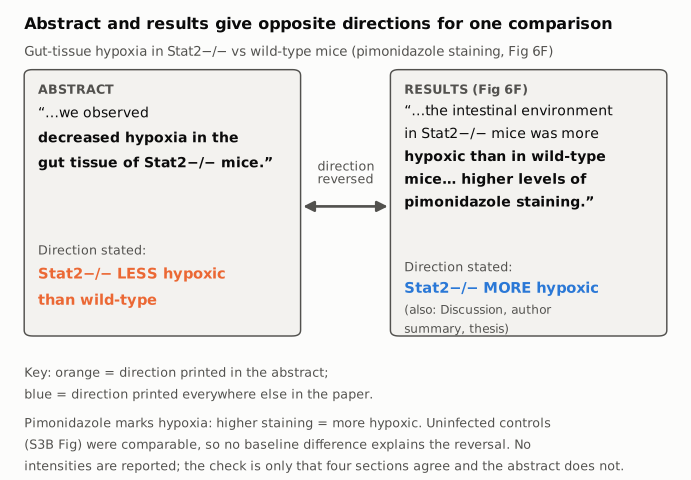
Figure 1. The left panel holds the abstract's sentence and the direction it states (Stat2−/− less hypoxic than wild-type); the right panel holds the Results sentence describing the same Fig 6F pimonidazole comparison and its direction (Stat2−/− more hypoxic), which the Discussion, author summary and thesis share. The two directions are opposite, as the labelled connector marks. Orange marks the direction as printed in the abstract and blue the direction printed everywhere else, so the contrast never rests on colour alone. Because pimonidazole marks hypoxia (higher staining = more hypoxic) and the uninfected controls in S3B Fig were comparable, no change of probe direction or baseline reconciles the two sentences.
Why it matters
- Direction, not magnitude. The error reverses the stated sign of a key mechanistic result. There is no magnitude or significance to get wrong, because Fig 6F is qualitative; the body states the correct direction in words three separate times.
- It sits in the most-read section. Readers, databases and evidence syntheses lean on the abstract. Anyone who tabulates a genotype-versus-hypoxia effect from the abstract alone — for a microbiome or enteric-infection review, say — records Stat2−/− as less hypoxic, the opposite of the finding. Nothing in the abstract signals the conflict.
- The abstract contradicts itself. The same abstract opens by saying type I IFN acts "by disrupting hypoxia" in wild-type mice, which implies that Stat2−/− mice retain hypoxia. The later "decreased hypoxia in … Stat2−/−" sentence is at odds with its own framing as well as with the Results.
- What it does not affect. The paper's central model — type I IFN/STAT2 signaling oxygenates the gut lumen, letting S. Typhimurium respire via cytochrome bd-II and expand over the microbiota, so Stat2−/− mice keep homeostatic hypoxia and resist expansion — is stated correctly throughout the body and is unchanged. Correcting the abstract restores internal consistency rather than overturning any conclusion. No clinical or policy decision depends on it.
Explanations considered
- Different experiments, time points or models. Ruled out. The abstract, Results, Discussion and author summary all refer to the same infected wild-type-versus-Stat2−/− comparison shown in Fig 6F (streptomycin-pretreated mice, 1:1 wild-type:cyxA infection, colons collected 4 days post infection).
- Different measurement or units. Ruled out. Both the abstract ("hypoxia in the gut tissue") and the Results ("intestinal environment … pimonidazole staining") describe tissue hypoxia measured with the same pimonidazole probe. There are no numeric values, so no unit, scaling or adjusted-versus-unadjusted difference is in play. The dose is stated consistently (2.0 mg/20 g = 100 mg/kg).
- The probe runs the other way. Ruled out. Pimonidazole (Hypoxyprobe) forms adducts only under low oxygen; the Methods call it "a marker of hypoxia." Higher staining means more hypoxia, so the Results' "higher levels of pimonidazole staining" unambiguously means Stat2−/− is more hypoxic.
- A baseline difference flips the infected sign. Ruled out. S3B Fig shows comparable hypoxia staining in uninfected wild-type and Stat2−/− mice, so there is no baseline asymmetry that could invert the infected comparison.
- The table/figure is the typo and the abstract is right. Not supported. There is no table of values; the direction is stated in words in four places (Results, author summary, Discussion, and the thesis of title and abstract opening), all agreeing that Stat2−/− is more hypoxic. The lone outlier is the one abstract word "decreased."
- A conversion or archiving artefact. Ruled out. The publisher's version of record, the Europe PMC full-text XML and the PMC archive used here all carry the same two sentences with the same directions.
- Already corrected. No correction, erratum or other notice was found (see Status).
Status
As of 2026-10-24:
- Version of record. The DOI resolves to the PLoS Pathogens version of record (the typeset "Version 2"). Its abstract reads "we observed decreased hypoxia in the gut tissue of Stat2−/− mice," while its Results read "the intestinal environment in Stat2−/− mice was more hypoxic than in wild-type mice." The Europe PMC full-text XML and the PMC archive (
src/show.py PMC6513112) carry the identical sentences. The error is in the published paper, not introduced downstream. - Supplementary material. No numeric hypoxia data exist to recover: Fig 6F is qualitative immunohistochemistry, and the only related supplement is S3B Fig (comparable staining in uninfected wild-type and Stat2−/− mice). The Fig 6F legend and the Methods "Hypoxia staining" section were read in full; neither bears on the abstract-versus-Results wording.
- Corrections and notices.
src/known.py 10.1371/journal.ppat.1007745returns only a self-referential publisher "new version" (2019-05-13) and no PMC or Europe PMC correction/retraction notices. The Crossref record carries no is-corrected-by/updated-by relation beyond that self-reference. The PLoS article page shows a version selector but no correction or erratum banner. A web search for a correction, erratum or PubPeer thread on the DOI and title found none. - Sources. The article as archived in PMC (PMC6513112): abstract, Results, author summary, Discussion, Methods "Hypoxia staining," Fig 6 legend;
src/known.pyfor the DOI; the PLoS version-of-record page; Crossref, PMC and Europe PMC notice records; a web/PubPeer search.
Suggested correction
In the abstract, change the one sentence so its direction matches the Results, Discussion, author summary and the abstract's own framing, for example:
Although inflammatory pathology was similar between wild-type and Stat2−/− mice, we observed increased hypoxia in the gut tissue of Stat2−/− mice.
No change to the figures, Methods or conclusions appears to be needed; the correction removes an internal contradiction rather than altering any finding.