← Back to the plain-language case
The abstract reports increased heat sensitivity, but the paper's own data show increased heat resistance
PLoS Pathog (2018) · doi:10.1371/journal.ppat.1007004 · PMC5927469
Summary
The abstract states that loss of the outer spore protein CsA "increased spore sensitivity to heat, sodium hydroxide and hydrochloric acid," grouping heat with the two chemicals. For heat this reverses the direction of the paper's own result. The Results report that the csA-mutant spores had a 15% increase in colony-forming efficiency at 75 °C (p = 0.0286), and, by the paper's stated definition of spore viability, a higher post-treatment colony-forming efficiency means more spores survive — that is, greater resistance, i.e. less sensitivity. The Discussion agrees, stating the mutant spores "were more resistant to heat." The two chemical treatments are decreases in colony-forming efficiency (−51% and −29%), so "increased sensitivity" is correct for them; only the heat term is reversed. The error is confined to a secondary characterization phenotype and the body of the paper carries the correct direction, but the reversed claim sits in the abstract and is echoed in the Discussion's closing summary.
What the paper reports
The absence of CsA reduced sporulation levels and increased spore sensitivity to heat, sodium hydroxide and hydrochloric acid.
— Abstract
Spores of the csA mutant showed an 15% increase in colony forming efficiency when incubated at 75°C (Fig 4A), a 51% decrease in colony forming efficiency when incubated with hydrochloric acid (Fig 4B) and a 29% decrease in colony forming efficiency when incubated with sodium hydroxide (Fig 4C) when compared to wild-type spores (p = 0.0286).
— Results, "The csA and csB mutations do not affect the colony forming efficiency"
Although csA mutant spores had greater sensitivity to hydrochloric acid, they were more resistant to heat and did not show an increased sensitivity to ethanol in comparison to wild-type spores (Fig 4A and 4B, S5C Fig).
— Discussion
CsA is required for wild-type levels of spore resistance to heat, sodium hydroxide and hydrochloric acid, while CsB is required for normal levels of spore adherence to cervical cells.
— Discussion (closing summary; "resistance to heat" here implies the mutant was less resistant, again reversed)
Percentage spore viability (the ability of spores to form colonies) following treatment was calculated as follows: (log10 CFU ml-1 after plating spores on HIS agar post treatment/log10 CFU ml-1 after plating untreated spores on HIS agar) X 100.
— Materials and methods, "Spore resistance" (the paper's own outcome definition)
What the paper's own numbers show
Method. This is a sign/direction error, not an arithmetic slip, so there is no hidden quantity to recompute from raw data (no numerical CFU values for Fig 4 are deposited). The check is a mechanical mapping from the paper's stated outcome definition to the implied direction of each effect: by "percentage spore viability = (log₁₀ CFU after treatment ÷ log₁₀ CFU untreated) × 100," a higher post-treatment colony-forming efficiency (CFE) means more spores survive the treatment = more resistant = less sensitive, and a lower CFE means the opposite. Applying this to the three reported CFE changes gives the direction each should carry, which is then compared with the abstract. Separately, the single reported p-value is checked against the stated n = 4 per group design. Every value below is printed by recompute.py.txt.
| Quantity | Location | Reported | Direction implied by the paper's own definition |
|---|---|---|---|
| csA mutant heat (75 °C), CFE vs wild-type | Results; Fig 4A | +15% (increase) | more survival → more resistant = LESS sensitive — opposite to the abstract's "increased sensitivity to heat" |
| csA mutant hydrochloric acid, CFE vs wild-type | Results; Fig 4B | −51% (decrease) | less survival → more sensitive — abstract agrees (no contradiction) |
| csA mutant sodium hydroxide, CFE vs wild-type | Results; Fig 4C | −29% (decrease) | less survival → more sensitive — abstract agrees (no contradiction) |
| Heat direction, Discussion body | Discussion | "more resistant to heat" | = LESS sensitive; consistent with the Results, both disagree with the abstract |
| Reported p-value | Results; Fig 4 legend ("average of four independent experiments"); Methods (Mann-Whitney) | p = 0.0286 | 2 ÷ C(8,4) = 2/70 = 0.0286, the smallest exact two-sided rank-test p for n = 4 vs 4; internally consistent and not the error |
The body of the paper (Results, Fig 4 legend's neutral "altered ... resistance," and the Discussion sentence "they were more resistant to heat") is internally consistent on the direction of all three treatments. The abstract sentence is the single outlier, and the Discussion's closing one-line summary repeats it by listing heat among the resistances for which "CsA is required."
Figure
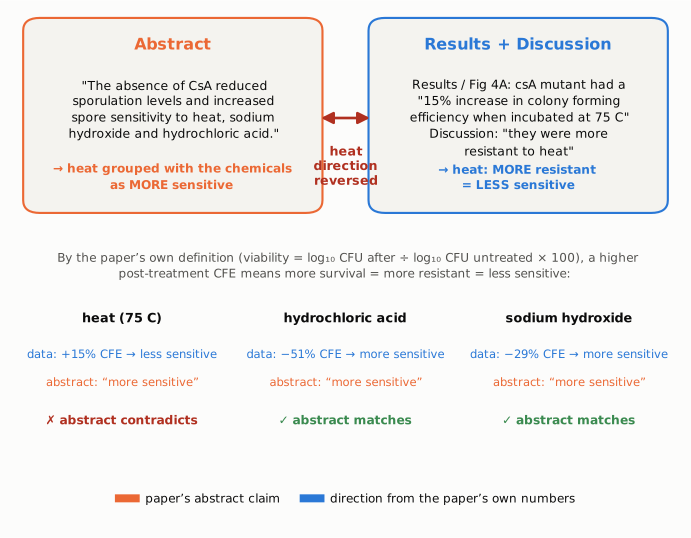
Figure 1. The direction conflict for heat. Left (orange): the abstract groups heat with sodium hydroxide and hydrochloric acid as treatments to which loss of CsA raised sensitivity. Right (blue): the Results report a +15% colony-forming efficiency at 75 °C and the Discussion calls the mutant spores "more resistant to heat." By the paper's own viability definition a higher post-treatment colony-forming efficiency is more survival, hence greater resistance and less sensitivity, so the two descriptions of heat point in opposite directions. The lower strip applies the same mapping to each treatment: the abstract's "increased sensitivity" matches the data for the two chemicals (both are efficiency decreases) but contradicts it for heat (an efficiency increase).
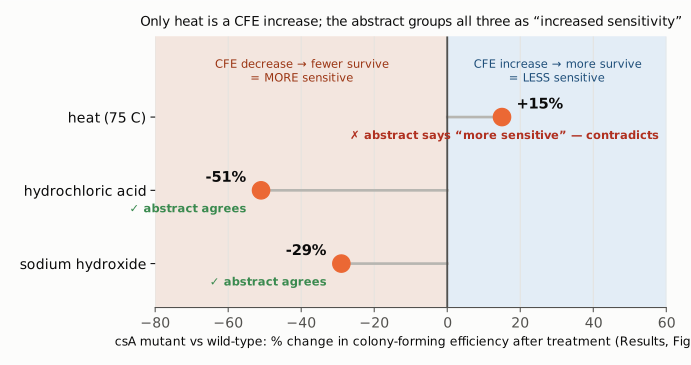
Figure 2. The three reported effects on one axis. The csA-mutant-versus-wild-type change in colony-forming efficiency is plotted from zero (no change). Heat alone falls on the positive side (more survival = less sensitive); the two chemicals fall on the negative side (less survival = more sensitive). The abstract's blanket "increased spore sensitivity" is correct for the two chemicals but has the wrong sign for heat.
Why it matters
Spore resistance to heat and chemicals is one of the characterization assays supporting the paper's claim that CsA contributes to spore integrity. The reversed heat term appears in the abstract — a high-exposure, headline location — and is repeated in the Discussion's closing summary, so a reader who takes the abstract at face value would conclude that CsA normally protects spores against heat, the opposite of what the data show (the mutant was more heat-resistant). The magnitude (15%) and the statistical significance are reported correctly in the Results; only the direction word is wrong, and only for heat. The paper's headline conclusions — that the outer spore proteins maintain spore structure, and that CsB loss affects gastrointestinal colonization and clearance — do not depend on the heat direction and are untouched. This is therefore a wrong secondary result rather than a wrong key result or conclusion.
Explanations considered
- A different definition of the measured quantity. The Materials and methods define percentage viability explicitly as post-treatment over untreated colony-forming ability. Under that definition a higher value is unambiguously more survival, so a +15% change is less sensitivity. No alternative reading of the stated definition makes +15% into increased sensitivity. Does not rescue the abstract.
- The log-ratio endpoint behaves non-monotonically. The endpoint is a monotone increasing function of post-treatment CFU for fixed untreated CFU, so a reported increase still means more survivors. Does not rescue the abstract.
- "Increased sensitivity" refers to the mutation process, not the phenotype. The Discussion states plainly "they were more resistant to heat," fixing the intended phenotype direction and matching the Results. The abstract and the Discussion's closing summary are the outliers. Does not rescue the abstract.
- A statistical artifact (the +15% is noise). The paper reports the heat comparison as significant at its own threshold (p = 0.0286, the minimum attainable for 4 vs 4), and the Discussion treats the heat result as real ("more resistant to heat"). The dispute is the sign of the reported, significant effect, not its reality. Does not rescue the abstract.
- A conversion or typesetting artifact in the archived text. The same wording is present in the version of record (see Status), so this is not an archiving artifact.
Status
- Version of record. The contradiction is present verbatim in the version of record: the abstract, Results and Discussion quotes above were confirmed in the PMC archive (
src/show.py PMC5927469). The independent re-derivation supplied with this case also confirmed the identical wording against the PLOS Pathogens HTML article and the Europe PMC full-text XML. - Supplements. Fig 4 (the heat/HCl/NaOH resistance figure) is supplied only as the rendered figure; no underlying numerical CFU values are deposited for it, and the related S5 figure is an image. There is no source-data file that could resolve the heat value independently; none is needed, since the dispute is a direction stated in the text.
- Corrections and comments. As of 2026-10-23, no correction, erratum, expression of concern or retraction is on record.
src/known.pyand the Crossref record show only a self-referential "new version" relation dated 2018-04-30 (the publication itself). Europe PMC returns the single article record (PMID 29668758) withcommentCorrectionList: None. PubPeer could not be queried in this session (the API and search page returned Cloudflare/HTTP 403 blocks); no PubPeer thread is known. - Sources. PMC5927469 (local archive via
src/show.py); Crossref and PMC/Europe PMC notice check viasrc/known.pyand the Europe PMC REST API.
Suggested correction
Correct the heat term in the abstract so that it is not grouped with the two chemicals — for example, "loss of CsA reduced sporulation levels, increased spore sensitivity to sodium hydroxide and hydrochloric acid, and altered (increased) resistance to heat" — and revise the Discussion's closing summary accordingly so that it no longer implies the mutant was less heat-resistant. The Results text, the Fig 4 legend and the Discussion sentence "they were more resistant to heat" already carry the correct direction and need no change.