← Back to the plain-language case
The abstract reverses the open/closed conformational preference reported in the Results and figures
Nat Commun (2017) · doi:10.1038/ncomms15744 · PMC5458555
Summary
The abstract states that the GTPase domain–BSE region of MxA prefers the open conformation in the nucleotide-free, GDP·AlF4−-bound and GDP-bound forms, and that GTP loading shifts the preference to the closed state. The Results define high FRET (~0.72) as closed and low FRET (~0.35) as open. They report the high-FRET (closed) state at ~70% occupancy in those three forms, and a shift toward low FRET (open) with the GTP analogue GMPPCP. The Fig. 3c legend, the Discussion and the Fig. 6 model all use the Results direction, so the abstract is the only place where the direction is reversed. This matters because the abstract carries the paper's headline result: a reader of the abstract alone gets the main smFRET finding, and the direction of the hydrolysis-driven step in the proposed torque model, the wrong way round.
What the paper reports
Abstract:
Whereas the open conformation is preferred in nucleotide-free, GDP·AlF4--bound and GDP-bound forms, loading of GTP activates the relative movement between the two domains and alters the conformational preference to the ‘closed' state.
Results, "Conformational preference for GD-BSE region" (paragraph 1):
Surprisingly, MxAMO2-AS displayed two steadily distinguished FRET states (∼0.35/low and ∼0.72/high, Fig. 3a and Supplementary Fig. 8a). Prior structural studies identified two GD-BSE conformations: MxA/dynamin molecules in apo, GDP·AlF4--bound and GDP-bound forms display a closed conformation, while MxA/dynamin bound with non-hydrolysable GTP analogue guanosine-5′-[(β,γ)-methyleno]triphosphate (GMPPCP) adopts an open conformation where the BSE swings ∼70° against the GD
Thus, the high- and low-FRET states represent the closed and open conformations of stalkless-MxA, respectively. The FRET traces in apo, GDP·AlF4--bound and GDP-bound forms are very similar and the high-FRET state is dominant with an occupancy of ∼70%, whereas loading of GMPPCP shifts the FRET distribution towards the low-FRET state (Fig. 3c).
Figure 3 legend, panel (c):
(c) Fraction variation in the low-FRET open state (red circle) and the high-FRET closed state (green circle) during GTP hydrolysis.
Discussion (paragraph 1):
This in turn releases the intrinsic potential for conformational recovery, thereby producing a mechanistic force that drives the transition from ‘open' to ‘closed' conformation at the GD-BSE region (Figs 3c and 6a).
Figure 6 legend, panel (b):
(I) Loading of GTP promotes domain movement. The GDs of molecule 4 and A associate at open conformation. (II) Stimulated GTP hydrolysis releases the potential of conformational alternation in the GD-BSE region of molecule 4 and A, and the GDs move back to closed conformation, thereby generating latitudinal shear force.
All quotes were checked word for word against the article as archived in PubMed Central (src/show.py PMC5458555 --grep). The archive writes "AlF4-" where the publisher's page has a subscript 4 and a superscript minus.
What the paper's own numbers show
Method. I took the state mapping the Results define (high FRET = closed, low FRET = open) and applied it to the occupancies and shifts the Results report. I then compared the result with the abstract sentence, and with the Discussion and Fig. 6 statements about the GTP-loaded and post-hydrolysis states. As an independent check of the mapping, I converted the two reported FRET efficiencies to dye-to-dye distances with the standard Förster relation E = 1/(1 + (R/R0)^6). The paper does not state R0, so I used 50–60 Å, the range usually quoted for Cy3/Cy5. All numbers below are printed by recompute.py.txt.
| Quantity | Location | Reported | Recomputed from the paper's own statements |
|---|---|---|---|
| FRET values of the two GD-BSE states | Results; Fig. 3a | ~0.35 (low), ~0.72 (high) | Förster distances: high FRET 42.7–51.3 Å, low FRET 55.4–66.5 Å (R0 = 50–60 Å). High FRET is the shorter distance, so it is the compact (closed) state |
| State mapping | Results; Fig. 3c legend | high FRET = closed, low FRET = open | Same; consistent with the Förster check and with the cited crystal structures (apo, GDP·AlF4−, GDP closed; GMPPCP open) |
| Occupancy in apo, GDP·AlF4−, GDP | Results | high FRET (closed) ~70% | closed 70%, open 30% (closed:open = 2.33:1), so closed is preferred |
| Preferred state in apo, GDP·AlF4−, GDP | Abstract | open | Results imply closed; the Abstract is reversed |
| Effect of GTP / GMPPCP loading | Abstract | preference altered "to the ‘closed' state" | Results: shift toward low FRET, i.e. toward open; the Abstract is reversed |
| Direction of the hydrolysis-driven step | Discussion; Fig. 6b (I–II) | GTP-loaded GDs open; hydrolysis drives open → closed | Agrees with the Results (GTP state open, post-hydrolysis closed); disagrees with the Abstract |
| Distance gap between the two states | Results | ~20 Å (crystal structures, residues 149–639) | 12.7–15.3 Å from the FRET values (R0 = 50–60 Å). Same direction; the size differs, plausibly because of dye linkers and the use of residue 639 for 634. Not part of the finding |
Figure
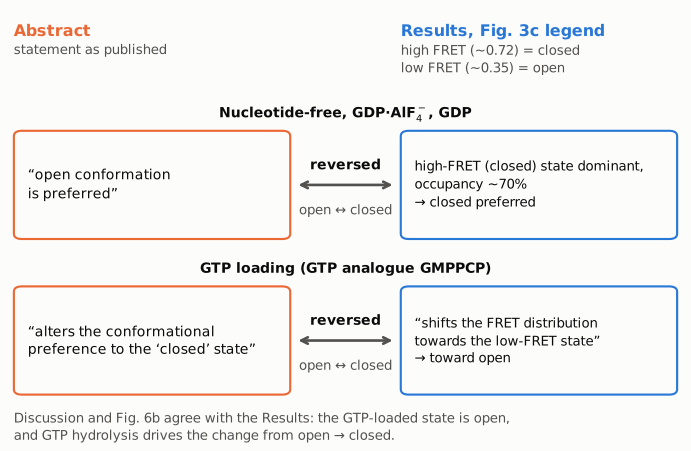
Figure 1. The abstract sentence (left, orange) next to the Results statements for the same conditions (right, blue). Under the mapping the Results define (high FRET ≈ 0.72 = closed, low FRET ≈ 0.35 = open), the high-FRET state at ~70% occupancy means the nucleotide-free, GDP·AlF4− and GDP forms prefer the closed state, and GMPPCP loading shifts the distribution toward open. The abstract states the opposite in both cases. The Discussion and the Fig. 6b model follow the Results. All excerpts are quoted from the paper; no numbers in the figure are new.
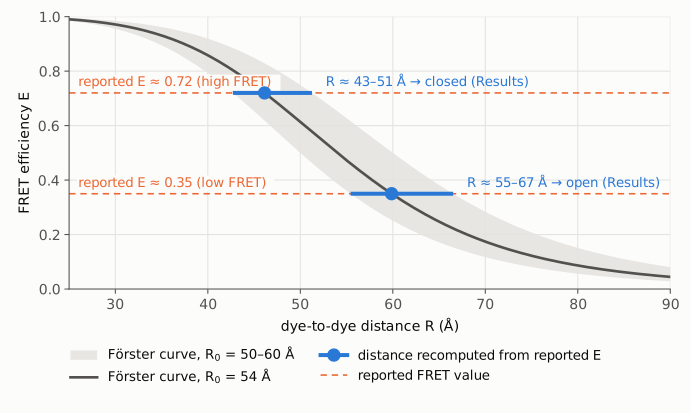
Figure 2. A physics check of the Results mapping. The gray curve is the Förster relation E = 1/(1 + (R/R0)^6) for R0 = 54 Å; the shaded band covers R0 = 50–60 Å. The dashed orange lines are the two FRET values reported in the Results. The blue bars are the distances recomputed from those values across the R0 band (dots at R0 = 54 Å). The high-FRET state lies at about 43–51 Å and the low-FRET state at about 55–67 Å. The high-FRET state is therefore the more compact one, which supports the Results' "closed" label and gives no support to the abstract's reversed wording.
Why it matters
The abstract is the only part of the paper most readers see, and it is what indexing services and citing papers pick up. Here it states the direction of the paper's main smFRET result the wrong way round on two counts: which conformation dominates without GTP, and which way GTP loading moves it. Read literally, it also implies that hydrolysis drives a closed-to-open change, the opposite of the open-to-closed step on which the Discussion builds the shear-force and torque model (Fig. 6). It also suggests that the full-length smFRET data disagree with the earlier stalkless-MxA and dynamin crystal structures, when the Results say they agree ("These results demonstrate that the GMPPCP-dependent BSE rearrangement observed in stalkless-MxA structures also occurs in full-length MxA").
The measurements, figures and model are consistent with one another, so the paper's actual conclusion is not affected. The rest of the abstract sentence, that GTP loading "activates the relative movement between the two domains", agrees with the body (Fig. 3g: "enhanced dynamics for GMPPCP-loading condition"). The error is confined to the two words "open" and "closed" in one sentence of the abstract.
Explanations considered
- A different region or construct. The abstract names the GTPase domain–BSE region, the same region measured with MxAMO2-AS (dyes at A149 and S634) in the Results. The BSE–stalk (hinge 1) measurements use other constructs and a low/medium/high state description with no open/closed preference, so they cannot be the source of the abstract sentence. Does not account for it.
- A different definition of open and closed. The Results define high FRET as closed and low FRET as open, in line with the cited crystal structures (apo, GDP·AlF4− and GDP closed; GMPPCP open, with the BSE swung ~70°). The Fig. 3c legend, the Discussion and the Fig. 6 legend use the same convention. No other definition appears anywhere in the paper. Does not account for it.
- Physics of FRET. Förster theory puts the higher efficiency at the shorter distance. With R0 = 50–60 Å, E = 0.72 corresponds to about 43–51 Å and E = 0.35 to about 55–67 Å, which fits the Results mapping (Fig. 2). Does not rescue the abstract.
- GTP versus GMPPCP. The abstract says "loading of GTP"; the relevant experiment uses the non-hydrolysable analogue GMPPCP, which the paper uses throughout as the GTP-loaded state. No condition in the paper shows a closed preference upon GTP loading. Does not account for it.
- Conversion or archiving artifact. The difference is a swap of the words "open" and "closed", not a number, sign, superscript or table cell. The publisher's HTML, the PMC page and the Europe PMC full text all carry the same abstract sentence. Ruled out.
- Supplementary material. The single supplementary PDF (10 pages) contains Supplementary Fig. 8a, a repeat of the Fig. 3a experiment with the same low/high two-Gaussian decomposition. It never uses the words "open" or "closed" and gives no occupancy table for MxAMO2-AS. It neither supports nor resolves the abstract wording.
None of these explains the abstract sentence. It is an internal inconsistency in the text; the data and the body of the paper agree with each other.
Status
- Version of record. Checked against the publisher's HTML at https://www.nature.com/articles/ncomms15744 (page metadata: datePublished and dateModified 2017-05-26). The abstract there contains the same sentence, "open conformation is preferred in nucleotide-free, GDP·AlF4−-bound and GDP-bound forms, ... alters the conformational preference to the ‘closed’ state", and the Results subsection carries the same mapping and occupancy text quoted above. The PMC and Europe PMC versions match.
- Supplements. The one supplementary PDF linked from the publisher page (41467_2017_BFncomms15744_MOESM590_ESM.pdf) was downloaded and searched; see above. No separate source-data file is linked.
- Corrections and comments. As of 2026-10-24 I found no correction, erratum, author correction, retraction or expression of concern.
src/known.pyreturns no Crossref update relations, no PMC notices and no Europe PMC notices for the DOI, and the publisher's page shows no correction notice. - PubPeer. The PubPeer API requires a developer key and the search page rate-limited automated requests (HTTP 429), so PubPeer could not be searched directly. A web search for the article title together with "PubPeer" found no PubPeer thread.
- Sources. PMC article PMC5458555 (via
src/show.py); publisher version of record https://www.nature.com/articles/ncomms15744; supplementary information PDF (MOESM590); Europe PMC full-text XML; Crossref; PubPeer; https://doi.org/10.1038/ncomms15744.
Suggested correction
Swap the two conformation labels in the abstract sentence so that it matches the Results, Fig. 3c, the Discussion and Fig. 6:
Whereas the closed conformation is preferred in nucleotide-free, GDP·AlF4−-bound and GDP-bound forms, loading of GTP activates the relative movement between the two domains and alters the conformational preference to the ‘open’ state.
No change to the data, figures, Results or Discussion appears to be needed.