← Back to the plain-language case
Trial report names an unregistered primary outcome and omits registered primary HIV risk behavior
JAMA Intern Med (2014) · doi:10.1001/jamainternmed.2014.2556 · PMC4811188 · NCT00987961
Summary
ClinicalTrials.gov record NCT00987961 has listed the same two primary outcomes, "opioid use" and "HIV risk behavior", in every version from the first (2009-09-30) to the last (2015-11-10). The published primary report calls two outcomes its "prespecified primary outcome variables": entry into buprenorphine treatment and length of illicit opioid use. Illicit opioid use matches the registered "opioid use" outcome. Entry into treatment, which gives the abstract its headline result (72.2% vs 11.9%), is not a registered primary or secondary outcome, and the registered primary outcome HIV risk behavior is not reported or mentioned anywhere in the paper. The paper cites the registration only by its identifier and does not mention these differences.
What was registered
The registry record has 11 versions (v0 to v10). The ClinicalTrials.gov history summary reports primaryOutcomesSame: true, secondaryOutcomesSame: true, outcomesUpdateCount: 0 and lastUpdateVersions.primaryOutcomes: 0. The outcomes were therefore set in v0 and never edited. Versions v1 to v10 changed only the Study Status, Sponsor/Collaborators, Contacts/Locations or Study Design modules.
| Version | Submitted | Primary outcomes (registry wording) | Time frame |
|---|---|---|---|
| v0 (first version) | 2009-09-30 (first posted 2009-10-01) | "opioid use"; "HIV risk behavior" | "baseline, 1-month, 3-months, 6-months" (both) |
| v1-v6 | 2010-03-23 to 2013-07-08 | unchanged | unchanged |
| v7 (last before the print issue) | 2014-07-16 | unchanged | unchanged |
| v8-v10 (after publication) | 2015-05-21 to 2015-11-10 | unchanged | unchanged |
The registered secondary outcomes, also unchanged since v0, are "reduction in injection-related medical conditions" and "reduction in emergency department and hospital utilization", with the same time frame.
The descriptive fields say the same thing. The Detailed Description ends: "Primary outcomes are opioid use and HIV risk behavior." The Brief Summary says the study "tests whether starting Suboxone (buprenorphine) during a medical hospitalization, and then providing an appointment (a "link") for after discharge to maintenance buprenorphine in an outpatient setting will reduce HIV risk behavior in individuals who inject opioids." "HIV risk behavior" is also one of the record's three keywords, in v0 and in the current version.
Timing: the registry gives the study start as 2009-09. The paper says patients were identified "From August 1, 2009", so the first registration came about two months after recruitment began. No registry version exists from before enrollment started, but the outcomes in v0 were entered during recruitment, years before the data were complete. Primary completion is given as 2014-03 (actual); v0 estimated 2013-12.
What the paper reports
The paper's primary-outcome definition (Methods, "Primary Outcome Variables"):
The prespecified primary outcome variables were entry into buprenorphine treatment (in-person intake [anytime between study enrollment and 6 months after enrollment]) at the hospital-associated OAT program, confirmed by OAT electronic medical record review, and length of illicit opioid use (number of days of reported opioid use in the 30 days before the 1-, 3-, and 6-month interviews using a standard 30-day time-line follow-back method).
The Introduction (final paragraph) sets out the same two goals, treatment entry first:
This study had 2 primary goals. We sought to determine whether offering hospitalized, opioid-dependent patients initiation and linkage to office-based opioid addiction treatment with buprenorphine would facilitate entry into and increase persistence in buprenorphine treatment. We then examined whether this treatment initiation and linkage would decrease illicit opioid use at 6 months.
The Abstract, Main Outcomes and Measures:
Entry and sustained engagement with buprenorphine OAT at 1, 3, and 6 months (medical record verified) and prior 30-day use of illicit opioids (self-report).
Secondary outcomes (Methods, "Secondary Outcome Variables"): "Secondary outcome variables included time to entry into the buprenorphine program (days to in-person intake at the hospital-associated OAT program, confirmed by electronic medical record review) and OAT days".
The sample-size statement (Methods, Statistical Analysis) concerns opioid use only: "Specifically, the study was powered (1 – β > .8) to detect a 33% between-group difference in the rate of opioid use during follow-up (days of use per 30 follow-up days)." The Discussion's limitations paragraph refers to a single primary outcome: "our primary outcome measure (past 30-day illicit opioid use) also depended on self-report".
On the registration, the paper's only statement is the back-matter line "TRIAL REGISTRATION clinicaltrials.gov Identifier: NCT00987961". Searches of the archived text found no occurrence of "HIV" (the only related mention is "human immunodeficiency virus disease", once as background in the Introduction and once as a discharge diagnosis in Results), no occurrence of "risk behavior", "registered" or "amend", and no use of "protocol" except for the treatment protocol. The paper cites no trial protocol, statistical analysis plan or supplement (Europe PMC: no supplementary files).
The discrepancy
| Outcome | Registered (version, date) | In the paper | Status |
|---|---|---|---|
| Opioid use / illicit opioid use | Primary: "opioid use", "baseline, 1-month, 3-months, 6-months" (v0, 2009-09-30; unchanged to v10) | Primary: days of illicit opioid use in the 30 days before the 1-, 3- and 6-month interviews; IRR 0.60 (95% CI 0.46-0.73) | matched |
| HIV risk behavior | Primary: "HIV risk behavior", "baseline, 1-month, 3-months, 6-months" (v0, 2009-09-30; unchanged to v10) | Not named, defined or reported | not reported |
| Entry into buprenorphine treatment | Not registered as primary or secondary in any version | "Prespecified" primary: in-person intake at the hospital-associated OAT program by 6 months, record-verified; 52/72 (72.2%) vs 8/67 (11.9%) | added |
| Injection-related medical conditions | Secondary (v0, 2009-09-30; unchanged) | Not reported as an outcome | not reported |
| Emergency department and hospital utilization | Secondary (v0, 2009-09-30; unchanged) | Not reported as an outcome; the Discussion cites a prior study linking injection drug use to such use | not reported |
| Time to treatment entry; OAT days | Not registered | Secondary outcomes | added |
Figures
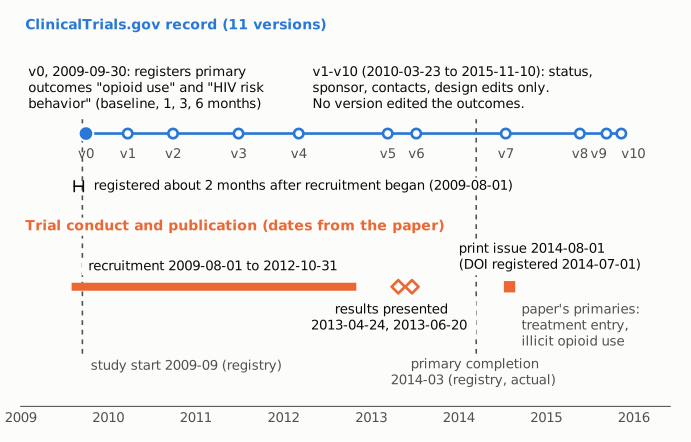
Figure 1. Timeline of the ClinicalTrials.gov record and the trial. The filled blue marker is v0 (2009-09-30), the only version that defined the outcomes. The hollow markers are v1 to v10, none of which edited the primary or secondary outcomes, before or after the registry's actual primary completion date (2014-03). The orange lane shows dates from the paper: recruitment from 2009-08-01 to 2012-10-31 (so v0 came about two months after recruitment began), presentation of the results at two meetings in April and June 2013, and the print issue of 2014-08-01. The Crossref DOI record was created on 2014-07-01; the online-first date could not be confirmed from the publisher. Study start and primary completion are month-level registry dates, drawn mid-month.
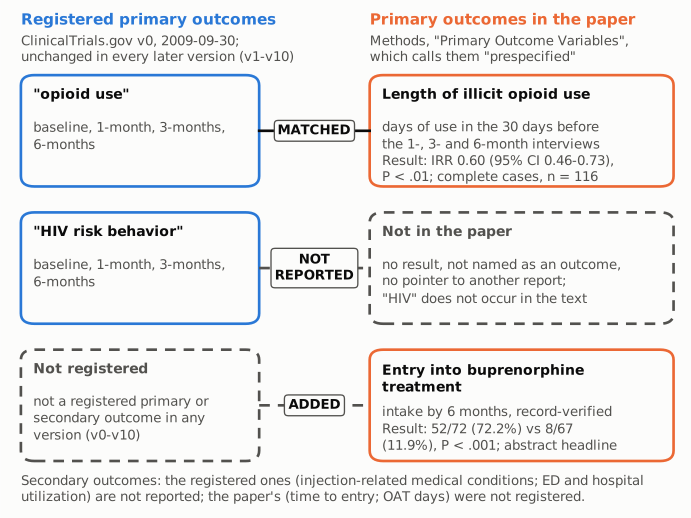
Figure 2. Registered primary outcomes (left; v0, 2009-09-30, unchanged in all later versions) against the outcomes the paper calls its prespecified primary outcomes (right; Methods, "Primary Outcome Variables"). Registered "opioid use" matches the paper's days of illicit opioid use, with the same 1-, 3- and 6-month time points; the paper reports IRR 0.60 (95% CI 0.46-0.73) for it. Registered "HIV risk behavior" has no counterpart in the paper. Entry into buprenorphine treatment appears as a primary outcome in the paper but in no version of the registration, and it carries the abstract's headline result. The note at the foot covers secondary outcomes: neither registered secondary is reported, and the paper's two secondaries were not registered.
Why it matters
The abstract's first and largest result is for an outcome the registration does not list: "linkage participants were more likely to enter buprenorphine OAT than those in the detoxification group (52 [72.2%] vs 8 [11.9%], P < .001)". The abstract conclusion that linkage "is an effective means for engaging medically hospitalized patients who are not seeking addiction treatment" rests on this outcome. Calling it "prespecified" leads readers to treat it as a confirmatory primary result, but the public record does not show that it was prespecified as an outcome at all. Entry into the linked program is also an outcome that follows closely from the intervention itself (the linkage arm was given an intake appointment and a bridging prescription), which makes the choice of primary outcome especially relevant to how the result is read.
For the registered primary outcomes, the paper reports one and not the other:
- Opioid use (registered primary): reported, favourable to linkage. "On the basis of complete case analysis, the estimated rate of illicit opioid use in those in the linkage group was approximately 40% lower (IRR, 0.60; 95% CI, 0.46-0.73; P < .01) than for participants randomized to the detoxification group." Worst-case substitution (IRR 0.73, 95% CI 0.65-0.83) and last observation carried forward (IRR 0.72, 95% CI 0.64-0.81) gave similar results. The second abstract conclusion ("reduces illicit opioid use 6 months after hospitalization") therefore rests on a registered primary outcome. Two caveats come from the paper itself. The abstract describes the IRR as applying to "the 30 days before the 6-month interview", while Results present it as a rate over the whole follow-up. And the outcome is self-reported, with 59.0% follow-up at 6 months that differed by arm ("The linkage group had a significantly higher rate of follow-up at 6 months (χ2 = 6.75, P = .009).").
- HIV risk behavior (registered primary): not reported. The paper gives no result, does not mention it as an outcome, and does not point to another report. Its direction and size cannot be judged from the paper. The registry's Brief Summary presents HIV risk behavior as the outcome the study tests, so its absence changes what the trial can be said to have shown.
The registered secondary outcomes (injection-related medical conditions; emergency department and hospital use) are also not reported. The Discussion suggests the reduction in opioid use "is likely to translate into improved health outcomes", and the Conclusions say future work "should evaluate whether decreased illicit opioid use and increased use of OAT in the 6 months after hospital discharge could have health benefits and prevent subsequent hospitalizations". Emergency department and hospital use was, however, a registered secondary outcome of this trial, with a time frame of baseline to 6 months.
The paper does acknowledge multiplicity in general terms ("Given multiple outcomes, readers concerned about overall type I error rates may consider P < .01 a conservative standard to evaluate statistical significance."), but a reader cannot tell from it how many outcomes were planned or which ones were dropped.
Explanations considered
- Paper role. This is the primary report of the randomized trial: it reports the full randomized sample (139 randomized; 67 detoxification, 72 linkage), and the registry links it as the trial's results publication. The only other publication the registry links (PMID 24045030, Addict Behav 2013) is, by its title, an analysis of days of heroin use and self-reported health among hospitalized heroin users, published before the registry's primary completion date; it is not a report of HIV risk behavior outcomes. The paper does not say HIV risk behavior is being reported elsewhere. This does not account for the discrepancy.
- Disclosure. The paper does not mention the registered outcomes, HIV risk behavior as a planned outcome, an amendment, or any difference from the registration. It calls its primary outcomes "prespecified" without saying where they were prespecified. No protocol or analysis plan is cited or supplied. Nothing in the paper accounts for the discrepancy.
- Protocol amendments. The registry history shows no outcome edit in any of the 11 versions (outcomesUpdateCount 0; primary outcomes last updated in v0), including the versions submitted after primary completion and after publication. An amendment that was made in a protocol but never entered in the registry or the paper cannot be excluded, but it is not documented anywhere available to readers. It may well have legitimate reasons; the issue documented here is that it is not disclosed.
- Wording differences. "Opioid use" and "length of illicit opioid use" are the same construct at the same time points, so that pair is treated as matched. Entry into buprenorphine treatment cannot be read as a rewording of "HIV risk behavior", or of either registered secondary outcome. The paper's "persistence in"/"sustained engagement" in treatment likewise has no registered counterpart.
- Time-point differences. None for opioid use: both use 1, 3 and 6 months (the registry adds baseline). Time points do not explain the other differences.
- Registration timing. v0 was submitted about two months after recruitment began. That makes v0 a registration made during recruitment rather than before it, but it is still the only public statement of the trial's outcomes and long predates the results. It does not explain why the paper's primary outcomes differ from it.
Status
As of 2026-10-23:
- Registry history. The ClinicalTrials.gov version list and history summary (11 versions, v0 to v10, 2009-09-30 to 2015-11-10; primaryOutcomesSame true, outcomesUpdateCount 0) were retrieved from the ClinicalTrials.gov history API on 2026-10-22, together with the full v0 record. Versions v6 (2013-07-08, the last before the likely online-first date) and v7 (2014-07-16, the last before the print issue) were fetched individually in an earlier check of this record and list the same two primary outcomes. On 2026-10-23 the history endpoints returned HTTP 403. The current record (v2 API, fetched 2026-10-23, last updated 2015-11-10) still lists "opioid use" and "HIV risk behavior" as the primary outcomes. An independent re-check, which could not reach the history endpoints, found an Internet Archive snapshot of the record dated 2011-10-19 with the same primary and secondary outcomes.
- Publisher version. The journal page (jamanetwork.com, by DOI and full-article URL) returned 403 or a CAPTCHA, so the quoted text could not be checked against the publisher's version of record, and no publisher correction notice could be looked for there. The quotes above are from the PubMed Central copy (released 2016-03-29), which appears to be the NIH-deposited author manuscript.
- Corrections. No corrections, retractions, expressions of concern or update notices were found in PubMed Central, Crossref (no update-to or relation entries) or Europe PMC. Europe PMC links one item, PMID 24978013 (JAMA Intern Med 2014;174(8):1377-8), as "Comment in"; that is a commentary, not a correction.
- PubPeer. The search returned a human-verification block, so no PubPeer result could be obtained.
- COMPare. Not applicable: it covered trials published in 2015-16 in five journals, not including JAMA Internal Medicine.
Sources: ClinicalTrials.gov NCT00987961 (current record, version history and v0, v6, v7 records); PMC4811188 as archived in PubMed Central; Crossref and Europe PMC metadata for doi:10.1001/jamainternmed.2014.2556.
Suggested correction
A correction or clarification notice could:
- State the primary and secondary outcomes as registered at ClinicalTrials.gov (NCT00987961, first submitted 2009-09-30 and unchanged since): opioid use and HIV risk behavior at baseline, 1, 3 and 6 months; secondary outcomes injection-related medical conditions and emergency department and hospital use.
- Say when and why entry into buprenorphine treatment became a primary outcome and HIV risk behavior was dropped, and point to the document (protocol, grant application or analysis plan) in which the outcomes described as "prespecified" were set out, ideally making that document available.
- Report the results for HIV risk behavior and for the registered secondary outcomes, or say where they are reported or why they cannot be.
- Label entry into buprenorphine treatment in the abstract and Methods as an outcome not listed in the trial registration, and make the abstract's description of the illicit opioid use IRR match the Results.
The registry record could also be updated with a note describing the outcomes as analysed, so that readers of either source can see the relationship between them.