← Back to the plain-language case
HTC uptake, the trial's first primary outcome, appears in no version of its registration
PLoS Med (2014) · doi:10.1371/journal.pmed.1001768 · PMC4267810 · NCT01459120
Summary
This cluster-randomized trial compared home-based HIV testing and counseling (HB-HTC) with mobile clinic HTC (MC-HTC) in rural Lesotho. The paper names uptake of HTC as its first primary outcome, states its main hypothesis in terms of uptake, bases its sample size on uptake, and leads the abstract results with uptake (92.5% vs 86.7%, aOR 2.06, p = 0.011). None of the four versions of ClinicalTrials.gov record NCT01459120 lists HTC uptake as a primary or a secondary outcome, and the registered outcomes never changed between versions. The paper has a section on deviations from the registration, but it discloses only that a registered cluster-level outcome was dropped, and it describes uptake as one of the endpoints that "were kept", which the record does not bear out.
What was registered
ClinicalTrials.gov holds four versions of NCT01459120. The record history lists them as v0 (submitted 2011-10-18, QC 2011-10-21, first posted 2011-10-25), v1 (2011-10-31; modules changed: Study Status, Contacts/Locations; the start date went from 2011-11 to 2011-10), v2 (2011-12-09; Study Status, Contacts/Locations) and v3 (2012-02-08, posted 2012-02-09; Study Status only; status COMPLETED; primary completion 2012-02, actual). The history summary reports primaryOutcomesSame: true, secondaryOutcomesSame: true and an outcomes update count of 0. I compared the outcomes module of v0, v1 and the current record (v3) field by field. They differ only in HTML character encoding (for example HIV/AIDS for HIV/AIDS) and line breaks. Enrollment is 1800 (ESTIMATED) in every version.
The five registered primary outcomes, identical in v0 (2011-10-18) through v3 (2012-02-08), are quoted here from the current record:
- "Proportion of newly tested HIV-positive clients over all clients tested for HIV during the campaigns". No time frame is given.
- "Proportion of clients newly tested HIV-positive who enrolled into HIV/AIDS care within one month over all clients newly tested HIV-positive during the campaigns". Time frame: "4 weeks after tested positive".
- "Overall number newly tested HIV-positive and enrolled into chronic HIV/AIDS-care at each facility". Time frame: "4 weeks after campaign". The description says this compares the facility-level total "Irrespective if these patients were tested during one of the campaigns or during routine activities at the facility" and the total "from the 5 villages where campaigns were held as compared to the five villages where no campaigns were held."
- "Absolute number of newly tested HIV-positive clients". No time frame is given.
- "Absolute number of clients newly tested HIV-positive who enrolled into HIV/AIDS care". Time frame: "4 weeks after tested HIV-positive".
The ten registered secondary outcomes cover CD4 count, WHO stage, four tuberculosis screening and sputum outcomes with their absolute-number counterparts, "Proportion of first-time HIV-testers among all clients accessing the testing services" and "Demographic characteristics of clients accessing the voluntary counseling and testing services". No primary or secondary outcome measures acceptance of testing among the people offered it. In outcome 1, "all clients tested" serves only as the denominator for HIV positivity.
What the paper reports
Methods, "Study Hypothesis, Design, and Setting":
The study's main hypothesis was that the HB-HTC approach would result in a higher uptake of HTC than the MC-HTC approach among individuals accessing the multi-disease campaigns.
The same section dates the trial "from 17 October to 25 November 2011".
Methods, "Outcomes at the Individual Level":
The trial had three primary and five secondary outcomes. The first primary outcome was the number of persons taking up HTC.
Uptake was defined as acceptance and completion of HTC with pre-test counseling, HIV test, and post-test counseling.
The second primary outcome was the proportion of participants newly tested HIV-positive among participants who took up HTC.
The third primary outcome was linkage to care within 28 d after a positive HIV test among participants who tested HIV-positive during the campaign.
Methods, "Sample Size and Statistical Analysis":
we estimated that HTC uptake would be about 65% in the MC-HTC arm
Abstract, "Methods and Findings":
The trial was powered to test the hypothesis of higher HTC uptake in HB-HTC campaigns than in MC-HTC campaigns.
Overall HTC uptake was higher in the HB-HTC group than in the MC-HTC group (92.5% versus 86.7%; adjusted odds ratio [aOR]: 2.06; 95% CI: 1.18–3.60; p = 0. 011)
(The space in "0. 011" is in the archived text.)
Methods, "Deviations from Initial Trial Registration", which is the paper's only statement about the registration:
Aggregate data from clusters on numbers of persons newly tested HIV-positive through routine facility-based HTC during the 28 d following the study campaigns were initially registered as one of the primary outcomes. While finalizing the internal study protocol, cluster data were dropped as a primary outcome because the trial was designed and powered to measure differences in outcomes at the individual level and not at the cluster level. Only individual endpoints were kept as primary outcomes—uptake of HTC, participants newly detected HIV-positive, and subsequent enrollment in HIV care—as these endpoints represent the three major steps of the HTC cascade. Nevertheless, description of cluster data was maintained and is reported in this paper.
Table 2 ("Primary outcomes") reports, for HB-HTC vs MC-HTC: uptake of HTC overall 92.5% (1,083/1,171) vs 86.7% (1,207/1,392), aOR 2.06 (1.18–3.60), p = 0.011; participants newly detected HIV-positive 3.6% (39/1,083) vs 6.2% (75/1,207), aOR 0.64 (0.48–0.86), p = 0.002; linkage to care 25.6% (10/39) vs 25.3% (19/75), aOR 0.99 (0.35–2.79), p = 0.978.
The supporting information includes Text S2, "Trial protocol", an undated internal protocol for a study "to be held from October to December 2011". Its outcome table lists "Proportion and absolute number of clients accepting HTC" first among the primary outcomes, and its sample-size section reads "Expected difference in HTC-uptake between study-arms (1st primary outcome): 80% (door-to-door) versus 65% (pitso)". The protocol does not mention the registry record.
The discrepancy
| Outcome | Registered (version, date) | In the paper | Status |
|---|---|---|---|
| Uptake of HTC (acceptance and completion of testing among eligible attendees) | Not registered, as primary or secondary, in v0 (2011-10-18), v1, v2 or v3 (2012-02-08) | First primary outcome; main hypothesis; basis of the sample size; first result in the abstract (aOR 2.06, p = 0.011) | added (not disclosed) |
| Proportion newly HIV-positive among those tested | Primary 1, v0–v3 | Second primary outcome: 3.6% vs 6.2%, aOR 0.64, p = 0.002 | matched |
| Proportion newly HIV-positive enrolled in care within one month / 4 weeks | Primary 2, v0–v3 | Third primary outcome, "within 28 d": 25.6% vs 25.3%, aOR 0.99, p = 0.978 | matched (4 weeks = 28 d) |
| Facility-level number newly HIV-positive and enrolled in care, 4 weeks after campaign | Primary 3, v0–v3 | Dropped as primary; reported descriptively (49 newly HIV-positive at facilities in 28 d; 7 from control villages); no arm comparison; facility-level enrolment not reported | demoted (disclosed) |
| Absolute number newly HIV-positive | Primary 4, v0–v3 | Counts 39 vs 75 shown within the second primary outcome; not named as a primary outcome | demoted (reported as count, not disclosed) |
| Absolute number newly HIV-positive enrolled in care, 4 weeks | Primary 5, v0–v3 | Counts 10 vs 19 shown within the third primary outcome; not named as a primary outcome | demoted (reported as count, not disclosed) |
Figures
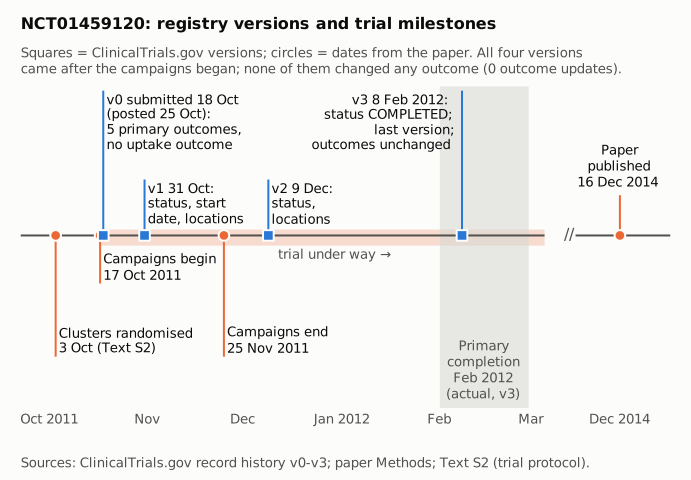
Figure 1. Timeline of the trial. Squares are ClinicalTrials.gov versions; circles are dates from the paper and its Text S2 protocol. Clusters were randomised at a meeting "held on October the 3rd" (Text S2; its campaign timetable runs from 17 October 2011), and campaigns ran from 17 October to 25 November 2011. The record was first submitted on 18 October 2011, one day after the campaigns began. All four versions therefore came after the study started, and v3 (8 February 2012, status COMPLETED) falls in the month of primary completion. No version changed any outcome; the versions changed only status, dates and locations. The record was not updated again before publication on 16 December 2014 (the axis is broken between March 2012 and December 2014).
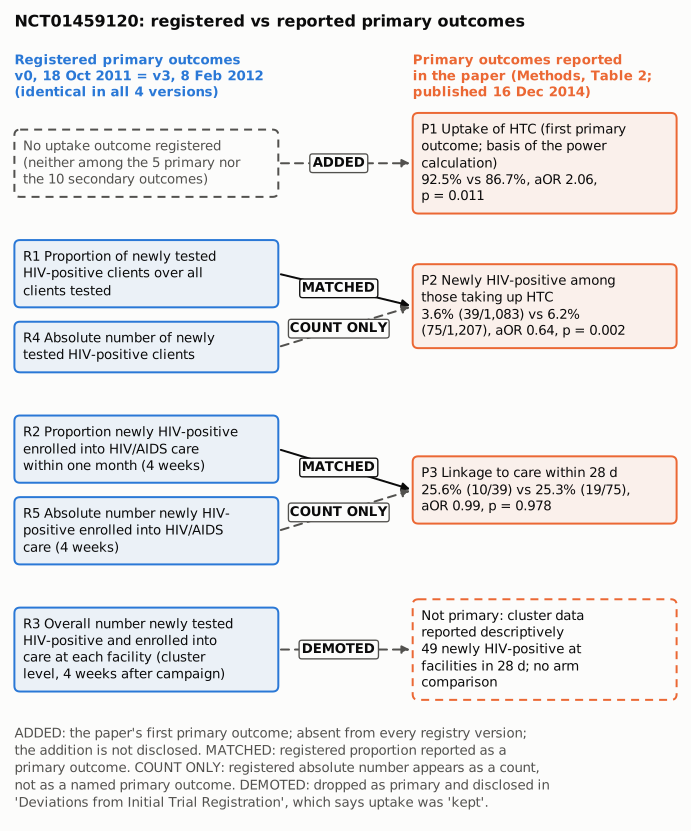
Figure 2. Registered primary outcomes (left, blue; v0 of 18 October 2011, unchanged through v3 of 8 February 2012) and the primary outcomes reported in the paper (right, orange), with each registered item's fate labelled. The paper's first primary outcome, HTC uptake, has no registered counterpart in any version (ADDED). The two registered proportions match the paper's second and third primary outcomes (MATCHED), whose results are shown in the boxes, including the null linkage result. The registered absolute numbers appear only as counts (COUNT ONLY). The cluster-level outcome was dropped as primary and reported descriptively (DEMOTED), which is the only change the paper discloses.
Why it matters
Uptake is the outcome on which the paper's design and headline rest. The main hypothesis, the power calculation and the first result in the abstract all concern uptake, and the abstract's conclusion that "HB-HTC was better in reaching children, individuals who had never tested before, and men" draws on it. A reader who checks the registration to see whether the main comparison was pre-specified finds no uptake outcome at all. The deviations section says uptake was "kept" as a primary outcome, which reads as if uptake had been registered.
The uptake result is also sensitive to how it is analysed. The paper reports that "This overall difference was due to a much higher uptake in the age group <12 y in the HB-HTC group (Table 2)", where uptake was 87.5% vs 58.7% (aOR 4.91). It also reports that "Among participants ≥12 y of age, uptake tended to be lower in the HB-HTC group compared to the MC-HTC group (Table 2)": 94.7% vs 97.1% at 12–24 y (aOR 0.59, p = 0.322) and 93.9% vs 96.1% at ≥25 y (aOR 0.61, p = 0.117). Without a registered definition, a reader cannot tell from the registry which population and analysis were intended to carry the primary comparison.
For the registered primary outcomes the paper does report results, in full. The registered first primary (proportion newly HIV-positive among those tested) favoured the comparator: 3.6% (39/1,083) with HB-HTC vs 6.2% (75/1,207) with MC-HTC, aOR 0.64 (0.48–0.86), p = 0.002. The registered second primary (linkage to care within one month) was null: 25.6% (10/39) vs 25.3% (19/75), aOR 0.99 (0.35–2.79), p = 0.978. The abstract states both. The registered facility-level outcome was not compared between arms, which the paper discloses. So no registered primary outcome is hidden. What the registry does not support is the paper's framing of uptake as the pre-specified, powered primary outcome. On the two registered individual-level primary outcomes, the intervention arm was not better.
Explanations considered
- Paper role. This is the main report of the trial, not a secondary or exploratory analysis. Its outcomes should be compared with the registered primary outcomes.
- Disclosure. The "Deviations from Initial Trial Registration" section discloses one change: the cluster-level outcome was dropped. It does not say that uptake was absent from the registration, or that it was added, and its wording ("were kept") implies the opposite. The paper does not disclose that the registered absolute-number outcomes are not treated as separate primary outcomes, though the counts are reported. The disclosure therefore does not account for the main discrepancy.
- Protocol amendments and registry edits. The registry history rules out a change in the record: the outcomes module is the same in all four versions, so uptake was never registered and then removed. The paper attributes its outcome set to "finalizing the internal study protocol". Text S2, the internal protocol, does list uptake as the first primary outcome and powers on it, so uptake was pre-specified there. But Text S2 is undated (it speaks of a study "to be held from October to December 2011") and does not say whether it was written before or after the registration, and the registration was never brought into line with it. A pre-specified internal protocol is a legitimate reason for the outcome set the paper uses; the issue is that the paper does not tell readers that the public registration differs from it.
- Wording differences. No registered outcome measures uptake under other words. Registered primary 1 uses "all clients tested" only as a denominator for HIV positivity. The registered secondary outcome "Proportion of first-time HIV-testers among all clients accessing the testing services" is a different quantity, and the paper reports it separately as its second secondary outcome. "Demographic characteristics of clients accessing the voluntary counseling and testing services" is descriptive and also does not measure acceptance of testing.
- Time point. The registered "within one month" / "4 weeks" for linkage and the paper's "within 28 d" are equivalent, so the matched outcomes are not affected.
- Registration timing. The record was first submitted on 18 October 2011, the day after campaigns began on 17 October and about two weeks after randomisation (Text S2). This is a separate, minor timing point; it does not explain the absence of uptake, since no later version added it.
- Enrollment. The registry's estimated enrollment of 1800 was never updated; the paper analysed 2,563 eligible participants from 3,197 attendees. This is a minor, separate point and does not bear on the outcome discrepancy.
Status
As of 2026-10-23:
- Registry history. Four versions, v0 to v3 (2011-10-21 QC through 2012-02-08). The version list, v0 and v1 were retrieved from the ClinicalTrials.gov history endpoints on 2026-10-22, and higher version numbers returned no version. On 2026-10-23 those endpoints returned HTTP 403, so v2 and v3 were not re-fetched; v3 is the current record, retrieved through the v2 API on 2026-10-23. The outcomes in v0, v1 and the current record are identical apart from character encoding, and the history summary reports no outcome update in any version.
- Publisher version. The PLoS Medicine article page (published 16 December 2014; received 13 September 2013; accepted 3 November 2014) links no correction, erratum, expression of concern or retraction. Its supporting information includes Text S1 (CONSORT table), Text S2 (trial protocol) and Table S1 (costs).
- Corrections. No Crossref update, PMC notice or Europe PMC notice was found (
src/known.py). - PubPeer. The PubPeer browser-extension lookup for the DOI returned no comments. An earlier web search found no thread.
- Sources. PMC4267810 as archived in PubMed Central; Text S2 from the publisher's supporting information; ClinicalTrials.gov NCT01459120 current record and record history; Crossref, PMC and Europe PMC notice searches; PubPeer.
Suggested correction
A correction to the article could state that HTC uptake, reported as the first primary outcome and the basis of the sample-size calculation, was not listed as a primary or secondary outcome in any version of ClinicalTrials.gov record NCT01459120. It could say that uptake was specified as a primary outcome in the internal protocol (Text S2), and give that protocol's date relative to the registration (18 October 2011) and the start of the campaigns (17 October 2011) if it is known. The sentence in "Deviations from Initial Trial Registration" that says uptake was "kept" as a primary outcome could be revised to say that uptake was added relative to the registration. The same section could note that registered primary outcomes 4 and 5 (absolute numbers) are reported as counts rather than as separate primary outcomes. The sponsor could also add a note to the registry record, or post results there, that points readers to the outcome set actually analysed.