← Back to the plain-language case
Registered primary outcome is overall survival; the final report uses melanoma-specific survival without comment
N Engl J Med (2014) · doi:10.1056/NEJMoa1310460 · PMC4058881 · NCT00275496
Summary
Every version of the ClinicalTrials.gov record for MSLT-I (NCT00275496), from the first on 2006-01-10 to the current one dated 2015-09-01, gives one primary outcome: whether sentinel-node biopsy with selective lymphadenectomy "will effectively prolong overall survival", with a 10-year time frame added in 2009. The final trial report states instead that "The primary end point was melanoma-specific survival (survival until death from melanoma)." The paper does not mention the registered outcome or explain the difference, and it reports no overall-survival estimate, hazard ratio or curve. The only all-cause mortality information in the paper is a set of crude death counts in the Fig. 1B flow diagram. The trial was registered about 12 years after it started, so the registry entry may not reflect the original protocol. Even so, the registered primary outcome had been public for eight years before publication and the paper does not reconcile the two.
What was registered
ClinicalTrials.gov has 10 versions of the record. All of them postdate the study start (1993-11) and the end of enrollment (2002). The primary outcome measure text is the same, character for character, in all 10:
To determine whether wide excision of the primary with intraoperative lymphatic mapping (LM) followed by selective lymphadenectomy will effectively prolong overall survival compared to wide excision of the primary melanoma alone.
| Version | Date | Primary outcome | What changed in Outcome Measures |
|---|---|---|---|
| v0 | 2006-01-10 (first submitted; first posted 2006-01-12) | text above, no time frame | first registration |
| v1 | 2006-01-20 | unchanged | secondary only: "Sentinel node metastases in WEX arm; Incidence of nodal metastases" became "Incidence of Sentinel Node Metastases (biopys) vs clinical metastases (observation)" |
| v2, v3 | 2006-11-29, 2007-11-02 | unchanged | none (Study Status, References) |
| v4 | 2009-04-30 | unchanged; time frame "10 years" added | "10 years" added to primary and secondary; "biopys" corrected to "biopsy" |
| v5, v6 | 2011-11-07, 2012-07-30 | unchanged | none (v6 records primary completion 2012-06, actual) |
| v7 | 2012-11-19 (last version before publication) | unchanged, "10 years" | none (Study Status, References) |
| v8, v9 | 2014-05-13, 2015-09-01 | unchanged, "10 years" | none (Study Status only) |
The registered secondary outcomes in v4 to v9 are: "Disease-free survival; Incidence, timing, and anatomic distribution of distant metastases; Morbidity of procedures; Significance of TA90 levels; Incidence of Sentinel Node Metastases (biopsy) vs clinical metastases (observation); Accuracy of LM" (time frame "10 years"). Melanoma-specific survival does not appear as a primary or secondary outcome in any version.
Other registry dates: study start 1993-11; primary completion 2012-06 (actual); last update posted 2015-09-02. The current record lists this paper (PMID 24521106) as a "derived" citation and three "result" citations: the 2006 third interim report (N Engl J Med 2006 Sep 28, PMID 17005948); a 2010 Ann Surg Oncol paper on morbidity and length of stay after early versus delayed completion lymphadenectomy (PMID 20614193); and a 2012 Ann Surg Oncol paper on metastasectomy for distant metastases in MSLT-I patients (PMID 22648554). The two Ann Surg Oncol citations first appear in v7. The registry records masking as None (open label) in every version.
What the paper reports
The primary end point, in Methods, Statistical Analysis (first paragraph):
The primary end point was melanoma-specific survival (survival until death from melanoma). The secondary end points, described previously,11,12 included disease-free survival, survival with tumor-positive or tumor-negative sentinel nodes, and the incidence of sentinel-node metastases, as compared with the incidence of clinically detected nodal metastases.
References 11 and 12 are the 2006 third interim report in the same journal and a 1999 Ann Surg report on the accuracy of lymphatic mapping (PMC1420894). Neither is a protocol or a statistical analysis plan.
The registration appears once, at the end of the abstract:
(Funded by the National Cancer Institute, National Institutes of Health, and the Australia and New Zealand Melanoma Trials Group; ClinicalTrials.gov number, NCT00275496.)
The main results for the paper's own primary end point (abstract; Results, Survival Rates):
No significant treatment-related difference in the 10-year melanoma-specific survival rate was seen in the overall study population
hazard ratio for death from melanoma in the biopsy group, 0.84; 95% confidence interval [CI], 0.64 to 1.09; P = 0.18
This is for patients with intermediate-thickness melanomas (1.20 to 3.50 mm), the primary study group.
The analysis methods name only melanoma-specific and disease-free survival (Methods, Statistical Analysis, third and fourth paragraphs):
The Kaplan–Meier method was used to estimate mean 5-year and 10-year rates of melanoma-specific and disease-free survival.
Comparisons of melanoma-specific and disease-free survival were based on data from patients who underwent their assigned treatment.
The Discussion (fourth paragraph) refers to survival without saying which kind:
We did not see a significant survival advantage for all patients with intermediate-thickness melanomas.
The design changes the paper does disclose are a larger sample size ("After the second interim analysis, the sample size for the intermediate-thickness group was increased to 1200 patients") and the latent-subgroup method ("In post hoc analyses, a latent-subgroup analytic method was developed"). Both are in Methods, Statistical Analysis.
What the paper does not contain: searches of the full text as archived in PMC (abstract, body, table, figure legends) for "overall survival", "all-cause", "any cause" and "amend" find nothing. Every use of "protocol" refers to the per-protocol analysis. The one use of "registered" refers to enrollment ("Enrollment closed in 2002, after 2001 patients had been registered."). The Supplementary Appendix archived with the PMC manuscript (16 pages) has no overall-survival analysis and no statement about end points or protocol amendments. Its survival analyses are all melanoma-specific, disease-free or distant disease-free.
All quotations above were checked verbatim with src/show.py PMC4058881 --grep, and each full quotation occurs exactly once in the archived text. The Fig. 3 legend repeats the definition "survival until death from melanoma". Registry quotations were checked against the archived version records and the current API v2 record.
The discrepancy
| Outcome | Registered (version, date) | In the paper | Status |
|---|---|---|---|
| Overall survival (death from any cause), 10 years | Primary in every version, v0 2006-01-10 to v9 2015-09-01 (time frame "10 years" from v4 2009-04-30; v7 2012-11-19 is the last version before publication) | Not named as an end point. No estimate, hazard ratio or curve. Fig. 1B gives only crude counts of deaths by cause | not reported |
| Melanoma-specific survival, 10 years | In no version, as either primary or secondary | "The primary end point was melanoma-specific survival" | added (as primary) |
| Time frame of the primary outcome | 10 years (from v4 2009-04-30) | 10-year rates | matched |
| Disease-free survival, 10 years | Secondary, all versions (time frame "10 years" from v4 2009-04-30) | Secondary. The abstract's conclusions cite it first as a treatment benefit | matched |
| Incidence of sentinel-node metastases vs clinical metastases | Secondary, v1 onward | Secondary ("the incidence of sentinel-node metastases, as compared with the incidence of clinically detected nodal metastases") | matched |
| Distant metastases (incidence, timing, distribution) | Secondary, all versions | Reported as distant disease-free survival in the node-positive subgroup (Results; Fig. S2) | matched (as distant disease-free survival) |
| Survival with tumor-positive or tumor-negative sentinel nodes | In no version | Secondary | added (as secondary) |
The core finding is two rows: the registered primary outcome (overall survival) is not reported, and a different measure (melanoma-specific survival) is reported as the primary end point. Neither the substitution nor the reason for it is stated in the paper.
Figures
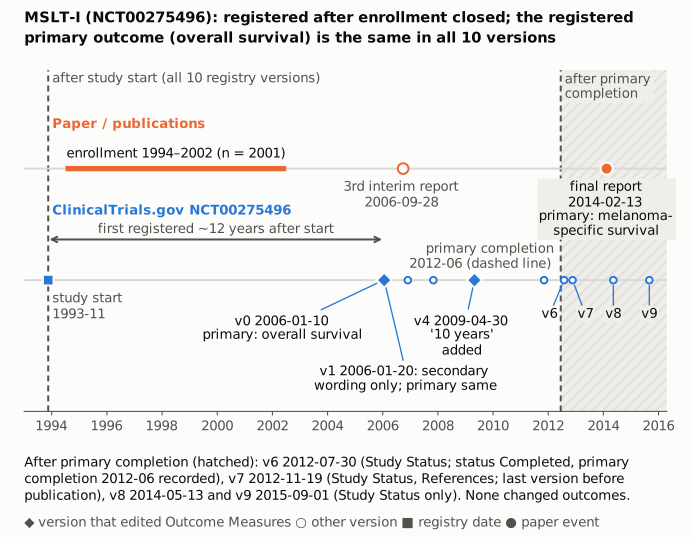
Figure 1. Timeline of the trial and its registry record. The trial started in 1993-11 (registry; the paper says it "commenced in 1994") and enrolled 2001 patients until 2002. It was first registered on 2006-01-10, about 12 years after the start. Every registry version therefore postdates the study start and the end of enrollment. Diamonds mark the versions that created or edited the Outcome Measures module: v0 (primary outcome overall survival), v1 (secondary wording only) and v4 (time frame "10 years" added to the unchanged primary). Open circles mark versions that changed other modules. The hatched band, bounded by the dashed line, is the period after primary completion (2012-06). The four versions in it did not touch outcomes: v6 (2012-07-30, Study Status; status set to Completed and primary completion 2012-06 recorded as actual), v7 (2012-11-19, Study Status and References; the last version before publication), and v8 (2014-05-13) and v9 (2015-09-01), Study Status only. The final report (2014-02-13) names melanoma-specific survival as its primary end point. Sources: ClinicalTrials.gov record history; the paper as archived in PMC; the registry's reference to the 2006 interim report.
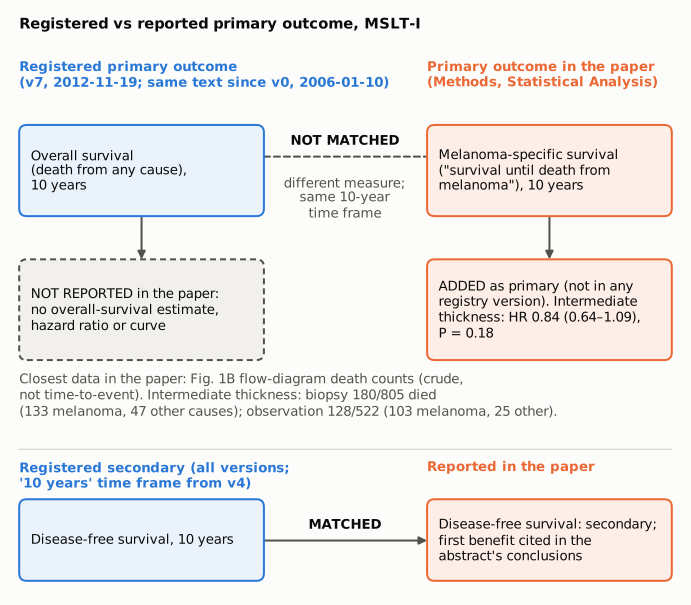
Figure 2. Registered primary outcome versus the primary end point in the paper. Left, in blue: the registry's primary outcome as of v7 (2012-11-19), the last version before publication, worded the same since v0 (2006-01-10). Right, in orange: the paper's stated primary end point. The two use the same 10-year time frame but measure different things: overall survival counts deaths from any cause, while melanoma-specific survival counts only deaths from melanoma. The paper gives no overall-survival result. The nearest data are the crude counts of deaths by cause in the Fig. 1B flow diagram, which are not time-to-event estimates and do not account for losses to follow-up. Melanoma-specific survival appears in no registry version. Its result in the primary study group is null (hazard ratio 0.84, 95% CI 0.64 to 1.09, P = 0.18). Disease-free survival, a registered secondary outcome, is reported as a secondary end point.
Why it matters
Overall survival and melanoma-specific survival differ in more than wording. Melanoma-specific survival treats deaths from other causes as censored, so a treatment effect on non-melanoma mortality cannot appear in it. It also depends on cause-of-death attribution, which may not be blinded in an open surgical trial (the registry records masking: None in every version). For a comparison of an extra surgical procedure (sentinel-node biopsy, with immediate completion lymphadenectomy when positive) against observation, all-cause mortality is the outcome the registry named, and it captures any harm or benefit regardless of cause.
What the paper reports for the registered primary outcome: no estimate. No overall-survival rate, hazard ratio, P value or Kaplan–Meier curve appears in the abstract, main text, Table 1, figure legends or the archived Supplementary Appendix. The only related information is in the Fig. 1B flow diagram (image), which lists deaths by cause among patients included in follow-up. For intermediate-thickness melanomas: biopsy group 133 died from melanoma and 47 from other causes, 180 of 805 in all (22.4%); observation group 103 and 25, 128 of 522 (24.5%). For thick melanomas: biopsy 68 and 19, 87 of 185 (47.0%); observation 43 and 9, 52 of 126 (41.3%). These are crude proportions with unequal losses to follow-up (120 and 68 in the intermediate groups; 18 and 9 in the thick groups). They are not a substitute for the registered time-to-event analysis, and this write-up draws no inference about treatment effect from them. They show that the paper did record deaths from other causes, so an overall-survival analysis was possible from the trial data.
The abstract's positive conclusions rest on outcomes other than the registered primary: disease-free survival (a registered secondary), melanoma-specific and distant disease-free survival in the node-positive subgroup (a comparison the paper itself says raises "concern about ascertainment bias"), and a post hoc latent-subgroup analysis. The paper's own primary end point is stated openly as null in the whole primary study group. A reader comparing the paper with the registry cannot tell from the paper whether the registered overall-survival comparison was done or what it showed.
Explanations considered
- Paper role. This is the final report of the main trial: the title says "Final Trial Report", and the paper reports 10-year results for the primary study group and names its own primary end point. It is the report in which the registered 10-year primary outcome would be expected. It is not a secondary analysis or a subgroup paper. Does not account for it.
- Disclosure in the paper. The registry number appears only in the abstract's funding line. The paper does not mention overall survival, the registered outcome, or any difference from the registry. The secondary end points are said to be "described previously" (refs 11 and 12), but the paper gives no comparable reference or explanation for its primary end point. Not disclosed.
- Protocol amendment. The paper discloses two design changes, the sample-size increase after the second interim analysis and the post hoc latent-subgroup method, but no change to the primary end point. No protocol or statistical analysis plan is cited or provided. The archived Supplementary Appendix contains none. The registry's primary outcome never changed across 10 versions, so there is no registry-side amendment either. No amendment documented in either source.
- Wording differences. "Overall survival" and "melanoma-specific survival" are standard, distinct end points, and the paper defines its own narrowly as "survival until death from melanoma". The registry entry is phrased as an objective ("To determine whether…"), not a formal measure, but "overall survival" is explicit in it. Cannot be read as a rewording of the same outcome.
- Time point. Both are 10-year outcomes (registry time frame "10 years" from v4; paper reports 10-year rates). No time-point issue.
- Retrospective registration. The trial was registered in 2006, after enrollment had closed in 2002. The registry entry may therefore not match the original protocol, and there is no pre-start version to compare. The abstract of the 2006 third interim report already reported melanoma-specific and disease-free survival. I could not read that report's full text to see whether it names a primary end point. This could explain why the investigators used melanoma-specific survival. It does not explain why the final report leaves a public registration's primary outcome unmentioned and unreported. Mitigates the significance of the change, not the non-disclosure.
- Outcomes split across papers. The registry lists a single primary outcome. Results for thin melanomas are described as "exploratory" and "not reported on in this article", but that concerns a cohort, not the overall-survival end point. The registry links three MSLT-I "result" publications besides this paper. One is the 2006 interim report; neither of the other two reports 10-year overall survival by randomized group: the 2010 Ann Surg Oncol paper (PMID 20614193) compares morbidity and length of stay after early versus delayed lymphadenectomy, and the 2012 Ann Surg Oncol paper (PMID 22648554) compares survival after a stage IV diagnosis by treatment received (surgery versus systemic therapy alone). Both full texts were read in PMC (PMC2970739, PMC3405182). I did not find a separate MSLT-I publication reporting 10-year overall survival as the primary outcome. Does not account for it on present evidence.
Status
As of 2026-10-23:
- Registry history: all 10 versions read through the ClinicalTrials.gov internal history API (
/api/int/studies/NCT00275496?history=trueand/history/0to/history/9; the version list and v0 cached 2026-10-22, v1 to v9 cached 2026-10-23; these endpoints now return HTTP 403 from this machine, so the cached copies were used) and the current record through API v2 (re-fetched 2026-10-23). The primary outcome is unchanged in every version, and the current record still lists overall survival. - Publisher version: the text checked is the NIH author manuscript archived in PMC (PMC4058881), including the Fig. 1 flow-diagram image and the Supplementary Appendix PDF archived with it. The publisher's page at nejm.org returned HTTP 403, so the version of record there was not compared directly.
- Corrections:
src/known.pyfound no Crossref update-to records, no PMC notices and no Europe PMC correction or retraction notices for 10.1056/NEJMoa1310460. The reference list's erratum note belongs to the 2006 interim report (ref 11), not this paper. Europe PMC links published comments (an editorial in the same journal, N Engl J Med 2014;370:663-4, correspondence, and comments in other journals) but no erratum. - Correspondence: the May 2014 letters and authors' reply (N Engl J Med 2014;370(22):2148-50, doi:10.1056/NEJMc1402989). The authors' reply is archived in PMC (PMC4522311) and was read in full. It answers points about recurrence prevention, the nodal-metastasis curves, subgroup offsetting and earlier trials, and gives a whole-population distant disease-free survival result that is not in the paper (hazard ratio 0.89, P = 0.34). It does not mention overall survival, the registration or the choice of primary end point. The letters themselves (PMIDs 24869727 and 24869728) are not in PMC and nejm.org returned HTTP 403, so they were not read; what the reply answers suggests their topics, but whether any letter raised overall survival is unknown.
- PubPeer: the PubPeer API returned HTTP 403 (Cloudflare challenge), so PubPeer was not checked.
- Sources: ClinicalTrials.gov NCT00275496 (current record and version history); the article as archived in PubMed Central; Europe PMC records for this paper and for the 2006 and 2005 MSLT-I reports; the authors' reply to the May 2014 correspondence (PMC4522311); the two registry-linked Ann Surg Oncol papers (PMC2970739, PMC3405182); Crossref.
Suggested correction
The authors and journal could add a correction or a note to the article that:
- States that the ClinicalTrials.gov record (NCT00275496, first registered 2006-01-10) lists overall survival at 10 years as the primary outcome, and that the paper's primary end point is melanoma-specific survival.
- Says when and why the primary end point was set as melanoma-specific survival. If the original pre-2006 protocol named melanoma-specific survival, the correction could say so and make that protocol available.
- Reports the registered primary outcome: 10-year overall survival by randomized group in the intermediate-thickness (primary study) group, with the Kaplan–Meier estimates, hazard ratio, 95% CI and P value, analyzed the same way as the melanoma-specific survival results (and by intention to treat).
- If the registry entry does not reflect the protocol, the sponsor could update ClinicalTrials.gov with a dated note explaining the difference, so the record and the publication agree.