← Back to the plain-language case
Abstract says VEGFR1 is downregulated in hyperlipidemic mice; the Results and Discussion report an increase
Nat Med (2012) · doi:10.1038/nm.2759 · PMC3959651
Summary
The Abstract states that "we observed VEGFR1 downregulation in hyperlipidemic mice", but the paper's only mouse experiments (Apoe-null and Ldlr-null versus wild-type C57BL/6 mice, Fig. 3c–e) are reported in the Results as showing "increased endothelial-specific Vegfr1 expression", and the Discussion says Ldlr-null endothelial cells "express elevated amounts of Vegfr1". Of the eight main-text statements that give VEGFR1's direction when ApoB-lipoprotein levels are raised or lowered, seven have VEGFR1 moving with the lipoproteins, as the paper's model requires; the Abstract's mouse clause is the only exception. The data and the main conclusion are unaffected, but the Abstract gives the paper's only mammalian in vivo result the wrong sign, which, read alone, implies that hyperlipidemia lowers an anti-angiogenic decoy receptor. The same wording is in the version of record and the PubMed abstract, and no correction has been issued.
What the paper reports
The Abstract sentence:
Mechanistically, we identified downregulation of vascular endothelial growth factor receptor 1 (VEGFR1), which acts as a decoy receptor for VEGF, as a key mediator of the endothelial response to lipoproteins, and we observed VEGFR1 downregulation in hyperlipidemic mice.
Abstract, second-to-last sentence
The same mouse experiments as described in the body:
In addition, hyperlipidemic Apoe- or Ldlr-null mice (reviewed in refs. 27,28) also showed increased endothelial-specific Vegfr1 expression compared to control WT mice (Fig. 3c–e), confirming conservation of this pathway in higher vertebrates.
Results, VEGFR1 paragraph (last sentence)
The finding that endothelial cells of Ldlr-null mice express elevated amounts of Vegfr1 highlights the potential role of alternative lipoprotein receptors in mediating the endothelial response.
Discussion, paragraph 2
(e) Semiquantitative RT-PCR measurement of Vegfr1 mRNA expression in aortic arches dissected from WT (n = 5) and Apoe-null (n = 5) mice. *P = 4 × 10-14 by z test.
Fig. 3 legend, panel e
All analyses were performed using mice at 8–38 weeks of age fed with a normal chow diet.
Online Methods, "Mice and immunofluorescence"
The zebrafish and cell-culture results in the same Results paragraph:
VEGFR1 protein concentrations were also strongly downregulated in stl mutants but were substantially upregulated in apoCII morphants, in which endothelial cells face high concentrations of ApoB lipoproteins (Fig. 3b). We found similar effects on VEGFR1 levels in endothelial cells in vitro. Treatment of cultured human umbilical vein endothelial cells (HUVECs) with LDL elicited an increase in VEGFR1 but not VEGFR2 concentrations (Fig. 3b).
Results, VEGFR1 paragraph
Every quotation was checked character for character against the article as archived in PubMed Central (src/show.py PMC3959651 --grep; recompute.py.txt repeats the check). The Abstract, Results and Discussion sentences and the Fig. 3e P value were also checked against a text dump of the typeset Nature Medicine PDF (see Status).
What the paper's own numbers show
Method. There is nothing to recompute numerically, because the error is in the stated direction of a change. The Fig. 3e group means are shown only as plotted bars, and the text states their direction explicitly. recompute.py.txt therefore holds a hand-curated list of every main-text statement that gives a direction for VEGFR1 (protein, mRNA or reporter) under a condition in which ApoB-lipoprotein levels are raised or lowered relative to a control. To build it, every sentence of the Abstract, Results and Discussion was read. Each statement is copied verbatim and labelled with two signs: the lipoprotein direction of the condition (+1 higher, −1 lower) and the VEGFR1 direction stated (+1 up, −1 down). The product of the two signs is +1 when VEGFR1 moves with lipoproteins and −1 when it moves against them. The script checks each excerpt against the archived text, prints the table below and draws both figures.
| Quantity | Location | Reported | Recomputed from the paper's own text |
|---|---|---|---|
| VEGFR1 in hyperlipidemic mice | Abstract | "downregulation" | Lipoproteins up, VEGFR1 down: product −1, the only one |
| Endothelial Vegfr1, Apoe- or Ldlr-null vs WT mice | Results; Fig. 3c–e | "increased" | Lipoproteins up, VEGFR1 up: +1 |
| Vegfr1, Ldlr-null endothelium | Discussion, paragraph 2 | "elevated amounts" | Lipoproteins up, VEGFR1 up: +1 |
| Vegfr1 mRNA, aortic arch, WT (n = 5) vs Apoe-null (n = 5) | Fig. 3e legend | P = 4 × 10⁻¹⁴ by z test; direction stated in Results as an increase | Not re-tested (see note below) |
| vegfr1 mRNA, mtp morphants | Results; Fig. 3a | "lower" | Lipoproteins down, VEGFR1 down: +1 |
| VEGFR1 protein, stl mutants | Results; Fig. 3b | "strongly downregulated" | Lipoproteins down, VEGFR1 down: +1 |
| VEGFR1 protein, apoCII morphants | Results; Fig. 3b | "substantially upregulated" | Lipoproteins up, VEGFR1 up: +1 |
| VEGFR1, HUVECs + LDL | Results; Fig. 3b | "an increase" | Lipoproteins up, VEGFR1 up: +1 |
| yfp (vegfr1-promoter reporter) mRNA, mtp knockdown | Results; Fig. 3i,j | "decrease" (P = 0.0248) | Lipoproteins down, VEGFR1 down: +1 |
| Condition statements in which VEGFR1 moves with lipoproteins | Main text | — | 7 of 8 |
| Mouse statements: Abstract vs Results and Discussion | Main text | — | Abstract down; Results up; Discussion up. They disagree. |
The first clause of the same Abstract sentence ("we identified downregulation of ... VEGFR1 ... as a key mediator of the endothelial response to lipoproteins") is consistent with the body. It describes the lipoprotein-depleted stl and mtp-morphant zebrafish, in which VEGFR1 falls. The second clause makes a separate claim about the mice, and that claim has the opposite sign to the Results.
Related observation (not part of the main finding). One concluding phrase in the Results also states the relation with the opposite sign to the result it summarizes. After reporting that "mtp knockdown resulted in a significant (P=0.0248) decrease in YFP expression (Fig. 3i, j)", the sentence goes on: "providing evidence that ApoB-containing lipoproteins inhibit vegfr1 expression at the transcriptional level". Removing lipoproteins lowered the reporter, so the result shows lipoproteins promoting vegfr1 transcription, not inhibiting it. This wording is also in the typeset PDF. The rest of the paragraph makes clear what is meant, so this phrase is less prominent than the Abstract sentence, but a correction could fix both.
Not evaluated. The Fig. 3e statistics (P = 4 × 10⁻¹⁴ from a two-tailed z test of the ratio of two group means against 1, n = 5 per group, as described in the Online Methods) are not part of this finding and were not re-tested. The group means and standard errors are not given in the text.
Figure
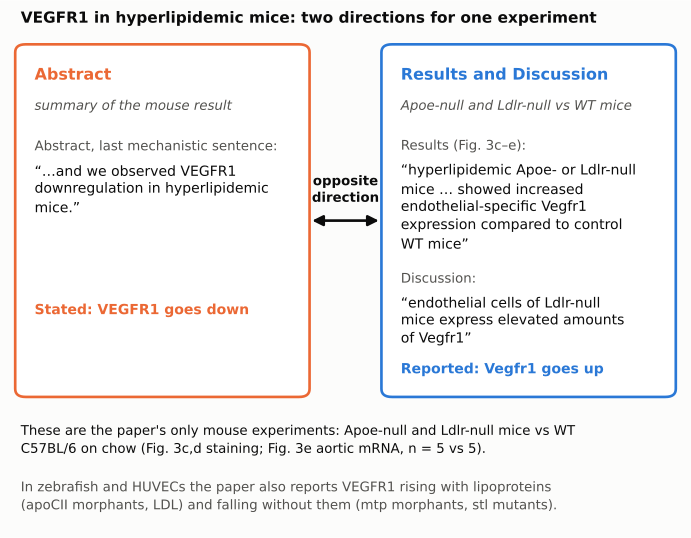
Figure 1. The left panel (orange) shows the Abstract clause that states VEGFR1 goes down in hyperlipidemic mice. The right panel (blue) shows what the Results and Discussion report for the same mice: Apoe-null and Ldlr-null mice compared with WT C57BL/6 on a chow diet (Fig. 3c,d immunostaining; Fig. 3e aortic mRNA, n = 5 per group). The connector marks the conflict: one set of experiments, two opposite directions. All text is quoted from the paper. None of the paper's figures or data are reproduced.
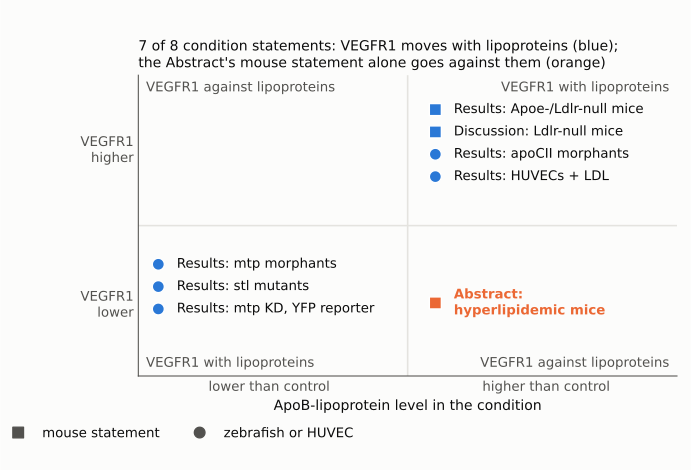
Figure 2. Each marker is one of the eight main-text statements that give a direction for VEGFR1 under a raised or lowered ApoB-lipoprotein level (inclusion rule under Method). The horizontal position gives the lipoprotein level of the condition relative to its control. The vertical position gives the VEGFR1 direction stated. Squares are mouse statements; circles are zebrafish or HUVEC statements. The seven blue statements lie in the two "VEGFR1 with lipoproteins" quadrants, as the paper's model requires. The orange Abstract statement is the only one in a "VEGFR1 against lipoproteins" quadrant. The other two mouse statements, for the same animals, lie in the opposite quadrant. Positions show direction only, not magnitude. Directions and locations come from recompute.py.txt.
Why it matters
- The Abstract gives the mammalian result the wrong sign. The mouse experiment is the paper's only in vivo test of the pathway outside zebrafish, and the Results present it as "confirming conservation of this pathway in higher vertebrates". The Abstract states that result in reverse.
- Read alone, the Abstract implies the opposite biology. VEGFR1 is described as a decoy receptor that restrains angiogenesis. If hyperlipidemia lowered it, hyperlipidemia would favour VEGF signalling. The paper argues the reverse: excess ApoB lipoproteins raise VEGFR1 and inhibit angiogenesis (apoCII morphants, LDL-treated HUVECs, Discussion). Its closing link to pathological hyperlipidemia ("seems to be reactivated during pathological conditions of hyperlipidemia") depends on the increase.
- The error reaches readers of the abstract. The same sentence is in the PubMed and Europe PMC record (PMID 22581286), which indexing services, text-mining pipelines and readers without journal access rely on. Crossref lists 114 citing works.
- The data and the main conclusion are not affected. No reported value, test or P value changes. Fig. 3c–e, its legend, the Results and the Discussion all give the increase, and so does every zebrafish and HUVEC experiment. The error is in one clause of the summary, not in the data or analysis.
Explanations considered
- Archiving or conversion artifact. Ruled out. The publisher's abstract page, the typeset PDF and the PubMed/Europe PMC abstract all carry the same wording as the PMC author manuscript. The conflict is in a word ("downregulation" against "increased"), not in a symbol or sign that a conversion could alter.
- A different mouse model or treatment. Ruled out. The only mouse experiments are Apoe-null and Ldlr-null mice versus WT C57BL/6 on a normal chow diet (Online Methods; Fig. 3c–e). No mouse experiment lowers lipids (for example with a statin or loss of Mtp) in a way that could produce a decrease.
- "Downregulation" describes the mechanism, not the mice. Not an explanation. The first clause of the sentence does use "downregulation" for the lipoprotein-depleted state. But the second clause, "we observed VEGFR1 downregulation in hyperlipidemic mice", is a direct observational claim about the mice, and the mice were hyperlipidemic, not depleted.
- A different measure (protein vs mRNA, endothelium vs whole tissue). Ruled out. Immunostaining of aortic endothelium (Fig. 3c,d), aortic-arch mRNA (Fig. 3e), the Results ("increased endothelial-specific Vegfr1 expression") and the Discussion ("elevated amounts of Vegfr1") all give an increase. The paper reports no mouse measure that falls. In the publisher's Fig. 3e bar chart, read by eye, relative Vegfr1 is about 1.0 for WT and about 1.7 for Apoe-null. This approximate reading is not used in any calculation or figure here.
- The supplement resolves it. It does not. The Supplementary Text and Figures (Supplementary Figs. 1–7) contain no mouse data. The mouse data that settle the direction are in main Fig. 3c–e.
- The paper's model predicts a decrease. It does not. In every zebrafish and HUVEC condition VEGFR1 moves the same way as ApoB lipoproteins (7 of 8 condition statements; Fig. 2), so hyperlipidemia should raise VEGFR1, as the Results say.
None of these explanations reconciles the Abstract clause with the paper's mouse results.
Status
As of 2026-10-23:
- Version of record. The abstract on the publisher's page (doi.org redirects to nature.com/articles/nm.2759) contains "we observed VEGFR1 downregulation in hyperlipidemic mice" word for word. The page shows no change history and no correction notice. The full text is paywalled there, so a copy of the typeset Nature Medicine PDF (vol. 18, no. 6, June 2012, p. 967 onward), posted on a university lab website, was converted to text and searched. It contains the Abstract clause, the Results and Discussion sentences, the Fig. 3e P value and the "inhibit vegfr1 expression" phrase exactly as quoted. The PMC copy is the author manuscript (NIHMS475364, pmc-version 1) and has the same wording at all of these places.
- Supplements. Nature's "Supplementary Text and Figures" PDF (Supplementary Figs. 1–7, 8 pages) was searched. It has no matches for Apoe, Ldlr, hyperlip or mice, and VEGFR1 appears only in the title. The PMC manuscript's own supplement (a .pptx file) was not opened.
- Corrections.
src/known.pyreturns no Crossref updates and no PMC or Europe PMC notices. The Crossref record has no update-to, updated-by or relation entries. The Crossref labs API, which carries the Retraction Watch data, lists no updates. The Europe PMC record (PMID 22581286) has no comment/correction list. The Nature article page has no correction link. - PubPeer and the web. The PubPeer site and API could not be reached (HTTP 403 or empty response), so a PubPeer comment cannot be ruled out. Web searches for the title or DOI together with correction, erratum, PubPeer or Retraction Watch found only the article itself and catalogue listings.
- Sources: PMC3959651 (via
src/show.py);src/known.py 10.1038/nm.2759; https://doi.org/10.1038/nm.2759 (publisher page and abstract); the typeset article PDF and Nature's supplementary PDF (41591_2012_BFnm2759_MOESM12_ESM.pdf); https://api.crossref.org/works/10.1038/nm.2759; Europe PMC REST record for PMID 22581286.
Suggested correction
Change the direction in the Abstract so that it matches the Results, Fig. 3c–e and the Discussion:
- Abstract: "...as a key mediator of the endothelial response to lipoproteins, and we observed VEGFR1 upregulation in hyperlipidemic mice."
For consistency, the concluding phrase in the Results paragraph on Fig. 3i,j could also be changed, for example to "providing evidence that ApoB-containing lipoproteins promote vegfr1 expression at the transcriptional level" (or "regulate", as in the Discussion). No change to the data, figures, statistics or conclusions is needed.