← Back to the plain-language case
Adult–child FP–salience difference called significant after FDR, but Table 3 gives P = 0.130
Cereb Cortex (2026) · doi:10.1093/cercor/bhag167 · PMC13641069
Summary
This fMRI study compares functional connectivity in 15 children and 16 adults during a conversation with ChatGPT. The Abstract names FP–salience as one of the two main between-network couplings that are stronger in adults, and the Results say that the FP–salience and FP–DAN findings "remained significant" after Benjamini–Hochberg FDR correction at q = .05. The paper's own Table 3 reports the FP–salience group effect as F(1,27) = 2.434, P = 0.130, which is not significant even before correction, and the table does not mark that row as significant. Recomputing the test from the printed F reproduces P = 0.130. A Benjamini–Hochberg correction over the 21 between-network tests leaves only FP–DAN significant (adjusted p = 0.024), with FP–salience at 0.228. The adult-greater FP–salience coupling in the Abstract therefore has no statistical support in the paper's reported analysis.
What the paper reports
Abstract:
Adults showed stronger within-network connectivity in control/attention systems, most robustly in FP, with additional effects in salience and DAN. Adults also exhibited greater cross-network integration, particularly FP-salience and FP-DAN couplings, alongside broader adult-greater effects among memory- and attention-related pairs.
Abstract, final sentence:
This highlights FP-centric pathways and their salience-gated interactions as candidate substrates by which creativity supports goal-directed co-creative dialog with AI.
Results, "Neuroimaging measures", between-networks analysis, third paragraph:
Overall, these results suggest a broader and more integrated pattern of between-networks connectivity in adults relative to children, particularly involving the FP, DAN,VAN, memory, and salience systems. After correcting for multiple comparisons (FDR correction (Benjamini and Hochberg 1995), Benjamini–Hochberg, q = .05), the results for the FP-salience and FP-DAN findings remained significant (Table 3). See also Fig. 2.
Results, between-networks analysis, second paragraph (the last of the pairs the text lists as significant; FP–salience is not among them):
Finally, significant group effects were found for connectivity between the FP-VAN, F(1,27) = 5.820, P = 0.023, η2P = .177, and FP-DAN, F(1,27) = 13.252, P = 0.001, η2P = .329, with adults again showing higher connectivity.
Table 3 ("Between networks, functional connectivity of EF, attention, and sensory after controlling for FD"), FP–Salience row, and the table footnote:
FP–Salience | 0.138 ± 0.040 | 0.180 ± 0.060 | F = 2.434, P = 0.130, η2P = .083 | A > C
Bold represents significant results.
Methods, "Statistical analyses":
a multivariate analysis of variance (MANOVA) was conducted with group (children, adults) as a between-subjects factor and framewise displacement (FD) as a covariate to control for head motion.
Results, "Moderation results" (a different test on the same pair):
Specifically, significant moderation effects emerged for the FP–Salience, F(1,26) = 5.869, P = 0.023, partial η2P = .184, and Salience–VAN, F(1,26) = 4.575, P = 0.042, partial η2P = .150, pairs, indicating that the relationship between creativity and connectivity strength differed between children and adults for these networks.
Discussion:
Children also demonstrated reduced functional connectivity between the selected cognitive networks (FP-salience, FP-DAN, DMN-memory).
Results, "Power analysis":
Our achieved sample (children, n = 15; adults, n = 16) is therefore well-powered for large effects, consistent with prior literature, but underpowered for moderate effects, guiding the interpretation of null or small effects accordingly.
What the paper's own numbers show
Method. Each row of Table 3 is a group effect with one numerator degree of freedom, so P = Pr(F(1, 27) ≥ F) and partial η² = F / (F + 27). I recomputed both from the printed F for all 21 between-network pairs and compared them with the printed values. I then applied the Benjamini–Hochberg step-up procedure at q = .05, the correction the paper names, to the 21 between-network P values (the family of Table 3). The adjusted p for the test ranked i of m is the minimum over j ≥ i of m·p(j)/j. I repeated the correction with the printed P values, with the 7 within-network tests of Table 2 as their own family, and with all 28 tests pooled. Individual-level data are not available, so the ANCOVA itself cannot be refitted. Every number below is printed by recompute.py.txt.
| Quantity | Location | Reported | Recomputed from the paper's numbers |
|---|---|---|---|
| FP–salience group effect, P | Table 3 | F(1,27) = 2.434, P = 0.130 | P = 0.130 (0.1304); not significant before correction |
| FP–salience partial η² | Table 3 | .083 | 2.434 / 29.434 = 0.083 |
| FP–salience, one-sided P | derived | – | 0.065, still above .05 |
| FP–salience after BH, 21 between-network tests | Results ("remained significant"); Abstract | significant at q = .05 | rank 12 of 21, critical value 0.0286, adjusted p = 0.228 |
| FP–salience after BH, printed P values | derived | – | 21 × 0.130 / 12 = 0.228 |
| FP–salience after BH, 28 tests pooled | derived | – | adjusted p = 0.243 |
| FP–salience after BH, any family size | derived | – | a BH-adjusted p is never below the raw p, so P = 0.130 fails for every family |
| FP–DAN group effect, P | Table 3; Results | P < 0.001 (Table 3); P = 0.001 (Results) | 0.0011 |
| FP–DAN after BH, 21 tests | Results ("remained significant") | significant | adjusted p = 0.024: significant, the only pair that is |
| Next-smallest BH-adjusted p (CO–salience and seven others) | derived | – | 0.062; no other between-network pair survives |
| DMN–memory | Table 3; Discussion | P = 0.017, listed among reduced couplings | adjusted p = 0.062 |
| Agreement of all printed P and η² with their F | Table 3 | 21 rows | all 21 within rounding of F (CO–DMN: F = 0.006 gives 0.936–0.941, printed 0.937) |
| Rows printed in bold | Table 3 (publisher XML) | 9 bold rows | exactly the 9 rows with P < .05; FP–salience not bold |
| Within-FP group effect after BH, 7 within-network tests | Table 2; Results ("the FP findings remained significant") | significant | P = 0.006, adjusted p = 0.044: significant |
| Within-salience and within-DAN after BH, 7 tests | Table 2; Abstract ("additional effects") | P = 0.025, 0.027 | adjusted p = 0.062 each |
| FP–salience group × creativity interaction | Results, Moderation | F(1,26) = 5.869, P = 0.023, η² = .184 | P = 0.023, η² = 0.184; a test of slopes, not of group means |
The table is internally consistent. Every printed P and η² follows from its F, and the bold marking matches uncorrected P < .05. The only statement that the numbers do not support is the sentence saying FP–salience "remained significant" after FDR, and the Abstract and Discussion statements that rest on it.
Figure
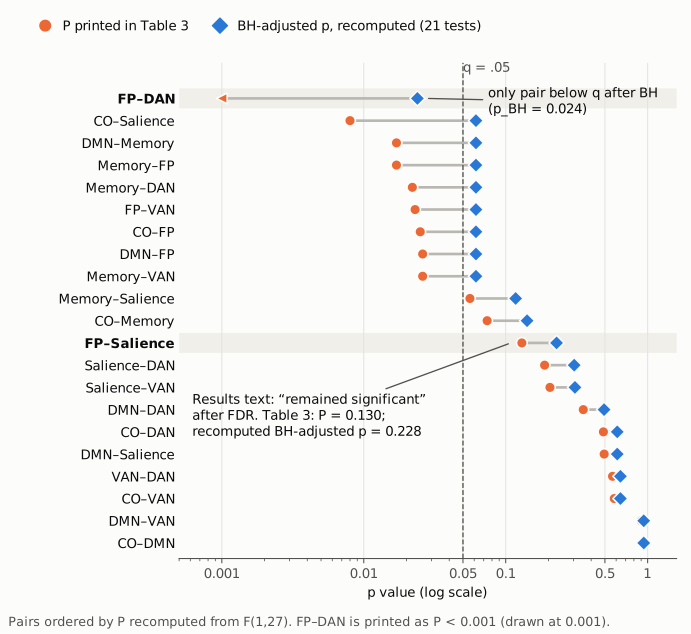
Figure 1. For each of the 21 between-network pairs in Table 3, the orange dot is the uncorrected P printed in the table and the blue diamond is the Benjamini–Hochberg adjusted p recomputed over the 21 tests from the printed F(1,27) values. Pairs are ordered by P. The axis is logarithmic and the dashed line marks q = .05. FP–DAN is printed as P < 0.001 and drawn at 0.001 (left-pointing marker); its recomputed P is 0.0011. Only FP–DAN has an adjusted p below .05 (0.024). FP–salience, which the Results describe as remaining significant after FDR, has a printed P of 0.130 and an adjusted p of 0.228, the twelfth of 21. Eight pairs with uncorrected P between 0.008 and 0.026 share an adjusted p of 0.062.
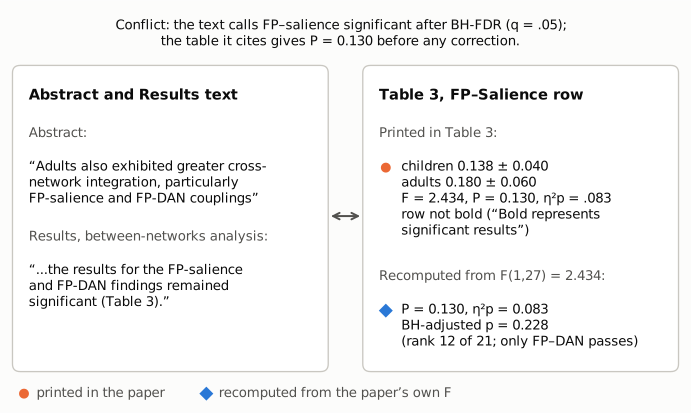
Figure 2. The Abstract and the Results text (left) present FP–salience, together with FP–DAN, as a significant adult-greater coupling after Benjamini–Hochberg correction. The Table 3 row the text cites (right) gives F = 2.434, P = 0.130 before any correction, and the row is not bold, although the footnote says bold marks significant results. Recomputing from F(1,27) = 2.434 gives the same P and η², and a BH-adjusted p of 0.228.
Why it matters
FP–salience is one of the two between-network couplings that the Abstract names as greater in adults, and the Abstract's closing sentence builds on it ("FP-centric pathways and their salience-gated interactions"). The Discussion lists it first among the couplings that are reduced in children. A reader of the Abstract would take it as a corrected, significant group difference. The paper's own test gives P = 0.130 for that difference, and after the correction the paper describes, only FP–DAN remains among the 21 between-network pairs.
The paper's main conclusion does not depend on this result alone. The within-FP group difference (P = 0.006, BH-adjusted 0.044 across the 7 within-network tests) and the FP–DAN coupling (adjusted 0.024 across 21 tests) both survive the correction the paper names, so lower FP engagement in children still has support. The "salience-gated" framing loses its group-difference evidence. What remains for FP–salience is the group × creativity interaction (P = 0.023), which is uncorrected and tests whether the creativity slope differs between groups, not whether adults have higher connectivity. Two other statements also rest on uncorrected results: the Discussion's DMN–memory coupling (P = 0.017, adjusted 0.062) and the Abstract's "additional effects in salience and DAN" within networks (P = 0.025 and 0.027, adjusted 0.062 each). The Abstract does not say these were corrected, but a reader is not told that they do not survive the correction applied elsewhere.
Explanations considered
- A conversion or typesetting error in the table. This is excluded. The printed F, P and η² agree with one another (F = 2.434 gives P = 0.1304 and η² = 0.083), the row is not bold in the publisher-supplied XML, and the Results paragraphs that list the uncorrected significant pairs do not include FP–salience. The publisher page, PMC and Europe PMC carry the same values.
- The FDR sentence uses a different family or ordering. This does not account for the numbers. A Benjamini–Hochberg adjusted p can never be smaller than the raw p, so a raw P of 0.130 cannot pass q = .05 in any family. With the 21 Table 3 tests the adjusted p is 0.228; pooled with the 7 within-network tests it is 0.243.
- A one-sided test. This does not account for the numbers. Halving P gives 0.065, which is above .05 before any correction.
- The FDR sentence refers to an analysis without the motion covariate. This does not account for the numbers. A Student t test from the Table 3 means and SDs (n = 15 and 16) gives P = 0.030 for FP–salience. Across the 18 pairs whose descriptives can be used, BH places it fifth (critical value 0.0139) with an adjusted p of 0.109, so it would still not be significant. The Salience–VAN, Salience–DAN and VAN–DAN rows were left out of this check because their printed SDs (0.000–0.007) with mean differences of 0.135–0.184 cannot be reconciled with their F values below 2. That is a separate inconsistency in those three rows and does not bear on FP–salience.
- The sentence refers to the moderation result. This does not account for the claim. The FP–salience group × creativity interaction is significant before correction (F(1,26) = 5.869, P = 0.023, reproduced), but it tests whether the association with creativity differs between groups. The sentence in question sits in the group-difference section, cites Table 3, and pairs FP–salience with FP–DAN, which has no reported interaction. The Abstract states the result as "greater cross-network integration" in adults.
- "FP-salience" was written where another FP pair was meant. This does not rescue the sentence. Every other between-network pair, including CO–salience, FP–VAN and Memory–FP, has a BH-adjusted p of 0.062 or more, so no substitution produces a second surviving pair. A substitution would also leave the Abstract and Discussion statements about FP–salience unsupported.
- Degrees of freedom. This does not change anything. With 31 participants, a model with group and FD as predictors has 28 error degrees of freedom, while the tables print 27; the η² values match 27. With 28, FP–salience gives P = 0.130 as well.
Status
- Version of record. The publisher page (academic.oup.com, reached through doi.org/10.1093/cercor/bhag167), the PMC article and the Europe PMC full-text XML were compared. All three carry the same Abstract, Results sentences and Table 3 values quoted above. In the Europe PMC XML the bold rows of Table 3 are CO–FP, CO–Salience, DMN–Memory, DMN–FP, Memory–FP, Memory–VAN, Memory–DAN, FP–VAN and FP–DAN; the FP–Salience row is not bold. Every quotation above was confirmed verbatim against the PMC-archived text with
src/show.py. - Supplements. The article has one supplementary file (supp_bhag167.docx). It holds a title page and the two ChatGPT prompts used for children and adults. It has no connectivity data, no FDR-adjusted P values and no source data. The article mentions no data deposit, so the ANCOVA cannot be refitted.
- Corrections and comments. As of 2026-10-24 no correction, erratum, expression of concern or retraction was found. Crossref lists no update relations for the DOI, and PMC and Europe PMC list no correction notices. A web search for corrections or comments on the article found none. The PubPeer API and search pages refused automated access (Cloudflare challenge, HTTP 403), so PubPeer could not be checked directly.
- Sources. PMC article PMC13641069; Europe PMC full-text XML and supplementary files for PMC13641069; the publisher's article page at academic.oup.com; Crossref; Europe PMC.
Suggested correction
- In the Results, state that after Benjamini–Hochberg correction at q = .05 only the FP–DAN between-network difference remained significant, and remove FP–salience from that sentence. Its group effect was F(1,27) = 2.434, P = 0.130 (adjusted p ≈ 0.23 over the 21 between-network tests).
- In the Abstract, remove FP–salience from the couplings described as greater in adults, or describe it as not significant. Revise the closing sentence so that the "salience-gated" interpretation rests only on the exploratory group × creativity interaction, and say that this interaction is uncorrected.
- In the Discussion, revise "reduced functional connectivity between the selected cognitive networks (FP-salience, FP-DAN, DMN-memory)" so that only FP–DAN is described as surviving correction.
- Report the FDR-adjusted P values for Tables 2 and 3, and state which within-network and between-network effects in the Abstract are uncorrected (within-network salience and DAN; the "broader adult-greater effects" among memory- and attention-related pairs).
- Minor: report FP–DAN consistently (P = 0.001 in the Results, P < 0.001 in Table 3; the F gives 0.0011), state the error degrees of freedom for 31 participants, and check the means and SDs printed for Salience–VAN, Salience–DAN and VAN–DAN, which cannot be reconciled with their F values.