← Back to the plain-language case
Abstract says metformin upregulates intestinal G6PC; the paper's own Results report a decrease
Cell Rep (2026) · doi:10.1016/j.celrep.2026.117791 · PMC13560472
Summary
The Abstract, the "In brief" summary and one Results subsection heading state that high metformin concentrations "upregulate" G6PC expression in intestinal epithelial cells (IECs), in the Abstract's words "to prevent glucose release". Every data statement in the paper reports the opposite: G6PC protein is reduced in IECs of metformin-treated HFD-fed mice (Figures 5E/5G) and in metformin-treated or AMPK-overexpressing primary IECs (Figures 5M, 6A–6C), G6pc mRNA is suppressed (Figure 6D), and the Figure 6 title, the Results conclusion and the Discussion all say G6PC goes down; of 13 statements giving a direction for this effect, the 3 summary-level ones say "up" and the 10 in the body say "down". The paper's own metabolite data (glucose 6-phosphate up 5-fold, glucose down) and its G6PC overexpression experiment fit a decrease, not an increase. The data and conclusions stand, but the most-read parts of the article give the first step of its intestinal mechanism the wrong sign.
What the paper reports
Statements that give an increase.
Abstract (Summary):
Here, we showed that high metformin concentrations upregulate G6PC expression through AMP-activated protein kinase (AMPK) activation to prevent glucose release in intestinal epithelial cells (IECs).
In brief (the opening clause, which names the authors, is omitted here):
in intestinal epithelial cells (IECs), high metformin concentrations upregulate G6PC expression to prevent glucose release and inhibit mitochondrial activity, leading to increased glucose utilization and lactate overproduction
Results, subsection heading:
Upregulation of G6PC expression by metformin increases glycolysis in IECs
Statements that give a decrease.
Results, subsection "Inhibition of mitochondrial respiration leads to increased glucose uptake and glycolysis in IECs":
However, it is important to note that we found that metformin treatment significantly reduced G6PC protein levels in IECs of HFD-fed mice (Figures 5E and 5G).
Results, the paragraph directly under the "Upregulation of G6PC expression..." heading:
Metformin treatment decreased G6PC protein levels in IECs of HFD-fed mice (Figures 5E and 5G), and treatment with high metformin concentration (1 mM) activated AMPK or overexpression of functional AMPKα1β1γ1 complex significantly decreased G6PC protein levels in primary IECs (Figures 5M and 6A–6C). Metformin treatment suppressed the mRNA levels of G6pc and Pck1 (Figure 6D).
The same paragraph, concluding:
Collectively, decreased G6PC expression by metformin leads to the accumulation of glucose 6-phosphate and augmentation of glycolysis in IECs.
Figure 6 legend, title:
Reduction of G6PC expression by metformin increases lactate production in primary epithelial cells
Discussion, paragraph 3:
we found that metformin treatment significantly decreased G6PC protein levels in the IECs of HFD-fed mice and in primary IECs; this will decrease glucose release from IECs because G6PC removes the phosphate group from glucose 6-phosphate and glucose will be then released from the cells with the bidirectional function of glucose transporters.
These data indicate that a decrease in G6PC protein by metformin leads to increased glycolysis in IECs.
Discussion, summary paragraph:
High metformin concentrations in the intestine downregulate G6PC expression to stimulate glycolysis inside IECs, and with inhibited mitochondrial complex 1 activity, leading to increased glucose utilization through glycolysis and lactate release.
Supporting experiments described in the Results.
Compared to IECs with expression of adenoviral GFP controls, overexpression of G6PC led to more than 6-fold reduction of metformin-stimulated accumulation of fluorescent glucose analog 2-NDBG in IECs (Figures 6F and 6G). Overexpression of G6PC also led to a 75% reduction of lactate levels in metformin-treated IECs (Figure 6H).
found that metformin treatment led to a 5-fold increase in glucose 6-phosphate levels; however, with decreased glucose levels in IECs (Figures 6I and 6J), resulting in drastically increased ratio of glucose 6-phosphate/glucose (Figure 6K).
All quotes above were checked verbatim against the PMC-archived article text.
What the paper's own numbers show
Method. This is a direction-of-effect contradiction, so there are no test statistics to recompute. I made a complete inventory instead. I searched the full archived text (abstract, In brief, headings, body and figure legends) for every mention of G6PC or G6pc. I kept each statement that gives a direction for metformin's effect on G6PC in IECs and recorded where it sits and which way it points. I first did this with a regex scan, then read each hit by hand; the hand count adds the two mRNA statements ("suppressed", "inhibition of the expression") that the regex missed and drops one regex false positive. I then checked whether the paper's own reported metabolite changes (Figures 6I–6K) and its G6PC overexpression results (Figures 6E–6H) fit an increase or a decrease. G6PC catalyses glucose 6-phosphate + H₂O → glucose + Pᵢ, the last step before glucose can leave the cell. All of this is in recompute.py.txt, which also re-checks every quote against the archived text.
| Quantity | Location | Reported | Recomputed |
|---|---|---|---|
| Direction, metformin → G6PC in IECs | Abstract | "upregulate G6PC expression ... to prevent glucose release" | Up; contradicts every data statement |
| Direction, metformin → G6PC in IECs | In brief | "upregulate G6PC expression to prevent glucose release" | Up; contradicts every data statement |
| Direction, metformin → G6PC in IECs | Results subsection heading | "Upregulation of G6PC expression by metformin increases glycolysis" | Up; the paragraph beneath it reports a decrease |
| G6PC protein, IECs of HFD-fed mice | Results; Figs 5E, 5G | "significantly reduced"; "decreased" | Down |
| G6PC protein, primary IECs, 1 mM metformin or AMPKα1β1γ1 overexpression | Results; Figs 5M, 6A–6C | "significantly decreased" | Down |
| G6pc mRNA, primary IECs | Results; Fig 6D | "suppressed" | Down |
| Mechanistic conclusion | Results; Fig 6 title; Discussion (×3) | "decreased G6PC expression", "Reduction of G6PC expression", "a decrease in G6PC protein", "downregulate G6PC expression" | Down |
| Tally of directional statements | Whole archived text | n/a | 13 statements: 3 up (all in Abstract, In brief, one heading), 10 down (all in Results text, Fig 6 legend, Discussion) |
| Statements citing a data figure | Results | n/a | 4 of 4 point down; none points up |
| G6P/glucose ratio | Results; Figs 6I–6K | G6P 5-fold up, glucose decreased, ratio "drastically increased" | Ratio fold = 5 / (glucose fold) > 5 for any fall in glucose: substrate up, product down, which fits lower G6PC activity |
| G6PC overexpression with metformin | Results; Figs 6F–6H | 2-NDBG accumulation down > 6-fold; lactate down 75% | Down to < 16.7% and 25% of control; restoring G6PC blunts metformin's effect, as a metformin-induced decrease predicts |
No experiment in the paper reports metformin raising G6PC in IECs. The one increase in G6pc the paper reports is in the liver of intestinal AMPKα1/2 knockout mice (Figure 4F), a different tissue and a genetic manipulation, not a metformin effect in IECs.
Figure
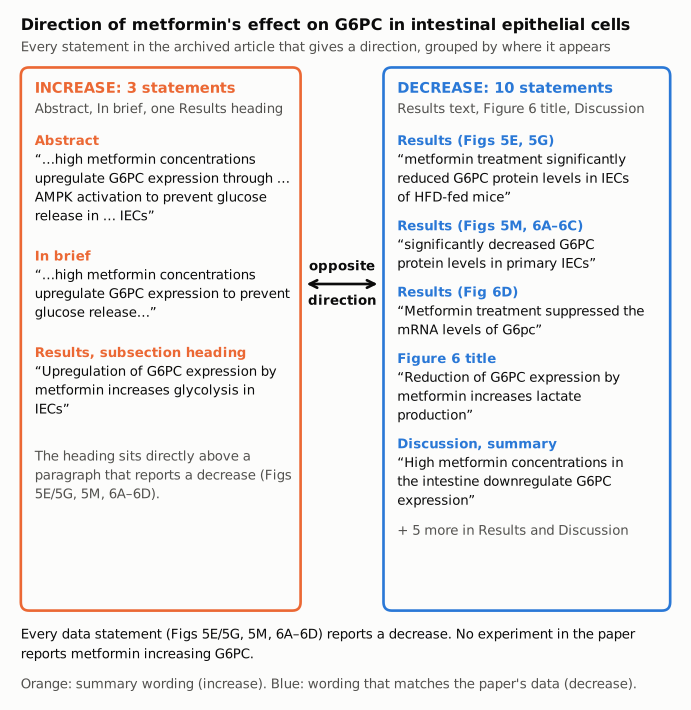
Figure 1. Every statement in the archived article that gives a direction for metformin's effect on G6PC in IECs, grouped by where it appears. Orange, left: the three statements that say "upregulate"/"Upregulation" (Abstract, In brief, one Results subsection heading). Blue, right: the statements that say G6PC is reduced, decreased, suppressed or downregulated (five are shown; five more in the Results and Discussion are listed in the table above and in recompute.py.txt). All of the data-backed statements (Figures 5E/5G, 5M, 6A–6D) are on the right. The connector marks the conflict: the two groups give opposite directions for the same effect, in the same cells, at the same high metformin concentrations.
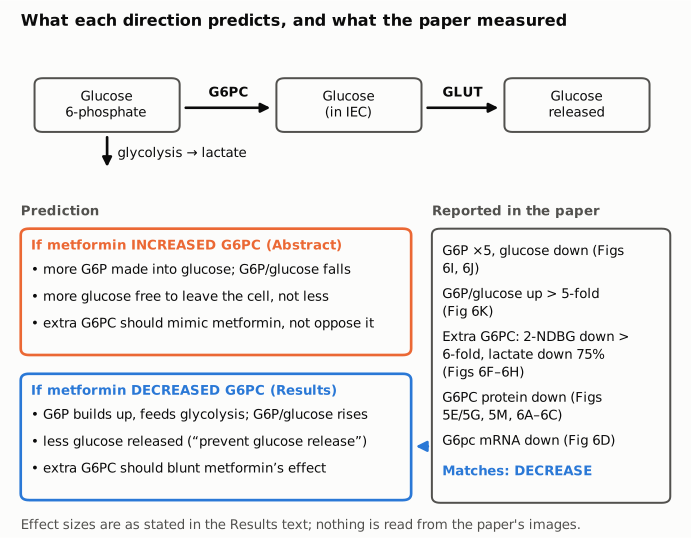
Figure 2. Why the data fit a decrease. The top row shows the reaction G6PC catalyses (glucose 6-phosphate to free glucose, which can then leave the cell through bidirectional glucose transporters) and the branch to glycolysis and lactate. The orange box lists what an increase in G6PC, as the Abstract says, would predict. The blue box lists what a decrease would predict. The grey box lists what the Results text reports: glucose 6-phosphate up 5-fold with glucose down (Figures 6I–6K), G6PC overexpression cutting metformin-stimulated 2-NDBG accumulation more than 6-fold and lactate by 75% (Figures 6F–6H), and G6PC protein and mRNA down. Each reported finding matches the decrease. The effect sizes are as stated in the Results text; nothing is read from the paper's images.
Why it matters
The change in G6PC is the first step of the intestinal half of the paper's model: high metformin concentrations in IECs lower G6PC through AMPK, glucose 6-phosphate builds up and is routed into glycolysis, and the extra lactate goes through the portal vein to the liver. The Abstract and the In brief are the parts of the article that are most widely read, indexed and quoted, and they give this step the wrong sign. A reader who sees only them learns that metformin raises intestinal G6PC, the opposite of what the paper measured. Such a reader might cite the paper as evidence for G6PC induction, or design experiments on that premise. The Abstract sentence is also internally inconsistent: G6PC frees glucose for export, so raising it would promote glucose release, not "prevent" it. A careful reader may notice that, but a reader skimming the abstract or an automated summary may not. The same wrong word in a Results subsection heading means even a reader who opens the Results may first meet "Upregulation" before the text beneath it reports a decrease.
The underlying data, figures and conclusions are unaffected. Every data statement, the Figure 6 title and the Discussion consistently report a decrease, and the overall claim that metformin's actions in the intestine and liver together improve hyperglycemia does not depend on this wording. The problem is confined to the three summary-level statements.
Explanations considered
A different model, tissue, dose or time point. The Abstract specifies "high metformin concentrations" in IECs. That matches the conditions under which the body reports a decrease: 1–2 mM metformin in primary IECs (Figures 5M, 6A–6D) and oral metformin in IECs of HFD-fed mice (Figures 5E/5G). The body reports no IEC condition in which G6PC rises. This does not account for the contradiction.
The liver G6pc result. The Results report "significantly higher mRNA levels of rate-limited gluconeogenic genes G6pc and Pck1 in the liver" of intestinal AMPKα1/2 knockout mice (Figure 4F). That is a knockout effect in the liver, compared with floxed controls, not metformin acting on IECs. It cannot be the source of a statement about high metformin concentrations in IECs. Does not account for it.
G6PC overexpression. Figures 6E–6H use adenoviral overexpression of G6PC, an increase made by the investigators, not by metformin. In those cells metformin's effects on 2-NDBG accumulation and lactate were reduced, which supports the decrease model. Does not account for it.
"Upregulate" in some other sense (e.g. upregulated activity, or regulation in general). The Abstract says "upregulate G6PC expression", and the body reports expression (protein and mRNA) going down. No passage reports increased G6PC activity; the G6P/glucose data (Figures 6I–6K) point to lower activity. Does not account for it.
Text-conversion or manuscript-stage artefact. The PMC record is the NIH author manuscript, not the typeset version. However, the publisher-supplied PubMed record (PMID 42555357) carries the same "upregulate G6PC expression" Abstract sentence verbatim, so the wording is in the publisher's own abstract metadata as well as the manuscript. A single-word conversion error would not change the same verb in three separate places while leaving ten others intact. Does not account for it.
A wording slip rather than a data error. This is the most plausible reading of the evidence: the data and the detailed text agree with each other, and only three summary statements disagree. It does not reconcile the two directions, but it does mean the correction needed is to wording, not to results.
Status
As of 2026-10-23:
- Version of record. The PMC record (PMC13560472) is the NIH author manuscript ("published before final editing"; Europe PMC metadata: NIHPA Author Manuscript, not the version of record). The publisher's full text could not be retrieved: doi.org and linkinghub.elsevier.com returned only a redirect stub, and the cell.com and ScienceDirect pages returned HTTP 403. The publisher-deposited PubMed record (PMID 42555357; Cell Rep 45(8):117791; e-published 2026-08-05; status "aheadofprint") was re-fetched on 2026-10-23, and its Abstract contains the "upregulate G6PC expression" sentence verbatim. Whether the typeset Results heading and Discussion match the manuscript could not be confirmed directly.
- Supplement. No supplement is archived with the PMC manuscript (has-supplement = no). The publisher's supplementary file could not be reached (HTTP 403). A supplement could not settle a wording contradiction of this kind; the main-text figures already show the decrease.
- Corrections and retractions. None found.
known.py: no Crossref updates, no PMC or Europe PMC notices. Crossref record re-checked on 2026-10-23: noupdate-to,updated-byor relations. The PubMed record carries no CommentsCorrections entries. - PubPeer and other discussion. PubPeer could not be queried directly (its search and API returned HTTP 403). Earlier web searches by DOI and by title combined with "correction", "erratum" and "PubPeer" found nothing relevant. Web searching was not available for a final re-check on 2026-10-23.
Sources: PMC-archived article text (via src/show.py PMC13560472); PubMed efetch for PMID 42555357; Crossref REST API for doi:10.1016/j.celrep.2026.117791; Europe PMC metadata; src/known.py.
Suggested correction
Change "upregulate" to "downregulate" in the Abstract and the In brief, and "Upregulation" to "Downregulation" in the Results subsection heading, so that they match the Results, Figure 6 and the Discussion:
- Abstract: "Here, we showed that high metformin concentrations downregulate G6PC expression through AMP-activated protein kinase (AMPK) activation to prevent glucose release in intestinal epithelial cells (IECs)."
- In brief: "...high metformin concentrations downregulate G6PC expression to prevent glucose release and inhibit mitochondrial activity..."
- Results heading: "Downregulation of G6PC expression by metformin increases glycolysis in IECs"
The same changes would need to be made to the abstract held by PubMed and other indexers. No data, figure or statistical result needs to change.