← Back to the plain-language case
Paper reports dose-limiting toxicity as primary endpoint; the only registered primary outcome is response rate
Cell Rep Med (2026) · doi:10.1016/j.xcrm.2026.102967 · PMC13522775 · NCT05459441
Summary
The ClinicalTrials.gov record for this trial has had one version (2022-07-12), and its sole primary outcome is "Clinical response rate", the percentage of patients with complete or partial response, at 24 months. The published report states that "The primary endpoint was the incidence of dose-limiting toxicities (DLTs)". DLT incidence appears nowhere in the registry, and the paper places radiographic response among "secondary or exploratory endpoints", reported as best overall response rather than at 24 months. The paper cites the registration number but does not mention that the registered primary outcome differs, and it gives no protocol amendment or reason for the difference. The paper reports that "There were no dose-limiting toxicities observed during dose escalation". The registered primary outcome is also reported, in Table 3 and outside the abstract: 2 of 17 efficacy-evaluable patients (11.8%) had a partial response and none had a complete response.
What was registered
The registry history (ClinicalTrials.gov record-history service, checked 2026-10-22 and 2026-10-23) lists exactly one version, version 0, dated 2022-07-12. The service reports outcomesUpdateCount: 0, and the current public record (API v2) has the same outcomes. The record was first submitted on 2022-06-24 and first posted on 2022-07-15. Its last update was posted on 2022-07-15. It gives the study start as 2022-01-01 (actual), so the trial was registered 174 days after it started, and no version exists from before the start date. The phase is "Early Phase 1". The brief title begins "Efficacy and Safety Evaluation of Percutaneous Ommaya Capsule Injection of Autologous Bi-dimensional Specific T Cells…".
| Version (date) | Type | Measure | Time frame | Description (verbatim) |
|---|---|---|---|---|
| v0 (2022-07-12) | Primary | "Clinical response rate" | "24 months" | "The percentage of patients with CR and PR in the total number of patients in the same period" |
| v0 (2022-07-12) | Secondary | "Overall survival (OS)" | "24 months" | "Frome the starting date of the enrollment until the date of the first documented disease progression or the date of the death from any cause,whichever comes first" |
| v0 (2022-07-12) | Secondary | "Safty(adverse events)" | "12 months" | "Number of participants with treatment-related adverse events as assessed by CTCAE v5.0" |
The other registered fields were never updated. The estimated primary completion date is 2023-06-30 and the estimated completion date is 2023-12-31. Enrolment is "30 (ESTIMATED)". The overall status is now "UNKNOWN", with last known status "RECRUITING" and status verified 2022-02. "Dose-limiting toxicity" does not appear anywhere in the record. The record's submission-tracking data show a results submission dated 2026-08-06, released and withdrawn the same day, and another released on 2026-08-08. As of the check, no results are posted and the submitted content is not public.
What the paper reports
The primary endpoint, from STAR Methods, "Objectives and endpoints":
The primary objective of this study was to evaluate the safety and tolerability of intracranial administration of non-chimeric autologous expanded T cells combined with pemetrexed. The primary endpoint was the incidence of dose-limiting toxicities (DLTs), assessed during a prespecified DLT evaluation window defined as inside the intracranial treatment cycle (once weekly for 5 weeks).
Secondary or exploratory endpoints included overall survival (OS), progression-free survival (PFS), and disease control rate (DCR).
Tumor response was determined based on the best overall response from treatment initiation until disease progression or last adequate tumor assessment.
The DLT definition, from STAR Methods, "Dose-escalation design":
DLT was defined as the occurrence of ≥1 treatment-related death or ≥3 unanticipated grade ≥3 treatment-related adverse events within the predefined DLT evaluation period.
From the Introduction:
The primary objective was to assess safety and tolerability, with comprehensive monitoring of both systemic and intracranial AEs.
Clinical outcomes, including radiographic response, progression-free survival (PFS), and overall survival (OS), were assessed as secondary or exploratory endpoints to characterize potential signals of therapeutic activity.
The result for this primary endpoint, from Results, "Safety of SCOPE-T treatment":
There were no dose-limiting toxicities observed during dose escalation; therefore, the highest dose tested (5 × 10⁸ RAK cells) was selected for dose expansion and designated as the recommended phase 2 dose (RP2D).
(The "108" is 10^8 as rendered in the PMC text.) The response results appear in Results under the heading "Exploratory radiographic and clinical assessments", and in Table 3 ("Summary of clinical responses in the PPS and EES"):
Objective response rate | 2 (10.5%) | 2 (11.8%)
Benefit beyond imaging evaluationa | 19 (100.0%) | 17 (100.0%)
Clinical benefit rate | 19 (100.0%) | 17 (100.0%)
(The trailing "a" marks a footnote listing clinical and laboratory improvements.) The Results attribute clinical benefit to RANO assessment: "Using RANO-BM and RANO-LM criteria, all 17 patients in the EES demonstrated clinical benefit."
The sample size is discussed in STAR Methods, "Study design and patients" ("The selected sample size (n = 25) is consistent with typical phase 1/1b trials designed to evaluate safety and tolerability."), and in "Statistical analysis" ("No formal hypothesis testing or power calculation was prespecified.").
The paper refers to the registration only by its NCT number (Abstract, Introduction) and in the line in STAR Methods, "Clinical trial registration":
This trial was registered with https://clinicaltrials.gov/study/NCT05459441.
The paper never mentions that response rate was the registered primary outcome, or any protocol amendment or change of endpoints. It does not give a registration date. Apart from the per-protocol analysis set (defined in STAR Methods, "Analysis populations", as "patients who completed at least one treatment cycle without major protocol deviations"), the study protocol is referred to only in the Table 4 footer ("OS and PFS: According to protocol, data cutoff as of July 6, 2024."). The same footer adds "OS∗: Updated data follow-up as of May 01, 2026." for a separate survival column. Neither a protocol nor a statistical analysis plan is published with the article: the supplement is Document S1 (Figures S1–S9, Tables S1–S3), Data S1 (xlsx) and Document S2 (the article plus supplement).
Every quotation above was checked character for character against the article as archived in PubMed Central (src/show.py PMC13522775 --grep), and each occurs exactly once. The endpoint sentences, the registration line and the Table 3 rows also appear unchanged in the publisher's typeset PDF (Document S2). make_figures.py.txt reruns the PMC check, and the registry check against API v2.
The discrepancy
| Outcome | Registered (version, date) | In the paper | Status |
|---|---|---|---|
| Clinical response rate (CR + PR / total patients) | Primary, 24 months (v0, 2022-07-12) | Radiographic response among "secondary or exploratory endpoints". Not in the named list of secondary/exploratory endpoints (OS, PFS, DCR). Reported as best overall response in Table 3: ORR 2/19 (10.5%) in the PPS and 2/17 (11.8%) in the EES | Demoted; time point changed (best overall response, not 24 months) |
| Incidence of dose-limiting toxicities | Not registered at any level (v0) | Primary endpoint, with a 5-week DLT window | Added |
| Treatment-related adverse events (CTCAE v5.0) | Secondary, 12 months (v0) | Reported (Table 2; Table S3; abstract: "no treatment-related adverse events greater than grade 2"), but not listed as an endpoint. No time frame stated | Reported; not named an endpoint; time frame not stated |
| Overall survival | Secondary, 24 months (v0). The registered description reads like a progression-or-death definition | Secondary or exploratory: Kaplan-Meier median and 1-year rate | Matched by name; 24-month time frame not used |
| Progression-free survival | Not registered (v0) | Secondary or exploratory | Added |
| Disease control rate (CR + PR + SD) | Not registered (v0) | Secondary or exploratory. Table 3 has no row named DCR, but lists PR and SD counts and a "Clinical benefit rate" | Added |
| Enrolment (context) | 30, estimated (v0) | 25 enrolled; "The selected sample size (n = 25)…" | Differs; not explained |
Figures
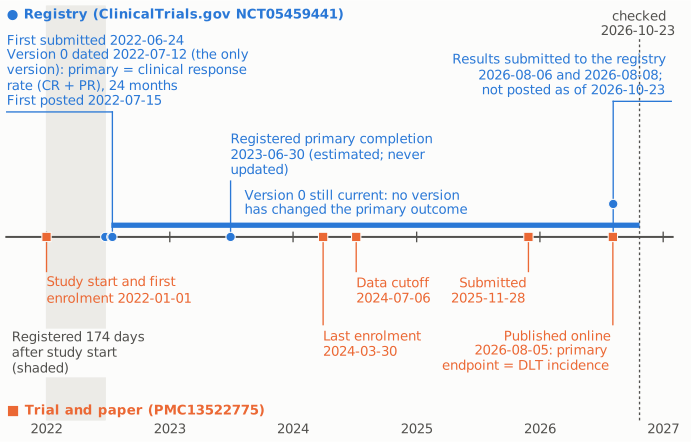
Figure 1. Timeline of the trial and its registration. Blue circles are registry events: first submission (2022-06-24), version 0 (2022-07-12; the only version), first posting (2022-07-15) and the registered estimated primary completion date (2023-06-30, never updated), all on the axis. The results submissions (2026-08-06 and 2026-08-08; not posted as of 2026-10-23) share one blue circle, drawn on its stem above the version bar because on the axis it would sit under the publication marker one to three days earlier. Orange squares are trial and paper events taken from the article: study start and first enrolment (2022-01-01), last enrolment (2024-03-30), data cutoff (2024-07-06), journal submission (2025-11-28) and online publication (2026-08-05). The shaded band marks the 174 days between study start and registration. The blue bar shows that version 0 has been in force from 2022-07-12 to the check date (2026-10-23). No registry version changed the primary outcome, either before or after primary completion. The difference arises between the registry and the paper, not within the registry. The registered primary completion date is shown only as the registry's own, never-updated estimate; it is not a measure of reporting time (enrolment ended 2024-03-30 and the paper's data cutoff was 2024-07-06).
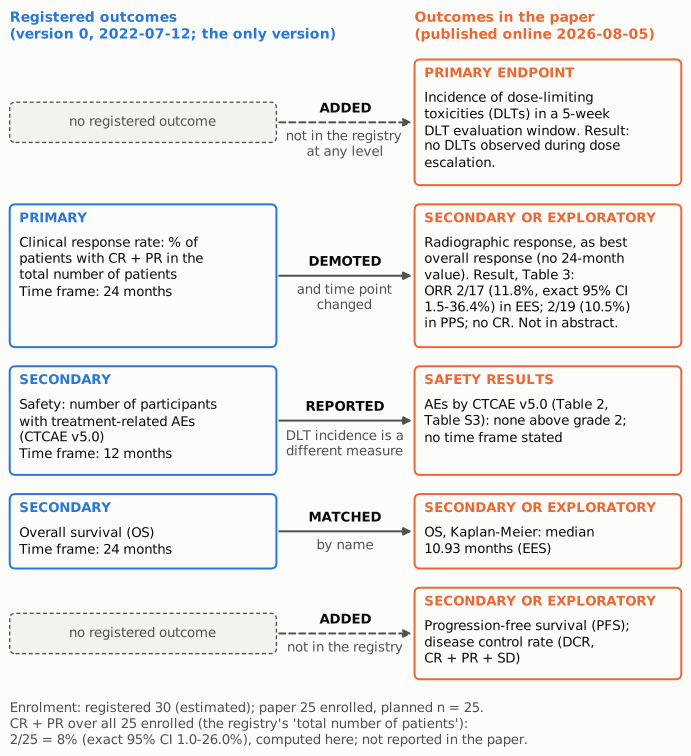
Figure 2. Registered outcomes compared with the outcomes in the paper. The left column (blue) shows the outcomes in version 0 (2022-07-12) with their registered type and time frame. The right column (orange) shows how the paper designates and reports each one. Every connector carries a text label. DLT incidence is labelled ADDED: it is the paper's primary endpoint and is absent from the registry. Its result box quotes the paper: no DLTs were observed during dose escalation. The registered primary, clinical response rate, is labelled DEMOTED and time point changed: the paper treats it as secondary or exploratory and reports it as best overall response, with the result from Table 3 (ORR 2/17, 11.8%, exact 95% CI 1.5–36.4%, in the EES; 2/19, 10.5%, in the PPS; no CR). The registered adverse-event outcome is labelled REPORTED. Overall survival is labelled MATCHED by name. PFS and DCR are labelled ADDED. The footnote gives the response rate over all 25 enrolled patients (2/25 = 8%, exact 95% CI 1.0–26.0%), computed here from Tables 3–4 because the registered description uses "the total number of patients" as its denominator; the paper does not report this figure. Exact intervals are Clopper-Pearson, the method the paper states for categorical variables.
Why it matters
- The registered primary outcome is reported, but it is framed as exploratory and left out of the abstract. The CR + PR rate is 2/17 (11.8%; exact 95% CI 1.5–36.4%) in the efficacy-evaluable set and 2/19 (10.5%) in the per-protocol set, with no complete responses. Over all 25 enrolled patients, the denominator the registered description implies, it would be 2/25 (8%). Of the two partial responses, one patient (Pt5) went from SD to PR and the other (Pt6) from PR to SD (Table 4). No response threshold was prespecified and no hypothesis was tested, so the result is not formally positive or negative. The abstract does not report the objective response rate.
- The abstract's efficacy statements rest on outcomes that were not registered. The abstract says "Exploratory radiographic and clinical assessments suggest disease stabilization in evaluable patients" and concludes that the findings "indicate preliminary signals of therapeutic activity". A Highlight reads "Preliminary disease control observed in a small early-phase cohort". These rely on disease control (CR + PR + SD) and on clinical benefit: Table 3 gives a "Clinical benefit rate" and a "Benefit beyond imaging evaluation" row, each 17/17 (100.0%) in the EES, and the Results attribute clinical benefit in all 17 to RANO-BM/RANO-LM assessment. Neither disease control nor clinical benefit appears in the registry.
- The headline safety conclusion rests on an unregistered primary endpoint. The abstract's main finding is safety and tolerability ("no treatment-related adverse events greater than grade 2"). The registry lists safety only as a secondary outcome, defined as a count of participants with treatment-related AEs at 12 months. The DLT endpoint the paper calls primary (result: "There were no dose-limiting toxicities observed during dose escalation"), and its "prespecified" 5-week window, cannot be checked against any public prespecified document. The safety data themselves are reported in full: Table 2 lists all AEs by grade for the 25 patients.
- The registered time frame is not used and is not addressed. The registry specifies response at 24 months. The protocol data cutoff for OS and PFS (2024-07-06, Table 4 footer) came about 3 months after the last enrolment (2024-03-30), so no patient enrolled after early July 2022 could have had 24 months of follow-up at that cutoff. The Table 4 footer also gives "OS∗: Updated data follow-up as of May 01, 2026.", so longer follow-up exists for some patients, but that update covers survival only: no response status at 24 months is reported. The paper reports best overall response instead and does not discuss the registered time frame.
- Readers comparing paper and registry get conflicting accounts. Anyone who follows the cited registration link finds response rate as the only primary outcome and no DLT endpoint. Systematic reviewers and outcome-reporting audits would code this as an undisclosed change of primary outcome.
On severity: safety as the primary endpoint is conventional for a first-in-human phase 1 study, the paper repeatedly calls its efficacy findings exploratory, and the registered primary result appears in Table 3. The safety conclusion therefore does not depend on the discrepancy. What is missing is any statement that the registered primary outcome was different.
Explanations considered
- Is this a secondary analysis or a partial report? No. The paper is the primary report of the trial. It covers all 25 patients enrolled between 1 January 2022 and 30 March 2024, at both sites, with safety, response and survival. The registry has a single primary outcome, so it cannot have been split across publications. The other NCT numbers in the paper (NCT02208362, NCT04185038, NCT04196413) belong to other trials and are cited to justify sample size and dosing.
- Does the paper disclose the change? No. Its only registration statement is "This trial was registered with https://clinicaltrials.gov/study/NCT05459441." No passage refers to the registered outcomes, an amendment, a change of endpoints or a reason for one. Searches of the text and the supplement for "primary outcome", "amend", "registered" and "response rate" found nothing relevant. The only "amend" hit is an acknowledgment of help with "amendments to enhance the manuscript".
- Was there a protocol amendment? The Table 4 footer refers to a protocol ("According to protocol, data cutoff as of July 6, 2024.") and the per-protocol set is defined by the absence of "major protocol deviations", but no protocol, amendment history or statistical analysis plan is published. The registry was never updated after 2022-07-12, so it records no amendment either. A change in the protocol may have happened, but there is no public record of one.
- Are these the same outcome under different wording? No. CR + PR response rate measures efficacy. DLT incidence ("≥1 treatment-related death or ≥3 unanticipated grade ≥3 treatment-related adverse events" within the DLT window) measures safety. The registered safety outcome, the number of participants with treatment-related AEs (CTCAE v5.0) at 12 months, is a secondary outcome. It is also a different measure from DLT incidence, with a different time window.
- Is a safety primary endpoint standard for phase 1? Yes. It is a legitimate reason a team might name DLT incidence as primary, and the paper's design (dose escalation guided by DLTs) is consistent with it. It does not account for the registry stating otherwise, though. The registered title begins "Efficacy and Safety Evaluation", and the registered primary outcome is efficacy. The paper does not explain the difference.
- Is the registry simply out of date? The record has not been updated since July 2022: the status is "UNKNOWN", and the completion dates and enrolment are still estimates. A stale record could explain why the registry was never aligned with a later protocol. It does not make the change disclosed. The registry is the only public prespecification, and the paper calls its DLT window "prespecified" without saying that the registry lists a different primary outcome.
- Did the registration timing play a part? The trial was registered 174 days after it started, so even the registered outcomes were entered after enrolment had begun. The paper neither claims prospective registration nor gives a registration date. This affects how the registration can be interpreted, but it does not explain the outcome difference: the registry and the paper still disagree.
- Is it a conversion or typesetting artifact? No. The same endpoint sentences and the same registration line appear in the PMC-archived text and in the publisher's typeset PDF (Document S2).
None of these accounts for the absence of disclosure. The issue documented here is that the difference is not acknowledged. It may well have had a legitimate reason.
Status
As of 2026-10-23:
- Registry history: checked. The ClinicalTrials.gov record-history service (
/api/int/studies/NCT05459441?history=trueand/history/0) lists one version (v0, 2022-07-12), withoutcomesUpdateCount: 0and the original primary and secondary outcomes unchanged. The current API v2 record matches v0. The website history tab (?tab=history) returns only a JavaScript shell through WebFetch. The internal routes return 403 to a cold client but 200 within a session that first calls API v2, which is how they were read. Results were submitted on 2026-08-06 and 2026-08-08 and are not posted. - Publisher version: checked through the typeset article in Document S2 (Europe PMC supplementary files: "Cell Reports Medicine 7, 102967, August 18, 2026"; Received 28 November 2025, Revised 25 March 2026, Accepted 7 July 2026, Published 5 August 2026). The primary-endpoint sentence, the secondary/exploratory sentences, the registration line and Table 3 match the PMC text. The publisher's HTML pages (cell.com, ScienceDirect) returned 403. The DOI resolves to Elsevier's linking hub.
- Corrections and notices: none found.
src/known.pyreturns no Crossref updates, no PMC notices and no Europe PMC notices, and Crossref has no update-to relation. A web search found no erratum or correction. - PubPeer: could not be checked. Its search page and API returned 403 (human-verification wall), so a PubPeer thread cannot be ruled out. COMPare does not apply: it covered 2015–2016 trials in five journals.
- Sources: https://clinicaltrials.gov/api/v2/studies/NCT05459441; https://clinicaltrials.gov/api/int/studies/NCT05459441?history=true; https://clinicaltrials.gov/api/int/studies/NCT05459441/history/0; PMC13522775 (
src/show.py, full text and Tables 2–4); https://www.ebi.ac.uk/europepmc/webservices/rest/PMC13522775/supplementaryFiles (mmc1.pdf, mmc2.xlsx, mmc3.pdf);src/known.py 10.1016/j.xcrm.2026.102967 --pmcid PMC13522775; https://doi.org/10.1016/j.xcrm.2026.102967.
Suggested correction
- A correction notice, or an added paragraph in "Objectives and endpoints". It should state that the ClinicalTrials.gov record (NCT05459441, registered 2022-06-24, after the 2022-01-01 start) lists "Clinical response rate" (CR + PR, 24 months) as the sole primary outcome and does not list DLT incidence. It should also give when and why the primary endpoint became DLT incidence (protocol version and date), or state that the registration was inaccurate from the outset.
- The protocol and statistical analysis plan, with version dates, added as supplementary material, so that the "prespecified" DLT window and the endpoint hierarchy can be checked.
- The registered primary outcome reported as registered, or a statement of why it cannot be. That means CR + PR over all enrolled patients (2/25 from the paper's Tables 3–4) alongside the EES and PPS figures, and the response status at 24 months (for instance from the May 2026 follow-up the paper already uses for survival), or a note that follow-up did not allow it. The abstract could give the objective response rate next to the disease-stabilization statement.
- The ClinicalTrials.gov record updated: outcome measures (with the change recorded in the registry's history), actual enrolment (25), actual primary completion and completion dates, and recruitment status. The results submitted in August 2026, not posted as of 2026-10-23, would let readers check the registered outcomes once they are public.