← Back to the plain-language case
Abstract reports 73.5% of trials used biomarkers; the Results and phase counts give 56.3%
Neurology (2026) · doi:10.1212/WNL.0000000000218373 · PMC13445500
Summary
This systematic review of 238 phase II–IV Alzheimer disease drug trials states in its abstract that "73.5% (175/238) used at least one biomarker as efficacy measures". The Results section gives 56.3% (134/238) for the same quantity. The phase-stratified counts in the Results (79/135 + 55/103 = 134/238) and the Discussion's "more than half" agree with 134, not 175. The figure 175/238 (73.5%) appears in the Results as the count of trials that used clinical outcome measures as primary measures, so the abstract seems to carry that count in the biomarker position. The abstract overstates one of the review's headline descriptive results by 41 trials (17.2 percentage points). The paper's qualitative conclusion that biomarker use is widespread still holds at 56.3%.
What the paper reports
Abstract, Results:
Among 238 included trials, 95.4% (227/238) used at least one clinical outcome and 73.5% (175/238) used at least one biomarker as efficacy measures.
Abstract, Discussion:
while biomarker use is widespread
Results, "Efficacy Measures in AD Drug Trials" (two consecutive sentences):
Among 238 included trials, 95.4% (227/238) used at least one clinical outcome measure as an efficacy measure, of which 73.5% (175/238) used clinical outcome measures as primary measures and 84.5% (201/238) as secondary measures. In addition, 56.3% (134/238) of trials used at least one biomarker as an efficacy measure, of which 11.3% (27/238) used at least one biomarker as a primary measure and 41.2% (98/238) as a secondary measure.
The next sentence in the same paragraph:
Overall, 18.1% (43/238) of trials included neither a clinical outcome measure nor a biomarker as their primary measure.
Results, "Sample Characteristics":
Of 238 included trials, 56.7% (135/238) were phase II and 43.3% (103/238) were phase III or IV.
Results, "Clinical Relevance of Efficacy Measures", phase II and phase III–IV (domains assessed overall):
functional ability and dependency (66.7%, 90/135), and biomarkers (58.5%, 79/135).
functional ability and dependency (77.7%, 80/103), and biomarkers (53.4%, 55/103).
The same paragraph, restricted to primary measures (phase II, then phase III–IV):
followed by biomarkers (14.8%, 20/135)
and biomarkers (5.8%, 6/103)
Results, same section, and Abstract, Results:
Notably, 8.4% (20/238) used biomarkers as the only primary efficacy measures.
whereas 8.4% (20/238) used biomarkers as the sole primary efficacy measure
Discussion, first paragraph and third paragraph:
Moreover, more than half of the trials evaluated biomarkers, predominantly as secondary measures
more than half of trials used biomarkers as efficacy measures
Methods, "Data Extraction" and "Data Analysis":
We also extracted whether outcome measures were evaluated as primary and secondary outcome measures or any exploratory outcome measures.
We determined the proportion of trials that used clinical outcome measures or biomarkers as any efficacy measures, primary or secondary.
What the paper's own numbers show
Method. All counts share one denominator: the 238 included trials, split into 135 phase II and 103 phase III–IV trials. I recomputed every printed percentage from its printed count. I then rebuilt the number of trials with any biomarker use from the phase-stratified counts, compared it with the abstract and the Results, and checked which other Results quantity equals 175/238. As a further check I used the primary-measure counts: the trials with a clinical or biomarker primary measure (238 − 43), the clinical-primary count (175) and the biomarker-primary count (27). Together they imply an overlap, and from it a biomarker-only primary count that can be compared with the paper's 20/238. Every number below is printed by recompute.py.txt.
| Quantity | Location | Reported | Recomputed from the paper's numbers |
|---|---|---|---|
| Trials using ≥ 1 biomarker as an efficacy measure | Abstract, Results | 73.5% (175/238) | 175/238 = 73.53%: the arithmetic is right, but the count conflicts with the body |
| Trials using ≥ 1 biomarker as an efficacy measure | Results, Efficacy Measures | 56.3% (134/238) | 134/238 = 56.30% |
| Abstract minus Results | derived | — | 41 trials, 17.2 percentage points; the abstract count is 1.31 × the Results count |
| Trials using clinical outcomes as primary measures | Results, Efficacy Measures | 73.5% (175/238) | 175/238 = 73.53%, the same count and percentage the abstract gives for biomarkers |
| Phase II, any biomarker use | Results, Clinical Relevance | 58.5% (79/135) | 58.52% |
| Phase III–IV, any biomarker use | Results, Clinical Relevance | 53.4% (55/103) | 53.40% |
| Sum of the phase strata | derived | — | 135 + 103 = 238 trials; 79 + 55 = 134 biomarker trials (56.3%), equal to the Results and 41 below the abstract |
| Discussion: "more than half" used biomarkers | Discussion | — | half of 238 = 119; 134 fits "more than half". 175 is close to three-quarters (178.5) |
| Biomarker primary + secondary | Results, Efficacy Measures | 27/238 (11.3%) and 98/238 (41.2%) | 27 + 98 = 125, the most trials that could use a biomarker as a primary or secondary measure. 175 exceeds it by 50 |
| Trials with a clinical or biomarker primary measure | Results, Efficacy Measures | 43/238 (18.1%) with neither | 238 − 43 = 195 |
| Implied trials with both clinical and biomarker primary measures | derived | — | 175 + 27 − 195 = 7 |
| Implied biomarker-only primary measures | derived vs Results and Abstract | 8.4% (20/238) | 27 − 7 = 20, which matches. So 175 fits the paper's own figures as the clinical-primary count |
| Clinical outcome, any, primary and secondary use | Results, Efficacy Measures | 95.4% (227), 73.5% (175), 84.5% (201) | 95.38%, 73.53%, 84.45%; 175 + 201 − 227 = 149 trials with both |
Two smaller inconsistencies inside the Results came up. They do not bear on the choice between 134 and 175:
| Quantity | Location | Reported | Recomputed |
|---|---|---|---|
| Any biomarker use vs primary + secondary use | Results, Efficacy Measures | 134 vs 27 and 98 | 134 is 9 more than 27 + 98 = 125. The Methods say exploratory measures were also extracted, which could account for this, but the paper does not say so |
| Biomarker as primary measure, phase strata vs overall | Results, Clinical Relevance vs Efficacy Measures | 20/135 + 6/103 vs 27/238 | 20 + 6 = 26, one less than 27 |
Figure
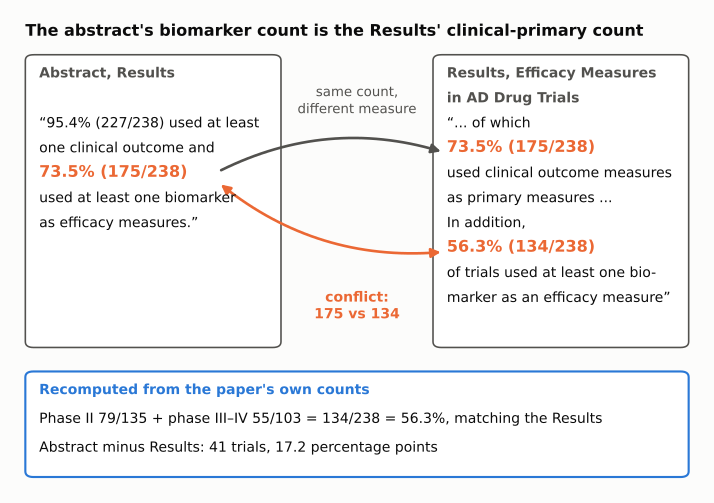
Figure 1. The two conflicting passages, quoted from the paper. Left, the abstract's Results sentence. Right, the Results paragraph "Efficacy Measures in AD Drug Trials", shortened with ellipses. Reported values are in orange. The gray connector links the abstract's biomarker figure to the identical Results figure for clinical outcomes used as primary measures. The orange connector links it to the Results figure for biomarkers, which it contradicts. The blue panel gives the value recomputed from the paper's phase-stratified counts. It matches the Results (134/238, 56.3%), not the abstract.
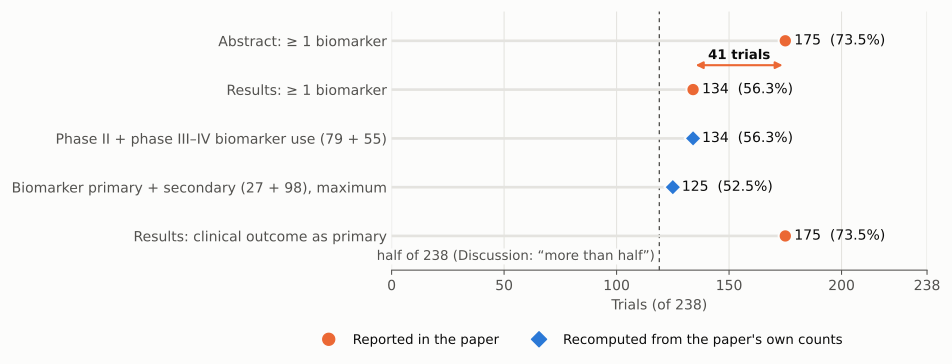
Figure 2. The counts behind the conflict, on one axis of trials from 0 to 238. Orange circles are counts printed in the paper. Blue diamonds are counts recomputed from the paper's other figures: the sum of the phase II and phase III–IV biomarker counts (79 + 55 = 134), and the upper bound on primary or secondary biomarker use (27 + 98 = 125). The dashed line marks half of the 238 trials, the threshold of the Discussion's "more than half". The abstract's 175 equals the clinical-primary count and lies 41 trials above every other count of biomarker use in the paper.
Why it matters
The abstract's Results section opens with this figure, and for many readers the abstract is the only part of a review they read or quote. A secondary summary of the article, whose URL carries the date 25 July 2026, already repeats the abstract's figure ("73.5% of analyzed trials incorporated at least one biomarker as an efficacy endpoint").
- Size. The abstract overstates biomarker use by 41 trials, from just over half of trials to about three-quarters, a relative overstatement of 31%.
- Comparison inside the abstract. The abstract puts the two headline figures side by side: 95.4% of trials used clinical outcomes and 73.5% used biomarkers. Read together, they make the two kinds of efficacy measure look much closer in use than the body reports (95.4% vs 56.3%).
- Conclusion. The abstract's Discussion says "biomarker use is widespread". That remains a fair description at 56.3%, and the body and Discussion carry the correct value. The error changes the magnitude of a key descriptive result, not the direction of the paper's conclusions. None of the review's other headline figures (domains assessed, co-primary measures, 20/238 biomarker-only primaries, counts of distinct measures) depends on it.
Explanations considered
- The two figures measure different things. This does not account for the numbers. Both refer to the same 238 trials and use the same wording ("at least one biomarker as an efficacy measure"). Neither refers to a subgroup, a time point or primary-only use.
- The abstract counts exploratory measures and the Results do not. This does not account for the numbers. The Methods define the analysis as "any efficacy measures, primary or secondary", and both passages use the same phrase. The phase-stratified Results, which add up to 134, also cover all domains assessed. No passage gives a broader count than 134.
- The Results figure is the wrong one, and 175 is correct. This is contradicted by three independent figures in the paper. The phase counts sum to 134. The Discussion twice says "more than half", which would understate 73.5%. Primary plus secondary biomarker use is at most 125. Separately, 175 fits the clinical-primary count: with 195 trials having a clinical or biomarker primary measure, it implies 20 trials with biomarker-only primaries, exactly the 20/238 the paper reports.
- A conversion or typesetting artifact in the PMC copy. This is excluded as far as the available copies allow. The PMC article page, the Europe PMC full-text XML and the local PMC archive all carry the same wording and numbers. A secondary summary whose URL is dated 25 July 2026, a month before the 25 August 2026 issue date, also repeats 73.5%. This suggests the figure was already in the online-first version, although the page shows no explicit date.
- The supplement resolves it. This could not be checked. eTable 2 may list counts by type of efficacy measure, but the supplement was not available (see Status). The main text alone points to 134.
The smaller inconsistencies (134 vs 125; 26 vs 27) leave some uncertainty about the exact correct value, perhaps by a few trials. They do not bring it near 175.
Status
As of 2026-10-23:
- Version of record. The publisher's site (www.neurology.org, reached from the DOI) returned HTTP 403 for the article HTML, the PDF and the supplement, so I could not read the publisher's own rendering. The PMC article page (pmc.ncbi.nlm.nih.gov/articles/PMC13445500/), the Europe PMC full-text XML and the local PMC archive all carry the same abstract sentence (73.5%, 175/238) and the same Results sentence (56.3%, 134/238). The PMC-hosted publisher PDF (WNL-2026-300706.pdf) could not be downloaded, because the server returned an interstitial page. Every quotation above was checked verbatim against the PMC-archived text.
- Supplement. The article cites eTables and eFigures. Neither PMC nor Europe PMC includes the supplementary material, the publisher's supplement page returned 403, and a web search found no public copy. The Data Availability statement says aggregated data are available on request.
- Corrections and comments. I found no correction, erratum, retraction or expression of concern. Crossref lists no update relations for the DOI, and PMC and Europe PMC list no correction notices (PMID 42492033). PubMed links only to a companion editorial (PMID 42492030, doi:10.1212/WNL.0000000000218468), whose text I could not open. The PubPeer API returned no comments for the DOI, though its web search page refused automated access (HTTP 403). A web search for the title with "correction", "erratum" or "PubPeer" found nothing relevant.
- Sources. PMC article PMC13445500; Europe PMC full-text XML; Crossref; PubMed; PubPeer API; secondary summary at omnicuris.com (URL dated 25 July 2026).
Suggested correction
- In the abstract's Results, replace "73.5% (175/238) used at least one biomarker as efficacy measures" with "56.3% (134/238) used at least one biomarker as efficacy measures", if the authors' data confirm the Results figure.
- Reconcile the any-use count (134) with the primary and secondary counts (27 and 98, total 125). For example, state whether exploratory measures are included in "any" use. Also reconcile the phase-level biomarker-primary counts (20 + 6 = 26) with the overall 27.
- Check any figure or supplementary table that reports overall biomarker use (for example eTable 2) against the corrected value.