← Back to the plain-language case
CGRP infusion rate is 5 µg/kg/min in Abstract and Results, 50 ng/kg/min in Methods
Brain (2026) · doi:10.1093/brain/awag008 · PMC13431663
Summary
The paper's main intervention is a 20-minute intra-carotid infusion of CGRP in anaesthetized rats. The Abstract and the Results give its rate as 5 µg/kg/min. The Methods and the Figure 1 and Figure 4 legends give 50 ng/kg/min for the same infusion. 5 µg/kg/min is 5,000 ng/kg/min, so the two values differ by exactly 100-fold. Both are described as the dose from human studies. The human provocation studies the paper cites infused 1.5–2 µg/min, about 21–29 ng/kg/min for a 70 kg adult. That supports 50 ng/kg/min and puts the Abstract's value at 175–233 times the human rate. The neuron counts and statistics do not depend on which rate is right. The paper's claim that the effect occurs at a physiologically relevant "human dose" does depend on it.
What the paper reports
The Abstract states the rate of the main intervention:
"Intra-carotid CGRP infusion (5 µg/kg/min, 20 min) activated 62% of Aδ-fibres and 56% of C-fibres" (Abstract)
The Methods give a rate 100 times lower for the same intra-carotid infusion, with the same duration and a stated human basis:
"CGRP (α calcitonin gene-related peptide rat; Sigma Aldrich) was infused using the intra-carotid artery cannula at a rate of 50 ng/kg/min for 20 min (dose from human studies)" (Materials and methods, "CGRP infusion protocol"; followed by citation 8)
The Results use the Abstract's value for the intra-carotid infusion, and the same value for the intravenous infusion:
"However, when delivered by intra-carotid infusion at the human dose (5 µg/kg/min for 20 min), CGRP, but not saline vehicle, produced sustained activation of first- and second-order neurons" (Results, "Activation and sensitization", paragraph 2)
"When administered either by intraperitoneal injection (100 µg/kg), or by intravenous infusion at the low dose used in human headache provocation studies (5 µg/kg/min for 20 min), CGRP failed to produce activation of first- or second-order neurons" (Results, "Activation and sensitization", paragraph 1)
Two figure legends use the Methods value:
"tested for activation by intra-carotid infusion of CGRP (50 ng/kg/min for 20 min) (A–D) or saline (E–H)." (Figure 1 legend)
"tested for activation by intra-carotid infusion of CGRP (50 ng/kg/min for 20 min) (A–C)." (Figure 4 legend)
The Discussion gives no number but describes the dose as human and physiological:
"Similar to previous findings,20 we also found that intravenous infusion of CGRP at the human dose failed to produce nociceptive neuronal activation."
"This change in route allowed us to achieve nociceptive neuronal activation without resorting to raising the dose to non-physiological levels and potentially inducing effects unrelated to CGRP’s role in headache." (Discussion, paragraph 2)
The paper also refers to "the human CGRP provocation studies9,10" (Discussion, paragraph 4). Its animals were "Male and female Sprague Dawley rats (250–320 g, 10 to 12 weeks old)" (Methods, "Surgical preparation").
What the paper's own numbers show
Method. I collected every per-minute CGRP rate in the PMC archive copy. "5 µg/kg/min" occurs three times (Abstract, Results paragraphs 1 and 2) and "50 ng/kg/min" three times (Methods, Fig 1 and Fig 4 legends). Every statement gives a duration of 20 min. I converted both rates to one unit, computed the total given over 20 minutes and per animal at the stated body masses, and compared the total with the paper's intraperitoneal dose. For an outside anchor I used the two human provocation studies the paper cites as refs 9 and 10. Their PubMed abstracts give fixed rates of 2 µg/min and 1.5 µg/min, each for 20 min. I converted these to ng/kg/min for a 60–80 kg adult, and also scaled them to rat by body surface area (FDA conversion factors, ×37/6). As a control I checked that the Abstract's activation percentages match the Results counts. All numbers are printed by recompute.py.txt.
| Quantity | Location | Reported | Recomputed |
|---|---|---|---|
| Intra-carotid CGRP rate | Abstract; Results para 2 | 5 µg/kg/min, 20 min | 5 × 1000 = 5,000 ng/kg/min |
| Intra-carotid CGRP rate | Methods; Fig 1 and Fig 4 legends | 50 ng/kg/min, 20 min | 0.05 µg/kg/min |
| Ratio of the two rates | Abstract/Results vs Methods/legends | — | 5,000 / 50 = 100-fold |
| Total over 20 min | from the rates above | — | 100 µg/kg at 5 µg/kg/min; 1 µg/kg at 50 ng/kg/min |
| Intraperitoneal dose | Results para 1 | 100 µg/kg | equals the 20-min total at 5 µg/kg/min; 100 times the total at 50 ng/kg/min |
| Total per rat (250–320 g) | Methods (body mass) | — | 25–32 µg at 5 µg/kg/min; 250–320 ng at 50 ng/kg/min |
| Intravenous CGRP rate | Results para 1 (no i.v. rate in Methods) | 5 µg/kg/min, 20 min | the Methods give no separate value to check it against |
| Human provocation rate, ref 9 (2 µg/min) | cited studies | — | 25.0–33.3 ng/kg/min at 80–60 kg; 28.6 at 70 kg |
| Human provocation rate, ref 10 (1.5 µg/min) | cited studies | — | 18.8–25.0 ng/kg/min at 80–60 kg; 21.4 at 70 kg |
| 50 ng/kg/min relative to human rate | Methods vs refs 9, 10 | "dose from human studies" | 1.75–2.33× at 70 kg (1.5–2.7× over 60–80 kg) |
| 5 µg/kg/min relative to human rate | Abstract/Results vs refs 9, 10 | "the human dose" | 175–233× at 70 kg (150–267× over 60–80 kg); 350 µg/min for a 70 kg adult |
| Human range scaled to rat by body surface area | refs 9, 10, ×37/6 | — | 116–206 ng/kg/min; 50 is 2.3–4.1× below, 5,000 is 24–43× above |
| Activation, Aδ / C-fibres | Abstract (62%, 56%) vs Results (10/16, 9/16) | 62%, 56% | 62.5%, 56.25% (consistent) |
| Activation, first- / second-order | Results (19/32, 18/24) | 59%, 75% | 59.4%, 75.0% (consistent) |
The two rates cannot describe one infusion. The 50 ng/kg/min value lies within about a factor of 2 of the cited human rates. The 5 µg/kg/min value is more than 100 times above them, and more than 20 times above them even after scaling to rat by body surface area. At 5 µg/kg/min the 20-minute total would equal the intraperitoneal dose (100 µg/kg) that the Results list beside the "low dose" infusion.
Figure
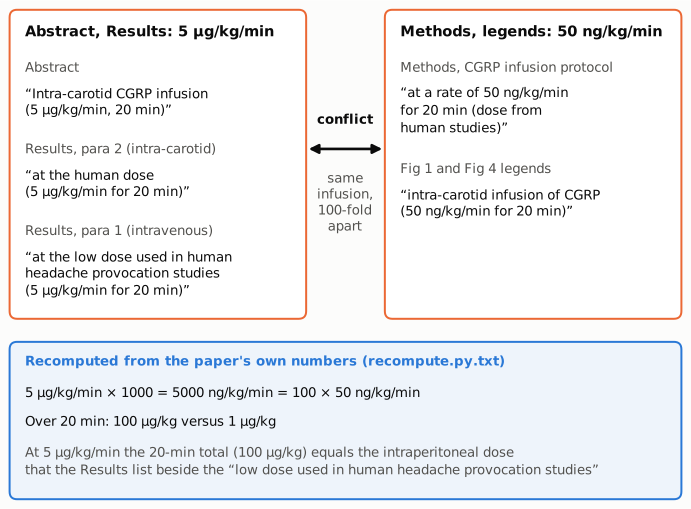
Figure 1. The two orange-bordered panels quote the paper. On the left are the three statements of 5 µg/kg/min: the Abstract, Results paragraph 2 (intra-carotid) and Results paragraph 1 (intravenous). On the right are the three statements of 50 ng/kg/min: the Methods and the Fig 1 and Fig 4 legends. All six give a 20-minute infusion. Five describe the intra-carotid infusion, and Results paragraph 1 describes the intravenous one. The blue strip shows the arithmetic from recompute.py.txt. 5 µg/kg/min is 5,000 ng/kg/min, 100 times 50 ng/kg/min. Over 20 minutes that is 100 µg/kg against 1 µg/kg, and the 100 µg/kg total equals the paper's intraperitoneal dose.
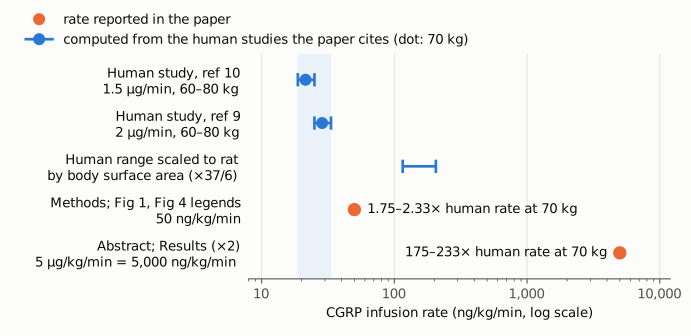
Figure 2. CGRP infusion rate on a log axis. Orange dots are the two rates reported in the paper. Blue intervals are computed in recompute.py.txt from the human studies the paper cites (refs 9 and 10: 2 and 1.5 µg/min for 20 min). Each interval spans a 60–80 kg adult, and its dot marks 70 kg. The light blue band covers both studies (18.8–33.3 ng/kg/min). The third row scales that human range to rat by body surface area (×37/6), giving 116–206 ng/kg/min. The Methods and legend value, 50 ng/kg/min, is 1.75–2.33 times the 70 kg human rate. The Abstract and Results value, 5,000 ng/kg/min, is 175–233 times it. That is two orders of magnitude, and on a log axis the difference is shown at true scale.
Why it matters
The infusion rate defines the paper's main experiment, and the paper's interpretation rests on it being a human-relevant dose. The Abstract is the part most often read and indexed, and it gives 5 µg/kg/min. A reader who uses that value to replicate the experiment or to compare it with other studies would give 100 times the dose in the Methods. The Results use the same value twice, once for the positive intra-carotid result ("at the human dose") and once for the negative intravenous result ("the low dose used in human headache provocation studies").
The counts, percentages and tests (19/32 and 18/24 neurons activated, Table 1, the lidocaine experiments) do not depend on which rate is printed, and the Abstract's percentages match the Results counts. The finding that intra-carotid CGRP activated these neurons is therefore not affected by the discrepancy. What is affected is the stated dose. The paper itself frames this as the key point: the intra-carotid route gave activation "without resorting to raising the dose to non-physiological levels". If the Abstract's value were the one given, the infusion would be about 175–233 times the cited human rate. Its 20-minute total would also equal the intraperitoneal dose, and that claim could not stand. If, as the evidence suggests, 50 ng/kg/min was given, the claim stands but the Abstract and Results misstate it. The intravenous comparison has a further uncertainty. The Results give the intravenous rate as 5 µg/kg/min, and the Methods give no separate intravenous rate. So it cannot be confirmed from the paper that the intravenous and intra-carotid infusions used the same rate. That comparison is the paper's main evidence that route, not dose, explains the different results.
Explanations considered
Unit typesetting or conversion artifact. Not supported. The two values differ in both the number (5 vs 50) and the prefix (µ vs n). A µ/n substitution alone would give 5 ng/kg/min or 50 µg/kg/min, and neither matches the other statement. The version of record on the publisher's site has the same six statements with the same values (fetched 2026-10-24). The PMC and Europe PMC copies match it.
Two different doses (for example, intravenous and intra-carotid). Ruled out for the intra-carotid infusion. The Abstract and Results paragraph 2 give 5 µg/kg/min for the intra-carotid route, and the Methods and both legends give 50 ng/kg/min for the same route, all for 20 min. The Methods describe a single CGRP infusion protocol, through the intra-carotid cannula. For the intravenous infusion the paper gives only 5 µg/kg/min (Results paragraph 1), and the Discussion calls both the "human dose". So the paper presents one intended rate.
Confusion with the paper's other, genuinely different doses. Not applicable. The intraperitoneal dose (100 µg/kg) and the trigeminal ganglion injection (Fig 7 legend, "300 ng CGRP") are single amounts, not per-minute rates, and are not in conflict. The fact that 5 µg/kg/min for 20 minutes equals exactly 100 µg/kg is noted above. The paper gives no reason for that equality.
A rat dose scaled up from the human dose. Does not account for 5 µg/kg/min. Scaling the cited human rates to rat by body surface area gives 116–206 ng/kg/min. That is 2.3–4.1 times above 50 ng/kg/min but 24–43 times below 5,000 ng/kg/min. The paper describes no scaling and calls the dose the dose "from human studies".
The Methods and legends hold the error, not the Abstract. Possible in principle but not supported by the paper's wording. The Abstract and Results call the 5 µg/kg/min infusion "the human dose" and "the low dose used in human headache provocation studies". The cited human studies infused 1.5–2 µg/min in total, which for a 70 kg adult would correspond to 5 µg/kg/min only if it were given 175–233 times over. For an adult the Abstract's rate would mean 350 µg/min. The Methods value fits the cited studies within a factor of about 2. The Discussion's "without resorting to raising the dose to non-physiological levels" also fits the lower value. The Methods cite reference 8 for the dose, an earlier study from the same group (Brain 2024, PMC11292906). An earlier audit stage found no CGRP infusion rate in its full text, so it cannot settle the question. The text alone cannot prove which rate was given; only the laboratory records can.
Status
As of 2026-10-24:
- Version of record. The publisher's article page (academic.oup.com, reached via doi.org) was read on 2026-10-24. It has 5 µg/kg/min in the Abstract and twice in the Results, and 50 ng/kg/min in the Methods and in the Fig 1 and Fig 4 legends, matching the PMC archive copy. The article history lists received 4 August 2025, published 8 January 2026, and "Corrected and typeset: 13 July 2026". The page shows no correction notice linked to that production date. The Europe PMC full-text XML, fetched on 2026-10-24, has the same three occurrences of each rate. An earlier audit stage found the same wording on the PMC article page.
- Supplements. The PMC/Europe PMC XML has no supplementary-material elements, and the PMC page lists no supplementary files. The publisher's page has a "Supplementary Data" tab, but an earlier audit stage found no supplementary files in it. The data availability statement says the data are "available from the corresponding author, upon reasonable request". Reference 8, the cited source of the dose, gives no CGRP infusion rate (earlier audit stage).
- Corrections.
src/known.pyreports no Crossref update records and no PMC or Europe PMC correction, retraction or expression-of-concern notice. An earlier audit stage found noupdate-to,updated-byor relation entries in the Crossref record, and no correction DOI in a Crossref title search. A web search on 2026-10-24 for the title with "correction", "erratum" or "PubPeer" found no notice for this paper. - PubPeer. Not checked: pubpeer.com returned HTTP 403 to both the API and the search page on 2026-10-24, as it had at the earlier stage.
- Human reference doses. Refs 9 and 10 were identified from the article's reference list in the Europe PMC XML. Their rates (2 µg/min and 1.5 µg/min, each for 20 min, i.v.) are from their PubMed abstracts (PMID 11993614; PMID 20855363).
Sources: PMC13431663 (PubMed Central archive); https://academic.oup.com/brain/article/149/8/2760/8417004; Europe PMC full-text XML for PMC13431663; Crossref and PMC notice records for 10.1093/brain/awag008; PubMed records 11993614 (Cephalalgia 2002;22:54–61) and 20855363 (Cephalalgia 2010;30:1179–86).
Suggested correction
The authors should confirm the administered rate against their infusion records. If it was 50 ng/kg/min, as the Methods, both figure legends and the cited human studies indicate, the Abstract should read "Intra-carotid CGRP infusion (50 ng/kg/min, 20 min)". Results, "Activation and sensitization", paragraph 2 should read "at the human dose (50 ng/kg/min for 20 min)". The authors should also state the rate actually used for the intravenous infusion in Results paragraph 1, and add it to the Methods ("CGRP infusion protocol"), which describes only the intra-carotid infusion. If 5 µg/kg/min was given instead, the Methods and the Fig 1 and Fig 4 legends would need correcting. The descriptions of this dose as "the human dose", the "low dose used in human headache provocation studies" and not "non-physiological" would then also need revisiting.