← Back to the plain-language case
Abstract reports no severe cardiac toxicity or hand-foot syndrome; the Results report five Grade 3 cases
BMC Med (2026) · doi:10.1186/s12916-026-04895-9 · PMC13267627
Summary
This phase I dose-escalation study gave liposomal mitoxantrone (Lipo-MIT) with capecitabine to 26 patients with HER2-negative advanced breast cancer. Its abstract says the combination showed "no reports of severe cardiac toxicity or hand-foot syndrome". The paper's "Bullet Points" list (third bullet) and the Discussion say much the same. The paper's own Table 2, Table 3 and Results text tell a different story. Hand-foot syndrome (HFS) occurred in 13 of 26 patients (50.0%), and 5 of 26 (19.2%) had Grade 3 HFS, which is the highest grade CTCAE v5.0 defines for this event. In the Q4W cohort, whose schedule was chosen as the recommended phase 2 dose (RP2D), the rates were 7 of 11 (63.6%) and 3 of 11 (27.3%). The abstract statement is therefore false whichever way "severe" is read. It misdescribes one of the most frequent clinically relevant toxicities in the summary that most readers will rely on.
What the paper reports
Abstract, Results:
The combination demonstrated a manageable safety profile, with no reports of severe cardiac toxicity or hand-foot syndrome.
Bullet Points (third bullet):
Manageable safety profile with no severe short-term cardiac toxicity or hand-foot syndrome observed.
Discussion, paragraph 3:
Our initial data support this design rationale: the combination was well-tolerated, with a notable absence of severe short-term cardiac events and Hand-Foot Syndrome.
Discussion, paragraph 3 (same paragraph, continuing):
offering a potential “re-challenge” strategy with a distinct toxicity profile (e.g., lower rates of severe palmar-plantar erythrodysesthesia typically associated with PLD) [29, 30].
Results, Safety and tolerability, paragraph 3:
Other common non-hematological TRAEs included fatigue (61.5%), anorexia (53.8%), and hand-foot syndrome (50.0%). While most non-hematological events were mild to moderate, Grade 3 hand-foot syndrome was observed in 5 patients (19.2%) and was managed through dose interruptions or reductions.
The same paragraph ends:
No Grade 4 non-hematological TRAEs or treatment-related deaths were recorded.
Table 2, "Treatment-related adverse events (TRAEs) in the total population (N = 26)", row "Hand-foot syndrome": any grade 13 (50.0), Grade 3–4 5 (19.2). Footer: "AEs are coded according to NCI-CTCAE v5.0."
Table 3, "Treatment-related adverse events (TRAEs) and treatment exposure by dosing schedule", row "Hand-foot syndrome": Q3W (N = 15) any grade 6 (40.0), Grade 3–4 2 (13.3); Q4W (N = 11) any grade 7 (63.6), Grade 3–4 3 (27.3).
Abstract, Conclusions (for context, not itself in error):
The combination of Lipo-MIT and capecitabine showed preliminary antitumor activity and manageable tolerability in heavily pretreated HER2-negative ABC.
What the paper's own numbers show
Method. I recomputed every printed HFS percentage from its count and denominator. I checked that the two cohorts in Table 3 add up to the totals in Table 2. I then compared those counts with the count of zero that the abstract sentence implies, under both readings of "severe". The confidence intervals are exact (Clopper–Pearson) binomial intervals computed from the printed counts; the paper itself gives no interval for adverse events. Everything below is printed by recompute.py.txt.
| Quantity | Location | Reported | Recomputed |
|---|---|---|---|
| HFS, any grade, all patients | Table 2; Results, Safety p3 | 13 (50.0%) | 13/26 = 50.0% (exact 95% CI 29.9–70.1%) |
| HFS, Grade 3–4, all patients | Table 2; Results, Safety p3 ("Grade 3 ... 5 patients") | 5 (19.2%) | 5/26 = 19.2% (6.6–39.4%) |
| HFS, Q3W cohort, any / Grade 3–4 | Table 3 | 6 (40.0) / 2 (13.3) | 6/15 = 40.0% / 2/15 = 13.3% |
| HFS, Q4W cohort (RP2D schedule), any / Grade 3–4 | Table 3 | 7 (63.6) / 3 (27.3) | 7/11 = 63.6% (30.8–89.1%) / 3/11 = 27.3% (6.0–61.0%) |
| Cohort sums vs total | Table 3 vs Table 2 | 13 any grade; 5 Grade 3–4; N = 26 | 6 + 7 = 13; 2 + 3 = 5; 15 + 11 = 26 (all consistent) |
| Grade of the 5 Grade 3–4 events | Results, Safety p3 | "Grade 3"; "No Grade 4 non-hematological TRAEs" | all 5 are Grade 3, the top CTCAE v5.0 grade for palmar-plantar erythrodysesthesia |
| HFS count implied by the abstract | Abstract, Results | "no reports of ... hand-foot syndrome" = 0 | 13 any grade; 5 Grade 3 |
| Severe HFS implied by Bullet Points and Discussion | Bullet Points (third bullet); Discussion p3 | "no severe ... hand-foot syndrome" = 0 | 5 Grade 3 (19.2%) |
| Share of HFS cases that were Grade 3 | Table 2 | — | 5/13 = 38.5% |
| HFS among non-hematological Grade 3–4 TRAEs | Table 2 | HFS 5, stomatitis 1, all others 0 | HFS accounts for 5 of the 6 non-hematological Grade 3–4 entries |
Every percentage the paper prints for HFS is arithmetically correct, and the tables agree with each other and with the Results text. The error is not in the data. It is in three summary sentences that contradict the data.
Figure
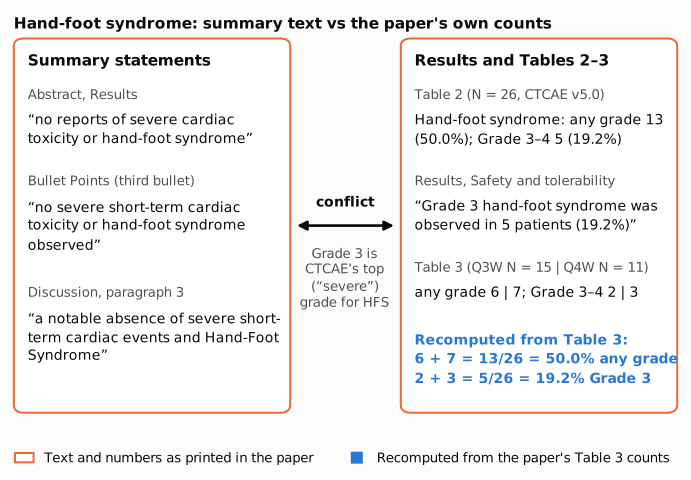
Figure 1. On the left are the three summary sentences as printed (abstract Results, Bullet Points third bullet, Discussion paragraph 3). On the right are the paper's own HFS data as printed: Table 2 (N = 26), the Results sentence and Table 3 by cohort. The blue text at the bottom right is recomputed from the Table 3 counts. The arrow marks the conflict. Grade 3 is the highest grade CTCAE v5.0 defines for palmar-plantar erythrodysesthesia, so the five Grade 3 cases are severe events under the grading system the paper uses.
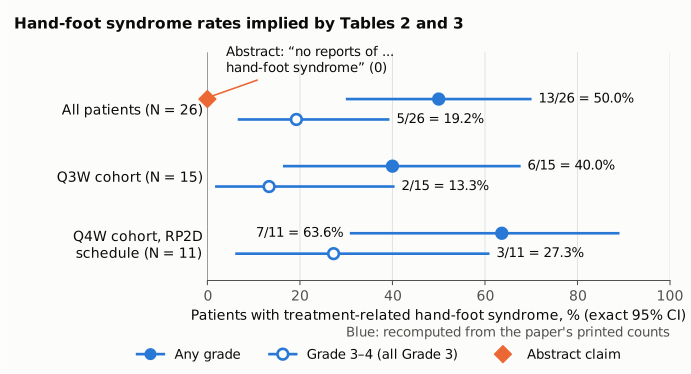
Figure 2. HFS rates recomputed from the printed counts in Tables 2 and 3, with exact (Clopper–Pearson) 95% confidence intervals. Filled circles show any grade; open circles show Grade 3–4, all of which were Grade 3. The orange diamond is the count of zero implied by the abstract. Every interval excludes zero; the lowest lower bound is 1.7% (Q3W Grade 3, 2/15), and the full-population intervals start at 29.9% (any grade) and 6.6% (Grade 3). The highest rates are in the Q4W cohort, whose schedule was chosen as the RP2D.
Why it matters
- The abstract inverts a safety finding. For many readers, and for indexing and evidence-synthesis services, the abstract is the paper. In this study HFS was the most frequent non-hematological Grade 3 toxicity: it accounts for 5 of the 6 non-hematological Grade 3–4 entries in Table 2. The abstract says it did not occur.
- The RP2D cohort is the most affected. Clinicians planning phase II use of 22 mg/m² Q4W need the Q4W rates: about two in three patients had HFS of any grade (7/11) and about one in four had Grade 3 HFS (3/11). The summary text gives no hint of this.
- The Discussion's mechanistic argument relies on the claim. The Discussion says the 60-nm liposome shields "healthy tissues such as the myocardium and skin", and that the "initial data support this design rationale", citing the absence of HFS. With HFS in half of patients, the data do not support the skin-sparing part of that argument. Because capecitabine also causes HFS, this design cannot attribute the HFS to either drug. That uncertainty leaves the argument unsupported rather than rescuing it.
- The comparison with pegylated liposomal doxorubicin (PLD). The Discussion suggests that Lipo-MIT may offer "lower rates of severe palmar-plantar erythrodysesthesia typically associated with PLD". This study's own Grade 3 rate (19.2% overall, 27.3% at the RP2D schedule) gives no internal support for that framing. The cited references may support it for Lipo-MIT alone. That is not established for this combination.
- What does not change. The primary endpoints stand: no dose-limiting toxicities (DLTs) in cycle 1 and an RP2D of 22 mg/m² Q4W. The abstract Conclusions ("manageable tolerability") are compatible with the data, since the Results say the HFS was managed by dose interruption or reduction. The cardiac part of the sentence is not contradicted by anything in the paper. The title is not affected.
Explanations considered
- "Severe" applies to both nouns ("no severe cardiac toxicity or [severe] hand-foot syndrome"). Does not account for the numbers. The paper grades adverse events with NCI-CTCAE v5.0 (Methods; Table 2 footer). For palmar-plantar erythrodysesthesia that scale defines only Grades 1–3, and Grade 3 is the severe grade. The Results report "Grade 3 hand-foot syndrome ... in 5 patients (19.2%)", and Tables 2 and 3 agree (5 = 2 + 3). So the sentence is false on the narrow reading as well as the broad one.
- A different population or denominator. Does not account for the numbers. The abstract describes all 26 enrolled patients. Tables 2 and 3 use the full safety population: "Safety was assessed in all patients who received at least one dose", and the Results say "All 26 enrolled patients completed the Cycle 1 DLT observation window". The cohort denominators add up (15 + 11 = 26), and every percentage recomputes exactly.
- HFS excluded as a capecitabine toxicity rather than a toxicity of the combination. Does not account for the numbers. Table 2 defines TRAEs as events "considered by the investigator to be related to the study treatment", which is the combination. The abstract sentence is also about "the combination". The paper contains no statement that leaves HFS out of the combination's safety profile.
- "Short-term" limits the claim to the cycle-1 DLT window. Partly accounts for the Bullet Points and Discussion wording, but not the abstract. The Bullet Points and the Discussion say "short-term". Under the Methods, any Grade ≥3 non-hematological toxicity in cycle 1 would have been a DLT, with no exemption for HFS, and the Results report no DLTs. If "short-term" means cycle 1, those two sentences could be technically true. The abstract sentence carries no "short-term" qualifier, though. Neither the paper nor its supplement says when the Grade 3 HFS events occurred, and the Bullet Points and the Discussion sentence do not mention that five Grade 3 cases occurred.
- A conversion or archiving artifact. Ruled out. The publisher's version of record carries the same sentences and table rows as the PMC archive and the Europe PMC XML (see Status).
- The supplement or registry resolves it. Ruled out. The only supplementary file (Additional file 1) holds a single Cox model table for PFS, with no adverse-event data. The registry record (NCT06156761) has no posted results.
Status
- Version of record. The publisher's page (link.springer.com/article/10.1186/s12916-026-04895-9; history line "Published: 28 April 2026, Version of record: 15 June 2026"; BMC Med vol 24, article 356) was fetched with a headless browser. It carries the same abstract sentence, Bullet Points item, Results paragraph, Discussion sentence and Table 2 and Table 3 HFS rows as the PMC archive. Its text also matches the Europe PMC full-text XML. Every quotation above was checked verbatim against the PMC-archived text.
- Supplements. There is one supplementary file, Additional file 1 (12916_2026_4895_MOESM1_ESM.docx). It is identical in the Europe PMC bundle and on the publisher's static-content server. It contains only Table S1, an exploratory multivariable Cox model for PFS, and has no adverse-event data.
- Registry. The ClinicalTrials.gov record NCT06156761 has no posted results; its status is listed as unknown.
- Corrections and comments. As of 2026-10-24 I found no correction, erratum, retraction or expression of concern. Crossref lists no update relations for the DOI, and PMC and Europe PMC list no notices. The PubPeer API and the PubPeer search page both refused automated access (HTTP 403, Cloudflare challenge). A general web search for PubPeer discussion of the paper returned no PubPeer page, so whether PubPeer has any comments remains unconfirmed.
- Sources. PMC article PMC13267627; the publisher's page and its Tables 2 and 3; Europe PMC full-text XML and supplementary-files bundle; Additional file 1; ClinicalTrials.gov NCT06156761; Crossref; Europe PMC; PubPeer (attempted).
Suggested correction
In the abstract Results, replace "The combination demonstrated a manageable safety profile, with no reports of severe cardiac toxicity or hand-foot syndrome." with a statement that matches Table 2. For example: "The combination demonstrated a manageable safety profile with no severe cardiac toxicity; hand-foot syndrome occurred in 50.0% of patients (Grade 3 in 19.2%) and was managed with dose interruption or reduction." Revise the third Bullet Points item the same way. In the Discussion, either remove "and Hand-Foot Syndrome" from "a notable absence of severe short-term cardiac events and Hand-Foot Syndrome", or, if, as the absence of DLTs implies, no Grade ≥3 HFS occurred in cycle 1, state that and that 5 patients (19.2%) had Grade 3 HFS in later cycles. Also revisit the skin-sparing "design rationale" and the comparison with PLD's palmar-plantar erythrodysesthesia in light of those rates. It would help readers to report the Q4W (RP2D) HFS rates (7/11 any grade, 3/11 Grade 3) next to the RP2D in the abstract.