← Back to the plain-language case
Abstract reports a 59.7% catalyst heat-duty reduction; the body reports 35.2% at the optimum
Nat Commun (2026) · doi:10.1038/s41467-026-69542-6 · PMC12966427
Summary
The abstract says that the optimal 1:1 iron-sulfated zirconia/silica (Fe-SZ/SiO2) catalyst "reduces relative heat duty by up to 59.7%" in the membrane vacuum regeneration (MVR) system. The Results and Discussion report something different for the same catalyst, solvent (3 M potassium glycinate, GlyK) and blank: a 35.2% reduction at 9 wt%, the loading the paper selects as optimal, and 40.3% at 12 wt%, the highest loading tested. Applying the paper's own Eq. 7 to its reported catalytic enhancements reproduces 35.2% and 40.3%. The same calculation shows that 59.7% is the relative heat duty that remains at 12 wt% (100/1.675 = 59.7%, i.e. 100 − 40.3), not a reduction. As written, the abstract's figure is 1.70 times the reduction at the stated optimum and 1.48 times the largest catalyst-only reduction in the paper. It is the abstract's only quantitative statement about the catalyst on its own.
What the paper reports
Abstract:
An optimal iron-sulfated zirconia to silica ratio of 1:1 reduces relative heat duty by up to 59.7% in the membrane vacuum system.
Finally, combining the optimized hybrid solvent, catalyst, and membrane system at 90 °C reduces thermal energy consumption by 66.8% relative to potassium glycinate, achieving an energy requirement of 2.6 GJ/tCO2.
Results, Composite solid acid catalyst › Catalytic support (SiO2 vs. Al2O3), Fig. 2g text (6 wt% 1:1 catalyst):
raising the total amount of desorbed CO2 from 244 to 307 mmol for 3 M GlyK
Results, Composite solid acid catalyst › Catalyst concentration and stability, paragraph 1 (the inputs):
the total desorbed CO2 increased from 244 to 377 mmol, corresponding to a 54.3% catalytic enhancement
the enhancement rising to 67.5%
Notably, the magnitude of improvement from 6 to 9 wt% (112%) was greater than that from 9 to 12 wt% (24.3%), suggesting a reduced catalytic effect beyond a certain concentration, indicating the presence of an optimum.
the use of 9 wt% catalyst resulted in the highest enhancement factor of 6.0 and was therefore selected as the optimal concentration for further evaluations.
Same section, paragraph 2 (text for Fig. 3g):
Accordingly, at 9 wt% and 12 wt%, the heat duty decreased by 35.2 and 40.3% as compared to the blank, respectively, reducing the thermal energy requirement from 7.8 to 5.1 and 4.7 GJ/tCO2.
Same section, paragraph 3 (stability at 9 wt%, Fig. S6b):
the RH% increased from 64.8% in cycle 1 to 68.8% in cycle 2
Results, Catalytic hybrid amino acid solvents in MVR (Fig. 5f text):
Considering GlyK as a benchmark, the catalyst reduced the RH of GlyK, SarK, and TauK to 64.8%, 90.1%, and 55.8%, respectively.
Notably, the combination of a hybrid solvent with the catalyst further reduced the RH to 33.2%, corresponding to a 66.8% reduction in energy consumption.
Discussion:
9 wt% fixed-bed catalyst was identified as the optimal concentration, achieving a 35.2% reduction in the system’s energy input.
Methods, MVR performance analysis (definition):
The relative heat duty, RH (%), was calculated using Eq. 7
where Eq. 7 is RH = Q_Cat / Q_Blank × 100.
All quotes were checked verbatim against the PMC-archived text (src/show.py; recompute.py.txt repeats the check). The string "59.7" occurs once in the archived article text, in the abstract.
What the paper's own numbers show
Method. The Methods define the catalytic enhancement CE = (M_cat − M_blank)/M_blank × 100 (Eq. 4), the thermal energy Q = m·cp·ΔT / (M_total_CO2·Mw) (Eq. 6) and RH = Q_cat/Q_blank × 100 (Eq. 7). In the catalyst-loading series the solvent (3 M GlyK), its mass and the temperature programme (90 °C) are the same with and without catalyst, so m, cp and ΔT cancel and RH = M_blank/M_cat × 100 = 100/(1 + CE/100). The heat-duty reduction is 100 − RH, and the thermal energy is 7.8 GJ/tCO2 (the blank) × RH/100. RH is computed from the reported CE values and, where the paper prints the desorbed amounts, also from the amounts in mmol. As a separate check, the reduction is recomputed from the reported, rounded energies, 1 − Q_cat/7.8. Every number below is printed by recompute.py.txt.
| Quantity | Location | Reported | Recomputed |
|---|---|---|---|
| CE, 9 wt% 1:1 | Results, Catalyst concentration, para 1 | 54.3% (244 → 377 mmol) | 377/244 − 1 = 54.5% |
| CE, 6 wt% 1:1 | Results, Catalytic support | 25.6% (244 → 307 mmol) | 307/244 − 1 = 25.8% |
| Gain in CE, 6 → 9 wt% and 9 → 12 wt% | Results, para 1 | 112% and 24.3% | 112.1% and 24.3% |
| Enhancement factor CE/W | Results, para 1 | 6.0 at 9 wt% (highest) | 4.27 (6 wt%), 6.03 (9 wt%), 5.62 (12 wt%) |
| RH, 9 wt% (stated optimum) | Results, para 3; Fig. 5f text | 64.8% | 100/1.543 = 64.8% (from mmol: 64.7%) |
| Heat-duty reduction, 9 wt% | Results, para 2; Discussion | 35.2% | 100 − 64.8 = 35.2% (from mmol: 35.3%; from energies: 1 − 5.1/7.8 = 34.6%) |
| Thermal energy, 9 wt% | Results, para 2 | 5.1 GJ/tCO2 | 7.8 × 0.648 = 5.06 GJ/tCO2 |
| RH, 12 wt% (highest tested) | not stated in the text | — | 100/1.675 = 59.7% |
| Heat-duty reduction, 12 wt% | Results, para 2 | 40.3% | 100 − 59.7 = 40.3% (from energies: 1 − 4.7/7.8 = 39.7%) |
| Thermal energy, 12 wt% | Results, para 2 | 4.7 GJ/tCO2 | 7.8 × 0.597 = 4.66 GJ/tCO2 |
| Heat-duty reduction, 6 wt% 1:1 | not stated in the text | — | 100 − 100/1.256 = 20.4% (RH 79.6%, 6.21 GJ/tCO2) |
| Heat-duty reduction, "optimal" 1:1 catalyst | Abstract | 59.7% ("by up to") | 35.2% at the optimum; 40.3% at most (12 wt%) |
| What a 59.7% reduction would require | — | — | RH 40.3%, Q = 3.14 GJ/tCO2, CE = 148% (highest reported catalyst-only CE: 67.5%) |
| Abstract figure ÷ body figure | — | — | 59.7/35.2 = 1.70 (optimum); 59.7/40.3 = 1.48 (12 wt%) |
| Hybrid solvent + catalyst | Abstract; Results (Fig. 5f text) | RH 33.2%, 66.8% reduction, 2.6 GJ/tCO2 | 100 − 33.2 = 66.8%; 7.8 × 0.332 = 2.59 GJ/tCO2 |
The inputs in this section of the paper agree with one another to within rounding. The Results paragraph, the stability paragraph, the Fig. 5f text and the Discussion all agree on 35.2% (RH 64.8%) at 9 wt%, and the Results give 40.3% at 12 wt%. The abstract's catalyst figure is the only value that departs from them. It equals, to the printed decimal, the RH remaining at 12 wt%. The other two headline numbers in the abstract agree with the body: 66.8% and 2.6 GJ/tCO2 for the combined system, and the 69.1% desorption gain of the hybrid solvent (69.2% in the body; 589/348 − 1 = 69.3%).
Figure
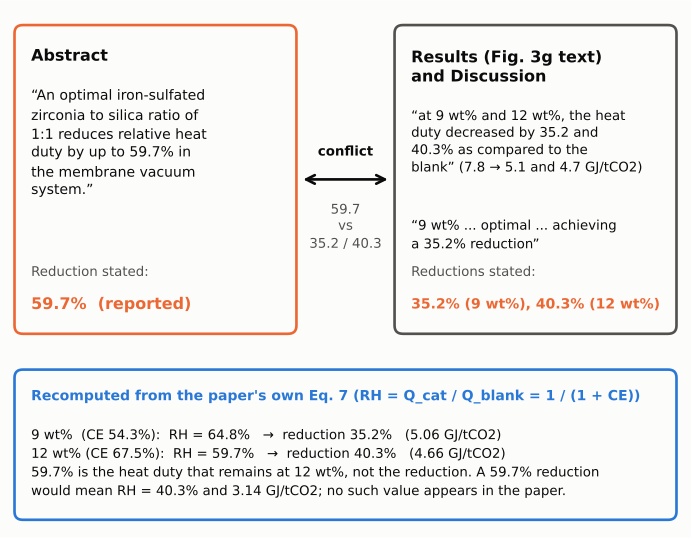
Figure 1. Left: the abstract's sentence on the catalyst, which states 59.7% as a reduction and links it to the optimal configuration. Right: the reductions the Results (Fig. 3g text) and Discussion report for the same 1:1 Fe-SZ/SiO2 catalyst in 3 M GlyK against the same blank: 35.2% at the stated optimum (9 wt%) and 40.3% at 12 wt%. Orange text marks values reported in the paper. Bottom (blue): RH recomputed from the reported catalytic enhancements using the paper's Eq. 7, RH = 100/(1 + CE/100). The recomputation reproduces the body's reductions and shows that 59.7% is the share of the blank heat duty that remains at 12 wt%. A real 59.7% reduction would mean RH 40.3% and 3.14 GJ/tCO2. The paper reports neither value for the catalyst at any loading.
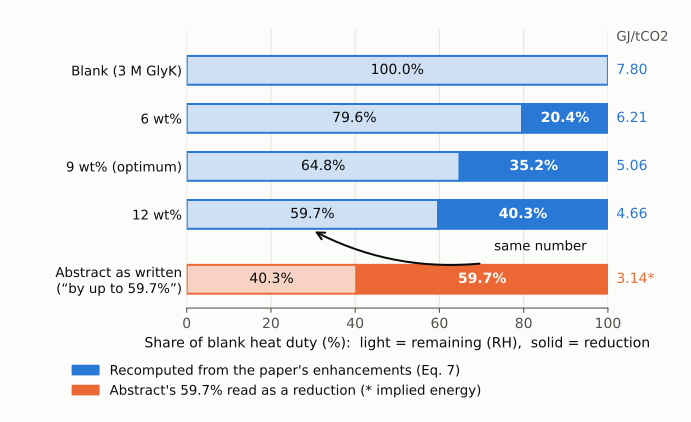
Figure 2. Each bar is the blank heat duty (3 M GlyK, no catalyst; 100%, 7.8 GJ/tCO2), split into the share that remains (light segment, RH) and the share removed (solid segment, reduction). Blue bars are recomputed from the paper's reported catalytic enhancements (25.6%, 54.3% and 67.5%) with Eq. 7. The column at the right gives the corresponding thermal energy, 7.8 × RH/100. The orange bar shows what the abstract's sentence states: a 59.7% reduction, which would leave 40.3% and imply about 3.14 GJ/tCO2 (marked *). The arrow links the abstract's 59.7 to the remaining-share segment at 12 wt%, which has the same value. The axis runs over the full 0 to 100% range.
Why it matters
The sentence is one of three quantitative claims in the abstract and the only one that isolates the catalyst. The catalyst is one of the paper's two named contributions, "catalytic solvent regeneration" and hybrid solvents. A reader of the abstract alone, or of a database or aggregator that reproduces it, would take the catalyst to cut heat duty by about 60% at its optimal configuration. The paper's own data show about 35% at that configuration (about 5.1 GJ/tCO2 instead of 7.8) and about 40% at the highest loading. A 60% reduction would mean about 3.1 GJ/tCO2. The abstract therefore overstates the catalyst's effect by a factor of 1.5 to 1.7. It also attaches the larger number to the word "optimal", although the paper selects 9 wt% as optimal on enhancement factor, which is the loading with the smaller reduction. The direction of the effect is unchanged: the catalyst still lowers the heat duty substantially. The body, figures and conclusions are not affected. These include the combined hybrid solvent plus catalyst result (RH 33.2%, a 66.8% reduction, 2.6 GJ/tCO2), which the abstract states correctly.
Explanations considered
- "Reduced to" written as "reduced by". 59.7 equals 100/1.675, the RH remaining at 12 wt% (equivalently 100 − 40.3). According to the version-of-record check, the publisher's full-resolution Fig. 3g, which is labelled RH (%), shows 59.7 for the 12 wt% bar and 64.8 for 9 wt%. This reading explains where the number comes from exactly. It does not make the sentence correct as published, because "reduces … by up to 59.7%" states a reduction. Even read as "to 59.7%", the value belongs to 12 wt%, not to the 9 wt% loading the paper calls optimal (RH 64.8%).
- "Up to" means the best case across loadings rather than the optimum. The best case for the 1:1 catalyst is 12 wt%, a 40.3% reduction. No loading or SZ:SiO2 ratio in the paper gives more: 20.4% at 6 wt% 1:1, 12.0% at 6 wt% 1:2 and 3.8% at 6 wt% 2:1. This reading changes which configuration is meant but not the size of the discrepancy.
- A different baseline or quantity. Measured against the 6 wt% catalyst instead of the blank, the reductions are 18.6% (9 wt%) and 25.0% (12 wt%). The gains in peak CO2 flux over the blank are 46.1% (9 wt%) and 56.5% (12 wt%), and the catalytic enhancement at 12 wt% is 67.5%. None of these equals 59.7. The closest other quantity in the paper is the hybrid solvent's reduction relative to GlyK without a catalyst: 1 − 3.2/7.8 = 59.0%, or 58.1% to 59.9% allowing for rounding of the two energies. That is a solvent effect, not the catalyst effect the sentence describes, and the paper does not state it as a percentage. The catalytic RH values for the other solvents (SarK 90.1%, TauK 55.8%) correspond to reductions of 9.9% and 44.2%, not 59.7%.
- Text conversion or archiving artefact. Ruled out. The PMC text, the Europe PMC full-text XML, the Nature Communications article page and the publisher PDF all carry the same abstract sentence and the same body values (see Status).
- Resolved in the supplement. No. The Supplementary Information does not contain 59.7. Its Fig. S6b gives RH 64.8% for cycle 1 at 9 wt%, which agrees with the body. The Transparent Peer Review file does not mention 59.7, 35.2 or 40.3. There is no separate Source Data file.
None of these makes the abstract's sentence consistent with the body. The arithmetic shows where the number most likely comes from. It says nothing about how the discrepancy arose.
Status
As of 2026-10-23:
- Version of record. The discrepancy is in the version of record. The abstract on the publisher's article page (reached through doi.org and re-checked on 2026-10-23) reads "reduces relative heat duty by up to 59.7% in the membrane vacuum system". The same page carries "the heat duty decreased by 35.2 and 40.3%" in the Results and "achieving a 35.2% reduction" in the Discussion. The publisher PDF (Nat Commun 2026, 17:2247) and the Europe PMC full-text XML carry the same text.
- Supplements. The Supplementary Information PDF (15 pages) and the Transparent Peer Review file were checked. Neither resolves the discrepancy (see above).
- Corrections. None found. Crossref lists no update-to or updated-by relations, and PMC and Europe PMC list no correction, erratum, retraction or expression of concern (
src/known.py). The publisher's article page shows no correction notice. - PubPeer and the web. Web searches for the title and DOI with "correction", "erratum" and "PubPeer", run in an earlier check on 2026-10-23, found no correction, PubPeer thread or published comment. PubPeer's own search could not be queried directly (it required human verification), and a repeat web search for this write-up was not possible because the session's search allowance was used up. A PubPeer thread therefore cannot be fully ruled out. Secondary listings, including a carbon-dioxide-removal literature aggregator and an institutional publication listing, repeat the abstract's 59.7% unchanged.
- Sources. PMC12966427 (
src/show.py); https://doi.org/10.1038/s41467-026-69542-6, which redirects to https://www.nature.com/articles/s41467-026-69542-6, and the publisher PDF; Europe PMC full-text XML; the article's supplementary files on the publisher's site; Crossref, PMC and Europe PMC notices (src/known.py); web searches as described above.
Suggested correction
In the abstract, replace
An optimal iron-sulfated zirconia to silica ratio of 1:1 reduces relative heat duty by up to 59.7% in the membrane vacuum system.
with a statement that matches the Results and Discussion, for example:
An optimal iron-sulfated zirconia to silica ratio of 1:1 at 9 wt% reduces the heat duty of the membrane vacuum system by 35.2% (by up to 40.3% at 12 wt%).
To keep the relative-heat-duty form instead, the sentence could say that the catalyst "reduces relative heat duty to 64.8% at the optimal 9 wt% loading (59.7% at 12 wt%)". No change to the body, figures or conclusions appears necessary.