← Back to the plain-language case
Abstract says VR Ocean lowered anxiety versus all conditions; Results report no difference from 2D controls
Lancet Reg Health Am (2026) · doi:10.1016/j.lana.2026.101385 · PMC12930066
Summary
The abstract states that the immersive "VR Ocean" condition improved five outcomes, situational anxiety among them, "relative to all other conditions (all p < 0.05)", which for each outcome means six significant pairwise comparisons. For anxiety, the paper's own Results report a significant difference from only three of the six comparators (VR Opera, VR Pink Noise, working memory task) and none from the three non-immersive 2D controls ("all p > 0.14" in the repeated-measures analysis; "No significant difference" in the mixed model, which the Methods call the primary analysis), with no main effect of immersion (p = 0.58). The same sentence also overstates pain unpleasantness, where VR Ocean did not differ from VR Opera (p = 0.198 and 0.19). The primary outcome, heat pain tolerance, is unaffected, but the abstract misstates a secondary result in a way that bears on the study's own question of immersion versus content.
What the paper reports
All quotations were checked verbatim against the PMC-archived text.
Abstract, Findings:
VR Ocean significantly increased heat pain tolerance (Cohen's d = 1.60), reduced pain intensity and unpleasantness, improved mood, and reduced situational anxiety relative to all other conditions (all p < 0.05).
Research in context, Added value of this study:
We found that a calming, nature based VR environment (VR Ocean) produced the greatest improvements in pain tolerance, pain intensity, unpleasantness, mood, and anxiety.
Results, "VR effects on mood and situational anxiety", second paragraph (repeated-measures ANOVA, then the mixed model):
Condition also affected situational anxiety (F (6, 330) = 29.01, p < 0.001; Fig. 3d, Cohen's d = 0.232, 95% CI = [-0.121, 0.586]), with VR Ocean reducing anxiety more than VR Opera (p = 0.024), VR Pink Noise (p < 0.001), and the Working Memory Task (p < 0.001). No differences were observed compared with 2D control conditions (all p > 0.14). A two-way ANOVA revealed a main effect of sound type (F (2, 108) = 7.98, p < 0.001), but not immersion ([F (1, 108) = 0.31, p = 0.582]), and a significant interaction (F (2, 108) = 13.06, p < 0.001).
VR Ocean reduced anxiety considerably (VR Opera mean difference = -0.21, 95% CI -0.38, -0.04, p = 0.014), VR Pink noise mean difference = -0.35, 95% CI -0.51, -0.19, p < 0.001), and Working Memory mean difference = -0.48, 95% CI -0.67, -0.29, p < 0.001). No significant difference was observed in the 2D controls. In the model excluding the Working Memory Task, there was a main effect of Music type (F (2, 61.0) = 7.9, p = 0.001), but not Immersion (F (1, 61.0) = 0.31, p = 0.58), and a significant interaction (F (2, 61.0) = 12.6, p < 0.001). Within VR, Ocean < Opera (p = 0.005) and Ocean < Pink (p < 0.001) for anxiety; within 2D, sound types did not differ (all p > 0.70).
Results, "VR effects on pain intensity and unpleasantness", third paragraph:
Similarly, condition had a significant effect on pain unpleasantness (F (6, 330) = 8.88, p < 0.001; Fig. 3b), with VR Ocean outperforming most conditions except VR Opera (p = 0.198; all other p < 0.05).
In the mixed effect model, condition also affected unpleasantness [F (6, 59.5) = 4.62, p < 0.001]. VR Ocean exceeded most conditions (VR Opera mean difference = -0.18, 95% CI -0.45, 0.09, p = 0.19);
Discussion, first paragraph:
Ocean sound also produced the largest reductions in pain unpleasantness and anxiety, and improvements in mood and users' enjoyment.
Fig. 3 legend:
For each outcome, VR conditions (blue bars) consistently produced greater improvements than their 2D counterparts (gray bars). VR Ocean led to the most robust reductions in pain ratings and anxiety, and the greatest improvements in mood and the highest enjoyment.
What the paper's own numbers show
Method. The design has seven conditions, so "relative to all other conditions (all p < 0.05)" means six significant pairwise contrasts for each outcome named. For each of the five outcomes in the abstract sentence, I counted the VR Ocean contrasts that the Results call significant. I did this for both of the paper's analyses: the repeated-measures (RM) ANOVA post hoc tests and the linear mixed model (MM). In the MM, a contrast counts as significant when its 95% CI excludes zero. For every MM contrast printed with a CI, I back-calculated a two-sided p (SE = (upper − lower)/3.92, z = estimate/SE), with t(61) as a sensitivity check. I also recomputed the p-values of the reported F statistics and the p implied by the anxiety Cohen's d and its CI. No participant-level data are public, so this is a check of the paper against itself. All numbers come from recompute.py.txt.
| Quantity | Location | Reported | Recomputed |
|---|---|---|---|
| Anxiety: VR Ocean contrasts significant (RM ANOVA) | Results, mood and anxiety | abstract: all 6 (all p < 0.05) | 3 of 6 (VR Opera 0.024, VR Pink Noise < 0.001, WMT < 0.001) |
| Anxiety: VR Ocean vs 2D Ocean, 2D Opera, 2D Pink Noise (RM ANOVA) | same paragraph | "all p > 0.14" | 0 of 3 significant |
| Anxiety: VR Ocean vs the three 2D controls (MM) | same paragraph | "No significant difference" | 0 of 3 significant; no estimates printed |
| Anxiety: VR Ocean vs VR Opera (MM), −0.21 (−0.38 to −0.04) | same paragraph | p = 0.014 | p = 0.0155 (t(61): 0.0163) |
| Anxiety: VR Ocean vs VR Pink Noise (MM), −0.35 (−0.51 to −0.19) | same paragraph | p < 0.001 | p = 1.8 × 10⁻⁵ |
| Anxiety: VR Ocean vs WMT (MM), −0.48 (−0.67 to −0.29) | same paragraph | p < 0.001 | p = 7.4 × 10⁻⁷ |
| Anxiety effect size, d = 0.232 (95% CI −0.121 to 0.586) | same paragraph | reported alongside the condition effect | CI includes 0; implied p = 0.198 |
| Anxiety, immersion main effect, two-way ANOVA F(1,108) = 0.31 | same paragraph | p = 0.582 | p = 0.579 |
| Anxiety, immersion main effect, MM F(1,61.0) = 0.31 | same paragraph | p = 0.58 | p = 0.580 |
| Anxiety, immersion × sound interaction F(2,108) = 13.06 | same paragraph | p < 0.001 | p = 8.3 × 10⁻⁶ |
| Unpleasantness: VR Ocean contrasts significant (RM ANOVA) | Results, pain intensity and unpleasantness | abstract: all 6 (all p < 0.05) | 5 of 6 (not VR Opera, p = 0.198) |
| Unpleasantness: VR Ocean vs VR Opera (MM), −0.18 (−0.45 to 0.09) | same section | p = 0.19 | p = 0.191 (t(61): 0.188) |
| Heat pain tolerance, pain intensity, mood: contrasts significant | Results | all 6 | 6 of 6 in both analyses (no discrepancy) |
| MM contrasts with an exact printed p (6 rows): best-fitting Bonferroni family size k | Results, all outcomes | Methods: "adjusted for multiple comparisons (Bonferroni)" | k = 1 (no adjustment) fits best in 6 of 6 rows |
| Pain intensity: VR Ocean vs VR Opera (MM), −0.88 (−1.44 to −0.33) | Results, pain intensity | p < 0.001 | p = 0.0019 (t(61): 0.0024); minor, still significant |
| Pain intensity: VR Ocean vs VR Pink Noise (MM), −0.44 (−0.77 to −0.11) | same paragraph | p = 0.006 | p = 0.009; minor, still significant |
Anxiety and unpleasantness are the only outcomes where the abstract's "all other conditions" fails. Elsewhere the recomputed values agree with what is printed to within rounding, apart from two small pain-intensity discrepancies that leave both contrasts significant. The abstract sentence is the statement that disagrees with the paper's own statistics.
Figure
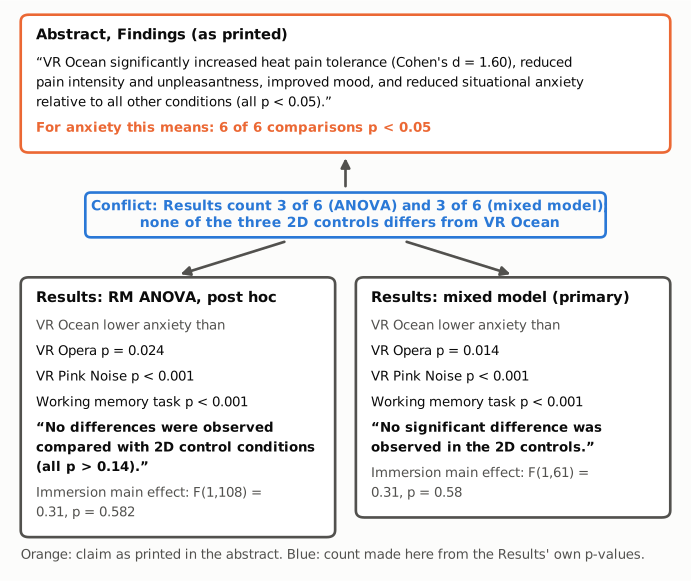
Figure 1. The abstract (top, orange border) puts situational anxiety among the outcomes on which VR Ocean beat "all other conditions (all p < 0.05)", that is, 6 of 6 comparisons. The anxiety paragraph of the Results (bottom) names three significant comparisons in each of the paper's two analyses and states that the remaining three, against the 2D controls, were not significant: "all p > 0.14" after the repeated-measures (RM) ANOVA, and "No significant difference was observed in the 2D controls" in the mixed model. Both analyses also report no main effect of immersion on anxiety. The blue connector gives the count made here from those printed results. All text in the panels is quoted or paraphrased from the paper; no number is estimated.
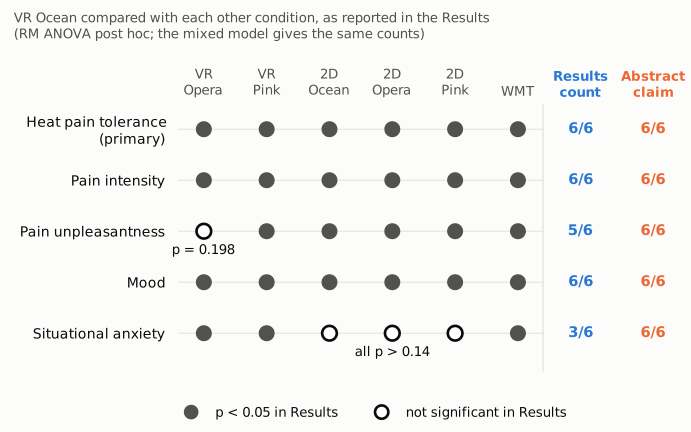
Figure 2. Scope of the overstatement. Each row is one of the five outcomes in the abstract sentence, each column one of VR Ocean's six comparators (WMT, working memory task). A filled circle means the Results report that comparison as p < 0.05; an open circle means they report it as not significant, with the printed p below. The blue column is the number of significant comparisons counted from the Results; the orange column is what the abstract's "all other conditions (all p < 0.05)" implies. The RM ANOVA post hoc results are drawn; the mixed model gives the same pattern and counts. Heat pain tolerance, pain intensity and mood agree with the abstract; unpleasantness (5 of 6) and anxiety (3 of 6) do not.
Why it matters
- Abstract and summary panel. The overstatement appears in the abstract's Findings and is repeated in the "Research in context" panel, which says VR Ocean "produced the greatest improvements in … anxiety". Many readers see only these two parts of the paper. Taken at face value, they report a significant anxiety benefit of immersive VR Ocean over the identical content in 2D, which the Results do not find.
- It bears on the study's own question. The study set out to "disentangle the roles of immersion and emotional engagement". For anxiety, the paper's own analyses find no immersion main effect (p = 0.58 in both models). VR Ocean did not differ from 2D Ocean, and the 2D conditions did not differ from one another (p > 0.70). The Fig. 3 legend says that for "each outcome" VR "consistently produced greater improvements than their 2D counterparts". The anxiety analysis in the text does not support that statement.
- Unpleasantness. The same abstract sentence also overstates the unpleasantness result, because VR Ocean did not differ from VR Opera.
- What stands. The overstatement does not change the primary outcome. Heat pain tolerance shows six of six significant contrasts, with mixed-model CIs that all exclude zero. Pain intensity and mood also stand. So do the mediation results, which find no mediation by anxiety. The paper's central interpretation is that mood and enjoyment, not anxiety, carry the effect, and that interpretation does not rest on the anxiety contrasts. The correction needed is therefore to the wording of a secondary result, not to the paper's main conclusion.
Explanations considered
- "Relative to all other conditions" modifies only the last item. Under the narrowest reading, the phrase attaches only to "reduced situational anxiety", and that is the outcome where it fails most clearly (3 of 6). Under the widest reading, it covers all five outcomes, and then it also fails for unpleasantness (5 of 6). Neither reading makes the sentence agree with the Results.
- A different analysis supports the abstract. The paper analyses anxiety three ways: a one-way RM ANOVA with post hoc tests, a two-way immersion × sound ANOVA, and a mixed model (described in Methods as the primary analysis). None of them reports VR Ocean as better than the 2D controls. The RM ANOVA gives "all p > 0.14". The two-way model shows no immersion effect and no sound differences within 2D. The mixed model states "No significant difference was observed in the 2D controls". The comparison with healthy controls uses a different sample and does not test VR Ocean against the 2D controls.
- Multiplicity adjustment. The Methods say pairwise contrasts were Bonferroni-adjusted. If the RM "p > 0.14" values were adjusted, unadjusted p-values could in principle fall below 0.05, and the abstract might have used them. Two things count against this as an explanation. First, the paper's stated inference uses its printed values, and the abstract does not mention unadjusted p. Second, the printed mixed-model CI and p pairs fit no adjustment. For each contrast printed with an exact p,
recompute.py.txtback-calculates p from the CI with no adjustment (k = 1) and with a Bonferroni family of k = 6 or 21, either multiplying the p by k or treating the CI as adjusted too. k = 1 is the closest fit in all six such rows: unpleasantness vs VR Opera gives 0.191 unadjusted against 0.47 (k = 6) and 0.90 (k = 21) under the adjusted-CI reading, with 0.19 printed; anxiety vs VR Opera gives 0.0155 unadjusted against 0.0067 and 0.0037, with 0.014 printed. On that reading, the mixed model found the 2D anxiety contrasts non-significant without any multiplicity penalty, so a multiplicity adjustment is unlikely to explain the gap between the abstract and the Results. - The omnibus test. The condition effect on anxiety is highly significant (F(6,330) = 29.01, p = 7 × 10⁻²⁸). An omnibus test shows only that the seven conditions are not all equal. It says nothing about any particular pairwise contrast, so it cannot support "all p < 0.05" for each comparison.
- A text-conversion artefact. The passages are prose, not table cells. The PMC HTML, the Europe PMC full-text XML (where the symbols are encoded as
<and>entities) and the local PMC copy all agree. No superscript, minus sign or comparison symbol was lost. - The figure supports the abstract. The publisher's high-resolution Fig. 3, panel d (situational anxiety), marks the VR Ocean vs 2D Ocean bracket as significant (***). This does not resolve the conflict. The figure disagrees with its own Results text ("all p > 0.14"), and it shows no VR Ocean vs 2D Opera or VR Ocean vs 2D Pink Noise comparison. So even the figure does not support "all other conditions". In the same panel, the VR Pink Noise vs 2D Pink Noise bracket is also marked *** with the VR bar higher (more anxiety). That contradicts the legend's statement that VR "consistently produced greater improvements than their 2D counterparts". Which of the figure and the text is correct for 2D Ocean cannot be decided from the published material. Either way, the abstract claim fails for at least two of the three 2D controls.
Status
- Version of record. The publisher's pages (doi.org → linkinghub.elsevier.com, thelancet.com, sciencedirect.com) returned only a redirect stub or HTTP 403 to automated requests. Three copies of the published text agree on every passage quoted here: the live PMC page, the Europe PMC full-text XML, and the PMC-archived text read with
src/show.py. Fig. 3 was checked in the publisher's own high-resolution file (gr3_lrg.jpg, from the Elsevier CDN, ars.els-cdn.com). - Supplements. Both supplementary files were opened:
mmc1.docx(extended methods, CONSORT flow, supplementary figures) andmmc2.docx(captions).mmc1.docxfrom the Europe PMC bundle is byte-identical to the Elsevier CDN copy. Neither file gives the VR Ocean vs 2D anxiety contrasts or any other pairwise anxiety statistics. The data sharing statement says the data are available "upon request", so there is no public source data. - Corrections and comments. As of 2026-10-24 I found no correction, erratum, retraction or expression of concern.
src/known.pyreturns no Crossref update relations, no PMC notices and no Europe PMC notices. The Crossref record has empty update-to and updated-by fields, and the PubMed record (PMID 41743617) has no CommentsCorrections entries. The PubPeer API returned no record (HTTP 404) for the DOI, and web searches for the title together with "PubPeer", "correction" or "erratum" (repeated on 2026-10-24) found no thread or notice. - Sources. PMC article PMC12930066; Europe PMC full-text XML and supplementary files for PMC12930066; Elsevier CDN copies of Fig. 3 and
mmc1.docx; Crossref; PubMed; PubPeer; https://doi.org/10.1016/j.lana.2026.101385.
Suggested correction
In the abstract's Findings, replace
reduced pain intensity and unpleasantness, improved mood, and reduced situational anxiety relative to all other conditions (all p < 0.05).
with wording that matches the Results, for example:
reduced pain intensity and improved mood relative to all other conditions (all p < 0.05), reduced pain unpleasantness relative to all conditions except VR Opera, and reduced situational anxiety relative to VR Opera, VR Pink Noise and the working memory task, but not relative to the 2D controls.
The "Research in context" sentence and the Fig. 3 legend ("VR conditions … consistently produced greater improvements than their 2D counterparts") would need the same qualification for anxiety. The authors may also wish to:
- reconcile the significance brackets in Fig. 3d (VR Ocean vs 2D Ocean, VR Pink Noise vs 2D Pink Noise, both marked ***) with the text ("all p > 0.14"; no immersion main effect);
- state which pairwise p-values and CIs are Bonferroni-adjusted;
- say what contrast the anxiety Cohen's d (0.232, 95% CI −0.121 to 0.586) refers to.
As a separate point, the within-VR heat-pain-tolerance contrasts ("mean difference = 0.88, 95% CI 0.329–1.437 … 0.44, 95% CI 0.112–0.765") repeat the pain-intensity mixed-model contrasts in magnitude (−0.88, −1.44 to −0.33; −0.44, −0.77 to −0.11). They are also on a different scale from the tolerance differences of 7.98 to 11.92 reported in the paragraph before. The authors may wish to check them.