← Back to the plain-language case
Abstract swaps the DALYs-averted estimates of the two dynamic choice HIV prevention policies
Lancet HIV (2025) · doi:10.1016/S2352-3018(25)00169-9 · PMC12854106
Summary
The abstract's Findings give 18 400 DALYs averted per year (95% CI 16 700–20 100) for dynamic choice HIV prevention (DCP) including long-acting cabotegravir and 56 400 (52 300–60 500) for DCP without cabotegravir. Table 5 prints the same two estimates and intervals with the labels reversed: 18 400 for DCP without cabotegravir and 56 400 for DCP including it. Every other number in the paper agrees with Table 5. Each policy's cost difference divided by its Table 5 DALYs gives the reported ICERs ($13.2M / 56 400 = $234; $8.6M / 18 400 = $467), and the reported net DALYs and the extended-dominance result also fit Table 5. With the abstract's labels, the same costs give $717 and $152, and DCP including cabotegravir would be dominated. As printed, the abstract reverses which policy delivers more health benefit, although its ICER and conclusion are right.
What the paper reports
Abstract, Findings:
Across setting-scenarios, both DCP policies led to DALYs being averted: 18 400 DALYs per year (95% CI 16 700–20 100) for DCP including cabotegravir and 56 400 DALYs per year (52 300–60 500) for DCP without cabotegravir in 10 million adults. Compared with no DCP, there was a mean increase in annual discounted costs over 50 years: $8·6 million (7·7–9·4) for DCP without cabotegravir and $13·2 million (11·6–14·8) for DCP including cabotegravir. Addition of long-acting cabotegravir PrEP to DCP was cost-effective (vs DCP without cabotegravir); the incremental cost-effectiveness ratio for DCP including cabotegravir (vs no DCP) was $234 per DALY averted.
Abstract, Findings (the incidence result, in the same paragraph):
These increases in PrEP use led to HIV incidence reductions, with incidence rate ratios of 0·89 (0·67–1·17) for DCP without cabotegravir and 0·64 (0·44–0·97) for DCP including cabotegravir, relative to no DCP.
Table 5, "HIV-related deaths, DALYs, and costs over 50 years and cost-effectiveness analysis compared with no DCP". Columns: No DCP | DCP without cabotegravir | DCP including cabotegravir. "Data are mean (95% CI); 90% range":
Difference in number of HIV-related deaths per year | ·· | -1300 (-1400 to -1200); -4500 to 800 | -3700 (-4000 to -3400); -12 300 to 200
Difference in DALYs per year over 50 years | ·· | -18 400 (-20 100 to -16 700); -68 600 to 19 000 | -56 400 (-60 500 to -52 300); -178 800 to 8200
Difference in annual cost over 50 years | ·· | $8·6 million (7·7 to 9·4); -6·1 to 32·3 | $13·2 million (11·6 to 14·8); -16·9 to 61·0
Difference in net DALYs* per year over 50 years | ·· | -1200 (-3600 to 1200); -65 900 to 55 800 | -29 900 (-35 400 to -24 400); -179 700 to 81 700
Incremental cost-effectiveness ratio (cost per DALY averted) | ·· | Dominated | $234
Incremental cost-effectiveness ratio (cost per DALY averted) for DCP compared with no DCP (if long-acting cabotegravir PrEP not available) | ·· | $467 | NA
Table 5 footnote: "*Given a cost-effectiveness threshold of $500 per DALY averted."
Results, paragraph 3:
Overall, as a mean across setting-scenarios, both DCP policies lead to DALYs being averted (table 5). There was, however, variability over setting-scenarios (appendix p 3); the policy with the least DALYs incurred was the status quo (no DCP or long-acting cabotegravir) in 6% of setting-scenarios, DCP without cabotegravir in 11% of setting-scenarios, and DCP including cabotegravir in 83% of setting-scenarios.
Results, paragraph 5:
The policy of DCP without cabotegravir was not a candidate for the cost-effective choice of intervention, as a combination of the policies of status quo and DCP including cabotegravir (represented by a point half way along the line between the two policies) was more effective and less costly than this policy (ie, the policy was extendedly dominated). The incremental cost-effectiveness ratio (ICER) for the policy of DCP including cabotegravir was $234 per DALY averted (figure). This policy incurred the lowest overall mean net DALYs at a cost-effectiveness threshold of $500 per DALY averted (table 5). If long-acting cabotegravir was not available, the ICER for DCP was $467.
Methods, "Cost-effectiveness analysis":
Net DALYs averted was calculated by DALYs averted plus the difference in costs divided by the cost-effectiveness threshold.
What the paper's own numbers show
Method. The abstract and Table 5 report the same quantity: mean DALYs per year over 50 years, discounted at 3%, for 10 million adults, compared with no DCP. Table 5 signs it as a difference, so a negative value means DALYs averted. I first compared the two pairs of estimates and confidence intervals. I then tested each possible assignment of the two DALY estimates to the two policies against three relationships the paper defines or reports. (1) ICER vs no DCP = difference in annual cost / DALYs averted, compared with the reported $234 and $467. (2) Difference in net DALYs = −DALYs averted + difference in cost / $500, compared with the Table 5 net-DALY row. (3) Extended dominance, which the Results state for DCP without cabotegravir. Finally I compared the ordering with the paper's other effectiveness outcomes: HIV deaths averted and incidence rate ratios. All inputs are the rounded values printed in the paper. Every number below is printed by recompute.py.txt.
| Quantity | Location | Reported | Recomputed from the paper's numbers |
|---|---|---|---|
| DALYs averted/yr, DCP without cabotegravir | Table 5 | 18 400 (16 700–20 100) | consistent with every check below |
| DALYs averted/yr, DCP including cabotegravir | Table 5 | 56 400 (52 300–60 500) | consistent with every check below |
| DALYs averted/yr, DCP including cabotegravir | Abstract, Findings | 18 400 (16 700–20 100) | equals the Table 5 value for DCP without cabotegravir, CI included |
| DALYs averted/yr, DCP without cabotegravir | Abstract, Findings | 56 400 (52 300–60 500) | equals the Table 5 value for DCP including cabotegravir, CI included |
| ICER vs no DCP, DCP including cabotegravir | Abstract; Results p5; Table 5 | $234 | $13.2M / 56 400 = $234.04 (Table 5 labels); $13.2M / 18 400 = $717.39 (abstract labels) |
| ICER vs no DCP, DCP without cabotegravir | Results p5; Table 5 | $467 | $8.6M / 18 400 = $467.39 (Table 5 labels); $8.6M / 56 400 = $152.48 (abstract labels) |
| Net DALY difference, DCP without cabotegravir | Table 5 | −1200 | −18 400 + 17 200 = −1200 (Table 5 labels); −56 400 + 17 200 = −39 200 (abstract labels) |
| Net DALY difference, DCP including cabotegravir | Table 5 | −29 900 | −56 400 + 26 400 = −30 000 (Table 5 labels; a cost of $13.15M–$13.25M, which rounds to $13.2M, gives −30 100 to −29 900); −18 400 + 26 400 = +8000 (abstract labels) |
| Extended dominance of DCP without cabotegravir | Results p5; Table 5 "Dominated" | stated | Table 5 labels: $467 > $234, so it is extendedly dominated; the midpoint of no DCP and DCP including cabotegravir averts 28 200 DALYs at $6.6M, against 18 400 at $8.6M. Abstract labels: DCP including cabotegravir would avert fewer DALYs (18 400 < 56 400) at a higher cost, so it would be strongly dominated, which contradicts the paper |
| Incremental ICER, including vs without cabotegravir | Abstract ("cost-effective (vs DCP without cabotegravir)") | not printed | Table 5 labels: $4.6M / 38 000 = $121.05 per DALY, below the $500 threshold, consistent with the statement |
| HIV-related deaths averted per year | Table 5 | 1300 (without); 3700 (including) | ratio including/without 2.85; DALY ratio 3.07 with the Table 5 labels, 0.33 with the abstract labels |
| Incidence reduction vs no DCP | Abstract | IRR 0·89 (without); 0·64 (including) | 11% vs 36% reduction, so the policy including cabotegravir is the more effective one |
Figure
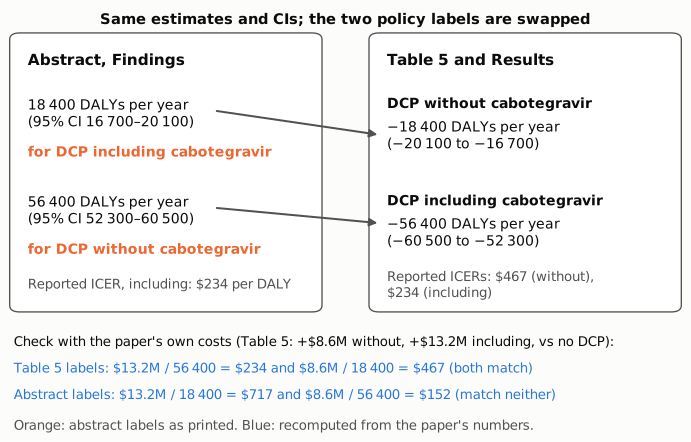
Figure 1. Left: the DALYs-averted sentence in the abstract's Findings, with its policy labels (orange) as printed. Right: the same estimates as printed in Table 5, where a negative difference means DALYs averted. The arrows join each abstract value to the identical value and interval in Table 5, which belongs to the other policy. Below, in blue: each policy's cost difference from Table 5 divided by its DALYs averted under each labelling. Only the Table 5 labelling reproduces the reported ICERs of $234 and $467. All values are from the paper or are printed by recompute.py.txt.
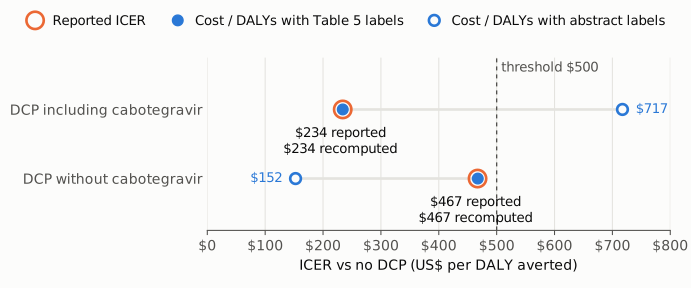
Figure 2. The ICER of each DCP policy against no DCP. Orange rings: the reported ICERs. Filled blue dots: cost difference / DALYs averted with the Table 5 labels. Open blue dots: the same calculation with the abstract's labels. The filled dots sit on the reported values. The open dots fall at $717, above the $500 threshold, for DCP including cabotegravir and at $152 for DCP without cabotegravir, which would reverse the paper's cost-effectiveness ranking. Dashed line: the $500 per DALY threshold used in the paper.
Why it matters
The sentence is the abstract's only statement of health benefit in DALYs. As printed, it says the policy without cabotegravir averts about three times as many DALYs as the policy including cabotegravir (56 400 vs 18 400). Table 5, the Results and the paper's conclusions all say the reverse. A reader who has only the abstract, or who takes the per-policy health gains from it for a review, a meta-analysis or a budget-impact estimate, would get the two policies' benefits the wrong way round. The abstract is then also inconsistent with itself. Its own costs ($8.6M and $13.2M) and its reported ICER of $234 cannot both hold with its DALY figures: with those figures, DCP including cabotegravir costs more and averts fewer DALYs than DCP without it, so it would be dominated rather than cost-effective.
The error does not affect the model results or the paper's conclusions. Table 5, the ICERs of $234 and $467, the net-DALY results, the extended-dominance finding and the Interpretation all use the correct assignment. The error is confined to the policy labels in one sentence of the abstract.
Explanations considered
- Different quantity, time horizon, population or comparator. Ruled out. The abstract and Table 5 both describe mean DALYs per year over 50 years for 10 million adults, compared with no DCP, and both print the same 95% CIs (16 700–20 100 and 52 300–60 500). The abstract states that "both DCP policies led to DALYs being averted" and gives the costs against no DCP, so it is not reporting an incremental comparison between the two DCP policies. Only the policy labels differ.
- Net DALYs rather than DALYs. Ruled out. The net-DALY differences in Table 5 are −1200 and −29 900, not 18 400 or 56 400.
- Table 5 is the version with the error, and the abstract is right. Ruled out by the paper's other results, all of which fit Table 5. These are both ICERs, both net-DALY values, the extended dominance of DCP without cabotegravir, the larger number of HIV deaths averted with cabotegravir (3700 vs 1300), the lower incidence rate ratio with cabotegravir (0·64 vs 0·89), and the statement that DCP including cabotegravir incurred the fewest DALYs in 83% of setting-scenarios. With the abstract's labels, none of the reported ICERs or net DALYs can be reproduced.
- Text conversion or column misalignment in the archived copy. Ruled out. The publisher PDF (Elsevier, "Published online September 11, 2025", obtained from an institutional repository deposit marked as the published version) has the same abstract sentence and the same Table 5 column order. The PubMed abstract (PMID 40946710) and the PMC/Europe PMC author manuscript text match as well. The values are whole numbers, so no decimal-point or minus-sign misreading is possible.
- The supplement gives a different picture. No. The appendix (126 pages) prints no aggregate figure of 18 400 or 56 400. Its plots of discounted annual DALYs and of DALYs averted against incremental cost show, qualitatively, more DALYs averted with DCP including cabotegravir. That agrees with Table 5, not with the abstract.
- Rounding. This accounts only for the 100-DALY gap between the recomputed (−30 000) and reported (−29 900) net DALYs for DCP including cabotegravir. It cannot account for a factor of three between the two labellings.
Status
As of 2026-10-23:
- Version of record: checked. The publisher PDF has the swapped labels in the abstract, and Table 5 is as described above. The PubMed abstract (PMID 40946710), the PMC archived text (PMC12854106, author manuscript NIHMS2140119) and Europe PMC are the same. The journal website (thelancet.com, sciencedirect.com) returned 403 or a bot check, so I could not view the online HTML version there.
- Supplement: the appendix (NIHMS2140119-supplement-Appendix.pdf) was checked as described above. It agrees with Table 5.
- Corrections: Crossref and PubMed list a publisher erratum, "Correction to Lancet HIV 2025; 12: e701–11" (Lancet HIV 2026;13(5):e296, doi:10.1016/S2352-3018(26)00080-9, PMID 42067279, May 2026). I could not get its text: the publisher page returned 403, and PubMed and Europe PMC list no abstract. I therefore cannot say whether this erratum corrects the swap described here. The PMC archived version still shows the swap. No PMC or Europe PMC correction notice was linked other than this erratum, and no retraction or expression of concern was found.
- PubPeer: searched for the DOI. The site returned a bot check to automated requests, so I could not confirm whether any comment exists.
- Sources: PMC12854106 (archived full text and Table 5); the publisher PDF from the repository deposit (eprints.whiterose.ac.uk/id/eprint/231798); PubMed records 40946710 and 42067279; Crossref metadata for the DOI; Europe PMC supplementary files.
Suggested correction
If the May 2026 erratum does not already address it, the abstract's Findings sentence should read:
Across setting-scenarios, both DCP policies led to DALYs being averted: 18 400 DALYs per year (95% CI 16 700–20 100) for DCP without cabotegravir and 56 400 DALYs per year (52 300–60 500) for DCP including cabotegravir in 10 million adults.
The same change should be made wherever the abstract is reproduced (PubMed, PMC, Europe PMC). No change to Table 5, the Results, the ICERs or the conclusions is needed.