← Back to the plain-language case
Significant C. difficile reduction in abstract contradicts Table 4: 4 vs 0 events, P = 1
BMC Med (2025) · doi:10.1186/s12916-025-04130-x · PMC12219783
Summary
This retrospective claims-database study compares flomoxef with cefmetazole for hospitalised urinary tract infection. The Abstract, the Results and the Discussion all state that C. difficile infection was significantly less common with flomoxef, and the Results give P = 0.03 and an incidence of 1.1% in the cefmetazole group. The paper's own Table 4 reports 4 cases among 4796 cefmetazole patients (0.1%) and 0 among 673 flomoxef patients, with P = 1. Recomputation from those counts gives a two-sided Fisher P of 1.00, and no standard test comes close to 0.03. The safety claim in the Abstract is therefore not supported by the paper's data. The text also gives the two kidney-failure P values the other way round from the tables, though that result is significant on every test. The preprint of the same study reported 63 vs 2 cases (P = 0.04) under a broader case definition. This fits the text not having been fully updated when Table 4 was revised.
What the paper reports
Abstract, Results:
Moreover, the flomoxef group demonstrated a significantly lower frequency of adverse events such as C. difficile infection and renal failure.
Results, "Safety outcome" (the whole paragraph):
The incidences of AEs related to the gastrointestinal, renal, and hepatic systems and hypersensitivity reactions were analysed (Table 4). Renal failure was the most reported AE in the cefmetazole group, affecting 7.5% of patients. This was followed by hepatic dysfunction, occurring in 2.3% of the cases. Furthermore, gastrointestinal AEs included C. difficile infection in 1.1% of the patients in the cefmetazole group. In the flomoxef group, renal failure (3.6%) was also the most common adverse event, followed by hepatic dysfunction (2.5%) and other forms of kidney dysfunction (0.9%). C. difficile infection (P = 0.03) and kidney failure (P = 0.04) were significantly less common in the flomoxef group than in the cefmetazole group. In the safety analysis of Dataset 3, similar to the findings in Dataset 1, the cefmetazole group showed a significantly higher incidence of kidney failure compared to the flomoxef group (P < 0.01) (Additional File 6).
Discussion, opening paragraph:
The incidence rates of C. difficile infection and renal failure after therapy were significantly lower in the flomoxef group than in the cefmetazole group.
Table 4, "Safety endpoints of Dataset 1" (selected rows; columns are cefmetazole n = 4796, flomoxef n = 673, P value):
Non-C. difficile diarrhoea [% (N)] | 23 (0.5) | 0 (0.0) | 0.14
C. difficile infection [% (N)] | 4 (0.1) | 0 (0.0) | 1
Kidney failure [% (N)] | 360 (7.5) | 24 (3.6) | < 0.01
Other kidney dysfunction [% (N)] | 54 (1.1) | 6 (0.9) | 0.73
Additional File 6, "Safety Endpoints of Dataset 3" (propensity-matched, cefmetazole n = 580, flomoxef n = 580), as printed in the publisher's file:
Clostridium difficile infection [% (N)] | 3 (0·5) | 0 (0·0) | 1
Kidney failure [% (N)] | 36 (6·2) | 20 (3·4) | 0·04
Methods, "Patient outcomes" and "Statistical analyses":
Safety outcomes were analysed using Dataset 1.
For safety outcomes, the frequencies were calculated and descriptively analysed for gastrointestinal, renal, hepatic, and hypersensitive AEs.
Statistical tests were two-tailed, with a p < 0.05 considered statistically significant, and performed using R version 4.2.1 (R Foundation for Statistical Computing, Vienna, Austria).
Additional File 4 defines C. difficile infection as "A04.7 Enterocolitis due to Clostridium difficile and include the prescription of oral vancomycin or metronidazole", recorded from the index date to 1 month.
What the paper's own numbers show
Method. The Methods do not name the test used for the safety outcomes, so for each 2×2 table I computed the three standard two-sided tests: Fisher's exact test, Pearson's chi-square with Yates' continuity correction (the default of R's chisq.test for 2×2 tables), and Pearson's chi-square without correction. The inputs are the event counts and group sizes printed in Table 4 and Additional File 6. As a check on the method, I first recomputed every P value in both tables. Yates' chi-square reproduces each printed value in Table 4 to the printed precision: 0.138 (printed 0.14), 1.00 (1), 2.5 × 10⁻⁴ (< 0.01), 0.727 (0.73), 0.758 (0.76) and 1.00 (1). So the tables appear to have been produced with R's default test, and they are internally consistent. The one exception is a minor point in Additional File 6, noted below. Every number here is printed by recompute.py.txt.
| Quantity | Location | Reported | Recomputed from the paper's numbers |
|---|---|---|---|
| C. difficile P, Dataset 1 (4/4796 vs 0/673) | Results text | P = 0.03, "significantly less common" | Fisher 1.00; Yates 1.00; uncorrected chi-square 0.454. One-sided Fisher 0.591 |
| C. difficile P, Dataset 1 | Table 4 | 1 | Agrees (Fisher 1.00, Yates 1.00) |
| C. difficile incidence, cefmetazole | Results text | 1.1% | 4/4796 = 0.083% (Table 4 prints 0.1). 1.1% of 4796 would be 53 cases |
| Row printed as 1.1% in Table 4 | Table 4 | Other kidney dysfunction 54 (1.1) | 54/4796 = 1.13% |
| C. difficile P, Dataset 3 (3/580 vs 0/580) | Additional File 6 | 1 | Fisher 0.249; Yates 0.248; uncorrected 0.083. Not significant on any test, though not 1 |
| Smallest split that could give P < 0.05 | (derived) | — | With 0 flomoxef cases, at least 28 cefmetazole cases (0.58%) are needed for a two-sided Fisher P < 0.05 (P = 0.042) |
| Kidney failure P, Dataset 1 (360/4796 vs 24/673) | Results text | P = 0.04 | Fisher 7.2 × 10⁻⁵; Yates 2.5 × 10⁻⁴; uncorrected 1.8 × 10⁻⁴ |
| Kidney failure P, Dataset 1 | Table 4 | < 0.01 | Agrees |
| Kidney failure P, Dataset 3 (36/580 vs 20/580) | Results text | P < 0.01 | Fisher 0.039; Yates 0.040; uncorrected 0.028 |
| Kidney failure P, Dataset 3 | Additional File 6 | 0.04 | Agrees |
| C. difficile, preprint Table 4 (63/4796 vs 2/673) | medRxiv v1 | 63 (1.3) vs 2 (0.3), P = 0.04 | 1.31% vs 0.30%; Yates 0.037; Fisher 0.021; uncorrected 0.023 |
There are four C. difficile cases in 5469 patients. If risk were equal in the two groups, the expected number in the flomoxef group would be 4 × 673/5469 = 0.49. So the observed split, all four in the larger cefmetazole group, is the single most likely outcome under the null, with probability 0.591. That is why the two-sided exact P is 1. The P = 0.03 in the text cannot be reached from these counts with any of the usual tests, one-sided or two-sided. It also cannot be reached from the Dataset 3 counts, where the best case is the uncorrected chi-square at 0.083.
The two kidney-failure P values in the text are the reverse of the tables. The text's "P = 0.04" for Dataset 1 is the Dataset 3 value (Additional File 6; recomputed 0.040). Its "P < 0.01" for Dataset 3 matches Dataset 1 (Table 4; recomputed 2.5 × 10⁻⁴). Both are below 0.05, so the conclusion on kidney failure is unchanged.
Figure
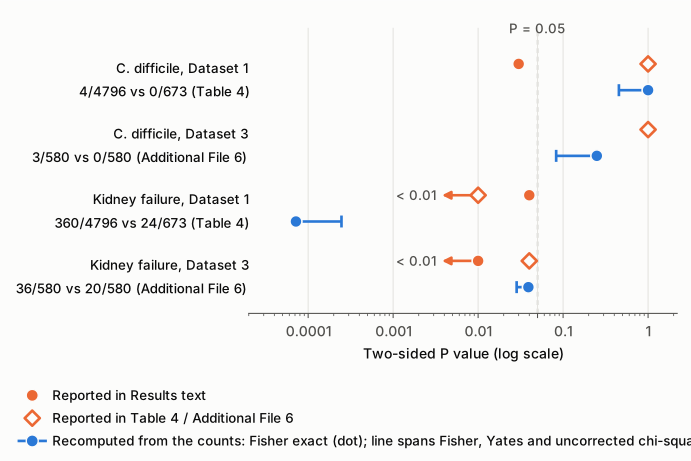
Figure 1. Reported and recomputed two-sided P values for C. difficile infection and kidney failure. Each outcome and dataset has two rows. The upper row shows the values the paper reports: filled orange circles for the Results text and open orange diamonds for Table 4 or Additional File 6. An arrow marks a value reported only as "< 0.01". The lower row shows the values recomputed from the printed counts: the blue dot is Fisher's exact test, and the blue line spans Fisher's test, Yates-corrected chi-square and uncorrected chi-square. The dashed line marks P = 0.05, the paper's threshold. For C. difficile in Dataset 1, the text's P = 0.03 lies on the significant side of the threshold, while Table 4 and every recomputed test sit at or near P = 1. In Dataset 3 every recomputed value is also above the threshold. For kidney failure, the text's values for the two datasets are the reverse of the tables. The direction of the result is unaffected.
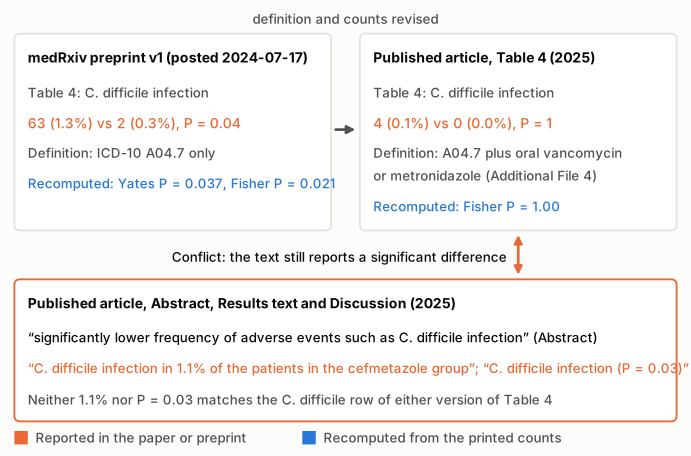
Figure 2. The C. difficile result in the preprint and in the published article. In the medRxiv preprint (v1, 2024-07-17), C. difficile infection was defined by ICD-10 code A04.7 alone. Table 4 reported 63 (1.3%) vs 2 (0.3%) cases, P = 0.04, which Yates' chi-square reproduces (0.037). In the published article the definition also requires oral vancomycin or metronidazole (Additional File 4), and Table 4 reports 4 vs 0 cases, P = 1. The Abstract, Results and Discussion of the published article still describe a significant reduction. The text's 1.1% and P = 0.03 match the C. difficile row of neither version.
Why it matters
The Abstract names a lower frequency of C. difficile infection as one of two safety advantages of flomoxef, and the Discussion repeats it in its summary of findings. C. difficile infection is a clinically important outcome in antibiotic choice. A reader of the Abstract would conclude that the study found evidence of lower risk with flomoxef. The paper's own table shows four events in total, none of them in the flomoxef group. That count gives no evidence either way: the study has essentially no power for this outcome, and the observed split is what equal risk would most often produce. The Discussion also notes that median hospital stay with flomoxef was about half that with cefmetazole, so adverse events had a shorter in-hospital window in which to be recorded in the flomoxef group. That is a further reason for caution with any between-group difference in these counts.
The error does not affect the paper's formal conclusions in the Abstract and main text, which rest on length of stay, 28-day mortality, carbapenem use and the in vitro data. The kidney-failure difference is significant on every test in both datasets, so the second safety claim stands, apart from the swapped P values. The 1.1% figure overstates the cefmetazole incidence about thirteen-fold (1.1% vs 0.083%).
Explanations considered
- A conversion or typesetting error in the archived text. Excluded. The PMC text, the publisher-supplied JATS XML in Europe PMC, and the publisher's article page (see Status) carry the same sentences and the same Table 4 cells. None of the affected values involve minus signs, superscripts or decimal mid-dots, and the table rows line up.
- The text reports a different dataset or a different test from Table 4. This does not account for the numbers. The Methods state that safety was analysed in Dataset 1, which is Table 4. For Dataset 1, Fisher's exact test, Yates' chi-square and uncorrected chi-square give 1.00, 1.00 and 0.454, and one-sided Fisher gives 0.591. For Dataset 3 (Additional File 6) they give 0.249, 0.248 and 0.083. None of these is 0.03 or below 0.05. A one-sided test is also ruled out by the Methods' statement that tests were two-tailed.
- The text reflects an earlier analysis. This fits the evidence best, but it cannot be confirmed from published material. In the medRxiv preprint, C. difficile was defined by A04.7 alone, and Table 4 reported 63 vs 2 cases with P = 0.04. Those counts would support a significant difference (Yates 0.037, Fisher 0.021). The preprint's Results said "C. difficile infection in 1.3% of patients in the cefmetazole group" and "Kidney failure (P=0.04) and C. difficile infection (P<0.01) were significantly less common in the flomoxef group than in the cefmetazole group." The preprint's Abstract made the same C. difficile claim. In the published version the definition was narrowed (A04.7 plus oral vancomycin or metronidazole) and Table 4 was updated to 4 vs 0, P = 1. The significance statements in the Abstract, Results and Discussion stayed. The published text's specific values (1.1%, P = 0.03) match neither the preprint's nor the published table's C. difficile row, so their exact origin is unknown. The 1.1% matches the "other kidney dysfunction" row in both versions of Table 4. In the preprint the text and table also disagreed: the text gave kidney failure P = 0.04 and C. difficile P < 0.01, the reverse of its Table 4 (< 0.01 and 0.04).
- The kidney-failure values are a transposition between datasets. This accounts for those two numbers exactly. The text's Dataset 1 value equals the Additional File 6 value (0.04) and its Dataset 3 value equals the Table 4 value (< 0.01). Recomputation supports the tables in both cases.
- The claim could rest on a model-based estimate not shown in the paper. Not supported. The Methods describe the safety analysis as descriptive frequencies, and no adjusted safety estimate appears anywhere in the article or its supplements. With four events and none in the flomoxef group, a covariate-adjusted regression would face complete separation and could not give a stable estimate.
A minor, separate point: Additional File 6 prints P = 1 for C. difficile in Dataset 3 (3/580 vs 0/580), where Fisher's test and Yates' chi-square both give 0.25. This does not change any conclusion, since neither value is significant.
Status
As of 2026-10-24:
- Version of record. The publisher's article page (link.springer.com/article/10.1186/s12916-025-04130-x, rendered in headless Chromium because plain requests met a bot check) and its Table 4 page carry the same Abstract sentence, Results paragraph and Table 4 cells as the PMC-archived text. The Europe PMC JATS XML (PMC12219783/fullTextXML) also matches. Every quotation from the published article above was checked verbatim against the PMC text with
src/show.py. The exception is Additional File 6, which was read from the publisher's file. - Supplements. There are six additional files (12916_2025_4130_MOESM1–6_ESM.docx), retrieved through the Europe PMC supplementary-files service. Additional File 4 holds the adverse-event definitions and no counts. Additional File 6 holds the Dataset 3 safety table quoted above. The other files cover definitions of UTI, complications and medical history, and the MIC distribution.
- Preprint. medRxiv doi:10.1101/2024.07.16.24310469, version 1 (posted 2024-07-17), is the only version, and medRxiv links it to the published DOI. Its text was read from the medRxiv JATS source XML, its Table 4 from the table image (T4.large.jpg) and its definitions from its supplementary PDF (Supplementary Table 4).
- Corrections and comments. I found no correction, erratum, expression of concern or retraction. Crossref lists no update relations for the DOI, only a "has-preprint" relation, and PMC and Europe PMC list no correction notices. A web search for comments on the article found none. PubPeer refused automated access (HTTP 403, Cloudflare challenge), so it could not be checked directly.
- Sources. PMC article PMC12219783; Europe PMC full-text XML and supplementary files; publisher article and Table 4 pages at link.springer.com; Crossref metadata for 10.1186/s12916-025-04130-x; medRxiv preprint 10.1101/2024.07.16.24310469 (API record, JATS XML, Table 4 image, supplementary PDF).
Suggested correction
- Remove the statement that C. difficile infection was significantly less frequent with flomoxef from the Abstract (Results), the Results "Safety outcome" paragraph and the opening paragraph of the Discussion. Report instead that C. difficile infection occurred in 4 of 4796 cefmetazole patients (0.1%) and none of 673 flomoxef patients (P = 1), too few events to compare the groups.
- Correct the cefmetazole C. difficile incidence in the Results from 1.1% to 0.1% (4/4796).
- Swap the kidney-failure P values in the Results to match the tables: P < 0.01 for Dataset 1 (Table 4) and P = 0.04 for Dataset 3 (Additional File 6).
- Name the test used for the safety comparisons in the Methods (the printed values match Pearson's chi-square with Yates' continuity correction). Check the Dataset 3 C. difficile P value in Additional File 6 (3 vs 0 of 580 gives P ≈ 0.25, not 1).
- Optionally, state in the Methods that the C. difficile case definition requires oral vancomycin or metronidazole in addition to ICD-10 A04.7, so readers comparing with the preprint can see why the counts differ.