← Back to the plain-language case
Abstract calls a subgroup sex difference significant (P < .001); the Results report P = .28
JAMA Netw Open (2025) · doi:10.1001/jamanetworkopen.2025.17149 · PMC12188365
Summary
The abstract says the female share among the additional eligible people with lung cancer under the 20-year smoking-duration (IPN-Potter) criterion, 70 of 128 (55%), differed significantly from USPSTF 2021 (55% vs 48%; P < .001). The Results section reports the same comparison as not significant: 55% vs 50% [370 of 747]; P = .28. A Pearson χ² test on the paper's own counts (70/128 vs 370/747) gives P = .281, which reproduces the Results. The abstract's "48%" equals 1847/3840, the female share of all USPSTF 2021 eligibles, and "55% vs 48%; P < .001" is word for word the result of a different comparison, the one for all additional eligibles. The error is confined to one abstract sentence. It turns a non-significant subgroup result into a significant one in the most-read part of the paper. The headline conclusions rest on other, correctly reported comparisons.
What the paper reports
Abstract, Results paragraph (the sentence in question):
The additional eligible individuals with lung cancer in IPN programs who were female included 70 of 128 (55%) by IPN-Potter criteria, 89 of 208 (43%) by IPN-ACS criteria, and 143 of 304 (47%) by IPN-Potter-ACS criteria, with statistically significant differences between the IPN-Potter criteria and USPSTF 2021 criteria (55% vs 48%; P < .001).
Results, section "Screening Eligibility in Those With Lung Cancer":
The additional eligible individuals with lung cancer in IPN (IPN-Potter Extra, IPN-ACS Extra, IPN-Potter-ACS Extra) who were female included 70 of 128 (55%) in Potter criteria, 89 of 208 (43%) in ACS criteria, and 143 of 304 (47%) in Potter-ACS criteria, respectively; not significantly different between IPN-Potter Extra and IPN-USPSTF 2021 (55% vs 50% [370 of 747]; P = .28) (Figure 2).
The same Results section, preceding paragraph, gives the comparator group:
compared with 50% (370 of 747) in IPN-USPSTF 2021
The comparison for all additional eligibles, which carries the same "55% vs 48%; P < .001", appears in the sentence just before the one in question in the abstract:
There were significant differences in the number of additional eligible individuals who were female (55% vs 48%; P < .001) and Black (35% vs 22%; P < .001) between the IPN-Potter and USPSTF 2021 criteria.
and in Results, section "Additional Persons Eligible":
with significant differences in the numbers of females included between the IPN-Potter Extra and IPN-USPSTF 2021 criteria (55% vs 48%; P < .001) (Figure 2)
The test, from Methods, "Statistical Analysis" (the abstract also names the χ2 test):
using an α = .05 to determine statistical significance without adjusting for multiple comparisons. Tests were 2-sided.
What the paper's own numbers show
Method. I took the counts printed in the text and confirmed them against eTables 1 and 2 of Supplement 1. eTable 2 gives Female 370 (49.53%) of 747 for IPN-USPSTF2021 and 70 (54.69%) of 128 for IPN-Potter Extra. eTable 1 gives 1847 (48.1%) of 3840 and 606 (54.94%) of 1103. I then ran the 2-sided Pearson χ² test that Methods describes on each 2 × 2 table. As checks I also ran the Yates-corrected χ², Fisher's exact test and a pooled two-proportion z test. Proportions carry 95% Wilson intervals. recompute.py.txt prints every number below.
| Quantity | Location | Reported | Recomputed from the paper's own numbers |
|---|---|---|---|
| Female, IPN-Potter Extra with lung cancer | Abstract; Results | 70 of 128 (55%) | 54.7% (95% CI 46.1–63.0) |
| Female, IPN-USPSTF 2021 with lung cancer | Results | 50% (370 of 747) | 49.5% (95% CI 46.0–53.1) |
| Comparator % in the abstract's lung-cancer sentence | Abstract | 48% | 48% is 1847/3840 = 48.1%, the female share of all IPN-USPSTF 2021 eligibles, not of those with lung cancer (49.5%) |
| P, 70/128 vs 370/747 | Results | P = .28 | P = .281 (χ² = 1.16; z = 1.08). Yates P = .326; Fisher P = .294 |
| P, the same comparison | Abstract | P < .001 | P = .281 |
| P, 70/128 vs 1847/3840 (if the 48% group was meant) | Abstract, alternative reading | P < .001 | P = .142 (Yates .168; Fisher .151) |
| Female, all additional eligibles: 606/1103 vs 1847/3840 | Abstract, previous sentence; Results "Additional Persons Eligible" | 55% vs 48%; P < .001 | 54.9% vs 48.1%; P = 6.2 × 10⁻⁵ (consistent) |
| Black, lung-cancer subgroup: 50/128 vs 162/747 | Abstract; Results | 39% vs 22%; P < .001 | 39.1% vs 21.7%; P = 2.2 × 10⁻⁵ (consistent) |
| Black, all additional eligibles: 382/1103 vs 777/3840 | Abstract (35% vs 22%); Results (35% vs 20%) | P < .001 | 34.6% vs 20.2%; P = 2.6 × 10⁻²³. The abstract's 22% matches 162/747 (21.7%), not 777/3840 |
The Results value reproduces to the second decimal place from the printed counts with the test the Methods name. With these counts, P < .001 against 70/128 would require the USPSTF 2021 lung-cancer group to be at most 292/747 (39.1%) female, not 370/747.
Figure
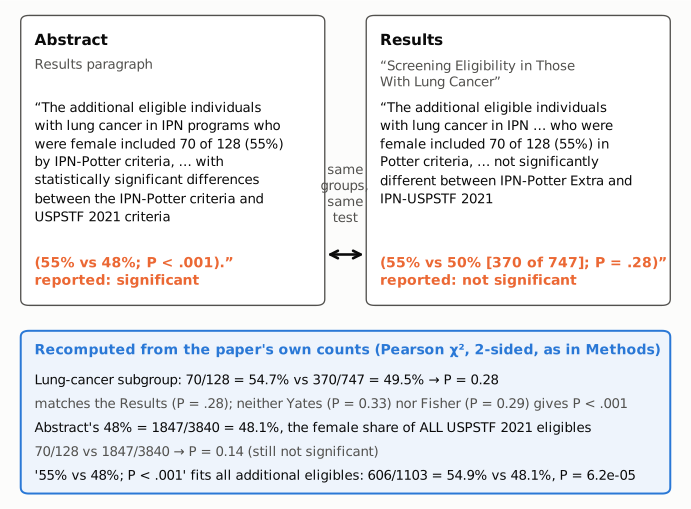
Figure 1. The two passages, shortened to their key clauses (full quotes above). Both describe the female share among additional eligible people with lung cancer under IPN-Potter (70 of 128) compared with IPN-USPSTF 2021. The values the paper reports are in orange. The blue box gives values recomputed from the paper's own counts with the 2-sided Pearson χ² test named in Methods. The counts reproduce the Results (P = .28), not the abstract (P < .001). The abstract's comparator (48%) is the female share of all USPSTF 2021 eligibles. "55% vs 48%; P < .001" is the correct result for all additional eligibles (606/1103 vs 1847/3840), reported in the sentence before.
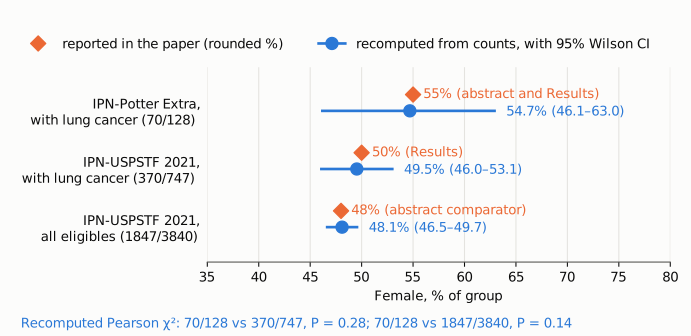
Figure 2. Female share in each group. Orange diamonds are the rounded percentages the paper reports. Blue dots and lines are proportions recomputed from the printed counts, with 95% Wilson intervals. The 128 additional eligibles with lung cancer form a small group, and their interval (46.1–63.0%) overlaps both possible comparators. The difference from the USPSTF 2021 lung-cancer group is 5.2 percentage points (P = .28). Even against the abstract's 48% group it is 6.6 points (P = .14). The axis starts at 35% to show the intervals. The figure is a dot-and-interval plot with no bars, so the cut-off axis does not change how large any difference looks relative to its interval.
Why it matters
- A significance verdict is reversed in the abstract. Readers of the abstract are told that the Potter criterion significantly raised the share of women among the extra lung cancers it would catch. The paper's own data show no detectable difference: 54.7% vs 49.5%, P = .28. The direction is the same, but the gap is about 5 points rather than the 7 the abstract implies, and it is not significant.
- It bears on the equity argument as read from the abstract. The paper's premise is that relaxing smoking criteria reduces race- and sex-based disparities. With the correct numbers, the sex benefit holds for eligibility overall (55% vs 48% female among all additional eligibles, P < .001), but not among those who had lung cancer. Among those who had lung cancer, only the race difference is significant (39% vs 22%, P < .001).
- The headline conclusions are not affected. The Key Points claim that the change "reduced race- and sex-based disparities in eligibility, while maintaining diagnostic efficiency", and the Discussion limits the lung-cancer finding to race: "reduced race-based and sex-based disparities in LCS eligibility and race-based disparities in lung cancer diagnosis". Both rest on comparisons that are reported correctly. The full-text Results also give the correct value, so the error is confined to one sentence of the abstract.
- A smaller, related inconsistency. In the abstract's sentence about all additional eligibles, the USPSTF 2021 comparator for Black individuals is given as 22%, while the Results give 20%. The counts (777/3840) give 20.2%. The 22% matches the lung-cancer subgroup (162/747 = 21.7%). The test is P < .001 either way, so no conclusion changes.
Explanations considered
- A different population in the abstract. Not supported. The abstract sentence names "additional eligible individuals with lung cancer", gives 70 of 128, and lists the matching ACS (89 of 208) and Potter-ACS (143 of 304) counts. These are exactly the numbers in the Results lung-cancer paragraph. The lung-cancer comparator printed in the paper is 370 of 747 (50%).
- A different comparator group (the 48%). It explains the 48% but not the P value. 48% equals 1847/3840, the female share among all USPSTF 2021 eligibles. Testing 70/128 against that group still gives P = .14 (Fisher .15), not P < .001. Comparing 70/128 with a group of people mostly without lung cancer would also not be the comparison the sentence describes.
- A different test, correction or sidedness. Not able to explain it. The uncorrected Pearson χ², the test the Methods name, gives P = .281 and reproduces the Results' P = .28. The Yates correction (.326), Fisher's exact test (.294) and a one-sided test (.141) are all far above .001. The Methods state that tests were 2-sided with no multiplicity adjustment.
- The overall Potter lung-cancer group instead of the "Extra" group. Not able to explain it. All IPN-Potter lung cancers, 440/872 (50.5%), against 370/747 give P = .71.
- A text-conversion artifact. Ruled out. The publisher's full text, the PMC HTML page and the Europe PMC full-text XML carry the same wording and numbers in both passages.
- Which passage is correct. The Results are. Their P value reproduces exactly from the printed counts, and those counts match eTable 2 of the supplement. The abstract's "(55% vs 48%; P < .001)" is word for word the result printed for the all-additional-eligible comparison in the sentence before it and in Results, section "Additional Persons Eligible". That result reproduces from 606/1103 vs 1847/3840 (P = 6.2 × 10⁻⁵).
Status
- Version of record. doi.org resolves to the publisher's full text at jamanetwork.com (article 2835517). Both passages appear there with the same numbers as quoted above. The PMC HTML page and the Europe PMC full-text XML match word for word. Every quotation here was checked verbatim against the PMC-archived text with
src/show.py. - Supplements. Supplement 1 (eTables 1–4, eFigures 1–3; 22 pages). eTable 2 lists Female 370 (49.53%) of 747 for IPN-USPSTF2021 eligibles with lung cancer and 70 (54.69%) of 128 for IPN-Potter Extra. eTable 1 lists 1847 (48.1%) of 3840 and 606 (54.94%) of 1103. The supplement has no P values. Supplement 2 is the data sharing statement and is not relevant. The paper's Figure 2, which also displays these proportions, was not used.
- Corrections and comments. As of 2026-10-24 I found no correction, erratum, retraction or expression of concern.
src/known.pyfinds no Crossref update relations and no PMC or Europe PMC notices. The Crossref record has no update-to or updated-by entries. The PubMed record (PMID 40553471) has no CommentsCorrections entries. Neither the publisher's page nor the PMC page shows a correction notice, and a web search found none for this article. Not checked: the Europe PMC search API returned HTTP 503 on every attempt, and PubPeer could not be queried (HTTP 403 on the search page; the API returned Not Found). Retraction Watch data was checked only indirectly, through Crossref. - Sources. PMC article PMC12188365; Europe PMC full-text XML and supplementary files; publisher full text via https://doi.org/10.1001/jamanetworkopen.2025.17149; Crossref; PubMed.
Suggested correction
In the Results paragraph of the abstract, replace
with statistically significant differences between the IPN-Potter criteria and USPSTF 2021 criteria (55% vs 48%; P < .001).
with
with no statistically significant difference between the IPN-Potter criteria and USPSTF 2021 criteria (55% vs 50%; P = .28).
so that it agrees with the Results section and with eTable 2. In the sentence before it, the authors may also wish to change the USPSTF 2021 comparator for Black individuals, "(35% vs 22%; P < .001)", to "(35% vs 20%; P < .001)", matching the Results (777 of 3840).