← Back to the plain-language case
Abstract says serum-treated human islets came from T2DM donors; the donor table lists none
Nat Metab (2024) · doi:10.1038/s42255-024-01130-8 · PMC12005094
Summary
The abstract's only human result says that "human islets from male and female donors with T2DM" showed fewer senescence markers after treatment with serum collected after an exercise training programme. The paper's own donor table (Extended Data Table 1) lists 17 islet donors, and all 17 are marked T2D = "NO", including the 11 used for serum treatment. In the Results, the Methods and Extended Data Table 2, T2DM status belongs to the people who gave the serum, so the experiment exposed islets from non-diabetic cadaveric donors to serum from exercise-trained people with T2DM. The abstract, the Results subsection heading and the Fig. 8 title instead describe an experiment on T2DM islets; no measured value changes, but the design behind the paper's main translational claim is misstated.
What the paper reports
The abstract (the only human result it states):
"Remarkably, human islets from male and female donors with T2DM treated with serum collected after a 10-week endurance exercise training programme showed a significant decrease in the levels of senescence markers." (Abstract)
The same framing appears in a heading and a figure title:
"Postexercise serum reduces senescence markers in T2DM human islets" (Results, subsection heading)
"Postexercise serum reduces senescence markers in T2DM islets." (Fig. 8 title)
The body text describes the design differently. Diabetes is attributed to the serum donors, and the islets come from separate cadaveric donors:
"To test whether exercise training affects islet senescence in humans, we obtained serum from five individuals with T2DM who participated in a moderate-intensity exercise training programme. [...] Serum was matched by sex, age and body mass index (BMI) (Extended Data Table 2) to pancreatic islets from cadaveric donors, received from the Integrated Islet Distribution Program (IIDP) (Extended Data Table 1)." (Results, "Postexercise serum reduces senescence markers in T2DM human islets", para 1)
"Human islet donors were matched by sex, age and BMI to serum donors (individuals with or without T2DM who underwent a moderate-intensity aerobic training programme)." (Methods, "Serum treatment in vitro")
"Notably, serum obtained from exercise-trained people with T2DM decreased the expression of senescence markers in human cadaveric islets, translating these findings to human physiology." (Introduction, last paragraph)
"Details of donors are given in Extended Data Table 1." (Methods, "Human islets")
Extended Data Table 1, "Donor information for human pancreatic samples" (columns: Age (years) | T2D | BMI | Applications), has 17 rows. Every T2D cell reads "NO". Eleven rows list "Serum treatment" among the applications. Two examples:
"54 | NO | 24.5 | Serum treatment, WB, FACS, qPCR"
"39 | NO | 32.4 | Serum treatment, WB"
(Extended Data Table 1, first and eleventh rows)
Elsewhere, the paper describes its human islets as non-diabetic:
"we exposed cadaveric human islets from donors without T2DM to glucagon in vitro for 4 days" (Results, "Glucagon activates AMPK in mouse and human islets", para 4)
"human (nondiabetic, 37–62 years old, male and female, n = 8 for qPCR and n = 11 for β-gal expression) islets" (Fig. 3 legend, panels i–k)
What the paper's own numbers show
Method. Both Extended Data tables were transcribed from the PMC archive into recompute.py.txt (the same values appear in the version-of-record table images). The script counts the T2D column for all islet donors and for the subset whose Applications column includes "Serum treatment". It also checks the table sizes against the counts given in the text.
| Quantity | Location | Reported | Recomputed |
|---|---|---|---|
| T2D status of the serum-treated islet donors | Abstract | "donors with T2DM" | 0 of 11 serum-treatment donors have T2D = YES (Extended Data Table 1) |
| Islet donors listed | Extended Data Table 1 | 17 rows | 17 |
| Islet donors with T2D = YES | Extended Data Table 1, T2D column | all "NO" | 0 of 17 |
| Islet donors used for serum treatment | Extended Data Table 1, Applications column | 11 rows list "Serum treatment" | 11 (ages 22–62); 0 with T2D |
| Serum volunteers listed | Extended Data Table 2 vs Methods ("seven female and six male participants") | 13 | 13 (consistent) |
| Serum volunteers with T2D = YES | Extended Data Table 2 vs Results ("serum from five individuals with T2DM") | 5 used, per the text | 10 of 13 listed; the paper does not say which 5 of the 10 supplied serum for Fig. 8 |
| Islet preparations | Methods ("male (17) versus female (3) islets") vs Extended Data Table 1 | 17 + 3 = 20 | 17 rows (side discrepancy) |
The serum-treatment rows in Extended Data Table 1 fall into two groups. Five rows are marked "Serum treatment, WB, FACS, qPCR", matching the five T2DM serum donors in the Results. Six rows are marked "Serum treatment, WB", with ages 22–57, which matches the age range in the Extended Data Fig. 5 legend for the non-T2D serum experiment ("Samples from individuals ranging from 22 to 57 years old, male, n=6/group"). On this reading the legend's n = 6 counts islet preparations; the legend itself does not say so. Every islet row in both groups is T2D = "NO". The split does not change the finding, but it is consistent with the Fig. 8 islets being five of the non-diabetic donors listed in Extended Data Table 1.
Figure
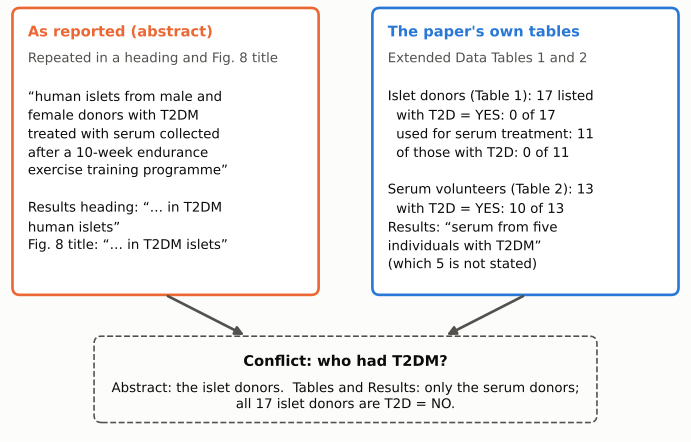
Figure 1. On the left (orange) is the wording reported in the abstract and repeated in the Results subsection heading and the Fig. 8 title. On the right (blue) are counts recomputed from the paper's Extended Data Tables 1 and 2. The abstract says the islets came from donors with T2DM. Extended Data Table 1 lists 17 islet donors, none with T2D, including the 11 used for serum treatment. T2D = YES appears only among the serum volunteers in Extended Data Table 2 (10 of 13), and the Results text attributes T2DM to the serum donors ("serum from five individuals with T2DM"; the paper does not say which five of the ten were used). All counts come from recompute.py.txt.
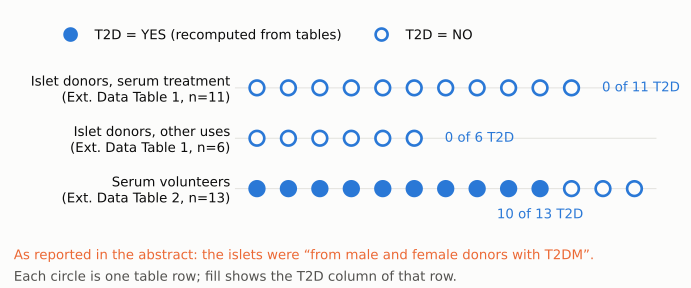
Figure 2. Each circle is one row of the paper's donor tables. Filled circles have T2D = YES and open circles have T2D = NO, as recomputed from the tables. The top row holds the 11 islet donors whose Applications column includes "Serum treatment", the middle row the 6 other islet donors, and the bottom row the 13 serum volunteers. Every islet donor is non-diabetic. The orange line gives the abstract's description of the islet donors for comparison.
Why it matters
The abstract sentence is the paper's only stated human result and its translational headline ("Remarkably, ..."). Taken at face value, it says exercise-conditioned serum reduced senescence markers in islets from people who already had T2DM, that is, in diabetic beta cells where senescence is the proposed therapeutic target. The experiment the paper actually documents is different: non-diabetic cadaveric islets cultured with serum from exercise-trained people with T2DM. These two designs answer different questions. The first tests whether diabetic islet tissue responds. The second tests whether circulating factors from trained diabetic individuals act on healthy islets.
No reported value, effect direction or P value changes, and the narrower conclusion (post-exercise serum from people with T2DM lowered senescence markers in cultured human islets) is unaffected. Three statements are framed in terms of people who already have T2DM, and the abstract's wording presents the human experiment as direct evidence for them: the abstract's closing claim of "promising therapeutic implications for T2DM", the Discussion's statement that the findings bear on "mechanisms that can restore β-cell function in individuals with T2DM", and the criterion stated in the Results subsection "Senolytic effects of exercise training" that exercise "must decrease the percentage of senescent cells in populations in which β-cell failure has already developed, such as in older individuals and those with insulin resistance or overt T2DM". These statements also draw on the mouse experiments (that criterion is introduced for the INK-ATTAC mouse model), so they do not depend on the human experiment alone. Because the abstract, the subsection heading and the Fig. 8 title all use the same wording, a reader sees the correct design only in the Results paragraph, the Methods and the Extended Data tables.
Explanations considered
Misplaced modifier or shorthand. The wording probably means "human islets treated with serum from male and female donors with T2DM". The Reporting Summary supports this: "Serum was obtained from male and female volunteers with established type 2 diabetes ... A total of 5 subjects were used in the manuscript, being 2 females and 3 males". The phrase "male and female ... with established type 2 diabetes" there describes the serum donors. This explains how the wording arose but does not make the published sentence accurate. Read normally, "human islets from male and female donors with T2DM" says the islet donors had T2DM, and the heading and Fig. 8 title ("T2DM islets") say the same.
Swapped tables. The footers of the two Extended Data tables appear swapped. Table 1 (islet donors) ends "Human serum information.", and Table 2 (serum volunteers) ends "IIDP cadaveric human islets information." If the tables themselves were swapped, the islets would be the 10 T2D = YES rows and the abstract would be right. The table contents rule this out: - Table 1 is captioned "Donor information for human pancreatic samples" and has an Applications column (serum treatment, WB, FACS, qPCR) that only makes sense for islet preparations. - Table 2 is captioned "Volunteer information for serum from moderate intensity training program", has subject IDs, and has 13 rows, matching the Methods' "seven female and six male participants". - The Methods say "Details of donors are given in Extended Data Table 1" under "Human islets". - The Results text attributes T2DM to the serum donors. - Fig. 3, Fig. 4 and the Results describe the human islets as non-diabetic.
The swapped footers are a separate, minor labelling error that adds to the confusion.
Conversion or archiving artifact. Ruled out. The conflict is categorical (YES/NO cells, the words "with T2DM"), not numeric. The version of record on nature.com has the same abstract sentence and the same Fig. 8 title. The version-of-record images of Extended Data Tables 1 and 2 have the same T2D columns (17 of 17 NO; 10 of 13 YES) and the same swapped footers.
Some islet donors had T2DM but were not listed. Nothing in the paper supports this. The Methods point to Extended Data Table 1 for donor details, the table has a T2D column, and no row is YES. The Methods do count 20 islet preparations ("male (17) versus female (3)") against 17 table rows. That gap is a separate inconsistency, but no passage anywhere in the paper says any islet donor had T2DM.
Open points about the serum donors (not the main finding). The Results say serum came from "five individuals with T2DM" and the Reporting Summary says "A total of 5 subjects were used in the manuscript", while Extended Data Table 2 lists 10 volunteers with T2D = YES. This need not be a contradiction: the Methods say serum samples were received from 13 participants, so the table may list every volunteer while only five T2DM sera were used for Fig. 8. The paper does not say which five. Similarly, the Extended Data Fig. 5 legend ("n=6/group") does not say whether n counts islet preparations or serum donors; six islet preparations treated with serum from the 3 non-T2D volunteers in Extended Data Table 2 would fit. Neither point affects the T2D status of the islet donors.
Status
As of 2026-10-23:
- Version of record. The nature.com article page, reached through doi.org, was fetched again on 2026-10-23. It carries the same abstract sentence ("human islets from male and female donors with T2DM treated with serum collected after a 10-week endurance exercise training programme...") and the same Fig. 8 title ("Postexercise serum reduces senescence markers in T2DM islets."). The page has no "Author Correction", "Change history" or "This article has been updated" notice. An earlier audit stage viewed the version-of-record images of Extended Data Tables 1 and 2 and found them identical to the PMC text (17 of 17 islet donors NO; 10 of 13 serum volunteers YES; same swapped footers). The full Results and Methods text on nature.com is paywalled, so those passages were checked in the PMC copy, which is the NIH author manuscript of the article.
- Supplements. The Reporting Summary (42255_2024_1130_MOESM2_ESM.pdf) was read on 2026-10-23. Page 2, "Reporting on sex and gender", reads: "Serum was obtained from male and female volunteers with established type 2 diabetes, no criteria was used to exclude sex. A total of 5 subjects were used in the manuscript, being 2 females and 3 males." It attributes diabetes to the serum volunteers and says nothing about diabetic islet donors. The Source Data workbook for Fig. 8 (42255_2024_1130_MOESM10_ESM.xlsx) has columns Pre, Post, dA1c, dP21CIP1, dP16INK4A and dGlucagon, most sheets holding five data rows, and no donor diabetes status. An earlier audit stage found that the Supplementary Information PDF contains only a gating-strategy figure.
- Corrections.
src/known.py(run 2026-10-23) lists no Crossref updates and no PMC or Europe PMC correction or retraction notices. A Crossreffilter=updates:query for the DOI returns 0 results. - PubPeer. PubPeer's site and API returned HTTP 403 on 2026-10-23, so PubPeer could not be checked directly. An earlier audit stage searched the web for the title and DOI together with PubPeer, correction and erratum and found no relevant thread or notice; no new web search could be run on 2026-10-23.
Sources: PMC12005094 (PubMed Central archive, read with src/show.py); https://www.nature.com/articles/s42255-024-01130-8; Reporting Summary https://static-content.springer.com/esm/art%3A10.1038%2Fs42255-024-01130-8/MediaObjects/42255_2024_1130_MOESM2_ESM.pdf; Source Data Fig. 8 (42255_2024_1130_MOESM10_ESM.xlsx, same location); https://api.crossref.org/works?filter=updates:10.1038/s42255-024-01130-8.
Suggested correction
Reword the abstract sentence so that T2DM describes the serum donors, for example: "Remarkably, human islets from non-diabetic donors treated with serum collected from male and female individuals with T2DM after a 10-week endurance exercise training programme showed a significant decrease in the levels of senescence markers." Make the same change to the Results subsection heading and the Fig. 8 title (e.g. "Postexercise serum from individuals with T2DM reduces senescence markers in human islets"). In the same correction, the authors could also:
- swap the footers of Extended Data Tables 1 and 2;
- identify which 5 of the 10 T2D = YES volunteers in Extended Data Table 2 supplied serum for Fig. 8, and state what n counts in the Extended Data Fig. 5 legend;
- reconcile the number of islet preparations (20 in the Methods, 17 in Extended Data Table 1).