← Back to the plain-language case
Abstract reports low-birth-weight estimates, including a nominally significant ASD effect, as preterm-birth results
Lancet Reg Health Eur (2025) · doi:10.1016/j.lanepe.2025.101247 · PMC11910110
Summary
The abstract's Findings say that, compared with term birth, preterm birth was associated with higher ASD symptoms, 3·23 (95% CI 0·37, 6·08) percentiles, and give preterm effects of 4·15 for ADHD symptoms and −5·44 for non-verbal IQ. All three values, estimates and both CI limits, are the cells of the birth weight <2500 g row of Table 4, not the gestational age <37 wk row. Table 4's preterm row gives ASD 0·60 (−2·60, 3·79), which is null (p ≈ 0·71 recomputed from the CI), ADHD 2·51 and non-verbal IQ −3·41; the Results and Discussion agree with the table and state explicitly that preterm birth was not associated with ASD symptoms. A reader of the abstract alone would therefore take away a preterm–ASD association that the paper's own analysis did not find, and preterm effects on ADHD and IQ about 1·6 times larger than estimated.
What the paper reports
Abstract, Findings (second sentence):
As compared to term birth, preterm birth was associated with higher internalizing problems (difference 3·43 (95% CI: 2·52, 4·33)) and externalizing problems (difference 2·31 (95% CI: 1·16, 3·46)), ADHD symptoms (difference 4·15 (95% CI: 3·15, 5·16)), ASD symptoms (difference 3·23 (95% CI: 0·37, 6·08)), and lower non-verbal IQ (difference -5·44 (95% CI: -7·44, -3·44)).
Results, "Birth outcomes, emotional, behavior and cognitive outcomes", paragraph 2:
As compared to children born term, those born preterm had increased scores for ADHD symptoms in childhood (2·51 percentiles (95% CI: 1·61, 3·40)) and early adolescence (2·33 percentiles (95% CI: 1·16, 3·50)).
Not preterm birth, but low birth weight was associated with ASD symptoms (3·23 percentiles (95% CI: 0·37, 6·08)).
Preterm birth and low birth weight were also associated with a -3·41 percentiles (95% CI: -5·46, -1·36) and -5·44 percentiles (95% CI: -7·44, -3·44) lower Non-verbal IQ in childhood respectively.
Discussion, paragraph 4:
The lack of association for preterm birth might also be explained by lower numbers since ASD was only available in two cohorts, that have both a rather healthy population, without extremely premature children.
Table 4 (confounder model; childhood ADHD, ASD and non-verbal IQ columns), as printed:
<37 | 2·51 (1·61, 3·40)∗∗n = 4522 | … | 0·60 (-2·60, 3·79)n = 279 | -3·41 (-5·46, -1·36)∗∗n = 780
<2500 | 4·15 (3·15, 5·16)∗∗n = 3531 | … | 3·23 (0·37, 6·08)∗N = 353 | -5·44 (-7·44, -3·44)∗∗N = 821
Table 4 footer: "∗p value < 0·05, ∗∗p value < 0·01". Methods, Statistical analysis:
To correct for multiple testing, we used the Bonferroni correction method taking account for five outcomes and specified multiple-test corrected p-values as <0·01.
What the paper's own numbers show
Method. Each number in the abstract's "preterm birth" sentence was matched, estimate and both CI limits, against every relevant cell of Tables 3 and 4 (confounder model). For each cell a standard error was recovered from the printed 95% CI as SE = (upper − lower)/3·92 and a two-sided Wald p-value computed. The basic-model (Table S5) and complete-case (Table S9) results in the paper's Appendix A were checked the same way, to rule out that the abstract quotes a different model or analysis set. All arithmetic is in recompute.py.txt.
| Quantity | Location | Reported | Recomputed / located |
|---|---|---|---|
| ASD symptoms, "preterm birth" | Abstract, Findings | 3·23 (0·37, 6·08) | Identical to Table 4 <2500 g ASD cell (N = 353); not in the <37 wk row |
| ASD symptoms, preterm <37 wk | Table 4 | 0·60 (−2·60, 3·79), n = 279, no asterisk | SE 1·630, z 0·37, p = 0·71; CI includes 0 |
| ASD symptoms, birth weight <2500 g | Table 4; Results | 3·23 (0·37, 6·08)∗ | SE 1·457, z 2·22, p = 0·027 (matches ∗; does not meet the paper's Bonferroni p < 0·01) |
| ADHD symptoms (childhood), "preterm birth" | Abstract, Findings | 4·15 (3·15, 5·16) | Identical to Table 4 <2500 g cell; preterm cell is 2·51 (1·61, 3·40), p < 0·001; abstract/preterm ratio 1·65 |
| Non-verbal IQ, "preterm birth" | Abstract, Findings | −5·44 (−7·44, −3·44) | Identical to Table 4 <2500 g cell; preterm cell is −3·41 (−5·46, −1·36), p = 0·001; ratio 1·60 |
| Internalizing (childhood), "preterm birth" | Abstract, Findings | 3·43 (2·52, 4·33) | Identical to Table 3 <37 wk childhood cell (correct) |
| Externalizing, "preterm birth" | Abstract, Findings | 2·31 (1·16, 3·46) | Table 3 <37 wk early-adolescence cell; the childhood cell is 2·28 (1·43, 3·13). Correct exposure, different age window from the other four numbers (minor) |
| ASD, preterm, basic model | Appendix A, Table S5 | 1·35 (−1·89, 4·60) | z 0·82, p = 0·41; not the abstract value |
| ASD, <2500 g, basic model | Appendix A, Table S5 | 3·71 (0·82, 6·60)∗ | not the abstract value; no basic-model cell equals any abstract value |
| ASD, preterm, complete-case | Appendix A, Table S9 | −0·50 (−4·41, 3·41) | z −0·25, p = 0·80; no complete-case cell equals any abstract value |
| LGA vs AGA, ADHD (side finding) | Abstract vs Table 5 | Abstract −1·09 (−1·73, 0·45); Table 5 −1·09 (−1·73, −0·45)∗ | With +0·45 the CI midpoint is −0·64, not −1·09, and the interval would include 0; Table 5's interval is symmetric about −1·09 (p = 0·0008). The abstract upper limit has lost its minus sign |
Three of the five numbers in the "preterm birth" sentence (ADHD, ASD, non-verbal IQ) reproduce the confounder-model <2500 g row of Table 4 exactly, to two decimals in all three positions; none of them matches any preterm cell in the main, basic-model or complete-case tables, in any age window. In every one of these analyses the preterm ASD estimate is null. The first two numbers (internalizing, externalizing) do come from the preterm row of Table 3.
Figure
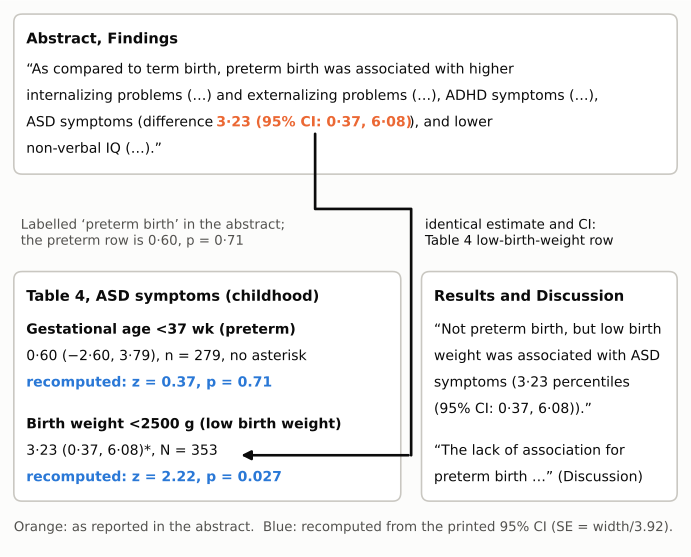
Figure 1. The abstract's ASD value (orange, as reported) is identical in estimate and both CI limits to the Table 4 row for birth weight <2500 g, not the row for gestational age <37 wk. The preterm row, 0·60 (−2·60, 3·79) with n = 279, has a recomputed p of 0·71; the low-birth-weight row has p = 0·027 (blue, recomputed from the printed 95% CIs). The Results and Discussion text (right) attribute the association to low birth weight and describe a lack of association for preterm birth.
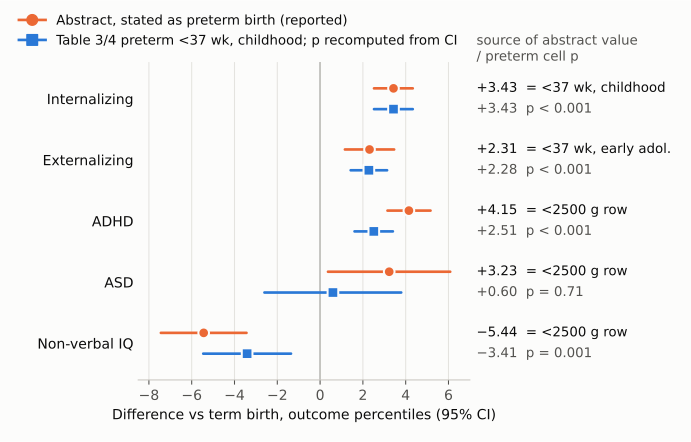
Figure 2. For each outcome in the abstract's "preterm birth" sentence, the value stated in the abstract (orange circles) is plotted against the preterm (<37 wk vs 37–42 wk) childhood estimate from Tables 3 and 4 (blue squares), with 95% CIs on one axis of outcome-percentile differences and a reference line at no difference. The right-hand column names the table cell each abstract value reproduces and the recomputed p-value of the preterm cell. Internalizing and externalizing agree; ADHD and non-verbal IQ are overstated by about 60%; for ASD the abstract's interval excludes 0 while the paper's preterm interval is centred near 0.
Why it matters
- A null result is presented as a positive finding. The abstract states that preterm birth was associated with ASD symptoms, with a CI excluding zero. The paper's own preterm estimate is 0·60 (−2·60, 3·79), p ≈ 0·71, and the Results ("Not preterm birth, but low birth weight") and Discussion ("The lack of association for preterm birth") say the opposite of the abstract.
- Effect sizes are overstated. The preterm effects on ADHD symptoms (2·51) and non-verbal IQ (−3·41) appear in the abstract as 4·15 and −5·44, about 1·65× and 1·60× larger. Direction and statistical significance are unchanged for these two.
- The abstract is the part most often read, indexed and reused. The same sentence is in the PubMed record and in the STROBE checklist in the paper's appendix. Evidence summaries or meta-analyses that extract preterm effects from the abstract would take the low-birth-weight values.
- Even the relocated value is weak. The 3·23 ASD estimate, correctly attributed to low birth weight, has p ≈ 0·027 and does not meet the paper's own Bonferroni threshold (p < 0·01); it rests on two cohorts and 353 exposed children.
- What is not affected. The tables, Results text, Discussion and the Interpretation ("Both fetal and early childhood growth are associated with emotional, behavioral and cognitive outcomes…") are internally consistent and do not depend on these abstract numbers.
Explanations considered
- Preterm birth used loosely to mean "adverse birth characteristics". Does not account for it. The sentence opens "As compared to term birth, preterm birth", which names a specific contrast, and the paper itself distinguishes the two exposures for ASD ("Not preterm birth, but low birth weight").
- A different model (basic vs confounder-adjusted). Does not account for it. The abstract values equal the confounder-model cells of Table 4. The basic-model Table S5 gives preterm ASD 1·35 (−1·89, 4·60) and low-birth-weight ASD 3·71 (0·82, 6·60); neither equals 3·23 (0·37, 6·08).
- A different age window or population. Does not account for the ASD or non-verbal IQ values: both outcomes were measured only in childhood, in one set of cohorts (ASD: GENR and INMA). For ADHD the other preterm cells are 2·33 (early adolescence) and −1·74 (late adolescence), neither 4·15. Only the externalizing value is explained this way: 2·31 is the preterm early-adolescence cell, while the other numbers in the sentence are childhood values.
- A sensitivity analysis. Does not account for it. The complete-case Table S9 gives preterm ASD −0·50 (−4·41, 3·41), and no cell equals an abstract value. The two-stage results are shown only graphically (Figure S4) and described as "less precise"; the abstract values instead equal the one-stage confounder-model cells exactly. Apart from the abstract text repeated in the STROBE checklist, the triples 3·23 (0·37, 6·08), 4·15 (3·15, 5·16) and −5·44 (−7·44, −3·44) appear nowhere in the appendix.
- Coincidental agreement. Three triples (estimate, lower, upper) matching one specific table row exactly cannot plausibly be coincidence.
- A text-conversion artifact in PMC. Ruled out: the same sentence is in the Europe PMC JATS XML, in the PubMed abstract (from the publisher's deposit) and in the authors' own STROBE checklist in Appendix A.
- A typographical slip. Fits the LGA ADHD upper limit (0·45 for −0·45), a lost minus sign. It does not fit the main issue, where whole estimate–CI triples correspond to a different exposure row. The values coincide with the adjacent row of Table 4; the paper does not say how the abstract sentence was compiled, and nothing here depends on how it arose.
Status
As of 2026-10-23:
- Version of record. The publisher's pages (thelancet.com, sciencedirect.com, linkinghub) returned 403 or a redirect stub to automated access, so the publisher-hosted HTML/PDF could not be read directly. The same abstract wording and the same Table 4 cells were confirmed in four independent copies of the published text: the PMC article (show.py and the PMC web page), the Europe PMC JATS full-text XML (Table 4 parsed cell by cell, with U+2212 minus signs), the PubMed record PMID 40094119, and the STROBE checklist in the paper's own Appendix A (item 1(b) repeats the abstract sentence; item 16 repeats the Results sentence). A PDF-to-HTML conversion artifact is therefore excluded.
- Supplements. Appendix A (mmc1.docx, the only supplementary file) was read: Tables S4–S5 (basic models) and S8–S9 (complete-case analyses) do not contain the abstract values under preterm birth; preterm ASD is 1·35 (−1·89, 4·60) in Table S5 and −0·50 (−4·41, 3·41) in Table S9, both null.
- Corrections. No correction, erratum or retraction found in Crossref update metadata, PMC notices, or the Europe PMC record (no comment/correction links);
known.pywas re-run on 2026-10-23 and still returns no updates or notices. Web searches for the DOI and title with "correction"/"erratum", run earlier in this audit, found none; a further web search on 2026-10-23 could not be run (search quota exhausted). Because the publisher's own pages could not be read, a notice posted only on the publisher site cannot be fully excluded. - PubPeer. PubPeer's site and API refused automated access (403 / Cloudflare challenge); web searches for a PubPeer thread on the title or DOI found none. Absence of a thread is therefore not fully confirmed.
- Sources.
src/show.py PMC11910110(Abstract, Methods, Results, Discussion, Tables 3–5);src/known.py 10.1016/j.lanepe.2025.101247; Europe PMC REST full-text XML and supplementaryFiles for PMC11910110; PubMed efetch for PMID 40094119.
Suggested correction
In the Abstract, Findings, replace the second sentence so that each estimate is attributed to its own exposure and age window, for example:
As compared to term birth, preterm birth was associated with higher internalizing problems (difference 3·43 (95% CI: 2·52, 4·33)), externalizing problems (difference 2·28 (95% CI: 1·43, 3·13)) and ADHD symptoms (difference 2·51 (95% CI: 1·61, 3·40)) in childhood, and with lower non-verbal IQ (difference −3·41 (95% CI: −5·46, −1·36)), but not with ASD symptoms (difference 0·60 (95% CI: −2·60, 3·79)). Low birth weight (<2500 g) was associated with higher ADHD symptoms (difference 4·15 (95% CI: 3·15, 5·16)) and ASD symptoms (difference 3·23 (95% CI: 0·37, 6·08)) and lower non-verbal IQ (difference −5·44 (95% CI: −7·44, −3·44)).
If the early-adolescence externalizing value (2·31 (1·16, 3·46)) is preferred, label it as early adolescence. Consider noting that the low-birth-weight ASD association (p ≈ 0·03) does not meet the paper's Bonferroni threshold of p < 0·01. In the next sentence on large size for gestational age, correct the ADHD interval to (95% CI: −1·73, −0·45), as in Table 5. The same corrections apply to the abstract text repeated in the STROBE checklist (Appendix A, item 1(b)).