← Back to the plain-language case
Abstract says the mAb reduces neutrophil apoptosis; the body and Fig. 3 show an increase
Sci Adv (2021) · doi:10.1126/sciadv.abd1453 · PMC11057782
Summary
The abstract says the agonist anti-ChemR23 antibody "reduces neutrophil apoptosis at the site of inflammation". Every other statement in the paper about this effect says the opposite. The Results say the antibody "accelerated neutrophil apoptotic cell death", with more Caspase-3/7 activation and annexin V staining. The safety paragraph's premise is that it "accelerates neutrophil apoptosis". The Discussion reports "increased apoptosis of remaining neutrophils" at the inflammatory site. The Fig. 3 F–H data also show more apoptotic or dead neutrophils with the antibody than with the isotype control, in vitro and in mouse air-pouch exudates. The data and the headline conclusions are not affected. But the abstract, which is the part most readers and text-mining tools see, states one of the paper's two cellular mechanisms backwards.
What the paper reports
Abstract, fourth sentence:
We also identified an anti-ChemR23 agonist antibody that induces receptor signaling, promotes macrophage efferocytosis, and reduces neutrophil apoptosis at the site of inflammation.
Abstract, first sentence. This sentence sets out the effects that proresolving agonists are expected to have:
Resolution of inflammation is elicited by proresolving lipids, which activate GPCRs to induce neutrophil apoptosis, reduce neutrophil tissue recruitment, and promote macrophage efferocytosis.
Results, "Agonist anti-ChemR23 mAb as new proresolving therapeutic modality", paragraph 1:
In addition, agonist anti-ChemR23 mAb internalization accelerated neutrophil apoptotic cell death (Fig. 3G and fig. S10C), as revealed by an increase in Caspase-3/7 activation and annexin V staining (Fig. 3F and fig. S10E).
Mechanistically, this accelerated neutrophil apoptosis was associated with increased ROS production (fig. S10D).
Results, "ChemR23 activation with agonist mAb triggers resolution of acute and chronic intestinal inflammation", paragraph 4 (the safety assessment):
Given that anti-ChemR23 mAb accelerates neutrophil apoptosis (Fig. 3, F and G) and is a human immunoglobulin G1 (hIgG1) isotype with potential cell cytotoxicity (55), we assessed its in vivo effects on the peripheral immune cell population.
Discussion, paragraph 3:
We have identified an anti-human ChemR23 mAb with similar receptor signaling functions as RvE1, including in promoting macrophage resolutive polarization as well as inflammatory neutrophil migration and apoptosis.
However, as previously reported for RvE1 (33, 34), agonist anti-ChemR23 mAb significantly shortened the Ri, as revealed by an accelerated clearing of leukocytes from the inflammatory site, increased apoptosis of remaining neutrophils, and faster recovery from colitis.
Fig. 3 legend, panels F–H:
(F) Percentage of Caspase-3/7 human neutrophils determined by microcopy after 10 hours of culture with isotype hIgG1 or anti-ChemR23 mAb at 10 μg/ml (n = 3). (G) Percentage of dead human neutrophils determined using Live and Dead assay after 24 hours of culture with isotype hIgG1 or anti-ChemR23 mAb at 10 μg/ml (n = 8). (H) Neutrophils absolute number (left) and percentage of dead neutrophils (right) measured in mouse exudates of TNF-induced inflammation air pouch model at indicated time points.
The paper's framing of why apoptosis matters. Introduction, paragraph 2:
In IBD, delayed neutrophil apoptosis and neutrophil-mediated damage are associated with the development of UC and CD (22–26).
Discussion, paragraph 2:
Appropriate neutrophil apoptosis is fundamental for inducing resolution of inflammation
What the paper's own numbers show
Method. The discrepancy is one of direction, not arithmetic, so the check is a census. I extracted from the archived full text every sentence that mentions neutrophil apoptosis or death. I kept the sentences that state the direction of the antibody's effect, and recorded the word that sets the direction in each. I then compared that direction with the direction of the three data panels that measure it (Fig. 3F, G and the right side of H). The paper gives no numeric values for these panels. The values below were read by eye from the published figure image, are approximate, and are used only to show direction and rough size. recompute.py.txt holds all the quotes and confirms that each one appears verbatim in the PMC text (9 of 9). It prints the tally and the approximate readings, and draws the figure.
| Quantity | Location | Reported | Recomputed / observed from the paper's own content |
|---|---|---|---|
| Direction of the mAb's effect on neutrophil apoptosis | Abstract, 4th sentence | "reduces neutrophil apoptosis at the site of inflammation" (decrease) | Opposite to every statement and data panel below |
| Neutrophil apoptotic death in vitro | Results, para 1 of the mAb section (Fig. 3G, fig. S10C) | "accelerated neutrophil apoptotic cell death" | Increase |
| Caspase-3/7 activation and annexin V | Same sentence (Fig. 3F, fig. S10E) | "an increase in Caspase-3/7 activation and annexin V staining" | Increase |
| Mechanism | Results, next sentence (fig. S10D) | "this accelerated neutrophil apoptosis was associated with increased ROS production" | Increase |
| Premise of the safety assessment | Results, colitis section, para 4 | "anti-ChemR23 mAb accelerates neutrophil apoptosis (Fig. 3, F and G)" | Increase |
| Summary of in vitro activity | Discussion, para 3 | "promoting … inflammatory neutrophil migration and apoptosis" | Increase |
| Effect at the inflammatory site in vivo | Discussion, para 3 | "increased apoptosis of remaining neutrophils" | Increase |
| Caspase-3/7+ human neutrophils, 10 h (n = 3) | Fig. 3F | Marked * (P < 0.05) | About 45% with hIgG1 vs about 85% with the mAb (read by eye): higher with the mAb |
| Dead human neutrophils, Live/Dead, 24 h (n = 8) | Fig. 3G | Marked ** (P < 0.01) | About 20% vs about 55% (read by eye): higher with the mAb |
| Dead neutrophils in air-pouch exudate (n = 4 to 5 per group) | Fig. 3H, right | Marked * at 24 h and ** at 48 h | Higher with the mAb at both times |
| Tally of directional text statements | Whole article | — | 1 decrease (abstract only) vs 5 increase (Results 3, Discussion 2); 0 statements in the body say decrease |
| Tally of data panels | Fig. 3F, G, H right | — | 3 of 3 show more apoptosis or death with the mAb; 0 of 3 show less |
Figure
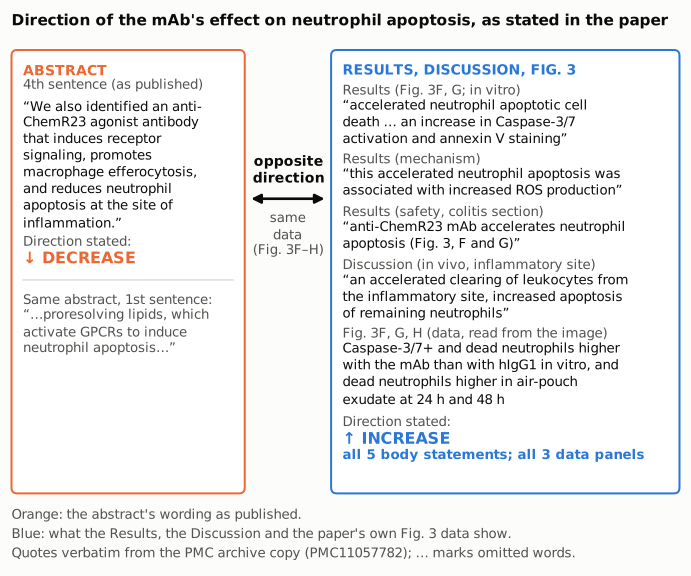
Figure 1. The left panel (orange) shows the abstract's sentence as published, which states a decrease in neutrophil apoptosis. Below it, in gray, is the abstract's own first sentence, which says proresolving GPCR agonists "induce neutrophil apoptosis". The right panel (blue) shows short verbatim excerpts from the Results and the Discussion, plus a description of Fig. 3F–H read from the published image. All of them state or show an increase. The connector marks the conflict: both panels describe the same experiments, but in opposite directions. Of the five body statements counted by recompute.py.txt, four are drawn here. The fifth, the Discussion's "promoting … inflammatory neutrophil migration and apoptosis", is listed in the table above. No values are plotted; the paper's own figure is not reproduced.
Why it matters
The abstract names two cellular mechanisms for the antibody: macrophage efferocytosis and an effect on neutrophil apoptosis. It gives the direction of the second one backwards. The paper argues that accelerated neutrophil apoptosis followed by efferocytosis is how resolution happens ("Appropriate neutrophil apoptosis is fundamental for inducing resolution of inflammation"), and that delayed apoptosis is part of IBD pathology. Read on its own, the abstract therefore describes a mechanism that runs against the paper's own model.
The direction also matters for safety. The Results say the antibody was screened for immune-cell depletion and neutropenia because it "accelerates neutrophil apoptosis" and is a cytotoxicity-capable hIgG1. An abstract that says it reduces apoptosis hides the reason for that check. Readers who see only the abstract (PubMed, indexing services, literature-mining tools that extract direction-of-effect relations) could record ChemR23 agonism as anti-apoptotic for neutrophils. That contradicts both this paper's data and the resolvin E1 literature it cites.
The data, the statistics and the headline conclusions are not affected. These are the title's "reduces tissue neutrophil accumulation", the faster resolution in the air-pouch model, and the reduced lesions, fibrosis and tumors in the colitis models. Only the wording of one abstract sentence is wrong.
Explanations considered
- Conversion or archiving error in PMC. Ruled out. The same wording appears in the publisher-deposited JATS XML held by Europe PMC (vol 7, issue 14, eabd1453, published 2 April 2021), in the PubMed abstract (PMID 33811066, checked on 2026-10-23) and in the institutional repository record (HAL, hal-03462811).
- The qualifier "at the site of inflammation" refers to a different measurement from the in vitro assays. This does not reconcile the two. The only in vivo measurement of neutrophil death at an inflammatory site is the percentage of dead neutrophils in air-pouch exudates (Fig. 3H, right). It is higher with the antibody at 24 h and 48 h, and the Discussion describes it as "increased apoptosis of remaining neutrophils" at the inflammatory site.
- "Reduces neutrophil apoptosis" means fewer apoptotic neutrophils remain because macrophages clear them faster. The paper reports no measurement showing fewer apoptotic neutrophils, and the exudate data show a higher fraction of dead neutrophils. Faster clearance would also be a statement about efferocytosis, which the same sentence already names separately. This reading is not supported.
- A different cell population or disease context. The only patient-derived neutrophil data (fig. S9, ANCA vasculitis) concern transmigration, not apoptosis. No sentence in the article reports reduced apoptosis in any population. The supplementary PDF (figs. S10C–E) could not be downloaded, but the main-text Results describe those panels as showing an increase.
- The intended phrase was "reduces neutrophil accumulation" (as in the title) or "induces neutrophil apoptosis" (as in the abstract's first sentence). Either would agree with the body. This explains how the sentence could be fixed, but it does not change what the published sentence says.
- The data, rather than the abstract, are wrong. Nothing points that way. Three separate assays in vitro (Caspase-3/7, annexin V, Live/Dead) and one in vivo all go the same way, with significance markers, and the text describes each one consistently.
A smaller wording problem sits in the same part of the paper. The Discussion's "promoting … inflammatory neutrophil migration and apoptosis" also reads as promoting migration, whereas the Results report that the antibody "significantly reduced human neutrophil transendothelial migration". This is noted for completeness and is not part of the main finding.
Status
- Version of record. The publisher page (science.org, reached via doi.org) returned HTTP 403 to automated access, so it was not read directly. The wording was confirmed in four independent copies: the publisher-deposited JATS XML in Europe PMC, the PMC text (via
src/show.py), the PubMed record (PMID 33811066) and the HAL repository record. All four have the abstract sentence as quoted. - Supplement. The supplementary PDF (sciadv.abd1453 SM, which holds figs. S10C–E) could not be retrieved: the PMC links returned 404 and the publisher link returned 403. The main Fig. 3 image (abd1453-f3.jpg, from the Europe PMC supplementary-files bundle) was viewed. Panels F, G and H go in the direction the Results describe. The discrepancy is in the abstract's wording, so the supplement would not resolve it either way.
- Corrections and comments. As of 2026-10-23, none found. Crossref lists no update relations for the DOI (
src/known.py). PMC and Europe PMC list no correction, erratum, retraction or expression of concern. The PubMed record has no comments or corrections links. - PubPeer. PubPeer's search page and API returned HTTP 403 (a Cloudflare challenge) to automated queries, so PubPeer could not be checked directly. A web search for the title together with "PubPeer" found no thread, only the article, repository records and a company announcement. Absence of a PubPeer thread is therefore not fully confirmed.
- Sources. PMC11057782; Europe PMC full-text XML and supplementary files for PMC11057782; PubMed 33811066; Crossref metadata for 10.1126/sciadv.abd1453; HAL hal-03462811.
Suggested correction
In the abstract, replace
…promotes macrophage efferocytosis, and reduces neutrophil apoptosis at the site of inflammation.
with wording that matches the Results and Discussion, for example
…promotes macrophage efferocytosis, and induces neutrophil apoptosis and reduces neutrophil accumulation at the site of inflammation.
The data, figures and statistics need no change. Optionally, the Discussion sentence "promoting macrophage resolutive polarization as well as inflammatory neutrophil migration and apoptosis" could be reworded to "promoting macrophage resolutive polarization and neutrophil apoptosis while reducing inflammatory neutrophil migration", which matches the transmigration result.